How to Rank in ChatGPT: 12 Practical Steps to Get Cited in AI Search (2026)
By [Rajendra Parmar] · Last updated: 24 September 2026 · 15-minute read
A few years ago, “getting found online” meant one thing: climbing Google’s results page. Today, a growing number of people skip the results page altogether. They ask ChatGPT, Gemini, or Perplexity a question and read the answer that comes back.
That raises an uncomfortable question for anyone who owns a website: how do you show up inside that answer? This guide walks through what actually helps, what’s just noise, and how to build a site that AI tools can find, understand, and trust.
Quick answer: There is no “position #1” in ChatGPT, and no trick that forces it to mention your site. What you can do is make your pages easy to crawl, easy to understand, and worth quoting. That means original content, clear answers, strong topical coverage, a technically clean site, and mentions from other credible websites. Do those consistently and your chances of being cited go up.
Key Takeaways
- “Ranking in ChatGPT” really means being mentioned, cited or recommended in an answer, not holding a fixed position.
- Good SEO is still the foundation. AI search builds on it; it doesn’t replace it.
- Answer-first writing, original data, and clear entity information make your content easier to quote.
- Nobody can guarantee a citation. Be wary of anyone who says they can.
- Measure progress with referral traffic, Search Console, Bing Webmaster Tools, and regular manual prompt tests.
In this guide
- What “ranking in ChatGPT” really means
- Can you actually rank in ChatGPT?
- The 12 practical steps
- ChatGPT SEO vs Google SEO
- Worked example: “Best AI Tools for Students”
- How to get cited
- Backlinks, domain authority and new sites
- How to track AI visibility
- Pre-publish checklist
- Common mistakes
- SEO, AEO, GEO, LLMO, SXO and AIO explained
- FAQs
What Does “Ranking in ChatGPT” Really Mean?
When people say they want to rank in ChatGPT, they usually mean one of three things:
- Their website is mentioned in an answer.
- One of their pages is linked as a source.
- Their brand becomes a go-to reference on a topic.
Google shows a list of links. An AI assistant writes a single conversational reply and pulls facts from several places. Ask “What are the best free AI SEO tools?” and you’ll often get a short list with a few sources attached, not ten blue links.
So the target isn’t “rank #1.” It’s this chain: be discoverable, be understandable, be useful, be trustworthy, be citable.
| Traditional SEO | AI Search / ChatGPT Visibility |
|---|---|
| Rank in a results page | Get mentioned or cited in an answer |
| Target keywords | Target questions and entities |
| SERP position | Inclusion in generated answers |
| Backlinks | Authority plus corroboration from other sources |
| Featured snippets | Answer-friendly, quotable passages |
| One dominant engine (Google) | Several AI and search systems |
| Click-through rate | Mentions, citations, and referral visits |
Can You Actually Rank in ChatGPT?
Not in the way you rank on Google. There is no public leaderboard and no submission form that puts your URL on top.
What does exist is AI-search visibility. When ChatGPT’s web search is on, it can fetch fresh pages and show its sources. When it’s off, it leans on what it learned during training. Either way, the sites that get referenced tend to be the ones that are easy to access, clearly written and backed up by other credible sources.
The good news: most of what makes a page useful to a person also makes it useful to a machine. You don’t need a separate playbook, just a sharper version of the one you already have.
Reality check: No guaranteed method or secret ranking factor exists. Anyone selling a “ChatGPT ranking hack” is guessing. The honest goal is to make your content easy to discover, understand, evaluate and cite.
How to Rank in ChatGPT: 12 Practical Steps
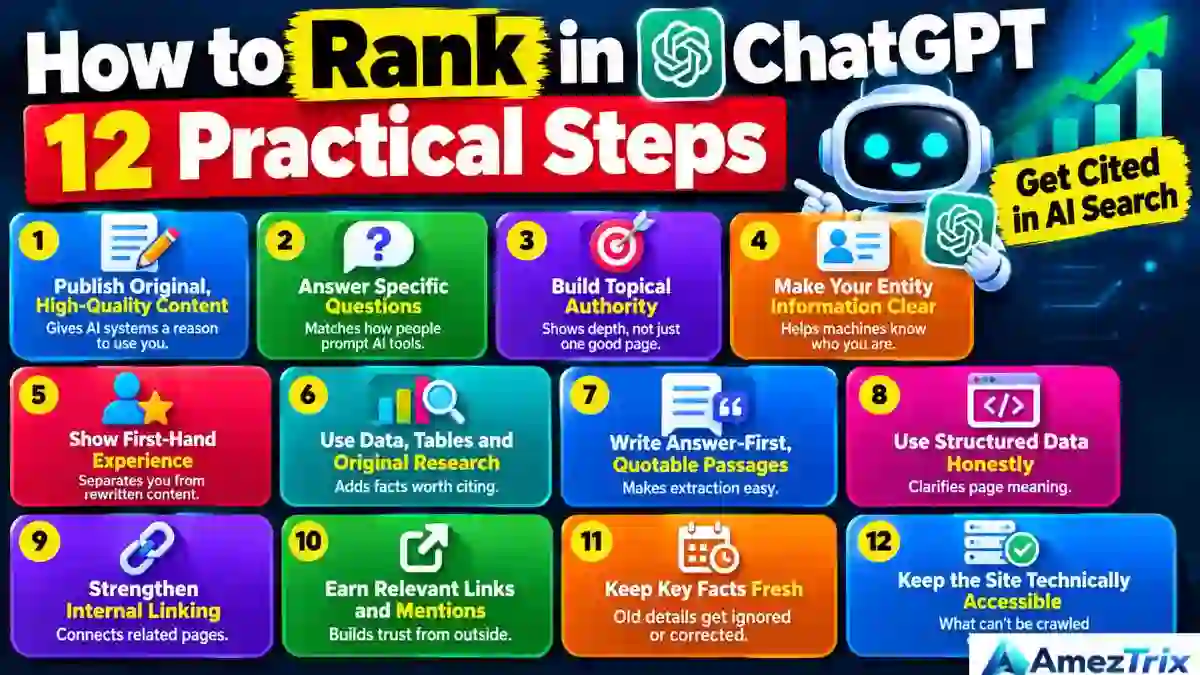
| # | Step | Why it matters |
|---|---|---|
| 1 | Publish original, high-quality content | Gives AI systems a reason to use you |
| 2 | Answer specific questions | Matches how people prompt AI tools |
| 3 | Build topical authority | Shows depth, not just one good page |
| 4 | Make your entity information clear | Helps machines know who you are |
| 5 | Show first-hand experience | Separates you from rewritten content |
| 6 | Use data, tables and original research | Adds facts worth citing |
| 7 | Write answer-first, quotable passages | Makes extraction easy |
| 8 | Use structured data honestly | Clarifies page meaning |
| 9 | Strengthen internal linking | Connects related pages |
| 10 | Earn relevant links and mentions | Builds trust from outside |
| 11 | Keep key facts fresh | Old details get ignored or corrected |
| 12 | Keep the site technically accessible | What can’t be crawled can’t be cited |
1. Publish Original, High-Quality Content
Everything else rests on this. If your site is full of thin, recycled or out-of-date posts, an AI system has little reason to lean on it.
Good pages tend to answer the question directly, include real examples, explain hard ideas in plain language, compare options, use tables where they help, link to trustworthy sources and clearly mark the important facts.
Compare these two approaches. A weak article says, “AI tools are useful for businesses.” A strong one names the tools, says what each does, lists pricing, points out limits, suggests best use cases, offers alternatives and tells you who should skip it. The second gives a reader (and a machine) something concrete to work with.
2. Answer Specific Questions
People talk to AI tools in full questions. So don’t only target “AI SEO tools.” Cover the questions around it too:
- What are the best AI SEO tools?
- How do AI SEO tools actually work?
- Which AI SEO tools have a free plan?
- Can AI tools really improve SEO?
- Which AI tool is best for keyword research?
- How can a small business use AI for SEO?
A clean page outline for that topic could look like this:
- H1: Best AI SEO Tools
- H2: What Are AI SEO Tools?
- H2: How Do They Work?
- H2: Best AI SEO Tools Compared
- H2: Free AI SEO Tools
- H2: Best Options for Beginners
- H2: How to Choose the Right Tool
- H2: FAQs
Related reading on AmezTrix: Best AI SEO Tools.
3. Build Topical Authority
One article rarely makes you a trusted source on a subject. Depth does. If you want your site known for AI tools, plan a cluster instead of a lone post.
| Level | Role | Example pages |
|---|---|---|
| Pillar | Broad overview | Best AI Tools 2026 |
| Supporting | Category deep-dives | AI Tools for Students, for Business, AI Writing Tools, AI Image Generators, AI Video Generators, AI Coding Tools, AI SEO Tools, AI Automation Tools, AI Agents |
| Long-tail | Specific needs | Free AI SEO Tools for Beginners, AI Tools for Small Businesses, AI Tools for WordPress, AI Tools for Content Writers |
Each page should link up to the pillar and across to close relatives. That web of links tells search systems how your content fits together.
4. Make Your Entity Information Crystal Clear
AI systems need to know who you are, what your site covers and why anyone should believe you. Say it plainly and say it the same way everywhere.
For example: AmezTrix is a technology website covering AI tools, SEO, digital marketing, web hosting, WordPress, gadgets and electric vehicles. Use that description (or a close variation) on your homepage, About page, and author bios.
Pages worth having and keeping accurate: About, Contact, author profiles, category pages, an editorial policy, Privacy Policy and Terms. On every article, show the author, publish date, updated date, main topic, and sources.
5. Show First-Hand Experience
Anyone can write “this tool is great for SEO.” Fewer people can say what they actually did with it. Experience is your edge over content that’s simply rewritten from other pages.
Tell readers what you tested, which features you used, what worked, what didn’t, who it suits, and where it falls short.
| Generic | More useful |
|---|---|
| “Tool X is one of the best AI SEO tools.” | “I used Tool X for keyword research, content briefs, and competitor checks. Its outlines saved me time, but the keyword clusters still needed a manual clean-up.” |
Only write what you truly did. Real screenshots and honest limitations make a page far harder to copy.
6. Use Data, Tables and Original Research
Facts that can’t be found elsewhere are the easiest reason for someone to cite you. Consider adding test results, feature comparisons, pricing tables, screenshots, small surveys, case studies and before-and-after examples.
Even a simple comparison table helps, as long as you keep it current:
| AI Tool | Free Plan | Main Use | Best For |
|---|---|---|---|
| ChatGPT | Yes | General-purpose assistant | Research and drafting |
| Gemini | Yes | AI assistant | People in the Google ecosystem |
| Claude | Yes | Writing and reasoning | Long-form work |
| Perplexity | Yes | AI search | Quick sourced research |
Plans and limits change often, so check each provider’s pricing page before you publish.
7. Write Answer-First, Quotable Passages
Long, winding paragraphs hide the useful part. Put the answer up top, then expand.
Here’s the pattern, using a definition as the example:
What is GEO? Generative Engine Optimization (GEO) is the practice of shaping your content so AI-powered search and answer tools can find it, understand it and, where appropriate, reference it.
After that short definition, go deeper. The rhythm to aim for is question, direct answer, explanation, example, evidence. It reads well for people and is easy for AI tools to lift.
8. Use Structured Data Honestly
Structured data (Schema) helps search engines understand what a page is about. Depending on the page, sensible types include Article or BlogPosting, Organization, Person, WebSite, BreadcrumbList and FAQPage (only where a real FAQ is visible on the page).
Rule of thumb: the markup must match what readers can actually see. Don’t add Schema for the sake of it. On WordPress, a plugin like Rank Math handles most of the common types.
9. Strengthen Your Internal Linking
Internal links show search systems how your pages relate. They also keep readers moving through your site.
This article, for instance, could naturally connect to:
- What Is GEO?
- GEO vs SEO
- Best GEO Tools
- LLMO in SEO
- Best AI SEO Tools
- Best AI Agents
- AI Automation Tools
Use descriptive anchor text, link where it genuinely helps the reader, and make sure your pillar pages get links from every related article.
10. Earn Relevant Links and Mentions
Links still help pages get discovered and trusted. But relevance beats volume. A handful of editorial links from sites about AI, technology, SEO, software, marketing or business is worth more than hundreds of random directory links.
Think relevance, editorial context, quality and natural placement. Unlinked brand mentions in credible places matter too, because they help confirm that your brand is real and known for the topic.
11. Keep Important Information Fresh
AI questions often involve things that change fast: tool pricing, features, model names, availability and company announcements. If your article praises a feature that was removed months ago, it quickly loses value.
For AI-tool content, schedule regular checks of pricing, free-plan limits, features, model names, links, screenshots and alternatives. Then show a visible “Last updated” date, but only when you’ve genuinely reviewed the page.
12. Keep Your Site Technically Accessible
Brilliant content is useless if crawlers can’t reach it. Check your robots.txt, XML sitemap, HTTPS, canonical tags, mobile usability, page speed, server uptime, indexability, broken links, redirects and how much of your content depends on JavaScript.
One point that’s easy to miss: OpenAI documents separate crawlers for different jobs, including one for ChatGPT search results and another for model training. If your robots.txt blocks the search crawler, you may be shutting the door on ChatGPT search. Read OpenAI’s crawler documentation and decide deliberately what to allow.
Also register your site with Bing Webmaster Tools. Several AI search experiences are reported to draw on Bing’s index, so being indexed there is cheap insurance.
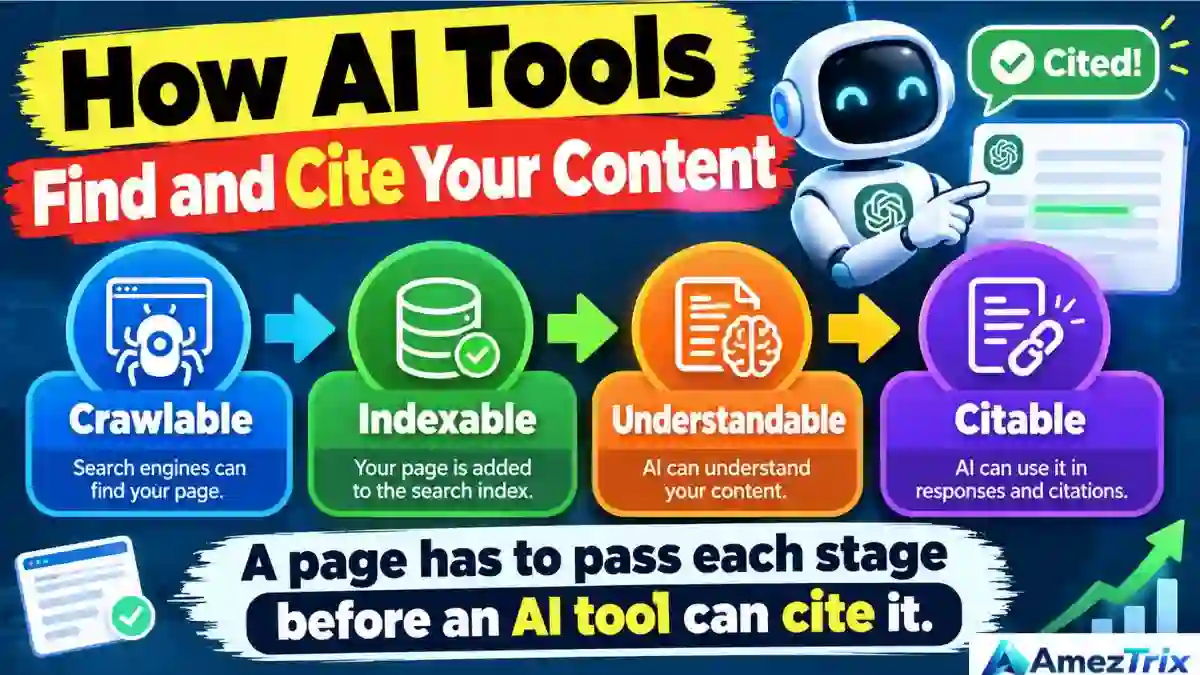
The chain to remember: crawlable, indexable, understandable, accessible.
ChatGPT SEO vs Google SEO
They overlap heavily but aren’t identical. Here’s how the emphasis shifts:
| Factor | Google SEO | ChatGPT / AI Search |
|---|---|---|
| Keywords | Important | Useful, but not everything |
| Search intent | Very important | Very important |
| Content quality | Important | Important |
| Backlinks | Important | Contribute to authority |
| Entities | Important | Very important |
| Direct answers | Useful | Highly useful |
| Structured data | Useful | Aids machine understanding |
| Freshness | Depends on topic | Key for current topics |
| Citations | Depends on the result type | Can be central to the answer |
| Conversational queries | Growing | The core use case |
The takeaway: don’t drop SEO, extend it.
Worked Example: Optimizing “Best AI Tools for Students”
A weak version of this article is a list of ten tools with a sentence each. A stronger, AI-friendly version is built like this:
| Section | What to include |
|---|---|
| Introduction | A two-sentence direct answer about what students use AI tools for |
| H2: What Are AI Tools for Students? | Short definition and typical use cases |
| H2: Best AI Tools for Students | Comparison table with tool, best for, free plan and key feature |
| H2: Best Free Options | Only tools with a genuinely usable free tier |
| H2: By Task | Research, writing, presentations, and coding, each with a short pick |
| H2: How to Choose | Criteria: price, privacy, accuracy, learning curve |
| H2: Are AI Tools Safe for Students? | Honest notes on accuracy, privacy, and school rules |
| H2: FAQs | Real questions students ask |
That structure covers the topic from several angles, which is exactly what both readers and AI systems reward.
How to Get Your Website Cited by ChatGPT
Again, no technique is guaranteed. But these habits improve your odds:
- Stick to facts. Skip claims you can’t support.
- Cite reliable sources. Link to primary or authoritative pages.
- Add something new. Don’t just reword what’s already everywhere.
- Cover the subject in depth. Build the cluster, not just the page.
- Stay crawlable. Important content must be indexable.
- Show who’s behind it. Named authors and a real About page.
- Update regularly. Especially on fast-moving tech topics.
- Earn genuine references. Relevant mentions and editorial links.
Backlinks, Domain Authority and New Websites
Do backlinks help you rank in ChatGPT?
They can support your overall authority and discoverability. But no public formula says “get X links and ChatGPT will feature you.” Buying hundreds of cheap links to chase AI mentions isn’t a reliable plan. One contextual link from an established tech publication usually says more than dozens of unrelated directory listings.
Does domain authority matter?
Metrics like Domain Authority (DA) and Domain Rating (DR) are handy SEO indicators, but they’re third-party scores, not official ChatGPT signals. A higher DR does not guarantee a citation. A smaller site with a genuinely better, more specific answer can win for a particular question.
Can a new website get cited?
Possibly, though nothing is promised. New sites should work in this order:
- Fix the technical basics.
- Publish genuinely useful content.
- Build topical clusters.
- Earn relevant links and mentions.
- Establish authors and brand identity.
- Update content regularly.
- Track AI visibility and adjust.
How to Track Your AI Search Visibility
You can’t check a “ChatGPT rank,” but you can watch for signals:
- Referral traffic: In analytics, look for visits from chatgpt.com and other AI platforms. Some AI tools add a tracking parameter to links they send, which makes these visits easier to spot.
- Manual prompt tests: Once a month, ask ChatGPT, Gemini and Perplexity the 10 to 20 questions your customers would ask. Note whether you’re mentioned, cited or missing.
- Search Console: Watch impressions and queries phrased as questions.
- Brand searches: More people searching your name is a healthy sign.
| Tool | What it’s for |
|---|---|
| Google Search Console | Search performance and indexing |
| Google Analytics | Traffic and referral analysis |
| Bing Webmaster Tools | Bing indexing and search data |
| Rank Math | WordPress SEO and Schema |
| Ahrefs / Semrush | Keyword and backlink research |
| Screaming Frog | Technical site audits |
| PageSpeed Insights | Performance testing |
| Schema validators | Structured data checks |
| AI visibility trackers | Monitoring mentions and citations |
Treat these as measuring tools. None of them can directly control what ChatGPT says.
AI Search Optimization Checklist
Run through this before you hit publish:
| Area | Check |
|---|---|
| Content | ☐ Answers the main question directly ☐ Facts are accurate ☐ Adds original value ☐ Includes examples ☐ Key claims are supported |
| SEO | ☐ Keyword used naturally ☐ Search intent satisfied ☐ Strong, honest title ☐ Clear headings ☐ Internal and external links ☐ Optimized images with alt text |
| AI / GEO | ☐ Clear definitions ☐ Question-based sections ☐ Short direct answers ☐ Entity and author details ☐ Updated information ☐ Easy-to-read tables ☐ Original insight |
| Technical | ☐ Indexable ☐ Mobile-friendly ☐ HTTPS ☐ XML sitemap ☐ Correct canonical ☐ No broken links ☐ Fast enough |
Common Mistakes to Avoid
| Mistake | Why it hurts | Do this instead |
|---|---|---|
| Keyword stuffing | Repeating “how to rank in ChatGPT” 30 times reads badly and helps no one | Write naturally and cover related concepts |
| Publishing AI drafts unreviewed | Produces generic or wrong content | Use AI for research and outlines, then fact-check and add your own experience |
| Buying spammy backlinks | Irrelevant links build no real authority | Earn relevant editorial links |
| Copying competitors | Adds nothing new for AI to cite | Add data, tests or a fresh angle |
| Ignoring traditional SEO | AI visibility sits on top of it | Keep intent, quality and technical health strong |
| Making guarantees | “This guarantees ChatGPT rankings” isn’t provable | Be honest about what’s uncertain |
SEO, AEO, GEO, LLMO, SXO and AIO: How They Connect
These acronyms overlap. Think of them as different lenses on one goal: being found and trusted wherever people search.
| Term | Stands for | Main focus |
|---|---|---|
| SEO | Search Engine Optimization | Visibility in search engines |
| AEO | Answer Engine Optimization | Being the clear answer to a question |
| GEO | Generative Engine Optimization | Visibility in AI-generated answers |
| LLMO | Large Language Model Optimization | Making information easy for language models to understand and use |
| SXO | Search Experience Optimization | Matching intent and delivering a great on-page experience after the click |
| AIO | AI Optimization (also used for AI Overviews) | Optimizing for AI-driven results, including Google’s AI summaries |
In practice: SEO helps you get found, AEO makes your answers clear, GEO puts you in generated responses, LLMO makes your facts machine-friendly and SXO makes sure visitors who arrive actually find what they wanted. One strategy can cover all of them. For more on the newest of these terms, see our guide to LLMO in SEO.
Frequently Asked Questions
How to Rank in ChatGPT?
There’s no traditional ranking system and no guaranteed method. Improve your content quality, topical authority, accuracy, accessibility and usefulness so AI search systems have solid reasons to reference you.
Can I submit my website directly to ChatGPT?
Don’t count on it. Inclusion depends on the ChatGPT experience being used, whether web search is active and how retrieval works. Focus on being crawlable and useful instead.
Does SEO help with ChatGPT visibility?
Yes, indirectly. Crawlability, useful content, internal linking, authority and clear site structure all support AI visibility, even though it isn’t the same as a Google ranking.
Do backlinks help with AI search?
Relevant backlinks can add to discoverability and perceived authority. No public threshold guarantees a citation.
Does GEO replace SEO?
No. GEO and related practices complement SEO. They don’t replace it.
How can I get cited by ChatGPT?
Publish authoritative, original, accessible content that answers real questions with reliable facts. No citation method is guaranteed.
Does Schema markup help ChatGPT?
Accurate structured data can help systems understand your page’s entities and structure. On its own, it doesn’t guarantee visibility.
Should I write content specifically for ChatGPT?
Write for people first, then organize it so machines can follow it too. Clear answers, tidy structure, accurate facts and useful context help both audiences.
Final Thoughts
“How to rank in ChatGPT” is really a question about AI-search visibility, not a hunt for position #1. The fundamentals are surprisingly familiar:
- Create genuinely useful content.
- Answer real questions.
- Build topical authority.
- Share original information.
- Keep your site technically open.
- Earn relevant references.
- Keep key facts up to date.
The bigger shift is in behavior. More people now ask an AI to summarize instead of browsing ten results. That doesn’t make it Google versus ChatGPT. It means building content that can be found and understood across Google, Bing, ChatGPT, Gemini, Perplexity and whatever comes next.
For AmezTrix, the opportunity is a connected content ecosystem: AI tools, AI agents, AI automation, SEO, GEO, AEO and LLMO, all linked together. That beats a pile of isolated tool reviews for long-term authority.
The quick formula: Useful content + original information + topical authority + technical accessibility + relevant references + freshness = stronger AI search visibility.
There’s no shortcut to a guaranteed citation. The dependable route is to become a source that people, and the systems that serve them, can understand and trust.
Further Reading
- OpenAI: Overview of crawlers
- Google Search Central: Creating helpful, reliable, people-first content
- Google Search Central: AI features and your website.
About Author
Rajendra Parmar is the Founder and Editor of AmezTrix, where he covers Artificial Intelligence [AI Tools], Technology, WordPress, Web Hosting, Digital Marketing, Gadgets, and Software. His mission is to simplify complex technology through practical tutorials, honest reviews, and well-researched guides that help readers make smarter digital decisions.