Learn Generative Engine Optimization (GEO) strategies with AmezTrix to rank in AI search, increase visibility, citations & drive more organic traffic.
Generative Engine Optimization (GEO): The Complete 2026 Guide to Ranking in AI Search
Something’s shifted in how people search online. You’ve probably felt it yourself. Instead of scanning ten blue links and picking one, a lot of us now just ask an AI a question and take the answer it gives us — no click required.
That change has quietly created a whole new field in digital marketing. People are calling it Generative Engine Optimization, or GEO for short.
If you write for a blog, run content for a brand, or handle SEO for a living, you’ve probably already bumped into the term somewhere. So let’s actually unpack it — what GEO means, how it’s different from the SEO you already know, and what you can realistically do about it starting today.
So, What Is Generative Engine Optimization?
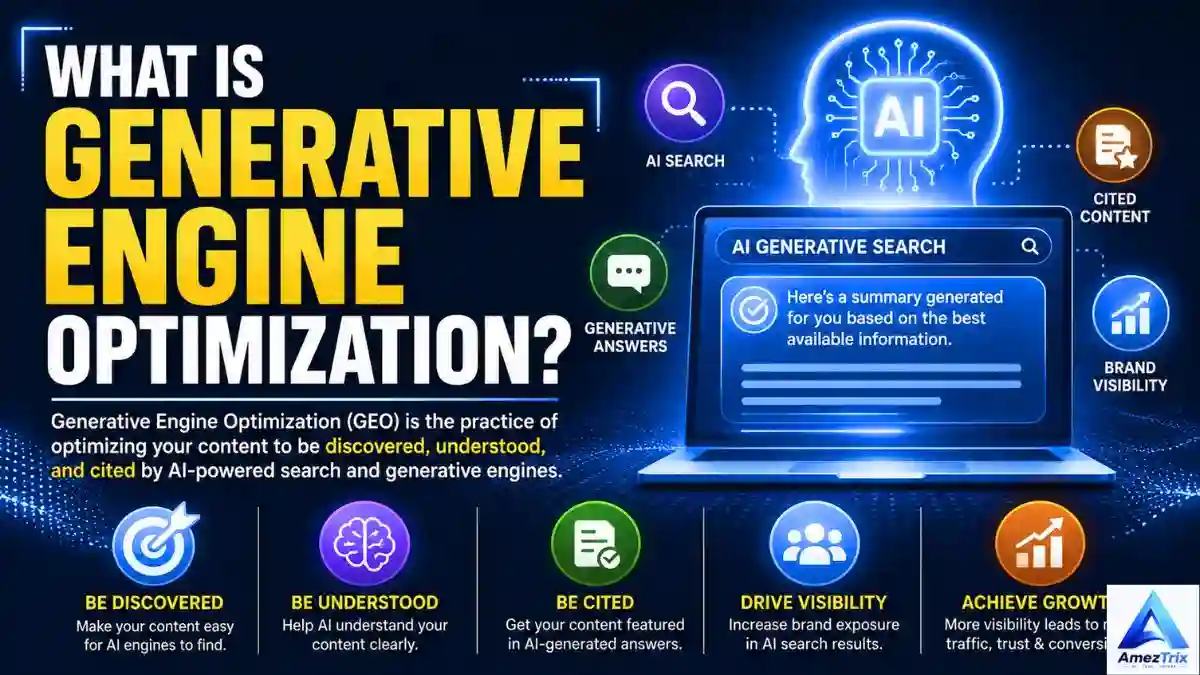
Here’s the simplest way I can put it: GEO is about shaping your content so AI tools — chatbots, AI search assistants, whatever you want to call them — can read it, trust it, and pull from it when they’re building an answer for someone.
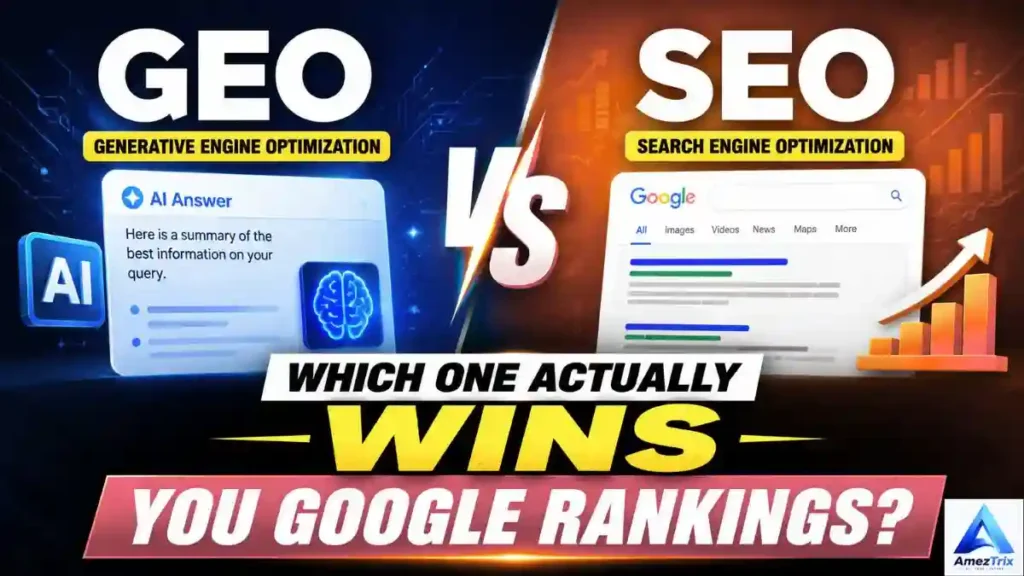
Old-school SEO wants a ranking spot on a results page. GEO wants something a little different — a mention, a citation, maybe just your idea showing up, paraphrased, inside an AI’s response.
Break it down like this:
- SEO gets someone to click through to your site.
- GEO gets your knowledge baked directly into the answer a machine gives them, click or no click.
Neither one replaces the other, by the way. GEO just sits on top of whatever SEO groundwork you’ve already laid.
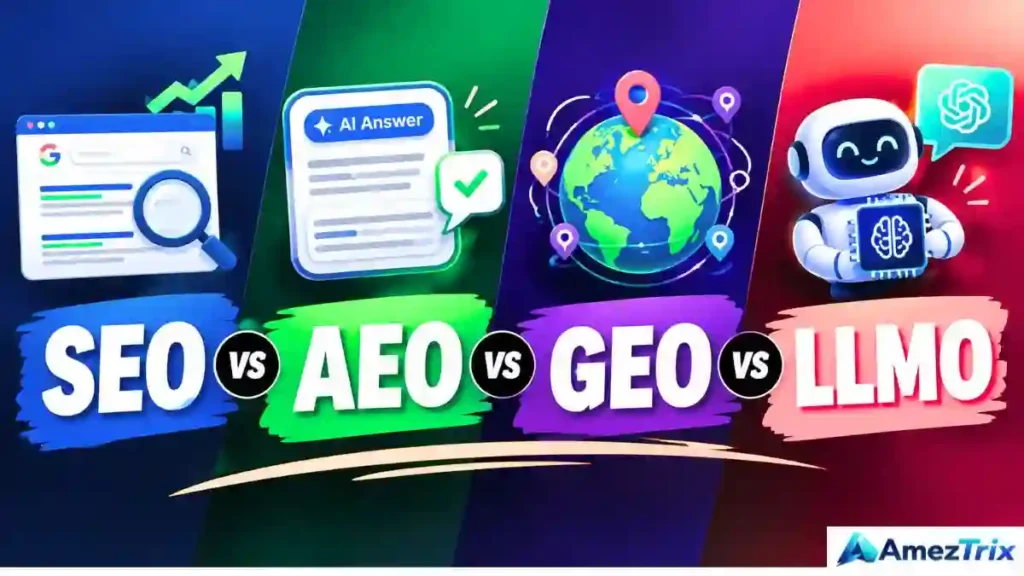
GEO vs SEO vs AEO: Full Comparison Table
Generative Engine Optimization full details
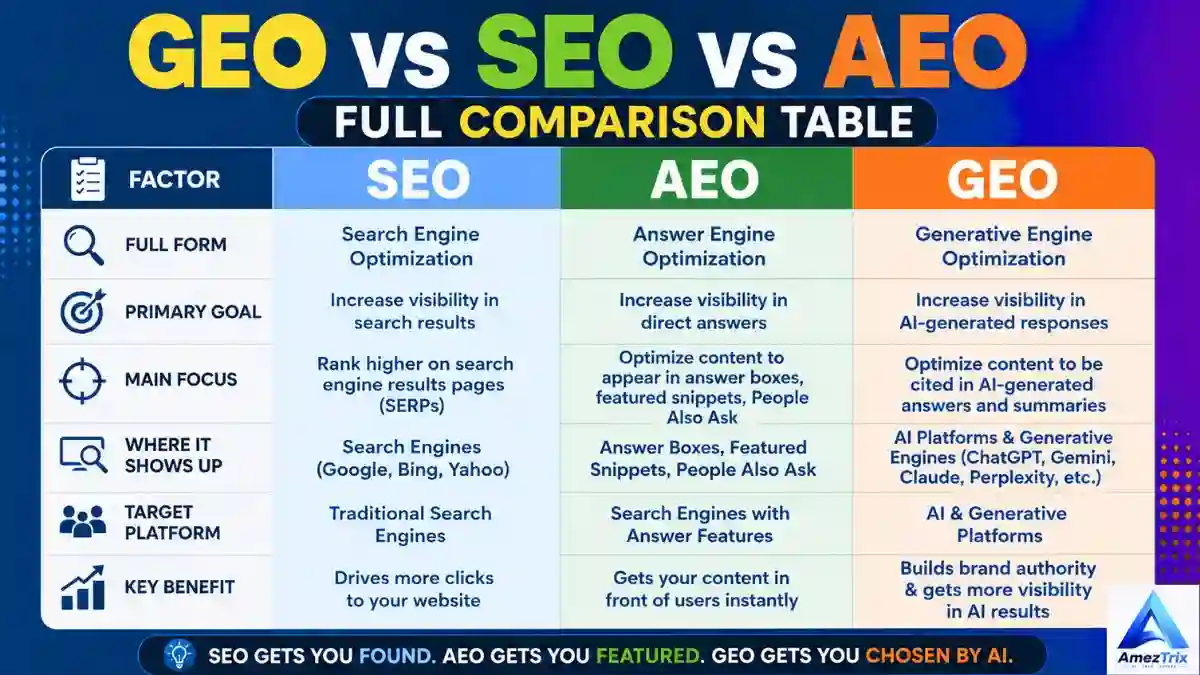
| Comparison Factor | SEO | AEO | GEO |
|---|---|---|---|
| Full Form | Search Engine Optimization | Answer Engine Optimization | Generative Engine Optimization |
| Primary Goal | Increase visibility in search results | Increase visibility in direct answers | Increase visibility in AI-generated responses |
| Main Focus | Traditional search engines | Answer engines & direct-answer experiences | Generative AI & AI-powered search |
| Primary Platforms | Google, Bing & other search engines | Featured snippets, voice assistants & answer systems | AI search & conversational AI platforms |
| Main Output | Search results & organic listings | Direct answers / featured results | AI-generated answers, summaries or citations |
| Target User | Users searching with queries | Users looking for quick answers | Users asking conversational or complex questions |
| Keyword Strategy | Keywords + search intent | Questions + conversational queries | Questions + entities + topics + context |
| Content Format | Blogs, guides, landing pages & product pages | FAQs, concise answers & structured content | Guides, comparisons, FAQs & authoritative resources |
| Content Length | Depends on search intent | Usually concise | Short to comprehensive, depending on the query |
| Question Optimization | Important | Very Important | Extremely Important |
| Search Intent | Core | Core | Core |
| Conversational Queries | Increasingly important | Very Important | Extremely Important |
| AI Search | Indirectly relevant | Relevant | Core focus |
| Generative AI | Secondary | Partially relevant | Central focus |
| Featured Snippets | Important | Core opportunity | Can provide indirect value |
| AI Citations | Not a traditional goal | Secondary | Potentially important |
| Backlinks | Strong authority signal | Supports authority | Supports authority & credibility |
| Internal Linking | Very Important | Important | Very Important |
| Technical SEO | Essential | Important | Essential foundation |
| Structured Data | Useful | Highly useful | Useful for machine-readable context |
| Entity Optimization | Important | Important | Very Important |
| Topical Authority | Very Important | Important | Very Important |
| E-E-A-T / Trust | Important | Important | Important |
| Content Freshness | Topic-dependent | Important | Especially important for fast-changing topics |
| Direct Answers | Helpful | Core strategy | Core strategy |
| FAQs | Useful | Extremely Useful | Extremely Useful |
| Natural Language | Important | Very Important | Extremely Important |
| Voice Search | Relevant | Highly Relevant | Potentially Relevant |
| Long-Tail Keywords | Important | Very Important | Very Important |
| Semantic Search | Important | Very Important | Extremely Important |
| Context Understanding | Important | Very Important | Extremely Important |
| Primary Success Metrics | Rankings, clicks, impressions & traffic | Answer visibility, impressions & clicks | AI visibility, mentions/citations & measurable referral traffic |
| Best For | Driving organic search traffic | Winning direct-answer visibility | Building AI-powered search visibility |
| Relationship | Foundation | Complements SEO | Complements SEO + AEO |
| Best Approach | Optimize for search engines and users | Answer questions clearly and directly | Create authoritative, structured & AI-understandable content |
SEO, AEO, and GEO in One Simple View
| Strategy | Simple Meaning | Primary Objective |
|---|---|---|
| SEO | Get Found | Appear in traditional search results |
| AEO | Get Answered | Provide direct answers to user questions |
| GEO | Get Referenced | Increase the potential to be referenced in AI-generated answers |
In short:
SEO → Get Found → AEO → Get Answered → GEO → Get Referenced
Why Is Everyone Suddenly Obsessed With This?
Because search itself changed. Simple as that.
A few years back, you’d type something clipped like:
best web hosting providers
Now? You’re more likely to type — or just say out loud — something like:
Which web host actually makes sense for a small tech blog, and what are the downsides of each one?
AI tools are genuinely good at unpacking a question like that and handing back a full answer, context and all. And that changes the math for publishers quite a bit. Your site doesn’t need the click to matter anymore. If an AI decides your page is worth trusting, your ideas reach someone before they’ve even opened a browser tab — sometimes they never open one at all.
That’s really the whole reason AI search optimization has become such a big deal for anyone trying to stay visible heading into 2026.
How Do These AI Tools Actually Pick What to Use?
Every platform — ChatGPT, Gemini, Perplexity, Google’s AI Overviews — runs on its own tech under the hood. But strip away the branding, and the process looks roughly the same everywhere.
First, it figures out what you actually mean. Not just the words you typed, but the intent behind them.
Then it goes looking for material. Sometimes that’s baked-in training knowledge, sometimes it’s a live web search, often it’s both. Pages that are easy to crawl, clearly organized, and genuinely useful have a much better shot here.
Next, it sizes up what it found. Is it clear? Relevant? Does it match what other trustworthy sources are saying? Does the source seem credible?
Then it writes the answer. All that gathered material gets stitched into something that reads naturally.
And sometimes, it shows its work. A growing number of AI search tools now attach citations or source links right next to the answer. This is the payoff moment for anyone doing GEO properly.
The point I keep coming back to: you’re not chasing one keyword anymore. You’re trying to become a source the model actually feels comfortable leaning on.
GEO vs. SEO — Laid Out Side by Side
| SEO | GEO |
|---|---|
| Wants a spot on the results page | Wants a spot inside the AI’s answer |
| Built around keywords and intent | Built around questions and entities |
| Rankings are the scoreboard | Citations and mentions are the scoreboard |
| Backlinks carry weight | Source credibility carries weight |
| Technical SEO health matters | Crawlability and clean data matter |
| Content quality drives rankings | Clarity and trust drive inclusion |
Neither one works well alone, honestly. A site that’s technically a mess, or thin on real content, is going to struggle in AI search the exact same way it struggles in regular search.
Where Does AEO Come Into This?
You’ll also run into Answer Engine Optimization, or AEO — a cousin term focused on getting picked for short, direct answers. Think featured snippets, or whatever a voice assistant reads back to you.
GEO usually covers more ground than that. It’s about longer, more conversational answers pulled from multiple sources rather than one crisp reply. Most solid content strategies these days just blend all three — SEO, AEO, and GEO — instead of treating them like separate boxes to check.
What Actually Influences GEO Performance?
Nobody’s published a GEO ranking algorithm, and honestly, I doubt there ever will be one clean formula that works across every platform. Still, a handful of things keep showing up as genuinely useful, no matter which AI tool you’re looking at.
1. Content That’s Actually Good
I’ll be blunt — content written purely to chase a keyword rarely holds up under scrutiny. Content written to solve someone’s actual problem does.
A strong article usually:
- Answers the main question early, not buried in paragraph nine
- Explains its reasoning instead of just stating facts
- Uses real examples, not hypothetical ones
- Covers the subtopics a curious reader would naturally wonder about
- Doesn’t repeat itself for the sake of hitting a word count
- Sticks to information you’d actually stand behind
2. Topical Authority
One article rarely convinces an AI model that you know a subject inside out. A cluster of connected, well-linked pages does that job much better.
Say your site covers digital marketing. A strong hub might include a core guide, plus supporting pieces on comparisons, tool round-ups, and practical how-tos — all circling back to reinforce the same territory from different angles.
3. Structure That Doesn’t Make You Work For It
AI systems parse a page roughly the way a person skimming on their phone would. A heading like “What Is GEO?” tells both a human and a model exactly what’s coming. Something vague like “Understanding the New Approach” tells them nothing.
Break up your paragraphs. Use headings that actually mean something. Reach for a table or bullet list when it genuinely helps — not just because it looks tidy.
4. Answers That Don’t Dance Around the Question
One of the easiest wins here? Just answer the important question directly, right where a reader would expect it.
Take this, for example:
What is GEO? Generative Engine Optimization is the practice of shaping content so AI-powered search and answer tools can understand it, retrieve it, and possibly use it as a source.
Short. To the point. No wandering.
5. Expertise You Can Actually See
A dictionary definition isn’t expertise. Show your thinking instead — comparisons, trade-offs, honest limitations, real recommendations. That’s what tells a reader (or a model) that an actual person who knows this stuff wrote the page.
6. Skip the Hype, Keep the Facts Straight
Don’t write things like “this trick guarantees ChatGPT will cite you.” Nobody can honestly promise that, and readers can smell it a mile away. Something more like “these practices can improve how clearly your content gets understood by AI systems” — that’s both truer and more convincing.
7. Say the Same Thing, Everywhere
Your brand name, author info, product details, key facts — they should match wherever they show up, on your own site and off it. When things don’t line up, it gets a lot harder for an AI model to pin down who you are as a trustworthy, distinct source.
A Practical Framework for Optimizing Your Site
Step 1 — Write something genuinely useful first. Don’t churn out a 1,000-word page just because a keyword tool flagged some volume. Ask what the reader actually needs. What will they wonder next? Where are they likely to trip up?
Step 2 — Think in questions, not just keywords. Take something like “AI SEO” and branch it out — What is it? How’s it different from regular SEO? Which tools are actually worth using? Each branch can become its own section, or its own article entirely.
Step 3 — Build clusters, not one-off posts. Anchor everything around a strong pillar page, then support it with focused pieces that link back and forth naturally. Don’t force it — let the connections feel obvious.
Step 4 — Tighten your internal linking. It helps readers navigate, sure. But it also tells AI crawlers how your content fits together. Use anchor text that actually describes what’s on the other end — not just a keyword crammed in.
Step 5 — Make your info easy to lift. Definitions, numbered steps, comparison tables, FAQs — all of this is easy for a human or a model to grab and reuse accurately. Structure isn’t just decoration.
Step 6 — Show people (and machines) you’re credible. An author bio, a real About page, contact info that actually works, editorial standards you stick to — all of it adds up to trust, and trust is basically the whole game here.
How Do You Actually Get Cited?
There’s no secret trick, and anyone selling you one is overselling it. But a few habits do consistently help:
- Answer specific questions head-on instead of circling the topic
- Add something original — your own data, comparisons, or firsthand take, not a rehash of what fifty other sites already said
- Cover the topic thoroughly enough that nobody needs to go elsewhere
- Keep things current — freshness matters a lot in a space that moves this fast
- Back up any real claims, especially numbers, with sources you can actually point to
Mistakes People Keep Making
- Stuffing “GEO” into every sentence. It doesn’t help. Write naturally instead.
- Publishing thin, AI-churned filler. Volume without substance doesn’t build authority — it just adds noise.
- Promising guaranteed citations. Nobody can deliver that, and saying so makes you look less credible, not more.
- Forgetting technical SEO exists. Crawlability, speed, metadata — none of that stopped mattering.
- Writing only for the machine. If a real person finds your page confusing, no AI model is going to save it.
- Letting good content rot. This field moves fast — go back and update your best pages regularly.
A Quick Checklist Before You Hit Publish
- Is the core question answered clearly, near the top?
- Are your headings actually descriptive, or just vague filler?
- Does the piece fully satisfy what someone came here looking for?
- Have you addressed the questions readers will naturally ask next?
- Is everything factually accurate — sourced, where it needs to be?
- Does this page add something you won’t find on ten other sites?
- Are your internal links relevant, not just shoved in?
- Is it obvious who wrote this?
- Does the page load fast and work fine on a phone?
- Has anything outdated been fixed or pulled?
Where Is All This Headed?
Search keeps drifting away from flat keyword matching, toward something more conversational — where people expect a real, synthesized answer instead of a pile of links to sort through themselves. That’s not slowing down anytime soon.
The smartest move isn’t picking GEO over SEO. It’s building for both at once — traditional search, AI search, answer engines, conversational tools — all resting on the same foundation: content that’s actually helpful, clearly organized, and technically sound.
Frequently Asked Questions
What does GEO actually stand for?
Generative Engine Optimization — shaping content so AI-powered search and answer tools can understand it and, ideally, reference it.
Is GEO just SEO with a new name?
Not quite. SEO chases visibility in traditional search results. GEO chases visibility inside AI-generated answers. They work together more than they compete.
Will GEO eventually replace SEO?
Doesn’t look like it. SEO’s still the foundation — GEO builds on top of it.
Where do I even start with GEO?
Write thorough, question-driven content, tighten your internal links, show real expertise, and keep your site technically healthy.
Can anything guarantee my site gets cited by ChatGPT?
No — and be skeptical of anyone who claims otherwise. The realistic goal is becoming a source the model trusts enough to lean on.
Does any of this matter if I’m just a blogger?
Yes, maybe more than you’d think. Focused, well-structured content can build authority even without a huge site behind it.
What’s the real difference between GEO and AEO?
AEO leans toward short, direct answers. GEO leans toward longer, conversational ones pulled from multiple sources. They overlap a lot in practice.
Can I just let AI write all my GEO content?
AI’s fine for outlining or organizing research. But the final piece still needs a human pass — fact-checking, real examples, and some actual original thinking.
Final Verdict
Honestly, Generative Engine Optimization [GEO] isn’t some totally new discipline invented out of nowhere. It’s really just an extension of what good content marketing has always demanded — being useful, being clear, showing real expertise, staying consistent. It’s just aimed at a new generation of AI-driven search tools now.
Get those fundamentals right — helpful content, clean structure, real depth on your topic, a site that actually works — and you’ll be in decent shape no matter how search keeps evolving from here.
About Author
Rajendra Parmar is the Founder and Editor of AmezTrix, where he covers Artificial Intelligence, Technology, WordPress, Web Hosting, Digital Marketing, Gadgets, and Software. His mission is to simplify complex technology through practical tutorials, honest reviews, and well-researched guides that help readers make smarter digital decisions.

Rajendra Parmar
Founder & Editor • AmezTrix
Rajendra Parmar is the Founder and Editor of AmezTrix, a platform covering Artificial Intelligence, Technology, WordPress, Web Hosting, Digital Marketing, Gadgets, Software Reviews, and emerging innovations. His mission is to simplify complex technology through practical tutorials, honest reviews, and well-researched guides that help readers make smarter digital decisions.