GEO ranking factors are the signals that make a web page easy for AI search tools to understand, trust and cite. They include clear answers, topical depth, entity clarity, credibility, original insight, clean structure and solid technical SEO. No official formula exists, but these fundamentals keep working across ChatGPT, Perplexity, Gemini and Google AI Overviews.
GEO Ranking Factors 2026: What Actually Gets You Noticed by AI Search
Everyone in marketing is talking about Generative Engine Optimization (GEO) right now. Say the phrase a few times and it starts to sound like one more buzzword. It isn’t.
For almost twenty years, SEO had one job: move your page up a list of blue links. GEO asks a different question. Can an AI system such as ChatGPT, Perplexity or Google’s AI Overviews read your content, trust it, and use it while answering someone’s question?
Let’s be honest up front. There is no secret formula. Nobody gives you a “GEO score” the way Search Console gives you clicks and impressions, and anyone who guarantees you a brand mention inside a chatbot answer is most likely selling something.
What we do know is that certain signals keep making content more useful, more believable and easier for people and machines to process. This guide covers those signals, shows how GEO compares with classic SEO, and ends with a workflow you can start using today.
Quick takeaways
- GEO builds on SEO. It does not replace it.
- Answer the question in the first two or three sentences, then add depth.
- Topical authority, credibility and original insight matter most.
- Structured data and internal links help machines read your page, but they cannot rescue weak content.
- Every AI platform behaves differently, so build on fundamentals, not tricks.
What Are GEO Ranking Factors?
Think of GEO ranking factors as the qualities that make a page worth referencing when an AI tool assembles an answer. Some overlap with SEO. Some do not. If you want the full comparison, our guide on SEO vs GEO vs AEO breaks down where each approach fits.
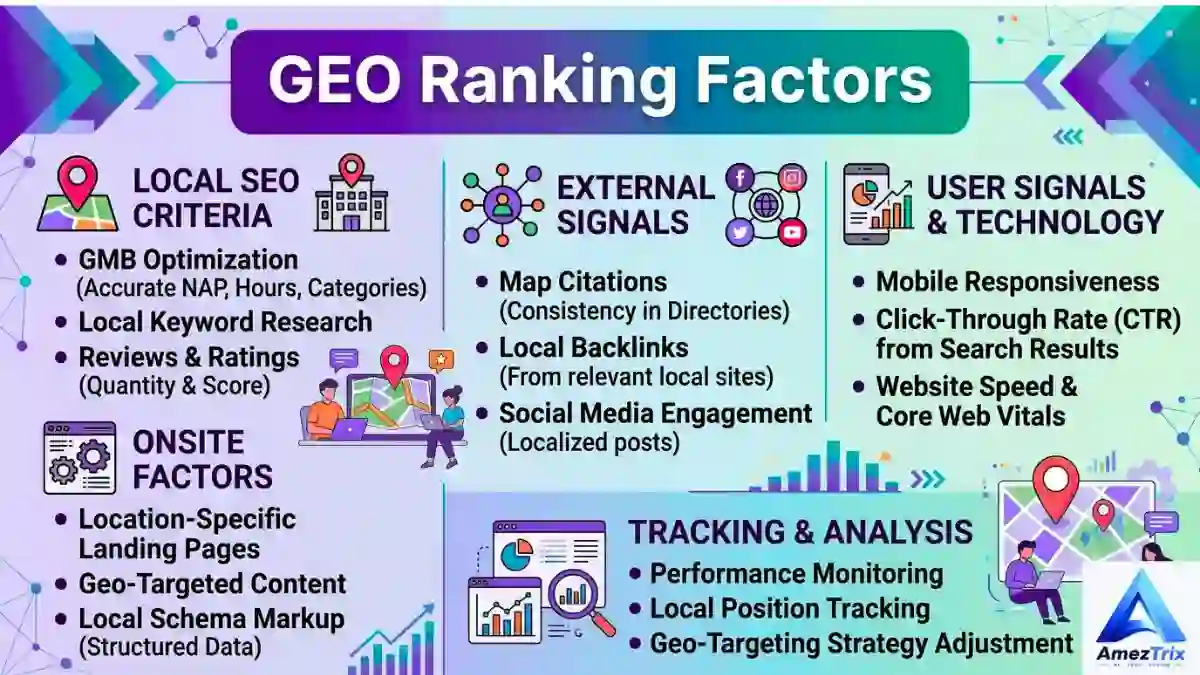
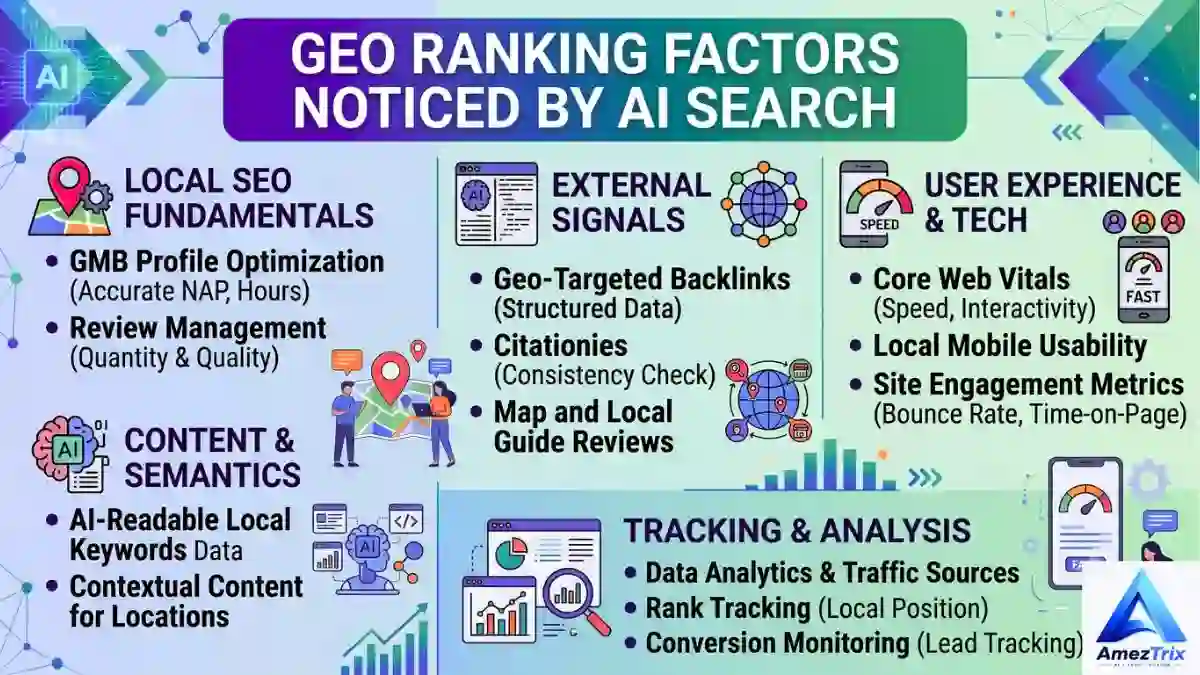
No official list exists. Based on how these systems behave, the following areas clearly matter:
- Relevance to the exact question asked
- Real writing quality, not just word count
- Depth of coverage on the topic
- Source credibility
- Clean page structure
- Clear links between entities and concepts
- Match with search intent
- Freshness and accuracy
- Technical accessibility
- Original thinking
- Citable references and data
The mindset shift matters more than any checklist. Stop asking how many times a keyword should appear. Start asking whether your point is unmistakably clear.
20 GEO Ranking Factors That Move the Needle
1. Content that solves a real problem
Everything starts here, and it is the step most people skip. AI models have already absorbed a huge amount of the web, so another generic “GEO is important” post adds nothing.
What helps instead:
- Answer the question early, not after three paragraphs of setup.
- Get the facts right instead of gesturing at them.
- Use examples a reader can picture.
- Cover the follow-up questions a reader would naturally ask.
- Cut the filler.
- Give advice someone can act on today.
- Separate fact from opinion.
Take AI marketing tools as an example. A weak article lists ten product names. A strong one explains who each tool suits, where it falls short, and when you would pick one over another.
2. Matching search intent
Intent matters as much as it ever did in SEO, and maybe more, because AI tools try hard to guess what a person wants rather than just match words. Compare these three searches:
- “What is GEO?” means the person wants a definition.
- “Best GEO tools for marketers” means they are comparing options.
- “GEO software pricing” means they are close to buying.
Write for that exact moment. Give the learner a short, clean answer. Give the comparer a real side-by-side. Give the buyer pricing and trade-offs. If the intent is wrong, even great writing will not land.
3. Building topical authority
One article rarely builds trust. A connected set of articles does. Picture two sites. Site A has a single post about GEO. Site B has a full cluster: what GEO is, GEO vs SEO, GEO vs AEO, a ranking factors guide like this one, an optimization playbook and tool comparisons.
If you were an AI system deciding who really knows the subject, you would lean toward Site B. That is topical authority in action, and it is one of the few strategies that keeps paying off over time.
4. Structure that doesn’t make readers work
AI systems must parse your page before they can use it, so make that easy. Write headings that say something. Keep paragraphs short. Use a table when you compare things. Number the steps when there are steps.
“The Bigger Picture” tells nobody anything. How Does GEO Affect AI Search Visibility?” does its job.
5. Answer first, explain after
Do not make people scroll through your life story before you reach the point. For example: What is GEO? It is the practice of shaping your content so AI search tools can understand it, trust it and possibly use it when they generate an answer.
Now you can move on to the why and the how. This “answer, then depth” pattern works for Google featured snippets, voice assistants and chatbots alike. Our list of best AI SEO tools follows the same approach.
6. Context that ties concepts together
A keyword sitting on the page is no longer enough. These systems are getting better at understanding how ideas relate. A solid GEO article will naturally touch on semantic search, entities, retrieval, citations and topical authority, not because you forced them in, but because they belong. Add related terms only when they add meaning.
7. Clear entities
An entity is any specific person, company, product or concept your page mentions. If you name several AI platforms, say briefly what each one is. Your reader does not have the context you carry in your head, so spell it out.
8. Proof that you know the subject
“GEO matters because AI search is growing” is true, but anyone who skimmed a headline could write it. Go further. Explain how AI-generated answers behave differently from a normal results page. Explain why citation patterns look nothing like ordinary referral traffic. And admit what is still uncertain, because plenty is. Real expertise is comfortable saying “we don’t know yet.”
9. Trust signals
Trust matters most for topics that touch money, health or big decisions. Make these things obvious:
- Who wrote the article and who runs the site
- Where the facts came from
- When the page was last reviewed
- How a reader can verify a claim
- How to contact the publisher
A real author bio helps, and so does an About page that is more than marketing copy. If you review a product, mention its downsides too. Pure promotion reads as untrustworthy to humans and, increasingly, to AI systems.
10. Original value
If ten sites already explain GEO the same way, a copy adds nothing. Original value can be:
- A worked example nobody else has used
- A comparison you built yourself
- A workflow based on what worked for you
- Small-scale but real data
- An honest pros-and-cons list instead of a sales pitch
Original does not mean invented. It means giving readers something they cannot get from the next five results.
11. Smart internal linking
Link your GEO content to related guides on your site, and link back the other way too. Use descriptive anchor text so both readers and crawlers know what they will find. For instance, a reader curious about ranking basics can continue with how to rank a website on Google’s first page. This turns scattered posts into one coherent resource.
12. Backlinks, without the obsession
Backlinks still help with authority. But GEO is not a numbers game. A few links from sites that are truly relevant to your industry beat a hundred random ones. Original research and genuinely useful tools attract them naturally.
13. Technical basics
GEO sits on top of technical SEO instead of replacing it. If a page cannot be crawled, nothing else matters. Check indexability, your sitemap, canonical tags, mobile usability, page speed, broken links and whether JavaScript actually renders your content.
14. Honest structured data
Schema markup such as Article, FAQPage, Product and HowTo helps machines read specific parts of a page more precisely. It will not lift weak content. When it accurately reflects what is on the page, though, it removes guesswork.
15. Real freshness
Some content ages well. A history explainer from five years ago may still be perfect. A guide to AI tools or pricing can go stale in months. Review product names, statistics and terminology on a schedule, and do a genuine update instead of just changing the date.
16. Natural language
Nobody searches by typing “GEO optimization GEO strategy GEO ranking factors.” People ask real questions and describe real problems. Write the way you would explain it to a friend over coffee.
17. Complete coverage, not keyword density
Aim for a page thorough enough that its meaning is clear from context alone. Mention retrieval, citations and conversational search where they fit, not because a tool told you to.
18. Good user experience
Slow loading, tiny fonts and an aggressive pop-up the second someone lands can undo good writing. Faster hosting also helps here, so if your pages feel slow, check your server response time first.
19. Fresh and accurate together
An article updated yesterday but full of errors is no better than an older, accurate one. Freshness only counts when the facts are right, and that matters most in fast-moving fields like AI.
20. Consistent brand details
Keep your business name, services and author bios identical across your site, social profiles and third-party listings. Contradictions confuse readers and make it harder for AI systems to work out who you are.
GEO vs Traditional SEO: How They Compare
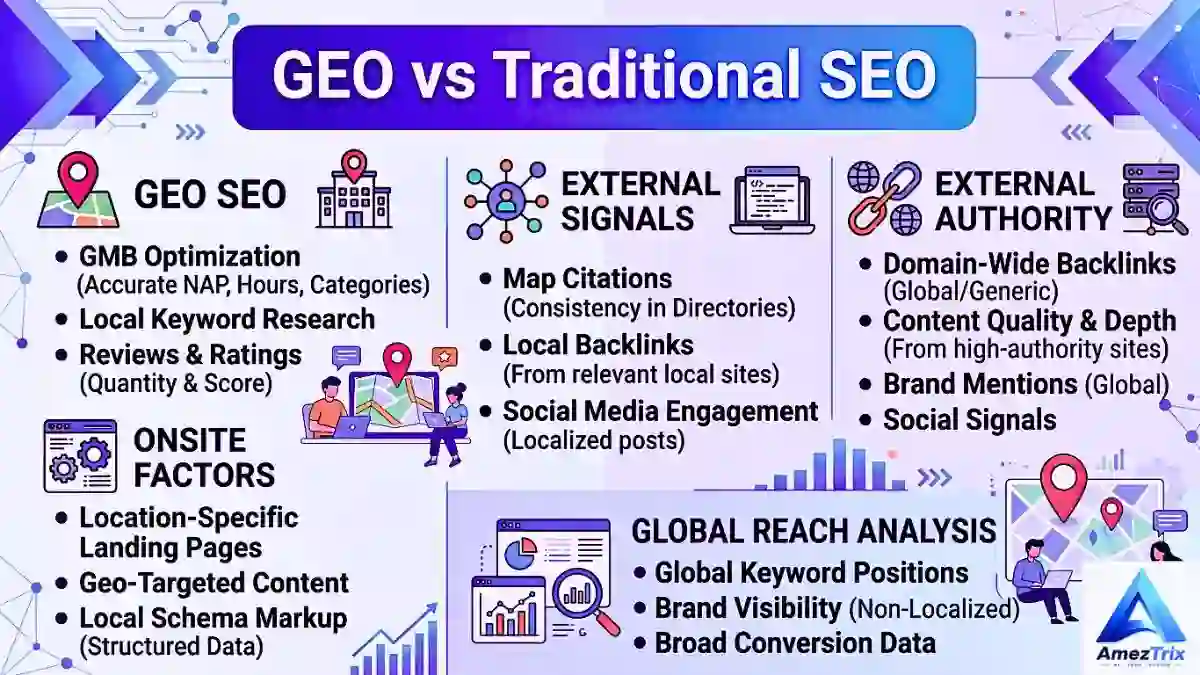
This table shows how much each factor tends to matter. The ratings are practical judgments, not official numbers.
| Ranking Factor | SEO Importance | GEO Relevance |
|---|---|---|
| Search Intent | Very High | Very High |
| Content Quality | Very High | Very High |
| Topical Authority | Very High | Very High |
| Technical SEO | Very High | High |
| Internal Linking | High | High |
| Backlinks | High | Relevant |
| Structured Data | High | Relevant |
| Entity Understanding | High | Very High |
| Natural Language | High | Very High |
| Question-Based Content | High | Very High |
| Original Insights | High | Very High |
| Trust & Credibility | Very High | Very High |
| Content Freshness | Topic-dependent | Topic-dependent |
| AI Citations | Not a classic metric | Potentially relevant |
Bottom line: GEO does not throw SEO out. It builds on top of it.
Where to Start: Priority Table
You do not need to fix everything at once. Use this table to pick your first moves.
| Priority | Action | Effort | Likely Impact |
|---|---|---|---|
| 1 | Put a direct answer in the first paragraph | Low | High |
| 2 | Rewrite vague headings into real questions | Low | High |
| 3 | Add an author bio and last-updated date | Low | Medium |
| 4 | Add tables and FAQs where readers compare or ask | Medium | High |
| 5 | Link related posts with descriptive anchors | Medium | Medium |
| 6 | Add original examples, data or screenshots | High | Very High |
| 7 | Fix crawl, speed and schema issues | Medium | Medium |
A GEO Workflow You Can Actually Follow
- Pick one specific topic. “How to Optimize Content for AI Search” beats “AI” every time.
- Find the real intent. What are people asking, and what already answers it?
- Outline around real questions, not around what sounds impressive.
- Answer the main question near the top.
- Add depth: examples, comparisons, honest limits and recommendations.
- Back factual claims with credible sources.
- Link the piece to other relevant pages on your site.
- Fix technical problems so the page can be crawled and rendered.
- Add structured data only where it is accurate.
- Read it like a visitor. Ask yourself if it would truly help you. If not, more keywords will not save it.
Mistakes That Quietly Hurt Your GEO Strategy
- Keyword stuffing. It makes writing harder to read and has not worked for years.
- Mass-producing generic AI content. Volume without substance is just noise.
- Chasing guaranteed citations. Nobody can promise an AI platform will quote you.
- Ignoring SEO fundamentals while chasing GEO trends.
- Writing only for machines and forgetting the human reader.
- Publishing unchecked claims, which slowly damages trust.
- Leaving content untouched for years, especially in fast-moving areas like AI tools.
Do All AI Platforms Use the Same Ranking Factors?
No, and it is worth repeating, because some “GEO experts” act as if one universal formula exists. Platforms differ in retrieval methods, ranking logic, training data and freshness signals. What earns citations in one system may do nothing in another.
Be skeptical of anyone claiming to know “the exact 10 factors every AI search engine uses.” Nobody outside these companies can say that with certainty. The safer bet is to stick to fundamentals that hold everywhere: relevance, accuracy, authority, context, structure, accessibility and original value.
GEO for High-CPC Commercial Content
If you run a monetized marketing site, GEO gets interesting around commercial topics such as marketing automation, CRM tools, email platforms, PPC software and lead generation. These searches carry more commercial weight than broad informational ones, which often means better CPC potential.
Still, do not write about a keyword just because it looks profitable. Your page has to out-answer what already ranks. Instead of a thin list, build a proper comparison like the one in our guide to the best digital marketing tools. Cover pricing, who each tool is built for, ease of setup, integrations, honest downsides and alternatives. Teams that also want to automate work can go further with our roundup of the best AI agents for businesses and the wider list of best AI tools.
That mix of commercial intent and real substance is what tends to perform, both for clicks and for revenue.
Frequently Asked Questions
What are the most important GEO ranking factors?
Content quality, search intent, topical authority, clear structure, credibility, original insight, well-defined entities, technical accessibility and smart internal linking top the list.
Is there a confirmed GEO ranking formula?
No. Nothing publicly confirmed applies the same way across every AI search system.
Does traditional SEO still help with GEO?
Yes. Crawlability, content quality, intent matching, internal linking and technical health all carry over. You can read more in our SEO vs GEO vs AEO articles.
Do backlinks still matter for GEO?
Yes, but quality beats quantity. A few relevant, credible links are worth more than a hundred random ones.
Can structured data improve GEO performance?
It helps machines interpret parts of your page more accurately, but it cannot fix weak content on its own.
How do I improve my visibility in AI search?
Write genuinely helpful content, answer questions directly, build real depth on your topic, fix technical issues, structure the page clearly and keep information current.
Can AI-assisted content rank well in AI search?
Yes, if it is accurate, original and properly edited by a person. Mass-producing generic AI text is not a strategy.
Does GEO replace SEO?
No. GEO builds on SEO and does not remove the need for it.
Final Verdict
No single formula guarantees visibility in AI search. The space is still shifting and probably will be for a while. One thing stays constant: make your content useful, easy to follow, trustworthy and technically sound, and make it better than the generic version already on page one.
In practice that means quality content, matched intent, real topical depth, clear structure, defined entities, original thinking, visible trust signals, strong technical SEO and sensible internal links. If you want the bigger picture, explore all our posts tagged GEO ranking factors, or start with our guides on ranking on Google.
Don’t treat GEO as a trick to game the system. Treat it as preparation for a world where people ask full questions and expect complete, honest answers.
About the Author
Rajendra Parmar is the Founder and Editor of AmezTrix, where he covers Artificial Intelligence, Technology, WordPress, Web Hosting, Digital Marketing, Gadgets and Software. His mission is to simplify complex technology through practical tutorials, honest reviews and well-researched guides that help readers make smarter digital decisions.

Rajendra Parmar
Founder & Editor • AmezTrix
Rajendra Parmar is the Founder and Editor of AmezTrix, a platform covering Artificial Intelligence, Technology, WordPress, Web Hosting, Digital Marketing, Gadgets, Software Reviews, and emerging innovations. His mission is to simplify complex technology through practical tutorials, honest reviews, and well-researched guides that help readers make smarter digital decisions.