Short answer: The best AI SEO tools in 2026 are Semrush (all-in-one), Ahrefs (backlinks and keywords), Surfer (content structure), Rank Math (WordPress), and Google Search Console (free, real data). Choose by your biggest weak spot, not by how many features a tool lists.
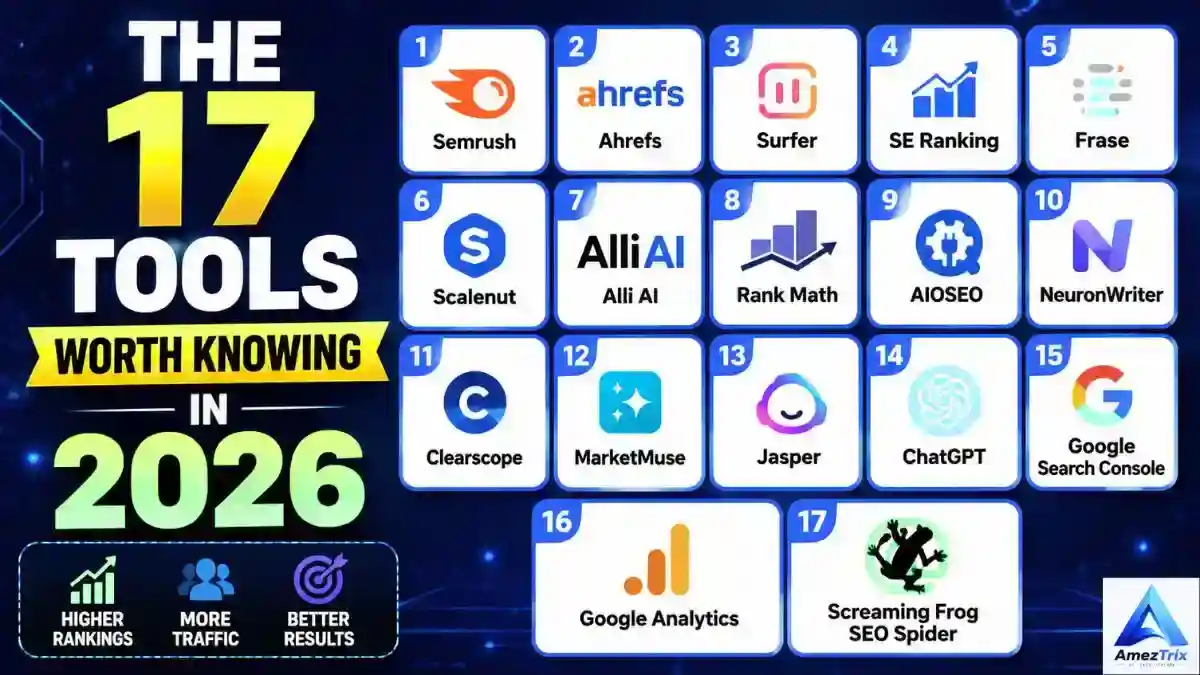
Best AI SEO Tools in 2026: 17 Tools I Tested (Honest Reviews, Pricing Tiers and Picks)
Paying for the wrong SEO tool is an expensive mistake, and in 2026 there are more options than ever. So I took 17 of the best AI SEO tools, ran the same keyword through each one for about four weeks, and wrote down what actually helped. No demo gloss, just what it felt like to use them.
Last updated: October 2026. Pricing is shown as tiers because vendors change plans often. Always confirm on each live pricing page.
Best AI SEO Tools at a Glance: Quick Picks by Need
| If you need… | Pick | Why |
|---|---|---|
| One tool for almost everything | Semrush | Research, audits, tracking and AI visibility in one place |
| Backlinks and deep keyword data | Ahrefs | The deepest link and keyword database I tested |
| Help structuring an article | Surfer | Live scoring inside Google Docs |
| SEO inside WordPress | Rank Math | Strong free tier, no extra login |
| A near-zero budget | Google Search Console | Real clicks, impressions and positions, free |
| An outlining partner | ChatGPT | Fast brainstorming and clustering |
| Crawl errors and broken links | Screaming Frog | Thorough technical crawling |
| Checking if AI chatbots mention your brand | Ahrefs Brand Radar | Tracks brand mentions across AI platforms |
There’s no single winner here. What’s broken in your process today decides the right answer.
How I Tested the Best AI SEO Tools
Here’s an uncomfortable confession. Most “best AI SEO tools” posts are written by people who never opened half the dashboards they praise. I used to write like that. Then a client asked me a question I couldn’t answer, and I realized I’d been repeating the same five names for two years without checking if they still deserved the spot.
So I started over. For roughly four weeks, I used every tool below on real work, noting where each one saved me time and where it only looked clever in a sales video. A few pleasantly surprised me. A couple of famous names let me down.
I used one keyword, “project management software,” as my test case. In every platform, I built a content brief and compared the output side by side. I also checked each tool’s keyword volume estimates against real Google Search Console data from three of my own sites, to see how far the guesses drifted from reality.
Not every tool did every job, so I judged each one on what it claims to do, not on a single checklist.
What Are AI SEO Tools? A Simple Explanation
An AI SEO tool is software that uses machine learning to help your website get found on search engines. It finds keywords, reads search intent, suggests content improvements, spots technical errors, and, increasingly, shows whether AI assistants mention your brand.
Two years ago the label mostly meant “a keyword tool with a chatbot attached.” In 2026 a real one typically handles at least one of these jobs:
- Turning one seed keyword into a list of related terms and questions
- Working out whether searchers want to buy, learn, or compare
- Building outlines from the pages that already rank
- Scoring your draft against current winners
- Crawling your site for technical faults
- Tracking Google rankings and mentions inside AI answers from ChatGPT, Gemini and AI Overviews
- Suggesting schema, internal links and meta tags
One thing separates good tools from gimmicks: data. The tools worth paying for pair AI with their own large datasets, built from years of crawling keywords and backlinks. That kind of work needs serious computing power too, the same kind that fills the AI data centers now being built worldwide. A plain language model without that data is guessing. A tool with it is measuring.
Who Actually Needs AI SEO Software?
This is mostly a commercial-investigation search. People already believe SEO matters and want help choosing before they spend. Some are still informational (what can AI do for SEO at all?), and a few are nearly transactional (they want a trial link today).
- Why are they searching? Research and writing take too long.
- Why now? AI answers now sit beside classic search results.
- Why not grab the biggest name? Big platforms can be costly overkill for a small site.
- Why the skepticism? Many lists are affiliate roundups with no hands-on use.
- What’s the real question? “Which one should I pay for, and what will it cost me?”
That’s why this guide gives a short list, honest downsides, and a decision guide instead of only names.
Why Use AI for SEO in 2026?
I resisted for longer than I should have. Four things changed my mind.
Research became much faster. Brainstorming every way people phrase a search used to eat twenty minutes. Now I enter one seed term and get dozens of related questions in about a minute.
I stopped missing content gaps. Articles I believed were complete got flagged for skipping a subtopic three competitors covered. Finding that before publishing is far better than after.
Technical problems surface early. A good crawler tells you which broken link matters, rather than dropping a two-thousand-row spreadsheet on you.
Search isn’t only Google now. People ask ChatGPT, Gemini and Perplexity what they used to type into Google. Google’s own documentation says normal SEO fundamentals still apply to its AI features, so it’s the same game with a bigger scoreboard. See Google’s AI features guidance.
Key points
- AI speeds up research, briefs and audits. It doesn’t replace your judgment.
- Tools with their own data (Ahrefs, Semrush) are more reliable than text generators alone.
- Google Search Console is the only first-party ranking data, and it costs nothing.
- One well-chosen tool beats five overlapping subscriptions.
AI SEO Tools Comparison Table (2026)
| Tool | Best For | Price Tier | Keyword Research | Content Help | Technical SEO | AI Search Visibility |
|---|---|---|---|---|---|---|
| Semrush | All-in-one | Mid-tier paid | Strong | Strong | Strong | Strong |
| Ahrefs | Backlinks & keywords | Mid-tier paid | Strongest | Strong | Strong | Strong (Brand Radar) |
| Surfer | Content structure | Low–mid paid | Moderate | Strongest | None | Limited |
| SE Ranking | Budget all-rounder | Low-tier paid | Strong | Moderate | Strong | Moderate |
| Frase | Content briefs | Low-tier paid | Moderate | Strong | None | Limited |
| Scalenut | Content volume | Low–mid paid | Moderate | Strong | None | Limited |
| Alli AI | On-page automation | Mid-tier paid | Weak | Moderate | Strong | Limited |
| Rank Math | WordPress plugin | Free + paid | Moderate | Moderate | Strong | Limited |
| AIOSEO | WordPress plugin | Free + paid | Moderate | Moderate | Strong | Limited |
| NeuronWriter | Budget optimization | Low-tier paid | Moderate | Strong | None | Limited |
| Clearscope | Enterprise editorial | High-tier paid | Weak | Strongest | None | Limited |
| MarketMuse | Topical authority | High-tier paid | Moderate | Strong | Limited | Limited |
| Jasper | AI writing | Mid-tier paid | Weak | Moderate | None | Limited |
| ChatGPT | Research assistant | Free + paid | Moderate | Moderate | None | Strong (with data) |
| Google Search Console | Real ranking data | Free | Actual queries | None | Strong | Limited |
| Google Analytics | Post-click data | Free | None | None | None | None |
| Screaming Frog | Technical crawling | Free + paid | None | None | Strongest | Limited |
Ratings show relative strength from my hands-on use. They aren’t a ranking guarantee, since no tool can see Google’s real algorithm.
Best AI SEO software Tools by Budget
| Budget | Tools to consider |
|---|---|
| Free | Google Search Console, Google Analytics, ChatGPT (free tier), Rank Math or AIOSEO (free versions), Screaming Frog (free version) |
| Low | SE Ranking, Frase, NeuronWriter |
| Mid | Semrush, Ahrefs, Surfer, Scalenut, Alli AI, Jasper |
| High | Clearscope, MarketMuse |
17 Best AI SEO Tools in 2026: Honest Reviews
1. Semrush: The One I’d Keep If I Could Only Keep One
I got tired of logging into five platforms to answer one question. Semrush fixed that. Keyword research, competitor tracking, site audits and AI visibility monitoring all sit in one dashboard.
Liked: I could build a full picture of a competitor without stitching exports together.
Disliked: It shows a lot at once. Give yourself a week to settle in.
Best for: Agencies and in-house teams who’ve outgrown free tools.
2. Ahrefs: Still the Backlink King
Ahrefs has the deepest keyword and backlink data of anything I used. Its AI Content Helper compares your draft with ranking pages and points out what’s missing, not just where to add more keywords.
Liked: Brand Radar shows how AI platforms talk about your brand.
Disliked: There’s no built-in writing tool, so you’ll draft elsewhere.
Best for: Anyone who takes backlinks as seriously as on-page work.
3. Surfer: Best Cure for the Blank Page
I usually know the topic. What I struggle with is the order. Surfer sorted that out better than any other tool in this test.
Liked: The Google Docs integration updates your score while you type.
Disliked: It has no technical SEO features at all. It does one job.
Best for: Writers who need structure more than research.
4. SE Ranking: The Budget Pick That Doesn’t Feel Cheap
SE Ranking covers most of what the pricier platforms do, without the sticker shock for a small agency.
Liked: Good value across rank tracking, audits and keyword research.
Disliked: On niche keywords the data felt a little thinner than Ahrefs or Semrush.
Best for: Freelancers and small teams leaving free tools behind.
5. Frase: Quick Briefs, Not Much More
Frase collects the questions people ask around a keyword and shapes them into an outline within minutes.
Liked: Briefs arrive fast.
Disliked: No technical SEO, and its content score is looser than Surfer’s.
Best for: Teams who want research and outlining together.
6. Scalenut: Made for Frequent Publishing
If your site pushes out lots of content, Scalenut’s clustering and brief features keep things organized.
Liked: It keeps topic clusters tidy across dozens of articles.
Disliked: AI drafts need real editing or they read generic.
Best for: Publishers who value a repeatable process.
7. Alli AI: The One That Actually Applies the Fixes
Most tools hand you a to-do list. Alli AI makes the changes across your site for you.
Liked: It solves the “our developers won’t touch this for two months” problem.
Disliked: Site-wide automation without review makes me nervous.
Best for: Agencies handling large, messy sites.
8. Rank Math: My Default for WordPress
For basic on-page work I rarely leave the WordPress dashboard now. Rank Math covers titles, schema, sitemaps and internal links right there.
Liked: The free tier is generous.
Disliked: It can’t replace proper keyword or backlink research.
Best for: WordPress bloggers who want SEO built in.
9. AIOSEO: Rank Math’s Calmer Cousin
The two are very close. I swapped between them for a week and found no real capability gap, only a difference in which screen I liked.
Liked: A simpler settings area.
Disliked: It doesn’t clearly stand apart from Rank Math.
Best for: People who don’t click with Rank Math’s layout.
10. NeuronWriter: Good Enough and Affordable
NeuronWriter offers SERP-based scoring without Surfer or Clearscope prices.
Liked: Real value for solo bloggers.
Disliked: SERP data refreshed more slowly than I wanted.
Best for: Small publishers watching every dollar.
11. Clearscope: Polished, Pricey, Built for Teams
Clearscope feels designed for a newsroom, not a lone blogger, and the price matches.
Liked: A clean interface editors enjoy using.
Disliked: Hard to justify for a one-person site.
Best for: Enterprise editorial teams.
12. MarketMuse: Thinks at Site Level
MarketMuse studies topical gaps across your whole site rather than one page at a time.
Liked: Great for planning months of content ahead.
Disliked: A steep learning curve, and too much for small sites.
Best for: Large sites building topical authority on purpose.
13. Jasper: A Writing Tool in an SEO Costume
Jasper writes quickly, but under the marketing it isn’t really an SEO platform.
Liked: Speed on brand and marketing copy.
Disliked: No proprietary keyword or SERP data, so pair it with another tool.
Best for: Teams that put brand voice ahead of search data.
14. ChatGPT: My Real Daily Driver
It’s not glamorous, but I reach for ChatGPT more than most paid tools here, mainly for clustering, intent checks and rough outlines.
Liked: Fast, flexible, and the free tier is workable.
Disliked: It has no true search volume data, and I check every fact before publishing. Google’s spam policies target mass-produced, low-value pages, so treat AI text as a first draft.
Best for: A thinking partner, not a platform replacement.
15. Google Search Console: Non-Negotiable
Everything else on this list estimates. Search Console reports what really happened: clicks, impressions and positions.
Liked: Free, and it’s the ground truth.
Disliked: Data lags by a couple of days and there’s no competitor view.
Best for: Every website, no exceptions.
16. Google Analytics: Where Rankings Meet Reality
A page in position one that nobody converts on isn’t a win. Analytics is how I notice that early.
Liked: Free, and it ties traffic to outcomes.
Disliked: GA4 still confuses beginners.
Best for: Anyone who wants proof that traffic does something.
17. Screaming Frog: The Unglamorous Workhorse
Screaming Frog crawls your whole site and flags the dull problems that quietly hurt rankings: broken links, duplicate titles and redirect chains.
Liked: Thorough, and the free version suits small sites (it has a URL limit, so check the current cap).
Disliked: You need some SEO knowledge to prioritize the results.
Best for: Technical audits, in-house or for clients.
How to Choose the Right AI SEO Tool
First, size up your operation. A small blog can run on Search Console, a WordPress plugin and ChatGPT. I’ve watched it work. A larger site needs real crawling, tracking and reporting.
Next, match the tool to your actual bottleneck:
- Weak keyword research → Ahrefs or Semrush
- Weak content structure → Surfer, Frase or Clearscope
- You use WordPress → Rank Math or AIOSEO
- Technical debt piling up → Screaming Frog
- Unsure whether AI chatbots mention you → Ahrefs Brand Radar or Semrush’s AI visibility tracking
Skip the enterprise plan just because it has more buttons. Small sites often do well with free Google tools and one mid-tier platform.
Checklist: Before You Pay for Any AI SEO Tool
- ☐ I can name the single problem this tool will solve.
- ☐ I tested the free trial on my own keyword, not the demo.
- ☐ I read the live pricing page, including renewal terms.
- ☐ I compared its keyword numbers with my Search Console data.
- ☐ I know how to cancel and export my data.
- ☐ My Search Console and Analytics habits are still in place.
AI SEO Workflow: How to Use These Tools Step by Step

- Find the opportunity with Search Console, Ahrefs or Semrush.
- Pin down intent. Is the searcher buying, comparing or learning?
- Study the results page for structure, depth and missing angles.
- Build a brief and let AI organize the research.
- Write it yourself, or edit heavily. First-hand experience is what AI can’t fake.
- Cover the on-page basics: title, headings, URL and schema.
- Check the technical side: crawlability, mobile speed and canonicals.
- Track results in Search Console and Analytics.
- Refresh older posts instead of only chasing new topics.
Free AI SEO Tools Stack for Beginners
- Google Search Console: real performance data
- Google Analytics: traffic and engagement
- ChatGPT: brainstorming and outlines
- Rank Math or AIOSEO: on-page work in WordPress
- Google Trends: spotting shifts in interest
- Screaming Frog (free version): light technical checks
I’ve seen this setup take a brand-new site further than people expect before a single paid tool is added.
Common AI SEO Mistakes to Avoid
- Publishing an AI draft unedited. AI gets facts wrong more often than most people think.
- Publishing too much, too fast. Volume without substance isn’t a strategy.
- Chasing keyword density. That stopped mattering years ago.
- Ignoring technical health. Great writing on an uncrawlable page ranks nowhere.
- Treating a tool’s score as gospel. It’s a signal, not a promise from Google.
- Skipping Search Console. Every other number is an estimate.
Red Flags Before Buying AI SEO Software
- Promises of guaranteed page-one rankings. Nobody can deliver that.
- No free trial, or a trial that hides the cancel button.
- Reviews that never mention a downside.
- Auto-publish features that push content live without your approval.
- Keyword volumes wildly different from your own Search Console numbers.
The Honest Downsides of AI SEO Tools
I’d be misleading you if I only talked up the good side.
- They cost real money. Subscriptions stack up, and some are priced for agencies.
- Data is estimated. Volumes and difficulty scores differ between tools. Use them to compare, not as exact figures.
- Content scores can mislead. Chasing a green score can make your writing stiff.
- AI visibility tracking is young. AI answers change from query to query, so treat those numbers as directional.
- Automation has risks. One bad site-wide change can hurt many pages at once.
- Tools can’t replace expertise. They show what’s happening. You decide what to do.
AI SEO vs Traditional SEO: What Changes?
| Traditional Approach | AI-Assisted Approach |
|---|---|
| Manual keyword research | AI-assisted keyword discovery |
| Manual SERP analysis | AI-assisted SERP analysis |
| Manual content briefs | Automated brief generation |
| Manual competitor tracking | AI-assisted competitor insights |
| Manual optimization checks | AI content recommendations |
| Manual technical audits | Automated crawling and flagging |
| Rank tracking only | Rank tracking + AI visibility monitoring |
| Search engines | Search engines + AI search surfaces |
AI didn’t replace SEO. It took the repetitive work off your plate, so you can spend time on what needs a person: strategy, judgment, and knowing your audience.
Frequently Asked Questions
What are the best AI tools for SEO right now?
Semrush, Ahrefs, Surfer, SE Ranking, Frase, Rank Math, ChatGPT, Google Search Console and Screaming Frog each lead in one area: keywords, content, technical health or AI visibility. The best choice depends on which of those currently holds your site back.
Which AI SEO tool should a beginner start with?
Begin with Google Search Console, Google Analytics, a free WordPress SEO plugin and ChatGPT for brainstorming. All are free or have free tiers. Add a paid platform only when your site has grown enough to justify it and you know which gap you need to close.
Can an AI SEO tool guarantee rankings?
No. No tool can see Google’s actual ranking system. These products help you work faster and catch problems, but rankings still depend on content quality, links and competition. Be wary of any vendor that promises a specific position or timeline.
Is AI-written content bad for SEO?
Not by itself. Google has said it rewards helpful, quality content regardless of how it’s produced. The danger is publishing unedited, mass-produced pages with nothing new to say. Use AI for drafts, then add your own experience, examples and fact-checking.
Is ChatGPT an SEO tool?
It’s a useful assistant for brainstorming, topic clustering and outlines. But it lacks proprietary keyword volume and SERP data, so it can’t replace Ahrefs or Semrush. Pair it with a data-backed platform and verify any figures it gives you.
Semrush or Ahrefs: which is better?
Semrush is the broader suite, covering content, ads and AI visibility. Ahrefs is stronger on backlinks and content-gap analysis. Decide whether you need breadth or backlink depth, then test both free trials on your own site before paying.
What are the best free AI SEO tools?
Google Search Console. It’s the only first-party source for how your site performs in Google, showing real queries, clicks and impressions. Every other tool estimates. Pair it with Google Analytics to see what visitors do after the click.
Will AI replace SEO professionals?
Not soon. AI handles repetitive research, first drafts and audits. Strategy, prioritization and understanding what your audience needs still take a person. The job is shifting toward judgment and editing rather than disappearing.
Final Verdict: Which AI SEO Tool Is Best?
After four weeks of testing, my conclusion is simple: there’s no single winner, only the best fit for your gap. Pick Semrush for breadth, Ahrefs for backlinks and content gaps, Surfer for writing structure, and Rank Math if you live in WordPress. Whatever else you choose, keep Search Console in the mix because it isn’t optional.
The sites doing well today aren’t the ones with the fanciest tool stack. They’re the ones where a real person still makes the calls software can’t.
Sources and Further Reading
About the Author
Rajendra Parmar is the Founder and Editor of AmezTrix, where he covers Artificial Intelligence, Technology, WordPress, Web Hosting, Digital Marketing, Gadgets, and Software. His mission is to simplify complex technology through practical tutorials, honest reviews, and well-researched guides that help readers make smarter digital decisions. You can also explore more new Google AI tools on the site.

Rajendra Parmar
Founder & Editor • AmezTrix
Rajendra Parmar is the Founder and Editor of AmezTrix, a platform covering Artificial Intelligence, Technology, WordPress, Web Hosting, Digital Marketing, Gadgets, Software Reviews, and emerging innovations. His mission is to simplify complex technology through practical tutorials, honest reviews, and well-researched guides that help readers make smarter digital decisions.