Learn what 6G Technology is, how fast it could be, how it differs from 5G, key uses and when it arrives—simple, honest guide.
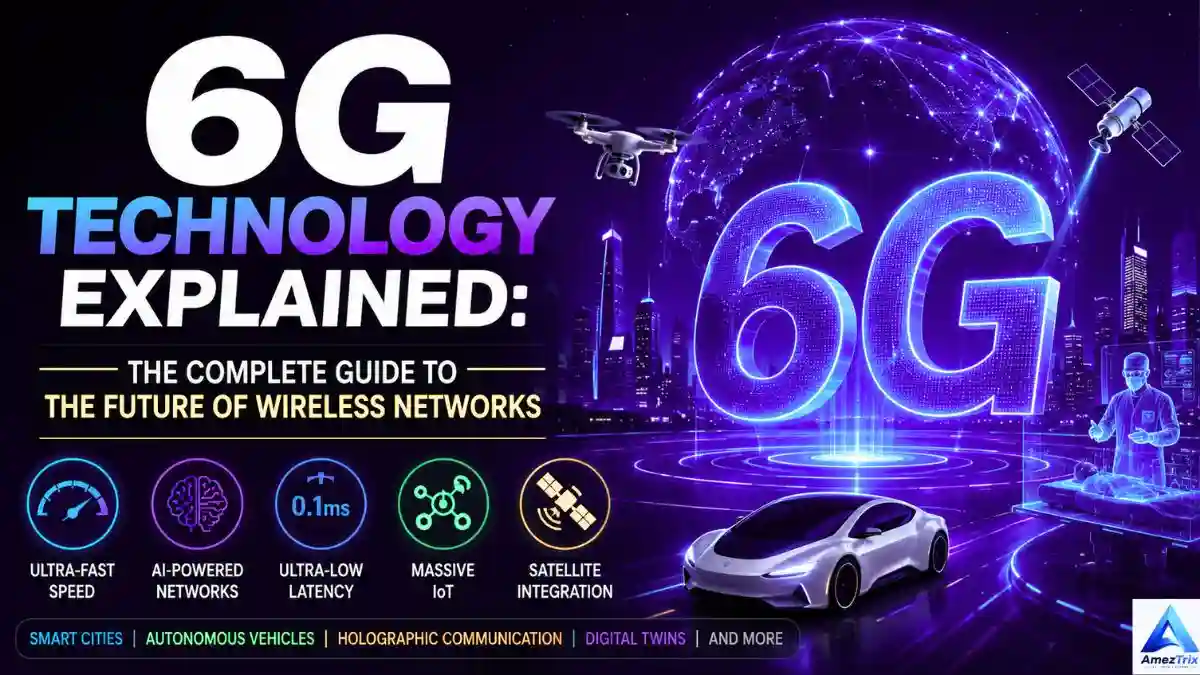
6G Technology Explained: Features, Speed, Uses and Launch Date
Everything you need to know about 6G: how fast it could be, what it will change, what is still uncertain, and what it means for the way we’ll live and work.
TL;DR: 6G Technology in 60 Seconds
| What it is | The sixth generation of mobile networks, designed to follow 5G |
| Expected launch | Around 2030 (first commercial networks), wider rollout after that |
| Target speed | Peak goal of up to 1 Tbps (lab and theory, not everyday use) |
| Target latency | Roughly 0.1 to 1 millisecond |
| Big idea | AI built into the network, plus sensing, satellites and terahertz-range radio |
| Can you use it now? | No. It is in research, testing and standards work |
What Is 6G Technology?
6G Technology is the next generation of wireless networks after 5G. It aims for much higher peak speeds, near-instant response times, built-in artificial intelligence, and coverage that blends mobile towers with satellites. Commercial launch is expected around 2030, and standards are still being written.
That is the short answer. Now the longer, more useful one.
If you’ve read tech news lately, you’ve probably seen 6G mentioned even though 5G is still spreading in many countries. It’s fair to ask whether this is just “5G, but faster”. It isn’t. Speed is only one part of the plan. The bigger shift is a network that can sense its surroundings, manage itself and connect people, machines and AI systems at the same time.
In this guide, you’ll learn what 6G is, how it works, where it will be used, what could go wrong, and how to separate real progress from marketing hype.
6G Explained Like You’re 5
Imagine a road. 2G was a small village lane. 3G was a proper street. 4G became a busy highway. 5G added more lanes and smarter traffic lights.
6G is like a highway that also has a brain. It watches the traffic, spots jams before they form, opens extra lanes on its own and even reaches places that never had a road. Your phone, car, watch and factory robots all share that one smart road.
Why Do People Search for 6G Technology?
Most people searching this keyword want to learn, not buy. Their questions tend to be simple:
- Informational: What is 6G? How fast will it be? When will it launch?
- Comparison: How is 6G different from 5G?
- Future-minded: Will my phone support it? Which jobs, businesses and industries will change?
- Commercial: Which companies and countries are leading, and is it worth investing in?
That is why this guide covers all four, in plain language, with honest limits.
A Quick Look Back: How Mobile Networks Got Here
Each generation solved a different problem. Here is the pattern.
| Generation | Era | Big Breakthrough |
|---|---|---|
| 1G | 1980s | Analog voice calls |
| 2G | 1990s | Digital calls and SMS |
| 3G | 2000s | Mobile internet |
| 4G LTE | 2010s | Smooth video streaming and app-heavy life |
| 5G | 2020s | Low latency, massive IoT, smart factories |
| 6G | Around 2030 | AI-native networks, sensing, space-ground integration |
Notice that every generation arrived roughly ten years after the last one. That rhythm is why 2030 keeps showing up.
Why Do We Need 6G When 5G Is Still Rolling Out?
Good question. The honest answer is that networks take about a decade to design, test and standardize. Work on 6G starts while 5G is still growing, so it is ready when demand arrives.
And demand is already building from things like:
- Self-driving vehicles that need constant, reliable links
- Smart factories with thousands of sensors and robots
- Augmented and virtual reality at scale
- Holographic and immersive communication
- Billions of IoT devices
- AI services that need fast, local processing
Many of these work today in limited form. 6G is meant to make them dependable and affordable at scale.
6G Technology Speed: How Fast Will It Really Be?

The most quoted number is 1 terabit per second (Tbps) as a peak target. The International Telecommunication Union (ITU) uses a similar figure in its IMT-2030 framework, which is the official blueprint for 6G. 5G’s official peak target is 20 Gbps, so on paper 6G is about 50 times higher.
Here is the part most articles skip: peak speed is not the speed you’ll get. Peak numbers come from perfect lab conditions. 5G also promised 20 Gbps, yet most people see far less. Early studies and industry projections suggest everyday 6G users may see somewhere in the range of several gigabits per second, but nobody can promise that figure yet.
4G vs 5G vs 6G: Full Comparison
| Category | 4G LTE | 5G | 6G (Target) |
|---|---|---|---|
| Rollout | 2009-2010 | 2019-2020 | Around 2030 |
| Network focus | Mobile broadband | Broadband, IoT, low latency | AI-native, sensing, global coverage |
| Peak speed (target) | ~1 Gbps | ~20 Gbps | Up to 1 Tbps |
| Typical latency | 30-50 ms | ~1-10 ms | ~0.1-1 ms (target) |
| Radio spectrum | Below 6 GHz | Sub-6 GHz and mmWave | Adds upper mid-band and sub-THz (research) |
| AI role | Minimal | Add-on tools | Built into the design |
| Satellite integration | None | Limited | Planned from the start |
| Device density | Low | High | Very high |
| Security approach | Standard LTE encryption | Stronger encryption | AI-assisted, zero trust, quantum-safe goals |
Key Features of 6G Technology
1. Ultra-Low Latency
Latency is the delay between sending a signal and getting a response. 5G brought it to around a millisecond in the best cases. 6G targets roughly 0.1 to 1 millisecond. That gap matters for robot arms, remote machinery and vehicles where a split second counts.
2. AI Built Into the Network
In 6G, AI is not a bonus app. It is part of how the network runs. It can reroute traffic, predict equipment failure, save energy and spot unusual behaviour. The network becomes more self-managing, which lowers running costs for operators.
3. Terahertz and New Frequency Bands
More speed needs more spectrum. Researchers are exploring sub-terahertz bands, roughly 100 GHz and above. The trade-off is clear: these signals carry huge data but travel short distances and struggle with walls. Many analysts expect the first real 6G networks to rely on upper mid-band spectrum (around 7 to 15 GHz) for everyday coverage, with very high bands used in small hotspots.
4. Integrated Sensing and Communication (ISAC)
This one is new. The same radio signals that carry data can also detect objects, movement and position, a bit like radar. Think of a city network that can notice a pedestrian stepping onto a road or help drones avoid each other.
5. Space, Air and Ground Together
6G plans to treat satellites and high-altitude platforms as part of the network, not an add-on. The goal is coverage in mountains, oceans and remote villages. If you want to see how satellite broadband works today, read our satellite internet guide.
6. Edge Computing
Instead of sending every request to a faraway data center, processing happens closer to you. The results are faster responses and less data travelling long distances.
7. Energy Efficiency
Networks use a lot of power. Energy efficiency is a stated design goal for 6G, with smarter sleep modes and AI-based power control. Whether it delivers will depend on how many extra base stations dense networks need.
Key Points
- 6G is a network redesign, not only a speed upgrade.
- Peak speed and everyday speed are very different numbers.
- AI, sensing and satellites are the real headline features.
- Standards are still being finalized, so specs can change.
How Does 6G Work? A Beginner’s Guide
6G is not one invention. It is a stack of technologies working together:
- New radio spectrum for more capacity
- Massive antenna systems that steer signals like a spotlight
- Reconfigurable surfaces, smart panels that bounce signals around obstacles
- AI and machine learning to tune the network in real time
- Edge and cloud computing for processing and storage
- Digital twins, virtual copies of networks or factories used for testing
- Quantum-safe encryption to resist future code-breaking
The 6G Timeline: Where Things Stand
| Stage | What Happens | Approximate Timing |
|---|---|---|
| Vision and requirements | ITU sets the IMT-2030 framework | Completed around 2023 |
| Studies | 3GPP starts early 6G studies | From about 2025 |
| Technical specifications | Standards written and refined | Late 2020s |
| First commercial networks | Limited launches in leading markets | Around 2030 |
| Mass adoption | Devices, coverage and prices catch up | Early to mid 2030s |
Dates are industry expectations and can shift. Check the ITU and 3GPP websites for the latest status.
Real-World Uses of 6G Technology
| Industry | 4G Era | 5G Era | 6G Goal |
|---|---|---|---|
| Healthcare | Telemedicine | Remote monitoring | More reliable remote procedures, connected smart hospitals |
| Transport | Navigation | Connected cars | Vehicle-to-everything coordination at scale |
| Manufacturing | Basic automation | Smart factories | Self-adjusting factories with digital twins |
| Agriculture | Smart sensors | Precision farming | Drone fleets and remote-area coverage |
| Education | Online classes | Interactive learning | Immersive XR classrooms |
| Entertainment | HD streaming | Cloud gaming, 4K/8K | Immersive XR and holographic-style calls |
| Cities | Basic connectivity | Smart traffic, sensors | Sensing-enabled city management |
Some Examples You Can Picture
- Healthcare: A specialist in one city guiding a robotic procedure in another, with a network that rarely drops. Remote surgery already exists in trials; 6G aims to make it more routine and dependable.
- Logistics: Warehouse robots and delivery drones coordinating without a human dispatcher.
- Disaster response: Satellite-backed coverage when ground towers go down.
- Daily life: Phones and glasses that stream rich 3D content without stutter.
Top 10 Countries Leading the Race Toward 6G
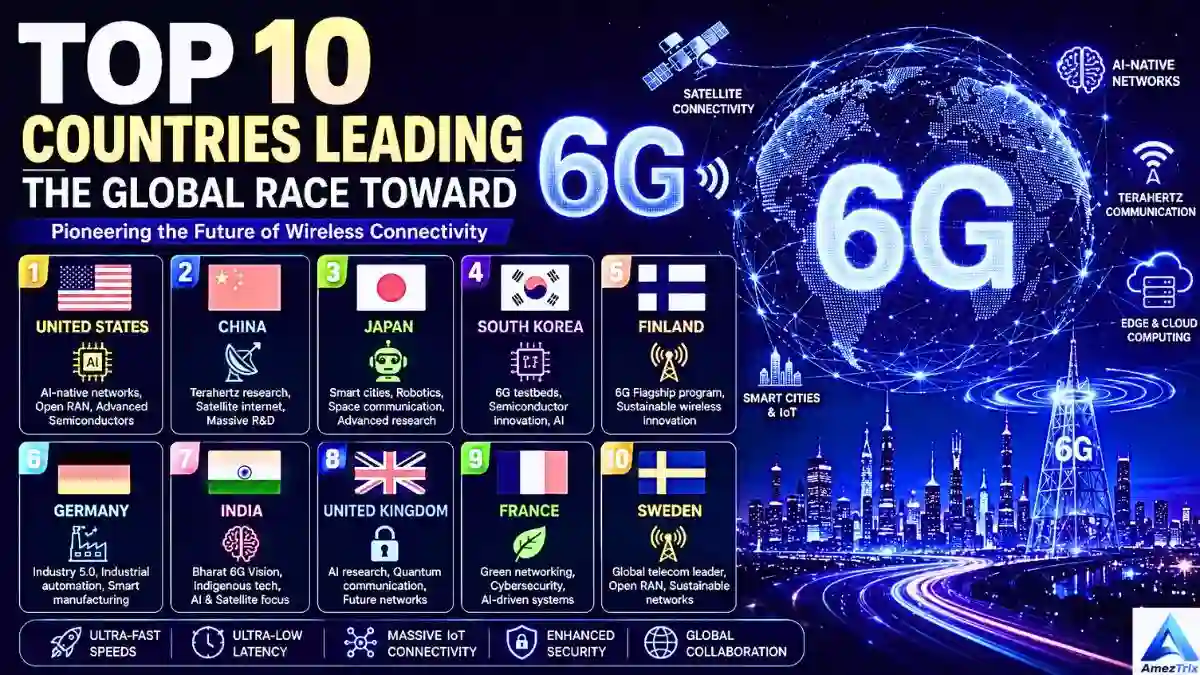
Governments and companies worldwide are funding research, test networks and standards work. The ranking below is an editorial view of activity and investment, not an official list, and it will change.
| Rank | Country | Main Focus | Key Organizations |
|---|---|---|---|
| 1 | United States | AI-native networks, Open RAN, chips | Next G Alliance, Qualcomm, Intel, NVIDIA |
| 2 | China | Terahertz research, satellite links, AI networks | Huawei, ZTE, China Mobile |
| 3 | Japan | Smart cities, robotics, space communication | NTT DOCOMO, NEC, Fujitsu, Sony |
| 4 | South Korea | Semiconductors, AI, devices | Samsung, LG, SK Telecom, KT |
| 5 | Finland | Sustainable design, wireless research | University of Oulu (6G Flagship), Nokia |
| 6 | Germany | Industry 5.0, smart manufacturing | Fraunhofer, Deutsche Telekom, Siemens |
| 7 | India | Indigenous telecom, satellite, AI | C-DOT, IITs, Bharat 6G Alliance |
| 8 | United Kingdom | AI research, quantum communication | University of Surrey, Bristol, BT |
| 9 | France | Green networks, security | Orange, CEA |
| 10 | Sweden | Sustainable networks, radio tech | Ericsson, KTH |
On the company side, Nokia, Ericsson, Samsung, Qualcomm, Huawei, Intel, Apple, NEC, Fujitsu and MediaTek are all active in 6G research. Chip supply will be a big factor, which is why our guide to the top semiconductor companies is worth a read.
Which Network Is Right for What?
Newer is not always better for you today.
- 4G still handles calls, social media, browsing and HD video well.
- 5G suits cloud gaming, 4K streaming, IoT and business use.
- 6G is for what comes next: AI-native services, sensing, immersive XR and global coverage.
Common Mistakes People Make About 6G Technology
- Treating 1 Tbps as real-world speed. It is a peak target.
- Thinking 6G replaces 5G overnight. The two will run side by side for years.
- Waiting to upgrade a phone “for 6G”. No 6G phones exist yet, and early ones will be costly.
- Believing every launch claim. Some companies label early tests as “6G” for attention.
- Ignoring 5G-Advanced. This upgrade to 5G is the real step in between and brings gains today.
Red Flags: How to Spot 6G Hype
- A product or SIM sold as “6G” today, since there is no commercial standard yet
- Speed claims with no test conditions or distance
- Exact launch dates promised by a single company
- Health scare posts with no scientific source
- Investment pitches that guarantee returns from “6G stocks”
The Downsides and Limits of 6G
No technology is perfect, and 6G has real challenges:
- Cost: New towers, chips and satellites need huge investment, and that can raise prices.
- Short range: High-frequency signals do not travel far or pass through walls well, so dense small cells may be needed.
- Power use: Dense networks and AI can raise energy demand, even if efficiency improves.
- Standards and spectrum: Countries must agree on frequency use, which takes time.
- Privacy and security: Sensing networks and AI-driven data handling raise new privacy questions.
- Digital divide: Poorer regions may wait longer, and many places still lack solid 4G.
- Uncertain demand: Some experts question whether consumers will pay extra, as 5G’s consumer payoff has been modest.
6G Readiness Checklist for Businesses and Curious Readers
- ☐ Check whether your area has solid 5G coverage first
- ☐ Follow ITU and 3GPP updates once or twice a year
- ☐ Review which of your processes depend on low latency
- ☐ Learn the basics of edge computing and IoT
- ☐ Plan device refresh cycles instead of rushing purchases
- ☐ Add security planning, including post-quantum encryption, to your roadmap
- ☐ Build AI and data skills, which will matter whatever the network
Will Your Phone Support 6G?
No. Current phones lack the radios 6G needs, so you’ll need new hardware after networks launch. Expect 5G and 6G to coexist well into the 2030s, which means you will not be forced to switch quickly. The same pattern happened when 4G arrived.
Frequently Asked Questions About 6G Technology
1. What is 6G Technology?
6G Technology is the sixth generation of mobile networks, expected around 2030. It targets far higher peak speeds, very low latency, built-in AI, sensing abilities and tighter links with satellites, supporting uses like smart cities, autonomous vehicles and immersive reality.
2. When is the 6G launch date?
Most industry roadmaps point to around 2030 for first commercial networks, with wider availability in the early to mid-2030s. Standards work is still in progress, so timing may shift by region and operator.
3. How fast will 6G be?
The peak target is up to 1 terabit per second, about 50 times 5G’s official peak of 20 Gbps. Real-world speeds will be much lower and depend on spectrum, distance, congestion and device quality.
4. What is the difference between 6G vs 5G?
6G aims for higher speeds and lower latency, but the bigger difference is design. It builds in AI, joint sensing and communication, and satellite integration from the start, while 5G added many of these later.
5. Is 6G available now?
No. 6G exists only in research labs, test beds and standards groups. Any product marketed as 6G today is either an early prototype or a marketing label. Commercial networks are expected around 2030.
6. Will 6G replace 5G?
Eventually, but not quickly. Networks overlap for years. 5G and 5G-Advanced will keep serving most users through the early 2030s, just as 4G still runs alongside 5G today.
7. Is 6G safe for health?
Current science shows no proven harm from mobile network signals within international exposure limits. 6G will use new frequencies, so regulators and researchers will test them before wide rollout. Check bodies like the WHO and ICNIRP for updates.
8. Which countries and companies lead in 6G?
The United States, China, Japan, South Korea, Finland, Germany and India are among the most active. Nokia, Ericsson, Samsung, Qualcomm, Huawei and MediaTek are major company players. Leadership will depend on patents, chips and standards influence.
Final Thoughts
6G Technology is not about faster downloads alone. It is about a network that senses, learns and reaches almost anywhere, and quietly supports the next wave of AI, robotics and connected devices.
There are real hurdles in cost, range, energy, privacy and global agreement. Still, past generations show that such problems get solved step by step. For now, stay curious, ignore the hype, and make the most of 5G while the standards mature.
If you want a reliable starting point, the ITU IMT-2030 page and 3GPP are the best official sources to follow. You can also read the general overview on 6G Technology at Wikipedia.
About Author
Rajendra Parmar is the Founder and Editor of AmezTrix, where he covers Artificial Intelligence, Technology, WordPress, Web Hosting, Digital Marketing, Gadgets, and Software. His mission is to simplify complex technology through practical tutorials, honest reviews, and well-researched guides that help readers make smarter digital decisions.
Related reading: drone camera phones and best AI SEO tools.

Rajendra Parmar
Founder & Editor • AmezTrix
Rajendra Parmar is the Founder and Editor of AmezTrix, a platform covering Artificial Intelligence, Technology, WordPress, Web Hosting, Digital Marketing, Gadgets, Software Reviews, and emerging innovations. His mission is to simplify complex technology through practical tutorials, honest reviews, and well-researched guides that help readers make smarter digital decisions.