SEO vs AEO vs GEO vs LLMO — confused which one actually matters in 2026? Get the clear, no-fluff breakdown with examples & a checklist.

SEO vs AEO vs GEO vs LLMO: Full Comparison & Which One You Need
If you’ve been anywhere near a marketing blog lately, you’ve probably noticed the acronym pile-up. SEO. AEO. GEO. LLMO. Every week there’s a new post claiming one of these has made the others obsolete.
It hasn’t. None of them has. And honestly, the whole SEO vs AEO vs GEO vs LLMO debate makes a lot more sense once you stop treating it as a competition.
Here’s the quick version, in case you’re skimming: SEO gets your site found by Google. AEO makes sure your content answers the actual question someone asked. GEO increases your odds of getting mentioned when a Google AI tool writes a summary instead of showing ten blue links. LLMO is about being clear enough that a language model doesn’t garble your brand when it talks about you.
They’re not competitors. They’re four layers of the same job — being useful and easy to understand, no matter where someone finds you. Once you break each one down piece by piece, the overlap becomes obvious.
This guide breaks each one down properly, shows where they overlap, and gives you an actual workflow you can use instead of four separate to-do lists. By the end, the whole comparison should feel a lot less confusing.
Quick Answer Box (for AEO)
Q: What’s the real difference in SEO vs AEO vs GEO vs LLMO?
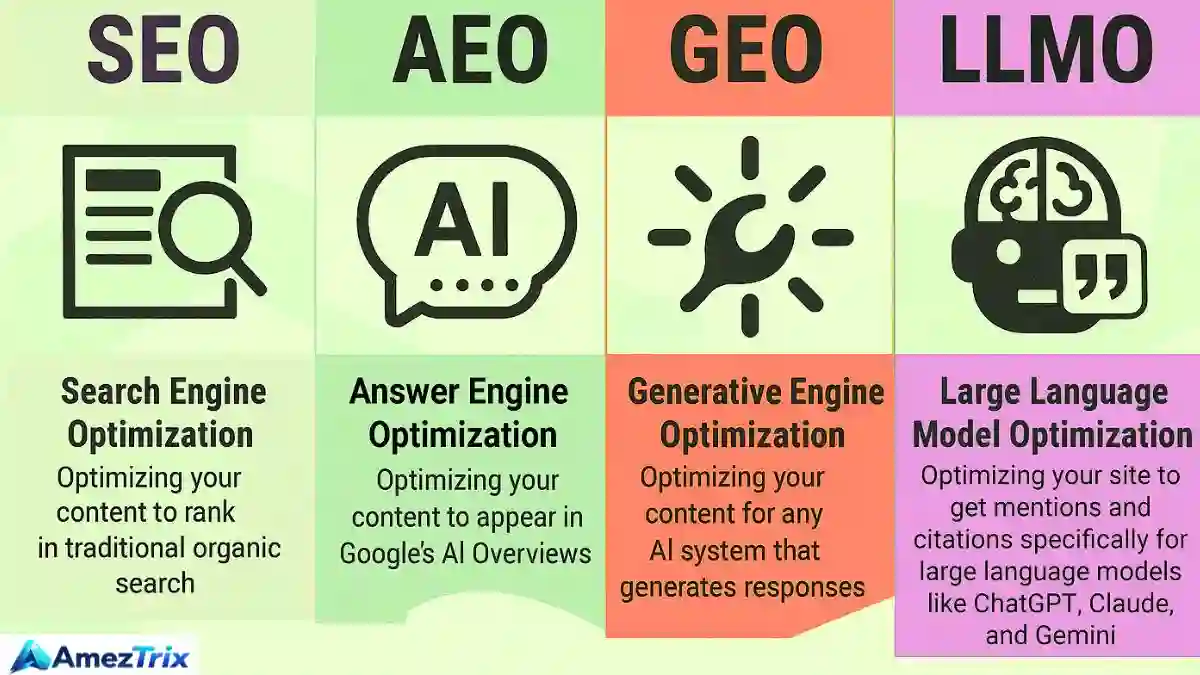
SEO improves your visibility in traditional search results. AEO structures content to directly answer questions. GEO improves your odds of being cited in AI-generated answers. LLMO focuses on clarity and accuracy so language models represent your brand correctly.
Table of Contents
Here’s everything covered in this SEO vs AEO vs GEO vs LLMO guide:
- What Is SEO?
- What Is AEO?
- What Is GEO?
- What Is LLMO?
- Comparison Table: Key Differences
- How Search Behavior Has Changed
- How to Make All Four Work Together
- Ranking Factors That Still Matter
- Keyword Research for the AI Search Era
- Step-by-Step Content Workflow
- Technical SEO Basics for AI Visibility
- Why E-E-A-T Still Matters
- Worked Example: An AI Tools Article
- Strategy by Business Type
- Mistakes That Kill AI Visibility
- How to Measure Results
- Pre-Publish Checklist
- FAQs
- Final Verdict
What Is SEO? (Search Engine Optimization Explained)
It makes sense to start with the oldest of the four. SEO is the practice of making a website easy for search engines to find, understand, and rank for relevant queries. That’s it — no magic, just accessibility plus relevance.
Google crawls billions of pages and tries to figure out which one deserves the top spot for a given search. SEO is how you make that decision easier for Google. You don’t control the ranking directly. You control how understandable and trustworthy your page looks.
Say someone types “best free AI tools for students” into Google. A page that actually covers that topic well — not stuffed with keywords, just genuinely useful — stands a real chance of showing up. There’s no guarantee, though. Competition, technical health, content depth, and backlinks all play a role.
The Four Pillars of SEO
| Type | What It Covers | Why It Matters |
|---|---|---|
| On-page SEO | Titles, headings, keyword placement, internal links, alt text | Helps Google understand what the page is actually about |
| Technical SEO | Crawlability, sitemaps, page speed, mobile-friendliness | Content can’t rank if search engines can’t access it |
| Off-page SEO | Backlinks, digital PR, brand mentions | Builds credibility outside your own website |
| Local SEO | Business listings, location pages, local content | Wins location-based searches like “web designer in Bhopal” |
Even with AI search on the rise, SEO isn’t going anywhere. Most AI-generated answers still trace back to crawlable, indexed websites somewhere in the chain. Skip SEO, and you’ve cut yourself out of that supply chain before you even started.
Takeaway: SEO is the foundation. Everything else — AEO, GEO, LLMO — builds on top of it.
What Is AEO? (Answer Engine Optimization Explained)
The second piece of the SEO vs AEO vs GEO vs LLMO puzzle is AEO — Answer Engine Optimization. It’s about structuring your content so voice assistants, AI overviews, and question-driven search features can pull out a clean, direct answer.
Someone asks, “What’s the difference between SEO and AEO?” An answer engine wants to hand over something short and accurate immediately, with the option to dig deeper. AEO is what makes that short answer available in the first place.
Why Question-Based Headings Win
A heading like “SEO and AEO Guide” tells a reader — and an algorithm — almost nothing. A heading like “What Is the Difference Between SEO and AEO?” mirrors an actual search query. That single change makes it far more likely to get pulled into an answer box.
What genuinely moves the needle for AEO:
- Answer the question in the first sentence of a section — don’t bury it.
- Use question-based subheadings that match real search phrasing.
- Build FAQ sections around questions people actually ask, not filler.
- Keep formatting scannable: short paragraphs, numbered steps, comparison tables.
- Match content format to intent — “how to” gets steps, “vs” gets a table.
One honest caveat: none of this guarantees a featured snippet or a voice-search win. AEO improves your odds and your usability — it doesn’t buy you a guaranteed placement.
Takeaway: AEO is about answering real questions clearly — not gaming a snippet box.
What Is GEO? (Generative Engine Optimization Explained)
Third in the SEO vs AEO vs GEO vs LLMO lineup is GEO — the newest term here, and probably the most misunderstood. Generative Engine Optimization is about improving your odds of being mentioned or cited when an AI tool generates a written answer instead of listing links.
Ask an AI assistant “which are the best free backlink checker tools for beginners?” and it might stitch together a comparison from a handful of sources. If your article is original, well-researched, and genuinely useful, you’ve got a shot at being one of them. If it’s a reworded version of five other “top 10” posts, probably not.
What actually helps with GEO:
- Publish something original. Real testing, first-hand screenshots, your own comparison data — not a summary of what everyone else already wrote.
- Build topical depth. A handful of connected, genuinely useful articles beats twenty thin ones scattered across your blog.
- Make claims checkable. Cite where your numbers came from. Date anything that changes, like pricing.
- Keep structure clean. Clear headings, consistent terminology, properly labeled tables — it just makes content easier to parse, for humans and machines both.
- Build a real, recognizable brand presence. An honest About page, genuine author bios, accurate contact info. Skip fake reviews — they tend to backfire eventually.
Worth remembering: ranking well on Google and getting cited in an AI answer are two different things entirely. You can have one without the other.
Takeaway: GEO is about making content worth citing — not just worth ranking.
What Is LLMO? (Large Language Model Optimization Explained)
The last piece of the SEO vs AEO vs GEO vs LLMO framework is LLMO — the fuzziest of the four, since the industry hasn’t fully agreed on a definition yet. Broadly, it’s about making information about your brand or topic easy for a language model to understand and represent accurately.
Compare these two lines: “AmezTrix is a technology and digital marketing website covering AI tools, SEO, web hosting, WordPress, and gadgets” versus “The future of everything online.” The first one gives a model something real to work with. The second is just noise.
What LLMO looks like in practice:
- Use consistent naming for your brand, products, and key concepts — don’t call the same service three different things.
- Explain how entities relate to each other (AmezTrix is a tech website, WordPress is a CMS, SEO is a visibility practice).
- Write to be understood, not to hit a keyword quota.
- Add context — “It improves visibility” says nothing; “GEO improves the odds of accurate representation in AI-generated answers” says something.
- Separate fact from opinion, and update information when it goes stale.
There’s no universal “LLMO score.” Different AI systems train and retrieve information differently. Treat LLMO as a mindset for clear writing, not a checklist you can fully complete.
Takeaway: LLMO is really just clarity and honesty, wearing a fancier acronym.
Comparison Table: SEO vs AEO vs GEO vs LLMO
Now that you understand all four individually, here’s the SEO vs AEO vs GEO vs LLMO comparison laid out side by side.
| Factor | SEO | AEO | GEO | LLMO |
|---|---|---|---|---|
| Full Form | Search Engine Optimization | Answer Engine Optimization | Generative Engine Optimization | Large Language Model Optimization |
| Main Goal | Rank in organic search | Provide direct answers | Get cited in AI-generated answers | Ensure accurate AI representation |
| Focus Area | Web pages, crawlability | Questions and answers | AI-generated summaries | Language-model interpretation |
| Best Content Style | Comprehensive, relevant | Concise, direct | Original, well-supported | Context-rich, consistent |
| Measured By | Clicks, rankings, impressions | Snippet wins, answer visibility | AI mentions, referral traffic | Brand accuracy in AI outputs |
| Guaranteed Ranking/Placement | No | No | No | No |
If you only remember one line from this SEO vs AEO vs GEO vs LLMO table: SEO is the base, and AEO, GEO, and LLMO all sit on top of it — not beside it.
How Search Behavior Has Actually Changed
Nobody searches the way they used to. It used to be “best AI tools.” Now it’s “which free AI tools can help a college student research, write assignments, build presentations, and organize notes.” That’s a completely different kind of question — it wants a comparison and a recommendation, not a one-line definition.
Good content today has to think about what someone’s actually trying to accomplish, what they’ll ask next, and where they might get stuck. That mindset helps SEO, AEO, GEO, and LLMO all at once — you’re writing one article, not four.
Search has gone multimodal too — text, images, video, voice, maps — and zero-click searches (where someone gets their answer without visiting a website) are genuinely reshaping traffic. That doesn’t mean visibility stopped mattering. It just means clicks aren’t the only metric worth watching anymore.
How to Make SEO vs AEO vs GEO vs LLMO Work Together
Here’s what most guides don’t tell you: you don’t need four separate strategies. One well-built article can cover SEO vs AEO vs GEO vs LLMO all at once.
Take an article titled “Best Free AI Tools for Students: Features, Benefits, and Limitations”:
- SEO — targets real search terms, uses a clean URL, logical headings, useful internal links.
- AEO — directly answers what a student would actually ask, like “which tools help with research” or “are free AI tools safe for academic work.”
- GEO — adds original value: how tools were tested, real limitations, links to official sources.
- LLMO — ties it together with clear, consistent descriptions of what each tool does and who it’s for.
A simple workflow: Research the topic → understand intent → build the SEO foundation → answer directly → add original value → keep context clear → check technical health → measure results. One pipeline, not four.
Ranking and Visibility Factors That Still Matter
No single factor guarantees success across Google, AI overviews, and language models — but a few things consistently move the needle.
Search intent beats keyword matching. “What is GEO?” wants a definition. Best SEO tools for small businesses” wants a comparison. Match your format to what’s actually being asked.
Original content beats rewritten content, every time. First-hand experience and real testing separate a useful article from filler.
Trust signals matter more for sensitive topics — health, money, law, security. Say who wrote it, what backs the claims, and when it was last checked.
Site experience is underrated. Fast load times and clean navigation affect whether people actually stay.
Internal links should connect genuinely related content. Backlinks should be earned, not bought in bulk.
Keyword Research for the AI Search Era
Keyword research isn’t dead — it’s just not the whole picture anymore, especially once AI search enters the equation.
Primary keyword: SEO vs AEO vs GEO vs LLMO
Secondary keywords:
| Keyword | Search Intent |
|---|---|
| SEO vs AEO | Comparative |
| What is GEO in SEO | Informational |
| What is LLMO | Informational |
| AI search optimization | Informational/practical |
| Is GEO replacing SEO | Informational |
| How to optimize content for AI search | Practical |
Long-tail, question-based phrases matter more now because they map almost directly onto what someone types into an AI chat window. Place your primary keyword — SEO vs AEO vs GEO vs LLMO — naturally in the title, opening paragraph, a subheading or two, and the meta description. Don’t force it into every line.
Step-by-Step Content Workflow
- Pick a clear topic your audience actually cares about.
- Map the intent — what does the reader want before, during, and after this article?
- Outline logically — definitions first, comparisons next, practical steps last.
- Lead with direct answers in key sections, then expand.
- Add something original — a real example, a table, an observation nobody else included.
- Cite reliable sources for anything that changes, like pricing or policy.
- Tighten readability — short paragraphs, real headings, no filler intros.
- Check technical basics — indexability, mobile usability, page speed.
- Fact-check before publishing — definitions, numbers, dates.
- Update when things genuinely change — don’t just bump the date for the sake of it.
Technical SEO Basics for AI Visibility
None of this becomes optional just because AI search exists.
- Make sure key pages are actually crawlable — check for stray noindex tags and robots.txt mistakes.
- Keep an updated sitemap, though it won’t guarantee indexing on its own.
- Use structured data where it genuinely applies (Article, Organization, FAQPage), matching what’s actually on the page.
- Optimize images with real, descriptive alt text.
- Keep improving page speed — it affects both usability and crawl efficiency.
Why E-E-A-T Still Matters
E-E-A-T stands for Experience, Expertise, Authoritativeness, and Trustworthiness. It’s less a checklist and more a description of what credible content actually looks like.
Experience means you’ve genuinely used what you’re writing about. Expertise means explaining it accurately without overreaching. Authoritativeness builds over time through reputation. Trustworthiness comes down to honesty — clear sourcing, transparent ownership, no hidden agenda.
AI-generated answers often blend multiple sources, and readers still need a way to judge reliability. No schema markup replaces content that’s actually trustworthy.
Worked Example: “Top 10 Best Free AI Tools for Students”
Here’s how the SEO vs AEO vs GEO vs LLMO framework plays out on a real article.
| Layer | How It Applies |
|---|---|
| SEO | Target “best free AI tools for students,” clean URL, useful internal links |
| AEO | Directly answer “which tools help with research,” “are free AI tools safe for academic work” |
| GEO | Explain how tools were tested, note real limitations, link to official sources |
| LLMO | Write “Tool A is an AI writing assistant for drafting and editing text; free plan has usage limits” instead of vague hype |
| Tool Category | Useful For | Worth Checking |
|---|---|---|
| AI writing assistant | Drafting and editing | Usage limits, accuracy |
| AI research assistant | Exploring topics | Source reliability |
| AI presentation tool | Building slides | Export options |
| AI note-taking tool | Organizing material | Privacy settings |
| AI coding assistant | Learning to code | Understand generated code before using it |
Strategy by Business Type
| Business Type | Priority Focus |
|---|---|
| Bloggers | Strong SEO fundamentals, question-based headings, original insight |
| Small businesses | Local SEO, accurate business info, honest FAQs |
| E-commerce | Original product descriptions, accurate reviews, structured data |
| Tech/news sites | Timely reporting, clear dates, original testing |
| SaaS companies | Useful documentation, comparison pages, real use-case content |
Mistakes That Kill AI Visibility
One of the biggest mistakes is treating the four as competing systems instead of one connected approach. A few others worth watching for:
- Treating each acronym as a separate algorithm — they overlap heavily; build one strong foundation.
- Keyword stuffing — repeating the target phrase everywhere hurts readability and risks looking spammy.
- Publishing AI drafts without review — unedited AI content is often generic or flat-out wrong.
- Making unrealistic AI-visibility promises — “add this schema and get cited” isn’t how it works.
- Neglecting basic SEO because AI search feels newer — crawlability still feeds the sources AI tools draw from.
- Publishing shallow content at scale — a few genuinely useful pages beat twenty thin ones.
- Ignoring search intent — ranking for a term means nothing if the content doesn’t match what people want.
- Faking authority — fabricated reviews and credentials tend to catch up with you.
- Not measuring results — without tracking, you’re just guessing.
How to Measure Results
| Goal | Metric | Tool |
|---|---|---|
| Organic search growth | Clicks, impressions, average position | Google Search Console |
| Page performance | Engagement, conversions | Analytics |
| Technical health | Crawl and indexing reports | Site audits |
| AI visibility | Brand mentions, citations | Manual AI search checks |
| Content quality | Accuracy, usefulness | Editorial review |
| Business outcomes | Leads, sales | CRM and analytics |
LLMO is the hardest to measure — there’s no dashboard yet. The most practical method is periodically asking AI tools direct questions about your business and checking whether the answers stay accurate over time.
Pre-Publish Checklist
Content & Intent: Clear user need addressed · relevant primary keyword · intent analyzed · original value included · claims verified
SEO: Descriptive title · useful meta description · clean URL · logical headings · optimized images · crawlable and indexable
AEO: Direct answers to key questions · question-based headings · genuine FAQs · clearly formatted steps
GEO: Original information · reliable sources · clear comparison criteria · well-explained context
LLMO: Consistent terminology · entities explained · facts checked · opinions clearly marked
Technical: Mobile-friendly · proper alt text · fast loading · no broken links · correct structured data
Frequently Asked Questions
What’s the actual difference in SEO vs AEO vs GEO vs LLMO?
SEO improves organic search visibility. AEO focuses on answering questions directly. GEO improves visibility in generative AI answers. LLMO ensures information is clear and accurate for language models to interpret.
Is GEO replacing SEO?
No. SEO remains the foundation for discovery and technical accessibility; GEO adds a layer on top for generative search experiences.
Is AEO the same as featured snippet optimization?
Not exactly. Snippet optimization is one small piece of AEO, which covers a broader range of answer-focused experiences, including voice search.
Can a site rank well on Google but not show up in AI answers?
Yes — AI tools often use different sources and selection logic than traditional rankings.
Can small websites benefit from GEO?
Yes. Original research and genuinely helpful tutorials can carry weight regardless of site size — there’s no guarantee, but no size requirement either.
Does structured data guarantee AI citations?
No. It helps machines parse content but doesn’t promise rankings, snippets, or citations.
Should AI write my SEO content?
AI is fine for outlines and drafts, but a human still needs to fact-check, edit, and add real value before publishing.
Are GEO and LLMO official Google ranking factors?
No — these are industry terms, not confirmed algorithmic signals. Focus on documented search guidance and genuinely helpful content.
How long before I see results with these strategies?
There’s no fixed timeline. It depends on competition, site history, technical health, and consistent tracking over time.
Final Verdict
The SEO vs AEO vs GEO vs LLMO debate really just reflects how differently people find information today. SEO gets you discovered. AEO gets you a direct answer. GEO gets you cited in a generative response. LLMO keeps your information clear enough to be represented accurately, wherever it ends up.
None of these are shortcuts. Anyone promising a guaranteed AI citation or an overnight first-page ranking is selling something.
The practical approach: build one solid, technically sound piece of content, understand what your reader actually wants, answer it directly, back it up with real sources, and keep your brand information consistent everywhere it appears. Do that well, and you’re covering all four sides of the equation — without ever treating them as four separate jobs.
About Author
Rajendra Parmar is the Founder and Editor of AmezTrix, where he covers Artificial Intelligence, Technology, WordPress, Web Hosting, Digital Marketing, Gadgets, and Software. His mission is to simplify complex technology through practical tutorials, honest reviews, and well-researched guides that help readers make smarter digital decisions.