GEO vs SEO: Discover which strategy wins Google rankings, how AI search is changing SEO, and why SEO + GEO can boost your online visibility.
GEO vs SEO: Which One Actually Wins You Google Rankings?
Search a question on Google right now. Chances are, you won’t even need to scroll. A written-out answer sits right at the top, stitched together from a handful of sources at once. No clicking required.
That’s the whole reason two acronyms keep popping up in every marketing group chat lately: SEO and GEO.
If you’ve landed here typing “GEO vs SEO” into a search bar, trying to figure out where to put your time and budget — I’ll give you the short version first. They’re not fighting each other. SEO gets your website found by search engines. GEO is about something newer: getting your brand mentioned when an AI writes an answer instead of listing links. You don’t have to choose one. But you do need to know how each actually works before you can use them together properly.
So let’s break it down, piece by piece.
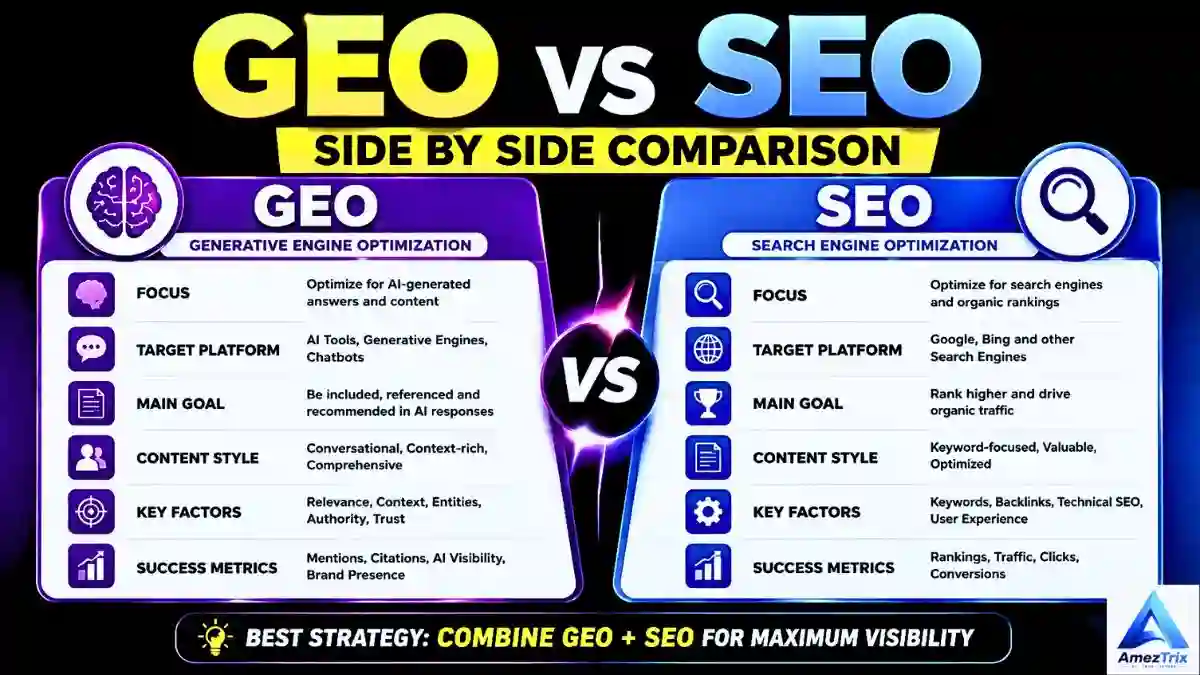
GEO vs SEO, Side by Side
GEO vs SEO, Side-by-Side comparison
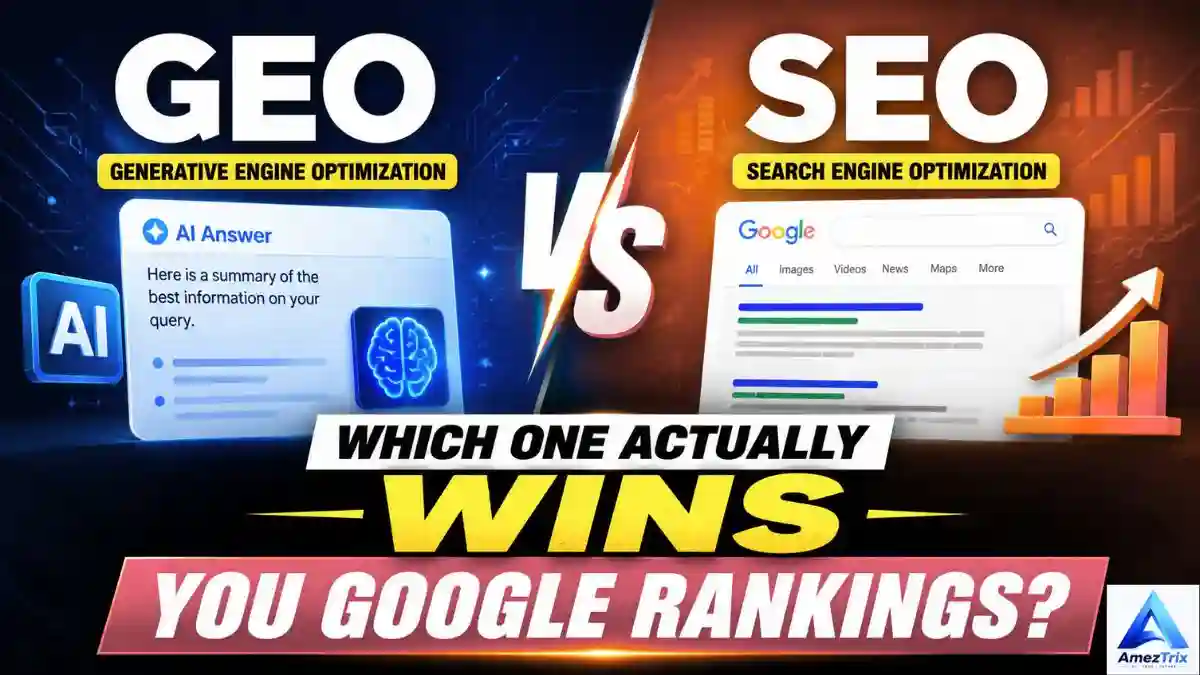
| Factor | SEO | GEO |
|---|---|---|
| Full Form | Search Engine Optimization | Generative Engine Optimization |
| Main Goal | Rank higher in organic results | Get referenced in AI-generated answers |
| Where It Plays Out | Google, Bing, other search engines | AI chatbots and AI-powered search |
| How You Measure It | Rankings, clicks, traffic | Mentions, citations, referral visits |
| Content Style | Built around search intent | Built to be quotable and complete |
| Keywords | Central to the whole strategy | Useful context, not the main driver |
| Backlinks | A major ranking signal | Adds to overall credibility |
| How Mature It Is | Decades old, well understood | Still evolving, honestly a bit messy |
What SEO Really Is
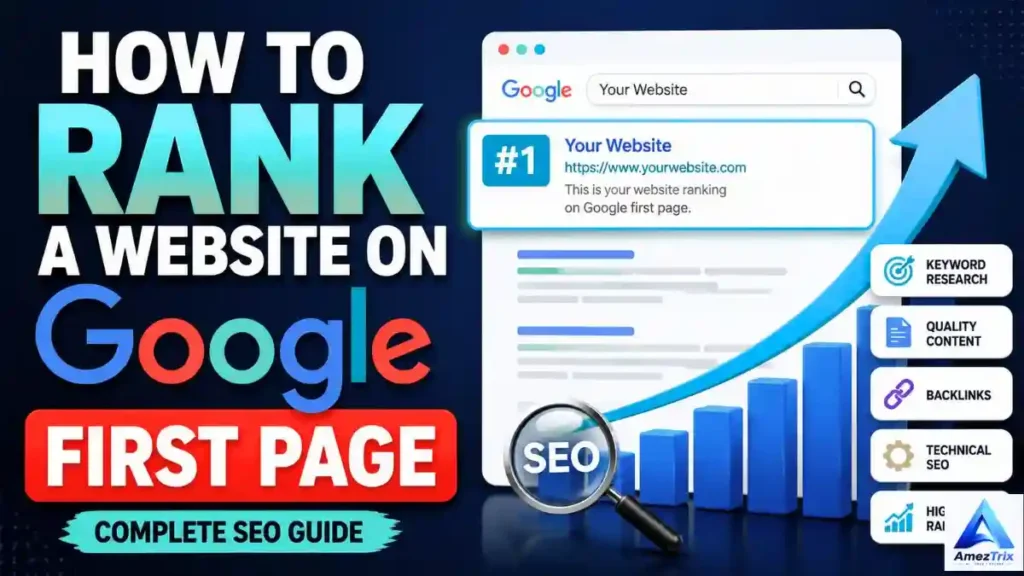
Search Engine Optimization, at its core, is the work of shaping a website so that Google (and other engines) can crawl it, understand what it’s about, and rank it for the right searches.
Think of someone typing “affordable web hosting for freelancers.” SEO is everything happening behind the curtain that decides whether your page shows up on page one for that exact phrase — or gets buried on page seven where nobody ever looks.
A few things SEO usually involves:
- Figuring out what people actually search for (and why)
- Cleaning up titles, headers, and internal links
- Fixing technical issues — slow load times, broken mobile layouts
- Earning backlinks and building real authority
- Adding structured data so Google reads your page correctly
- Writing content that genuinely solves the reader’s problem
Here’s something worth remembering: Google stopped rewarding simple keyword-matching a long time ago. These days, it’s asking a harder question — does this page actually help the person who searched? Stuff a page full of keywords without saying anything useful, and it’ll get outranked by a shorter, clearer page that just answers the question.
How Google Decides Who Gets Ranked ”GEO vs SEO”
Crawlers move through the web constantly, picking up pages and storing them in an index. When someone searches, Google digs through that index and ranks pages by how relevant and trustworthy they seem. Easy to crawl, technically clean, genuinely useful, backed by some credibility — that’s roughly the recipe.
Okay, so what is GEO marketing?
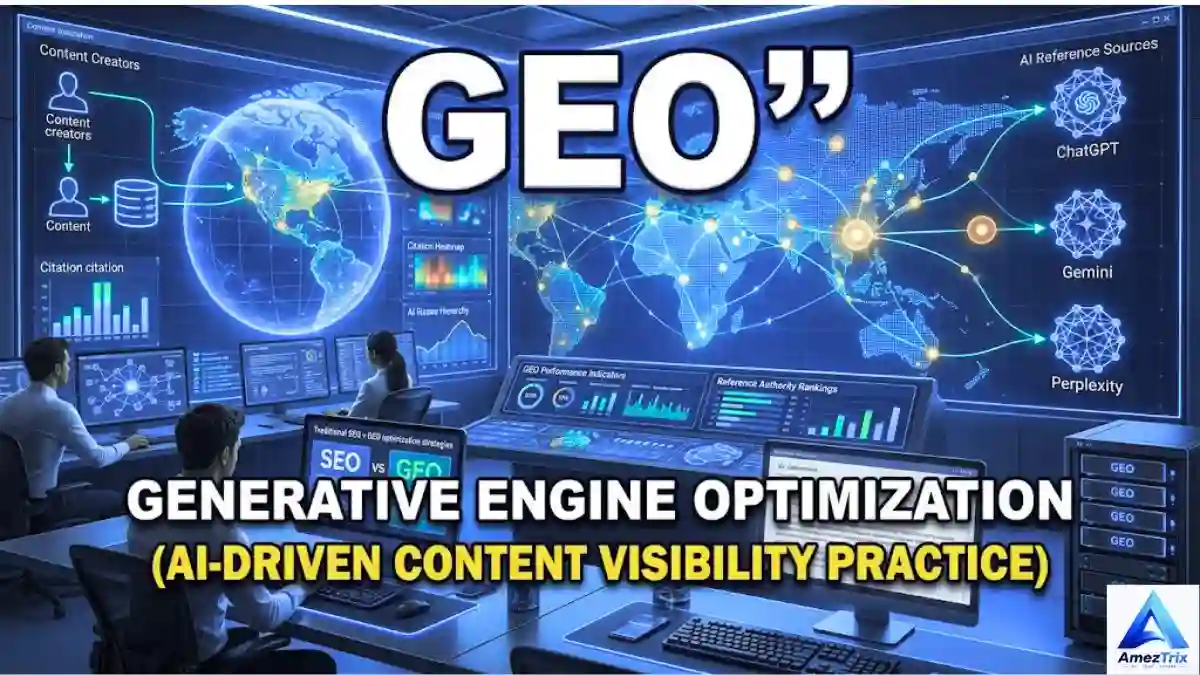
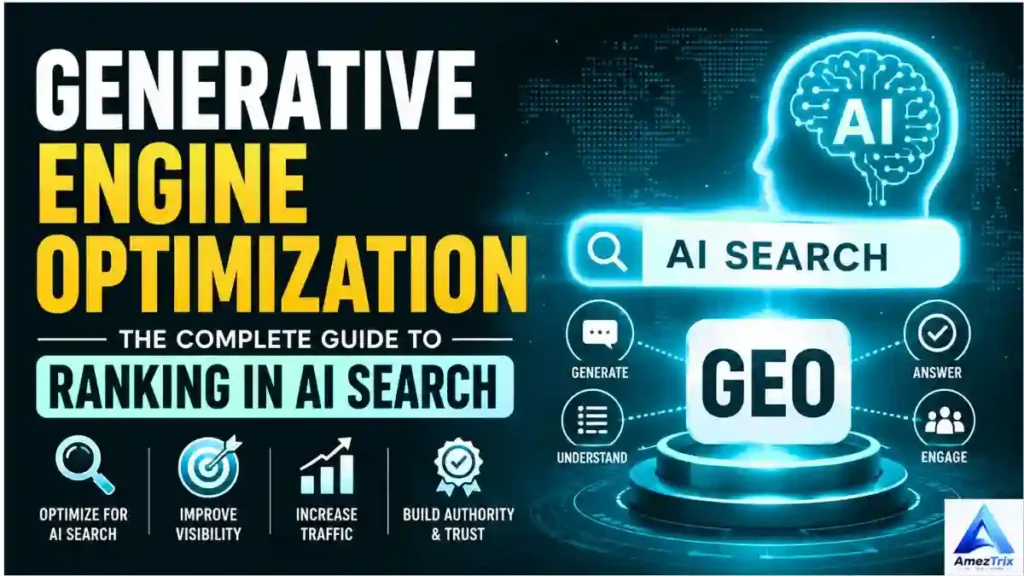
Generative Engine Optimization is the newer one, and honestly, it’s still finding its shape. Instead of chasing a ranking spot, GEO is about becoming the kind of source an AI model actually wants to pull from when it’s putting an answer together.
Ask an AI assistant something like “what’s the best project management tool for a five-person startup?” You probably won’t get ten links back. You’ll get two or three names, with reasons attached, wrapped into one short answer. GEO is simply the practice of increasing the odds that your product or article ends up being one of those names.
What seems to help, based on what’s out there so far:
- Writing that’s clear and doesn’t dance around the point
- Actually going deep on a topic instead of skimming it
- Original opinions, data, or examples — not the same recycled advice
- Consistent, checkable facts about who you are and what you do
- Content organized in a way machines can easily parse
- Other credible sites and sources pointing back to you
I’ll be straight with you here — there’s no confirmed formula that guarantees an AI system will cite your site. Nobody has cracked that code yet, and honestly, anyone promising guaranteed AI citations is selling you something. The field’s too young for guarantees.
The Real Difference Between GEO and SEO
It comes down to what each one is actually optimizing for.
SEO wants a spot in a list of results. GEO wants a mention inside a written answer. One line sums it up pretty well:
SEO asks: “Will Google rank this page?” GEO asks: “Will an AI trust this enough to quote it?
They’re not living in separate universes, though. Most AI systems still lean on web content, search indexes, and known brands to build their answers — which is exactly why the two keep bumping into each other.
Where the Two Content Approaches Split
Old-school SEO content usually starts with one keyword — say “best accounting software for freelancers” — and the whole article gets built tightly around ranking for that exact phrase.
GEO-minded writing starts a step earlier. What does the reader actually need to walk away knowing? What are the realistic options? How do they stack up on price? Who’s each one actually built for? What’s the obvious next question someone would ask?
I’ve noticed that mindset naturally produces fuller articles — ones covering pricing, use cases, trade-offs, alternatives — instead of one article circling the same phrase forty times. And here’s the useful part: that depth helps both SEO and GEO at once, simply because it’s better writing, full stop.
GEO vs SEO — Which One Should You Actually Focus On?
Depends on what you’re chasing right now.
Go heavy on SEO if you want organic traffic today, if you’re targeting commercially valuable search terms, or if converting high-intent visitors into leads is the priority.
Lean into GEO if you care about showing up when people ask AI tools for recommendations, or you’re playing a longer game around topical authority, or you just want your brand represented accurately when AI summarizes your industry.
Most businesses, realistically, need a bit of both GEO vs SEO. Skip SEO entirely and you’re invisible on Google. Ignore GEO and you might miss an entire discovery channel that’s only getting bigger from here.
Why SEO Isn’t Dying Anytime Soon
Some marketers love declaring SEO dead every time something new shows up. AI search included. I’d call that premature. Search engines still handle billions of queries a day, and a technically sound, well-optimized website remains one of the most dependable ways to build traffic you actually own — not traffic you’re renting from an algorithm that could change overnight.
SEO still gives you things GEO simply can’t replace yet: predictable organic traffic, measurable return on effort, less dependence on paid ads, and value that compounds as your domain builds authority over years.
Why GEO Deserves a Seat at the Table Now
People search differently than they used to. Instead of typing “best SEO tools” and opening five browser tabs, more and more people are asking full, conversational questions loaded with context. Something like: “I run a small blog — what SEO tools should I use for keyword research and technical audits, and I’ve got a tight budget?”
AI systems read that context and hand back a tailored response. That’s a genuine shift in how people find things, and it means brands need to start asking a second question beyond “where do I rank?” — namely, does AI actually understand what my business does, and is it representing me accurately?
One Content Framework That Covers Both
You don’t need two separate content teams or two content calendars. A handful of habits let one piece of writing work for GEO vs SEO at the same time.
Start by understanding real intent — is this person trying to learn something, compare options, or buy right now? Write your keywords in naturally, the way you’d actually talk, rather than repeating the same phrase five times in one paragraph. Answer the core question early, then explain your reasoning afterward — good for skimmers, and good for AI systems hunting for a clean, quotable answer.
Build out a real topic cluster too. One article rarely earns full authority on a subject by itself, so publish connected pieces and link them together in a way that actually makes sense to a reader. Strengthen your trust signals — who wrote this, what do they actually know, how can someone verify it or reach out. And keep facts scannable. Tables, short lists, real examples. Both humans and machines appreciate not having to dig for the point.
Mistakes I See People Make Constantly
Keyword stuffing is still around, somehow. It reads badly and barely helps anymore — skip it.
Publishing generic, templated content by the truckload doesn’t build authority either. Volume without anything original behind it just adds noise.
Ignoring technical SEO is another classic. No amount of great writing fixes a site that takes eight seconds to load or breaks on mobile.
Obsessing over whether an AI mentioned you today is a trap too. AI answers shift depending on how a question is phrased, what data it pulled that day, even where the person’s located. Chasing one lucky citation is a waste of energy — consistency matters more.
And writing purely for algorithms instead of people? Readers can tell. Robotic, repetitive content loses rankings and trust at the same time.
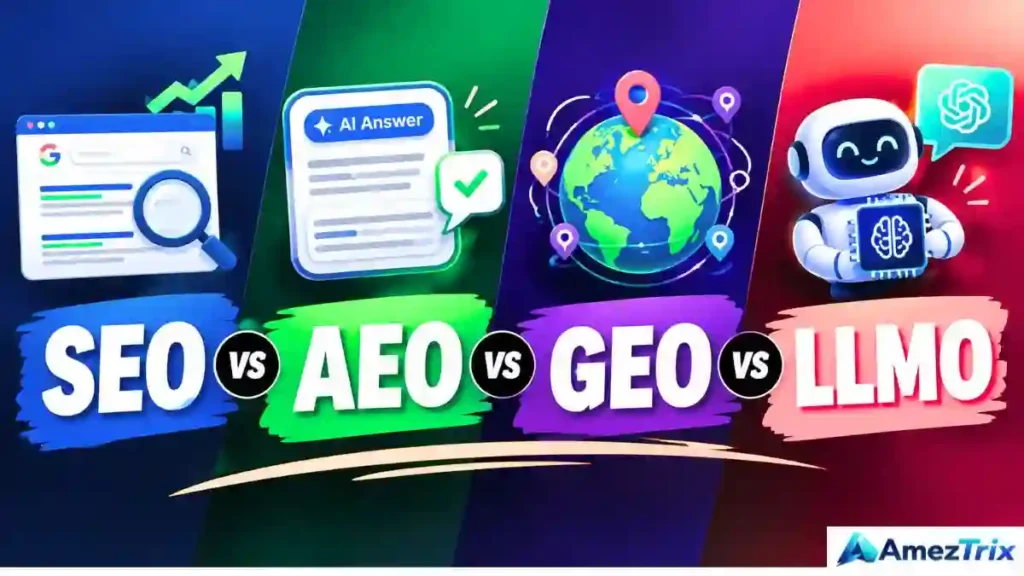
SEO vs AEO vs GEO — Untangling the Alphabet Soup
A third term, Answer Engine Optimization (AEO), gets tossed into this mix a lot too. Here’s the simplest way I’ve found to keep them straight:
SEO is about search visibility. AEO is about giving direct, answerable responses. GEO is about visibility inside AI-generated content specifically.
They’re not rivals fighting over the same job. Think of them more like three layers stacked on top of each other in how people discover things today.
SEO vs AEO vs GEO: How the Three Actually Compare
Once you throw AEO into the mix, things can start feeling like alphabet soup. So let’s lay it out side by side — no jargon, just what each one is actually doing.
| Comparison Factor | SEO | AEO | GEO |
|---|---|---|---|
| Full Form | Search Engine Optimization | Answer Engine Optimization | Generative Engine Optimization |
| Primary Goal | Rank higher in search results | Get picked for direct answers | Get referenced in AI-generated responses |
| Main Focus | Organic search visibility | Question-and-answer visibility | Visibility inside generative AI |
| Target Platforms | Google, Bing, other search engines | Search engines, voice assistants, answer boxes | AI search tools and generative AI platforms |
| Main Output | Search listings and results pages | Direct answers, snippets, answer boxes | AI-written summaries, recommendations, citations |
| Keyword Importance | Very high | High — especially question phrasing | Matters, but entities and context matter more |
| Search Intent | Critical | Absolutely critical | Absolutely critical |
| Content Strategy | Built around keywords and intent | Short, focused, question-driven answers | Deep, well-sourced, context-rich content |
| Content Structure | Headings, keywords, internal links | FAQs and clear Q&A formatting | Clear sections, facts, entities, credible sourcing |
| Backlinks | A core ranking factor | Helps build authority | Adds credibility and trust |
| Technical SEO | Non-negotiable | Still matters | Still matters |
| E-E-A-T | Important | Important | Extremely valuable |
| Long-Tail Queries | Useful | Genuinely powerful here | Genuinely powerful here |
| Brand Authority | Valuable | Valuable | Growing more important by the day |
| What The User Gets | Clicks on a search result | A direct answer, no click needed | A full AI-written response |
| What You’re Measuring | Rankings, clicks, impressions, traffic | Featured answers and snippet visibility | AI mentions, citations, referral traffic |
| Best Suited For | Driving organic website traffic | Winning direct-answer spots | Getting noticed across AI search |
| How They Relate | The foundation everything else builds on | Extends SEO into the answer space | Pushes optimization into generative AI |
| Core Approach | Optimize for engines and readers both | Answer the question clearly, fast | Build content AI can actually trust |
Here’s the simplest way I’ve found to keep all three straight, if the table’s too much to hold in your head at once:
SEO gets you ranked in search. AEO gets you featured as the answer. GEO gets you mentioned by the AI itself.
None of these are meant to replace each other, and treating them like competing strategies misses the point entirely. For a website built for how people actually search today, the smartest move isn’t picking one — it’s running SEO, AEO, and GEO together as one connected approach.
Frequently Asked Questions
Is GEO better than SEO?
Not really a fair comparison — they solve different problems. SEO drives visibility in traditional search; GEO improves your odds of being referenced inside AI-generated answers. Most brands end up needing both.
Will GEO eventually replace SEO?
Unlikely, at least not soon. Search engines still handle massive query volume, and solid technical and content SEO remains the foundation everything else sits on.
Does doing GEO directly improve my Google ranking?
No confirmed direct link exists. That said, a lot of GEO practices — clear writing, real authority, thorough coverage — overlap heavily with what already helps SEO.
What’s actually different between GEO and AEO?
AEO is about giving direct, concise answers to specific questions. GEO is broader — it’s about getting cited or represented inside AI-generated content and conversations in general.
Should a small business even bother with GEO right now?
Yes, but keep it light. Publish clear, consistent, well-organized information about your business, and don’t neglect your SEO fundamentals while you’re at it. That groundwork helps you with today’s search engines and tomorrow’s AI systems both.
Is SEO still worth the investment with AI search optimization?
Definitely. AI search hasn’t erased the need for a fast, well-built, authoritative website — if anything, those same qualities are exactly what help you get picked up by AI systems in the first place.
Final Verdict
GEO isn’t here to replace SEO, and SEO alone won’t prepare you for the way people are searching now. In my experience, the businesses actually pulling ahead are the ones treating this as “SEO plus GEO,” not “SEO versus GEO” — building technically solid sites, writing content that’s genuinely complete, earning real authority instead of faking it, and organizing information clearly enough that both a search crawler and an AI model can make sense of it.
Rankings still matter, obviously. But increasingly, so does being the kind of source an AI actually trusts enough to quote.
About Author
Rajendra Parmar is the Founder and Editor of AmezTrix, where he covers Artificial Intelligence, Technology, WordPress, Web Hosting, Digital Marketing, Gadgets, and Software. His mission is to simplify complex technology through practical tutorials, honest reviews, and well-researched guides that help readers make smarter digital decisions.

Rajendra Parmar
Founder & Editor • AmezTrix
Rajendra Parmar is the Founder and Editor of AmezTrix, a platform covering Artificial Intelligence, Technology, WordPress, Web Hosting, Digital Marketing, Gadgets, Software Reviews, and emerging innovations. His mission is to simplify complex technology through practical tutorials, honest reviews, and well-researched guides that help readers make smarter digital decisions.