Quick Answer: How to improve AI visibility? Let crawlers reach your pages, answer real questions with original, well-sourced content, and build a strong brand. Then measure citations, visits and conversions. It improves your odds, but there are no guarantees.
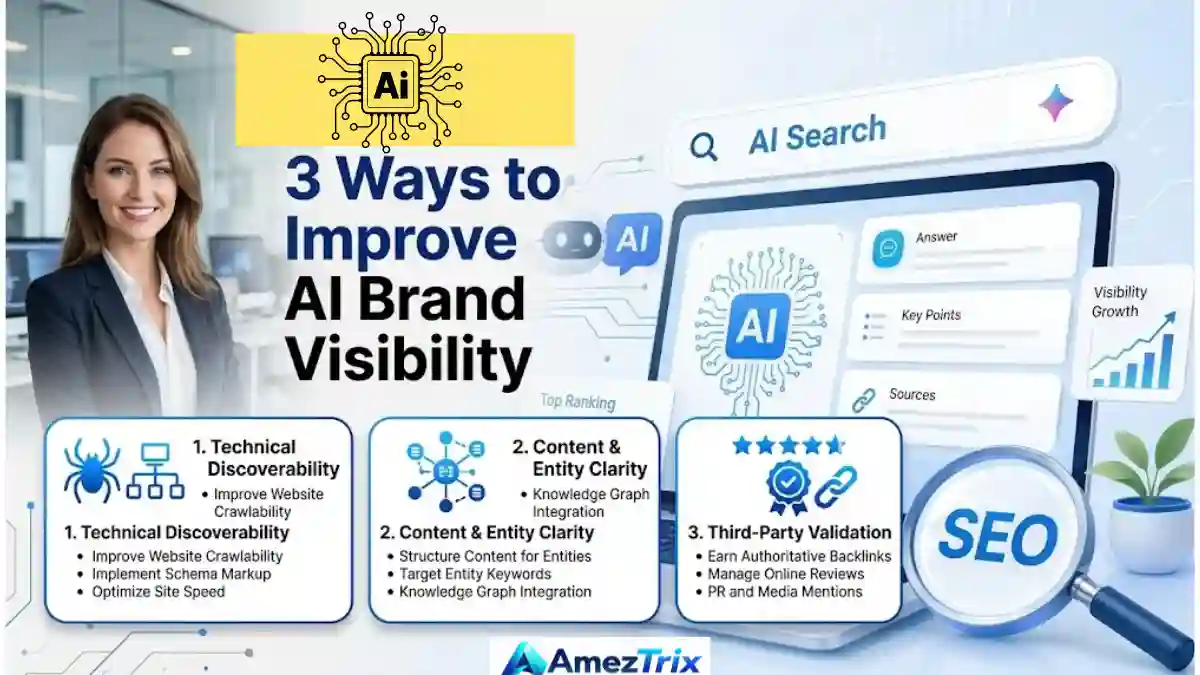
How to Improve AI Visibility: 12 Proven Strategies That Work
Picture this. You type your best topic into ChatGPT or Google, and an AI answer appears with three or four sources underneath. Your site is not one of them.
That sting is exactly why people search for how to improve AI visibility. The good news is that you do not need a secret trick. You need solid SEO foundations, answers that are easy to understand, and a habit of checking your results. This guide shows you how, step by step.
Key Takeaways (TL;DR)
- AI visibility means being cited, linked or mentioned in AI-generated answers.
- Google says standard SEO best practices still apply to its AI search features.
- Crawl access, original content, direct answers and trust matter most.
- Track results with Search Console, Bing Webmaster Tools, GA4 and monthly prompt tests.
- Be wary of anyone who promises guaranteed AI citations.
What You Will Learn in This ” How to Improve AI visibility” Guide
- What AI visibility is, in plain English
- SEO vs AEO vs GEO vs LLMO
- The 12 strategies
- Tools for tracking AI visibility
- A 30-day action plan
- Mistakes, red flags and honest limits
- FAQs
What Is AI Visibility? A Simple Explanation
AI visibility is how often your brand, website or product appears when people use AI-powered tools to find answers. Think of Google AI Overviews, Google AI Mode, ChatGPT Search, Microsoft Copilot and Gemini.
It usually shows up in four ways:
- Citation: your page is listed as a source.
- Link: someone can click through to you.
- Mention: your brand name appears in the answer.
- Referral visit: a visitor arrives from an AI platform.
Here is an easy way to think about it. Imagine asking a well-read friend where to learn about hosting. If your friend names your site, that is AI visibility. Your goal is to become the source a smart friend would recommend.
AI Visibility vs Traditional SEO
| Area | Traditional SEO | AI Visibility |
|---|---|---|
| Goal | Rank in search results | Be cited or mentioned in AI answers |
| Key metrics | Impressions, clicks, position | Citations, cited pages, AI referrals |
| Content style | Match search intent | Match intent, with clear and easy-to-quote answers |
| Technical needs | Crawlable, indexable pages | Same, plus access for AI crawlers |
| Guaranteed result | No | No |
AI visibility does not replace SEO. It sits on top of it.
SEO vs AEO vs GEO vs LLMO: What Is the Difference?
| Term | Meaning | In Simple Words |
|---|---|---|
| SEO | Search Engine Optimization | Help people find your pages in search |
| AEO | Answer Engine Optimization | Give short, direct answers to questions |
| GEO | Generative Engine Optimization | Raise your chances of being referenced in AI-written answers |
| LLMO | Large Language Model Optimization | Make your content and brand clear to LLM-based tools |
In practice, these overlap a lot. You do not need four different content plans. One helpful, well-structured page can serve all four goals.
12 Strategies to Improve AI Visibility
Strategy 1: Let Search and AI Crawlers Reach Your Pages
A bot cannot cite a page it cannot open. This step is boring, and it is also where many sites quietly fail.
Start with Google. Open Search Console and inspect your most important URLs. Check that each one is indexed, that the canonical URL is right, and that no stray noindex tag is hiding it.
Then check OpenAI. OpenAI uses OAI-SearchBot to find pages for ChatGPT Search. If you want eligibility, make sure robots.txt does not block it. Here is a simple example rule:
User-agent: OAI-SearchBot
Allow: /
That is a sample line, not a complete robots.txt file. Also check your firewall, CDN and security plugins. Some of them block bots without telling you. OpenAI treats OAI-SearchBot (search) and GPTBot (model training) as separate crawlers, so you can control them separately.
| Check | What to Do |
|---|---|
| robots.txt | Review rules for Googlebot, Bingbot and OAI-SearchBot |
| Server responses | Key pages should load normally, with no error loops |
| Canonical tags | Point each page to its preferred URL |
| Meta robots | Remove any accidental noindex |
| XML sitemap | Include your important canonical pages |
| Firewall or CDN | Make sure legitimate crawlers are not blocked |
| Internal links | Link key pages from related pages |
Access makes you eligible. It does not make an AI tool mention you.
Strategy 2: Publish Original Content That Adds Something New
The web has thousands of posts repeating the same facts. If your article says the same thing, an AI tool has no reason to prefer it.
Give readers something they cannot get elsewhere:
- Your own tests, with the method explained
- Real screenshots from real workflows
- Comparisons that use the same criteria for every option
- Small case studies or surveys
- Honest notes on where a tool or method falls short
Example: A basic “best AI writing tools” post lists features. A stronger post gives five tools the same task, shows the results side by side and says who each tool suits. That second post has value nobody can copy from another page.
Recommended Points
- Original value beats publishing volume.
- Never invent statistics, test results or quotes.
- If you relied on official documentation instead of hands-on testing, say so openly.
Strategy 3: Match Search Intent and Real Questions
Someone searching “AI SEO tools” is likely comparing software. Someone asking “how do I get cited by ChatGPT?” wants a tutorial. The topic is the same, but the content must differ.
Find real questions in these places:
- Your Search Console queries
- Google’s People Also Ask boxes and related searches
- Emails and messages from customers
- Communities such as Reddit and industry forums
- Your own test prompts in AI tools
Group similar questions by intent, then write one strong page for each intent. Avoid publishing dozens of thin pages for tiny keyword changes. Google’s spam policies warn against producing pages at scale mainly to manipulate results.
| Keyword Idea | Search Intent | Best Content Type |
|---|---|---|
| how to improve AI visibility | Informational | Pillar guide |
| generative engine optimization | Informational | Explainer |
| Google AI Overviews SEO | Informational | Platform-specific guide |
| ChatGPT visibility | Informational | Tutorial |
| AI search visibility tools | Commercial | Tool comparison |
| AI visibility agency or service | Transactional | Service page |
These are research ideas, not confirmed search volumes. Check them in your keyword tool first.
Strategy 4: Give the Answer First, Then Explain
This is the core of AEO. Readers (and AI tools) like pages that get to the point.
- Answer: one to three sentences
- Context: define any terms
- Proof: link an official source or show your data
- Example: show how it works in practice
- Next step: tell the reader what to do
Use descriptive H2 and H3 headings, short paragraphs, numbered steps and tables where they genuinely help. A short FAQ at the bottom covers long-tail questions.
One caution: you do not need to slice every paragraph into snippet-size pieces. Write for people first. Clear writing is easy for machines to read as well.
Strategy 5: Build Topical Depth and a Recognizable Brand
Topical authority simply means you cover a subject deeply and consistently. It is not a score you can look up, and no tool can prove it directly drives AI citations.
A healthy content cluster might look like this:
- Pillar: How to improve AI visibility
- What Is Generative Engine Optimization?
- How to Rank in ChatGPT
- LLMO in SEO
- How to Track AI Visibility in GA4
- Google AI Overviews SEO Best Practices
Link these pages together using clear anchor text. Then make your brand easy to understand with a real About page, author bios, clear contact details and consistent business information across the web.
Strategy 6: Show Trust, Sources and Editorial Care
Readers want to know who wrote the page, how they know what they know and whether the information is current. Quality systems look for the same signals.
| Element | Good Practice |
|---|---|
| Author | Real name and relevant experience |
| Sources | Link to official documentation and reliable research |
| Dates | Show an honest “last updated” date |
| Comparisons | Explain how you judged each option |
| Claims | Separate tested results from assumptions |
| Mistakes | Correct them openly |
A byline alone does not prove expertise. Substance does.
Strategy 7: Use Structured Data Correctly
Structured data (schema) is code that tells search systems what a page contains. For a blog, useful types include Article, BreadcrumbList, Organization and Person. Add FAQPage only when the FAQ is actually visible on the page.
| Question | Honest Answer |
|---|---|
| Does schema help describe a page? | Yes, when it is accurate |
| Does it guarantee rich results? | No |
| Does it guarantee AI citations? | No |
| Is special “GEO schema” required for Google’s AI features? | Google says no special markup is needed |
| Must markup match visible content? | Yes, always |
What about llms.txt? It is a proposed file meant to guide AI tools. Google has said it does not use llms.txt for Search. You can add one for other tools that may read it, but never put it ahead of crawlable pages, strong content and good technical SEO.
Strategy 8: Keep Local and Product Details Accurate
The word “GEO” can mean generative engine optimization or geographic SEO, so always make clear which one you mean. For local businesses, accuracy matters when someone asks an AI tool for “a laptop repair shop near me.”
- Keep your Google Business Profile complete and current
- Use the same name, address, phone number and hours everywhere
- Write dedicated service pages with real local details
- Earn genuine reviews and reply politely
- For online stores, keep product details, prices and availability up to date
Skip near-identical “city pages” that have nothing locally useful on them.
Strategy 9: Improve Page Experience and Speed
A great article loses its value if it loads slowly, breaks on a phone or hides the answer behind pop-ups.
- Mobile: readable text and scrollable tables
- Speed: compress images, trim scripts, review hosting and caching
- Accessibility: clear headings, descriptive links, helpful alt text
- Access: keep key information free of logins and complicated interactions
Use PageSpeed Insights and Search Console to find real problems. No speed score guarantees citations, so treat this as reliability work, not a ranking trick.
Strategy 10: Earn Real Mentions Around the Web
AI tools learn about brands from more than your own website. Relevant mentions on trusted sites, industry publications and communities help people find you.
What works:
- Publishing original research that others want to cite
- Offering honest expert comments to journalists and publications
- Building genuine relationships with relevant publishers
- Joining communities and helping without spamming
What to avoid: paid links, fake reviews, automated mentions and mass guest posting. No set number of backlinks guarantees AI visibility.
Strategy 11: Measure AI Visibility with Real Data
Without measurement, you are guessing. Track three separate things: whether you appear, whether you are cited and whether people actually visit.
Google Search Console. Google has been adding reporting for its generative AI features. Check your property to see what is available. If the report is missing, it may not be available for your site yet. It covers Google only, not ChatGPT or other tools.
Bing Webmaster Tools. Bing offers an AI Performance report for Copilot and AI summaries in Bing, including citation data. A citation is not a click or a ranking, so read it as a sign of source visibility.
Google Analytics 4. Check your traffic acquisition reports for AI referrals. OpenAI says ChatGPT Search links can includeutm_source=chatgpt.com, which makes some visits identifiable. Attribution will miss some traffic because people copy links and switch devices.
Manual prompt testing. Write 10 to 20 questions your audience might ask. Run them every month in each AI tool and record the date, the tool, the exact wording, whether you were mentioned, which URL was cited and whether the link was clickable. Answers vary, so one appearance proves very little. Trends matter.
| Metric (fill in your own numbers) | Baseline | Day 30 | Day 60 |
|---|---|---|---|
| Google AI search impressions | Record | Compare | Compare |
| Pages cited in Bing or Copilot | Record | Compare | Compare |
| Brand mentions in test prompts | Test | Retest | Retest |
| AI referral sessions in GA4 | Record | Compare | Compare |
| Conversions from AI referrals | Record | Compare | Compare |
The journey runs like this: crawl access, eligibility, relevance, citation, visit, conversion. You can fall short at any stage, which is why one number never tells the full story.
Strategy 12: Update Pages Using Real Performance Data
Do not publish and forget. Every month or two, review your top pages and ask:
- Is any fact, price or feature out of date?
- Does the opening answer the question quickly?
- Which questions from Search Console do I still not answer?
- Are my sources still working and official?
Update only when you add real value. Changing a date without improving the page helps no one.
Tools for Tracking AI Visibility
You can start for free, then add paid tools as your needs grow. Features and pricing change often, so confirm details on each vendor’s site before you buy.
| Tool Type | Examples | Best For |
|---|---|---|
| Free search data | Google Search Console, Bing Webmaster Tools | Official data on search and AI performance |
| Free analytics | Google Analytics 4 | AI referral visits and conversions |
| Manual testing | A simple spreadsheet and your own prompts | Spotting brand mentions over time |
| Paid SEO suites | Semrush, Ahrefs (including its brand-monitoring features) | Combining keyword, backlink and AI mention tracking |
| AI-focused trackers | Profound, Peec AI and similar newer tools | Monitoring many prompts across AI platforms |
Practical Tip
Begin with the free tools and a spreadsheet for two months. Upgrade only when you know which questions you need answered. Many paid dashboards simply repeat what you can learn from manual testing.
Priority Chart: What to Fix First
This is an editorial planning guide, not a list of any platform’s ranking weights.
| Activity | Priority | Why It Matters |
|---|---|---|
| Fix crawling and indexing issues | Very high | Pages must be reachable |
| Improve original content | Very high | Gives people a reason to cite you |
| Match search intent | Very high | Keeps content relevant |
| Add evidence and sources | High | Builds trust |
| Improve internal links | High | Helps discovery |
| Track AI visibility | High | Shows where to improve |
| Add structured data | Medium | Describes your page accurately |
| llms.txt for Google | Low | Google says it does not use it |
| Mass-produced AI pages | Avoid | Quantity is not quality |
How to improve AI visibility in a 30-Day Action Plan
| Days | Focus | What to Do |
|---|---|---|
| 1-3 | Technical audit | Check indexing, robots.txt, canonicals and server errors |
| 4-7 | Content audit | Spot outdated, overlapping or weak pages |
| 8-14 | Content upgrade | Improve answers, proof, examples and internal links |
| 15-20 | Topic coverage | Publish supporting articles that fill real gaps |
| 21-25 | Baseline | Record Search Console, Bing and GA4 numbers |
| 26-30 | Review | Retest prompts and plan the next round |
This is a work schedule, not a promise of results within 30 days. Crawling, indexing and citation changes can take much longer.
Only have two hours? Do this:
- Inspect your top five pages in Search Console.
- Check robots.txt and your firewall for blocked crawlers.
- Rewrite the first paragraph of your best page as a direct answer.
- Add one honest, sourced comparison table.
- Set up a GA4 view for AI referral sources.
Common Mistakes to Avoid
- Chasing “secret GEO hacks.” No checklist can guarantee a citation.
- Publishing generic summaries. If the same content exists everywhere, add something new.
- Stuffing keywords. Use your main phrase naturally.
- Ignoring crawler access. A blocked page cannot be cited.
- Misusing schema. Markup must match what readers can see.
- Faking mentions or reviews. It can backfire badly.
- Skipping measurement. You cannot improve what you never check.
- Promising guaranteed rankings. Nobody can honestly do this.
Red Flags to Watch For
- An agency that guarantees AI citations or a Top 3 position
- A tool claiming to know “the” AI ranking algorithm
- Advice to flood your site with AI-written pages
- Offers to sell you mentions, links or reviews
- A single “AI score” with no explanation of the data behind it
The Honest Downsides: Limits of AI Visibility Work
- Results are unpredictable. AI answers change by user, wording and time.
- Measurement is incomplete. No single report covers every AI platform.
- Citations are not clicks. You may be named and never visited.
- Some questions will not send traffic. Simple factual answers may satisfy users right inside the AI tool.
- The rules keep changing. Treat any advice, including this guide, as a snapshot and recheck official documentation.
That is why the goal is lasting quality, not a trick that works for one month.
Frequently Asked Questions About AI Visibility
What is AI visibility in SEO?
AI visibility is how often your website or brand is cited, linked or mentioned in AI-powered search answers, such as Google AI Overviews, ChatGPT Search and Copilot. It can also include visits that arrive from those platforms.
How to improve AI visibility quickly?
Fix crawl and indexing problems first, then rewrite your best pages with a clear opening answer and trusted sources. Track results every month. Citations rarely appear overnight, so expect weeks or months rather than days.
How do I get my website cited by ChatGPT?
Allow OAI-SearchBot in robots.txt, make sure your firewall is not blocking it and publish useful, original, well-sourced content. OpenAI does not guarantee placement, so focus on being a genuinely helpful source.
Does AI visibility affect Google rankings?
They are different measures. Google says its AI search features build on its normal ranking and quality systems, so standard SEO still matters. Strong SEO does not guarantee an AI citation, and a citation does not guarantee a ranking.
What is the difference between GEO and AEO?
AEO focuses on giving direct answers to questions. GEO focuses on being referenced in generative AI answers. The practical work overlaps heavily: clear answers, original content, credible sources and crawlable pages.
Does llms.txt help AI visibility?
Not for Google, which has said it does not use llms.txt for Search. Other tools may read the file, but there is no proof it works across platforms. Do not prioritize it over core SEO.
Which tools measure AI visibility?
Use Google Search Console for Google’s AI features where available, Bing Webmaster Tools for Copilot and Bing citations, and GA4 for AI referral traffic. Add monthly manual prompt tests to see how your brand appears.
Can small websites improve AI visibility?
Yes. Choose a narrow topic, publish original and genuinely useful content, link related articles together and keep facts current. Small sites usually win through specific expertise and real experience, not sheer volume.
Final Checklist: Improve AI Visibility
- ☐ Key pages are indexed and not blocked by robots.txt, firewall or noindex
- ☐ OAI-SearchBot and other relevant crawlers can reach public content
- ☐ Every page opens with a direct answer
- ☐ Content includes original value, such as tests, examples, data or experience
- ☐ Claims link to official or credible sources
- ☐ Related articles link to each other with descriptive anchors
- ☐ Structured data matches visible content
- ☐ Business and author details are accurate and consistent
- ☐ Pages are fast and easy to read on mobile
- ☐ Baseline recorded in Search Console, Bing Webmaster Tools and GA4
- ☐ Monthly prompt tests logged
- ☐ Important pages reviewed and updated on a schedule
Conclusion: Quality Beats Shortcuts
Improving AI visibility is not magic. It comes down to being easy to reach, genuinely useful, clearly written and honestly measured.
Start with the pages that already help your readers. Remove crawl barriers, sharpen the answers, add real evidence and watch the data. Platforms and tools will keep changing, but a site that deserves to be cited always has the best chance.
Sources and Official Resources
- Google Search Central: Optimizing for generative AI features
- Google Search Central: Helpful, reliable, people-first content
- OpenAI: Overview of crawlers
- Bing Webmaster Tools: AI Performance
About Author
Rajendra Parmar is the Founder and Editor of AmezTrix, where he covers Artificial Intelligence, Technology, WordPress, Web Hosting, Digital Marketing, Gadgets, and Software. His mission is to simplify complex technology through practical tutorials, honest reviews, and well-researched guides that help readers make smarter digital decisions.

Rajendra Parmar
Founder & Editor • AmezTrix
Rajendra Parmar is the Founder and Editor of AmezTrix, a platform covering Artificial Intelligence, Technology, WordPress, Web Hosting, Digital Marketing, Gadgets, Software Reviews, and emerging innovations. His mission is to simplify complex technology through practical tutorials, honest reviews, and well-researched guides that help readers make smarter digital decisions.