Most people still use AI the same way they did in 2023: type a question, read the answer, move on. GPT-6 Astra is built for a different habit. You give it a job, and it works through the steps on its own.
OpenAI calls Astra its most capable model for demanding work. It reasons through hard problems, writes and fixes code, browses the web, does research and can operate software on a computer. In other words, it does the task instead of describing it.
This guide covers what GPT-6 Astra is, what it costs, how the API works, how it compares with GPT-6.1 Sol and GPT-5.6, and where it actually makes sense to use it.
Quick answer: What is GPT-6 Astra?
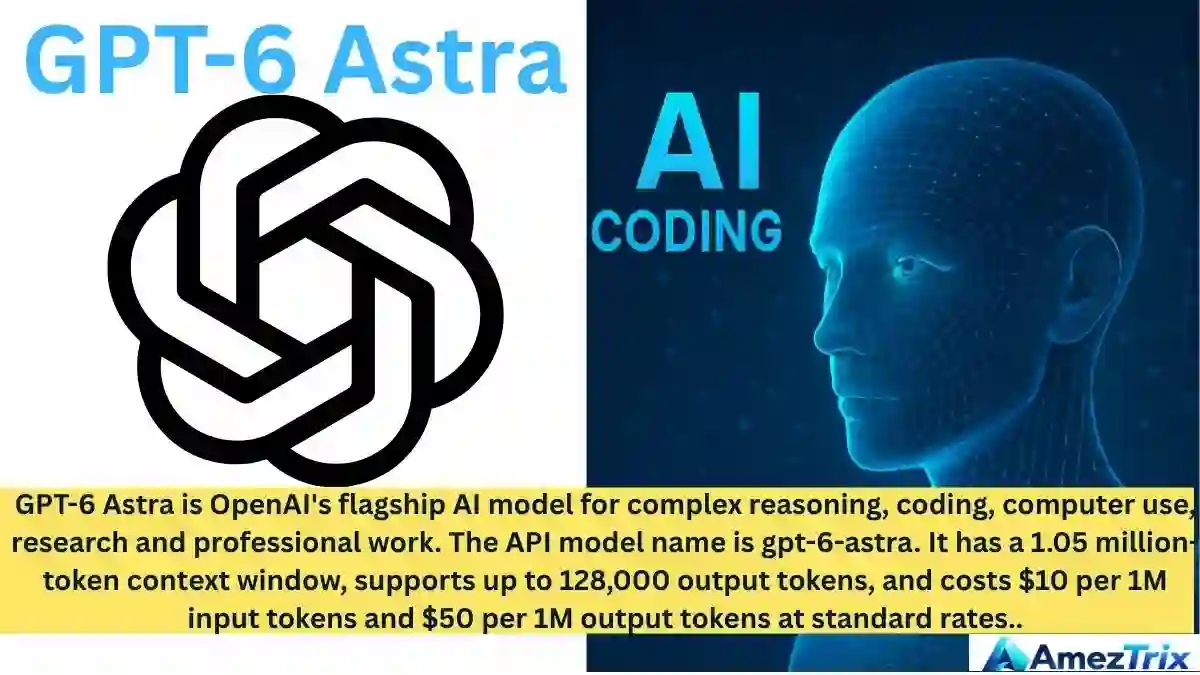
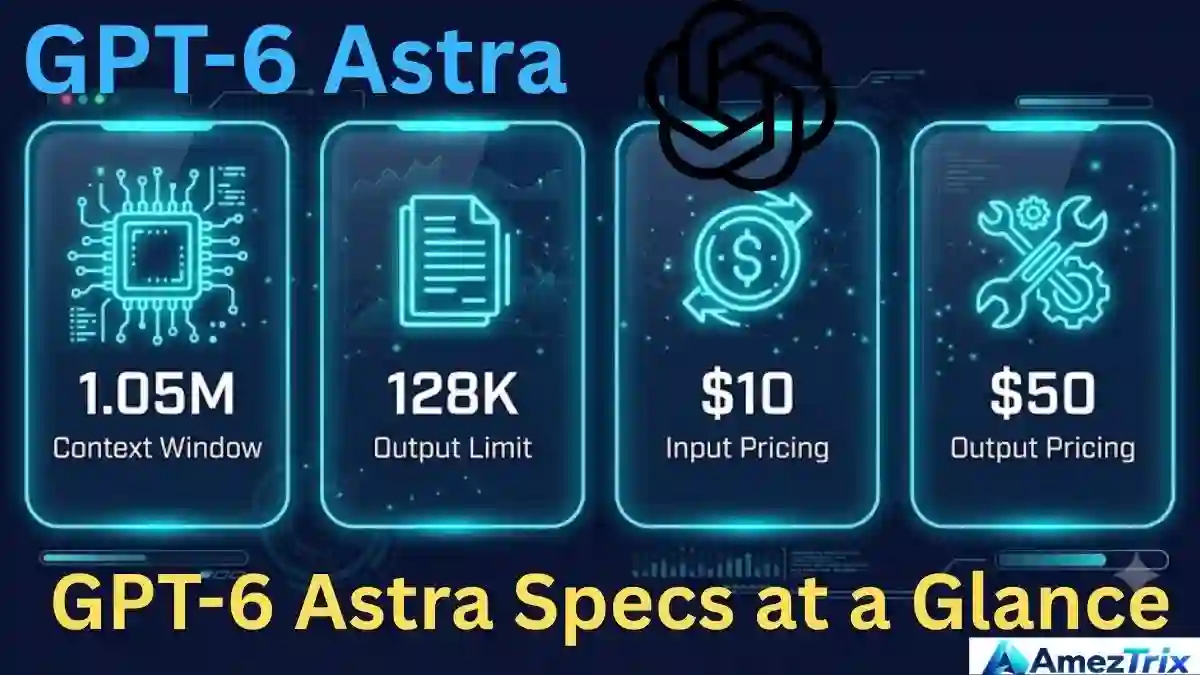
GPT-6 Astra is OpenAI’s flagship AI model for complex reasoning, coding, computer use, research and professional work. The API model name is gpt-6-astra. It has a 1.05 million-token context window, supports up to 128,000 output tokens, and costs $10 per 1M input tokens and $50 per 1M output tokens at standard rates.
What You’ll Find in This Guide
- What is GPT-6 Astra?
- Why it matters
- Specs at a glance
- Computer use explained
- Astra as the engine of an AI agent
- Coding and software engineering
- API pricing
- GPT-6 Astra vs GPT-6.1 Sol
- GPT-6 Astra vs GPT-5.6
- Safety and permissions
- How to use GPT-6 Astra well
- FAQs
What Is GPT-6 Astra?
GPT-6 Astra is OpenAI’s highest-intelligence model, designed for complex reasoning, coding, computer use, research and professional workflows.
The simplest way to see what’s new is to compare two styles of AI.
A traditional chatbot follows a short path: prompt → answer. Ask how to update a spreadsheet and you get instructions.
An agent follows a longer one: goal → reason → use tools → act → check → continue. Say “update the spreadsheet,” and it opens the file, makes the edits and reports back.
Astra is built around that second pattern. According to OpenAI, it works across browsers, code and professional applications, and it can create documents, spreadsheets and presentations that follow your templates.
Why GPT-6 Astra Matters
A smarter chatbot is nice, but it isn’t the headline. The real change is the bundle: strong reasoning, coding, web browsing, computer control, tool calling and document creation inside a single model.
OpenAI reports state-of-the-art results in its own evaluations for computer use, software engineering, science, cybersecurity and professional work. Treat that with a little caution, since the company is grading its own homework. Even so, the direction is clear. Astra is meant to power AI workers, not just chat windows.
GPT-6 Astra Release Date, Availability and Fast Pricing
Quick answer: When was GPT-6 Astra released?
OpenAI released GPT-6 Astra on 3 September 2026. It reached ChatGPT Plus, Pro, Business and Enterprise users first, then the API as gpt-6-astra. Standard pricing is $10 per 1M input tokens and $50 per 1M output tokens, and a faster tier called Astra Fast costs $20 and $100.
Release date, access and price are the three things most readers want to know before anything else, so here they are in one place.
GPT-6 Astra pricing, and Availability at a Glance
| Detail | GPT-6 Astra |
|---|---|
| Release date | 3 September 2026 |
| First access | OpenAI’s Daybreak program (application-only, aimed at cyber defenders) |
| ChatGPT plans | Plus, Pro, Business and Enterprise |
| API model ID | gpt-6-astra |
| Cloud platforms | Amazon Bedrock and Microsoft Azure (announced) |
| Standard price | $10 input / $50 output per 1M tokens |
| Astra Fast price | $20 input / $100 output per 1M tokens |
| Open weights | No, hosted access only |
How Did the GPT-6 Astra Rollout Work?
Access came in stages. Organizations admitted to the Daybreak program got Astra first on 3 September. Paid ChatGPT subscribers and the API followed within days, and OpenAI announced Amazon Bedrock and Microsoft Azure as further routes.
What Is GPT-6 Astra Fast?
Astra Fast is a quicker processing tier of the same model, and you pay double for it: $20 per million input tokens and $100 per million output tokens. It earns its price when speed matters, like a live agent a customer is waiting on. For overnight or background jobs, I’d stay on standard pricing.
Can You Self-Host GPT-6 Astra?
No. OpenAI hasn’t released the model weights, so there’s nothing to download or run on your own servers. You reach Astra through ChatGPT, the OpenAI API or a cloud partner.
GPT-6 Astra vs Claude Fable 5.1
Independent reviews put the two at the same input and output price, so the real question is which one fits your work. Here’s how they compare on the numbers reviewers cite most.
| Area | GPT-6 Astra | Claude Fable 5.1 |
|---|---|---|
| Standard price | $10 / $50 per 1M tokens | Same, per reviews |
| Humanity’s Last Exam (with tools) | 57.2% | 65.0% |
| Artificial Analysis Intelligence Index | 61.2 | 65.7 |
| Terminal-Bench 4.0 (OpenAI’s comparison) | 57.9% | 55.8% |
| Where it looks strongest | Computer use, cybersecurity, hard math | General reasoning on these indices |
Put simply, Astra shines when the job is operating software, while Fable 5.1 scores higher on the broader intelligence tests above. Some figures come from OpenAI’s own comparisons, so treat them as a guide and test both models on your real workload before you commit.
Is GPT-6 Astra Worth It?
It depends on what you’re doing. If you build agents, automate browser or desktop tasks, or tackle complex engineering work, it deserves a proper trial. OpenAI reports Astra finishing OSWorld 2.0 tasks in about 40 minutes, against roughly 75 for GPT-5.6 Sol, so judge it on completed tasks and total token spend rather than the list price alone.
For simple chat, classification or high-volume extraction, a cheaper model will serve you better. Paying premium rates for easy work is the most common way to waste an AI budget.
GPT-6 Astra features at a Glance
| Detail | GPT-6 Astra |
|---|---|
| Developer | OpenAI |
| Positioning | Highest-intelligence model for demanding work |
| API model name | gpt-6-astra |
| Context window | 1,050,000 tokens |
| Maximum output | 128,000 tokens |
| Input | Text and images |
| Supported tools | Web search, file search, image generation, code interpreter, hosted shell, computer use, MCP, tool search |
| Other features | Function calling, structured outputs |
| Standard API price | $10 input / $50 output per 1M tokens |
| ChatGPT access | Plus, Pro, Business and Enterprise (rollout began September 2026) |
That context window is big. In plain terms, the model can keep a large codebase, a pile of long reports or a whole project’s instructions in view at once.
What Is GPT-6 Astra’s Context Window?
GPT-6 Astra has a 1,050,000-token context window and can produce up to 128,000 tokens in a single response, based on OpenAI’s API documentation. It’s most useful for large repositories, long documents, big datasets and multi-stage projects.
One caveat. A bigger window doesn’t automatically mean better answers. Clear instructions and well-chosen tools still decide the quality of the result.
GPT-6 Astra Computer Use: The Feature to Understand
If you only take one thing from this article, make it this.
Computer use means the AI works inside a computer environment directly. It reads the screen, clicks, types, switches apps and reacts to what it sees. OpenAI says Astra can handle tasks like:
- Filling in online forms
- Updating customer records
- Organizing calendars
- Researching online and drafting findings into a document
- Analyzing scientific data and building plots
- Building websites and running front-end quality checks
- Installing and testing software
- Troubleshooting problems visible on screen
Picture someone who loses two hours a day copying data between apps. Nobody enjoys that work, and it’s a natural fit for an agent. The human’s role changes from clicking through every step to setting the goal, watching progress and reviewing what matters.
That shift sits at the center of agentic AI.
Is GPT-6 Astra an AI Agent?
Not by itself. Astra is a model. An agent needs more around it:
- A strong reasoning model
- Access to tools
- Memory or context
- A way to interact with software
- A way to see the results of its actions
- Decision-making ability
- Safety controls
- Human oversight where it counts
Astra covers the first and most important item. You build or buy the rest.
Here’s a realistic example. You tell an agent: “Check this week’s customer-support data, find the most common problems, write a report and suggest fixes.” A well-built agent can pull the data, spot patterns, draw charts, write the report and draft recommendations. Before it does anything with real consequences, such as emailing customers, it stops and asks you.
That’s a very different experience from asking a chatbot for a paragraph.
GPT-6 Astra for Coding
Coding is one of Astra’s main strengths. OpenAI’s published results include benchmarks such as Terminal-Bench, DeepSWE and FrontierCode, and it reports strong scores on complex engineering tasks.
Developers can use it for new code, debugging, refactoring, database migrations, code review, testing, documentation, front-end and back-end work, and edits across many files.
The difference is scope. A regular chatbot hands you one snippet. An agent built on a model like Astra can explore a whole repository, understand how it’s organized, edit several files, run the tests and fix what breaks.
Try a request like this: “Add user login to this app, update the database schema, write tests and fix any errors.” That’s a multi-step job, exactly what this class of model targets. It won’t nail everything on the first attempt, so you still need to read the diff. But the time saved can be real.
GPT-6 Astra for Research
Research mixes several skills: searching, reading, comparing, calculating and writing. That makes it a good match.
A typical flow goes from a clear question to sources, then to extracted facts, then to tables or charts, and finally to a written report. Astra can help at every stage, which trims the repetitive sorting and copying that eats so much time.
Still, check its work. When a topic involves law, money, health or fast-moving news, verify the key facts yourself. A quicker draft is a gift. A confident mistake is a trap.
How Businesses Can Use GPT-6 Astra
Companies stand to gain the most, mainly because so much office work is repetitive and spread across several apps.
| Team | What an Astra-powered agent can help with |
|---|---|
| Customer support | Reading requests, searching internal knowledge, drafting replies for approval |
| Sales | Organizing leads, summarizing past conversations, preparing follow-ups |
| Marketing | Content research, campaign analysis, competitor checks, SEO workflows, reports |
| Operations | Moving data between business tools, routine admin steps |
| Finance | Document review, spreadsheet processing, reporting (human sign-off for real money) |
| HR | Document prep, internal research, administrative workflows |
Notice what’s absent: wholesale replacement of people. The realistic gain is automating repetitive, multi-step digital work while humans keep the decisions that matter.
GPT-6 Astra for Bloggers and Content Teams
For publishers, a content workflow runs roughly like this: topic research, search analysis, outline, draft, fact-check, SEO pass, images, formatting, publishing. Astra’s ability to work with documents, websites and other tools can speed up much of that chain.
On a tech site, that could mean keyword research, outlines, FAQ drafts, comparison tables, content audits, internal-link ideas, update checks on older posts and WordPress formatting help.
I’d still draw a hard line at auto-publishing. Originality, accuracy and first-hand experience are what make an article worth reading, and they still come from a person. Let the AI carry the research and first drafts, then let an editor make the final call.
GPT-6 Astra API Pricing
Developers can call Astra through the OpenAI API with the model name gpt-6-astra. As of October 2026, OpenAI lists these standard rates:
| Usage type | Price per 1M tokens |
|---|---|
| Input | $10 |
| Cached input | $1 |
| Cache writes | $12.50 |
| Output | $50 |
OpenAI also publishes separate rates for faster processing and for longer-context usage, so check the official pricing page before budgeting a real project. Prices and tiers change.
Astra is a premium model, and the bill climbs fast at scale. If you process millions of tokens a day, caching, prompt length and model choice become real cost levers.
Which API Tools Does GPT-6 Astra Support?
OpenAI’s documentation lists web search, file search, image generation, code interpreter, hosted shell, computer use, MCP and tool search, plus function calling and structured outputs. You can combine them. One app could pair Astra with web search, file search, a code interpreter and computer use, which gives you the base of a very capable agent.
Is GPT-6 Astra Free?
OpenAI’s announcement names ChatGPT Plus, Pro, Business and Enterprise for Astra access, and it doesn’t mention a free tier. API usage is billed per token at the rates above.
GPT-6 Astra vs GPT-6.1 Sol
OpenAI doesn’t expect you to use its priciest model for everything, and that makes sense. Here’s how Astra stacks up against GPT-6.1 Sol, its cheaper sibling:
| Feature | GPT-6 Astra | GPT-6.1 Sol |
|---|---|---|
| Positioning | Highest intelligence | Near-Astra performance |
| Complex reasoning | Excellent | Strong |
| Coding | Advanced | Advanced |
| Computer use | Advanced | Advanced |
| Best for | The hardest workloads | Complex work on a tighter budget |
| Context window | 1.05M tokens | 1.05M tokens |
| Max output | 128K tokens | 128K tokens |
| Standard input | $10 / 1M | $2 / 1M |
| Standard output | $50 / 1M | $10 / 1M |
Sol costs one-fifth of Astra on both input and output. For plenty of jobs, that’s an easy trade.
A sensible setup mixes models. Simple, high-volume tasks can go to GPT-6 Luna. Complex but cost-sensitive work fits GPT-6.1 Sol. Keep Astra for the demanding workflows where quality matters most.
GPT-6 Astra vs GPT-5.6
The biggest jump from the previous generation shows up in computer use and agent-style work. Here are OpenAI’s published numbers:
| Benchmark | GPT-6 Astra | GPT-5.6 Sol |
|---|---|---|
| OSWorld 2.0 (computer use) | 72.6% | 65.7% |
| Agents’ Last Exam | 59.3% | 53.6% |
| Terminal-Bench 4.0 (coding) | 57.9% | 37.3% |
These figures come from OpenAI’s own test setups. They’re a helpful signal, not a promise of how the model will behave on your specific job.
Automating Computer Work, Realistically
Take an everyday admin task.
The old way: an employee reads an email, opens a website, copies data, fills a form, downloads a document, updates a spreadsheet and sends a confirmation.
The agent way: the employee states the goal, the agent performs the allowed steps and reports back, and a human reviews anything important.
That doesn’t mean everything should run unattended. Some actions need a human checkpoint every time: payments, legal commitments, account deletion, sensitive personal data, security settings and anything you can’t undo.
Is GPT-6 Astra Safe? Permissions and Risks
A model that can use a computer can cause real damage when something goes wrong. It can open sites, change files, run commands, reach applications and modify data.
OpenAI says Astra ships with added safety work around computer use, cybersecurity, browsing and agent workflows. Its safety overview also notes that Astra reaches a higher level of cybersecurity capability, which is why stronger protections were needed.
If you build with it, a few habits help:
- Least privilege: give the agent only the access the task needs.
- Confirmation: require approval before big actions.
- Logging: keep a record of what the agent does.
- Human oversight: keep a person in the loop for decisions that matter.
It’s boring advice. It’s also the advice that prevents bad days.
Will GPT-6 Astra Replace Human Workers?
Not the way the headlines suggest. Astra can take over more of the doing, but people still own the goals, the judgment and the big decisions.
An AI can write a business report, yet a manager decides what the company does next. An AI can write software, yet an engineer reviews the architecture and security. Google AI Tools can research a topic, yet an editor checks the claims that matter.
That human-plus-agent partnership is far more practical than fully unsupervised work.
Who Should Use GPT-6 Astra?
| User | Why Astra fits |
|---|---|
| Developers | Advanced coding, debugging, repository-wide changes |
| AI agent builders | A strong reasoning core for multi-step agents |
| Businesses | Complicated processes that cross several tools |
| Researchers | Large-scale reading, analysis and synthesis |
| Data professionals | Analysis, code and reporting workflows |
| Content teams | Research, writing, editing and document work |
| Enterprises | Structured processes tied into business software |
For simple tasks, a smaller and cheaper model usually does the job. There’s no prize for using the biggest tool on a small problem.
How to Use GPT-6 Astra Effectively
A powerful model won’t rescue a vague request. The most common mistake is a one-line prompt followed by high hopes. Spend a minute on these six points instead:
- The objective. Say exactly what you want done.
- The constraints. Mention limits, format and deadlines.
- The tools. Tell the agent what it may use.
- Success criteria. Describe what a good result looks like.
- Approval points. Name the actions that need your OK first.
- Output format. A table, report, spreadsheet, slide deck, code changes, JSON or a checklist.
Here’s a prompt that works:
Analyze the website performance data I’ve provided. Find the five biggest SEO issues, group them into technical, content and performance categories, build a prioritized action plan and write a short summary report. Don’t change anything on the website without asking me first.
Compare that with “analyze my website.” The first gives the agent a clear job and clear limits. The second gives it a guess.
GPT-6 Astra for a Tech Publisher
For a site like AmezTrix, the useful applications go well beyond plain article writing:
- SEO research: study a topic, map related search intents and shape an article structure.
- Content audits: review older posts for search intent, missing subtopics, FAQs, internal links, structure and readability.
- WordPress help: formatting, metadata and technical chores, with confirmation before anything goes live.
- AI tool research: comparison tables covering features, pricing, availability, use cases, strengths and limits.
- Content updates: flag outdated sections and prepare suggested edits.
The rule stays the same. AI assists the editorial process. It doesn’t get to publish unchecked claims.
Where AI Is Heading
The first wave of generative AI was about text. Then came models that handle images, audio and video. Now the push is toward reasoning plus tools plus computer use plus agents.
That matters because most real work isn’t a question. It’s a workflow. Take “prepare a market report.” Behind that one sentence sit searching, reading, extracting data, running numbers, building charts, writing, formatting and reviewing. An agent can coordinate many of those steps, and that’s why Astra is getting so much attention.
GPT-6 Astra Limitations
Astra is impressive, but it isn’t magic.
- It still makes mistakes. Even top models state wrong things with confidence.
- Tools add risk. The more systems you connect, the costlier an error becomes.
- It’s expensive. Premium pricing doesn’t suit every workload.
- Humans still need to review. Don’t hand over important decisions.
- Benchmarks aren’t real life. Scores help, but they don’t guarantee results.
- Security takes work. Agents need careful permissions, monitoring and testing.
These points matter most when you build agents for production.
GPT-6 Astra FAQs
What is GPT-6 Astra?
GPT-6 Astra is OpenAI’s flagship model for demanding reasoning, coding, computer use, research and professional work.
Is GPT-6 Astra available in ChatGPT?
Yes. OpenAI announced availability for ChatGPT Plus, Pro, Business and Enterprise users, with the rollout starting in September 2026. Enterprise admins can control workspace access.
What is the GPT-6 Astra API model name?
The identifier is gpt-6-astra.
How much does GPT-6 Astra cost?
Standard API pricing is $10 per 1 million input tokens and $50 per 1 million output tokens. Cached input costs $1 per million tokens.
What is GPT-6 Astra’s context window?
It offers 1.05 million tokens of context and up to 128,000 tokens of output, according to OpenAI’s API documentation.
Can GPT-6 Astra write code?
Yes. Coding and software engineering are among its main use cases, and OpenAI reports results across several engineering benchmarks.
Can GPT-6 Astra use a computer?
Yes. OpenAI describes tasks such as form filling, CRM updates, online research, software testing and troubleshooting.
Is GPT-6 Astra better than GPT-5.6?
OpenAI’s published tests show gains in computer use, coding and professional workflows. Your results will depend on the task and the setup.
Is GPT-6.1 Sol cheaper than GPT-6 Astra?
Yes, by a wide margin. Sol is listed at $2 input and $10 output per million tokens, and OpenAI positions it as near-Astra performance for complex work.
Should everyone use GPT-6 Astra?
No. Match the model to the job. Smaller models are often cheaper and quicker for simple or high-volume work.
Is GPT-6 Astra available on Azure or Amazon Bedrock?
OpenAI announced both as access routes alongside the API. Check each platform’s model catalog for live availability in your region.
How much does GPT-6 Astra cost?
Standard rates are $10 per 1M input tokens and $50 per 1M output tokens. Astra Fast is $20 and $100.
Is GPT-6 Astra open source?
No. OpenAI doesn’t publish the weights, and access is hosted only.
Updated October 2026. Details are based on OpenAI’s announcement and independent reviews, so confirm current pricing on OpenAI’s official pricing page.
Final Verdict
The interesting thing about GPT-6 Astra isn’t that it writes nicer answers. It’s built to work through a task, using tools and a computer along the way.
Developers get a path to stronger coding agents. Businesses get a chance to automate repetitive digital work. Researchers handle information faster, and publishers get help with research, drafting and optimization.
Treat it as a tool that works under human direction. Check the important outputs, limit what it can touch and pick the cheapest model that does the job well. Do that, and Astra can save you serious time.
Key Takeaways
- GPT-6 Astra is OpenAI’s flagship model for demanding AI work.
- It focuses on reasoning, coding, research, computer use and professional workflows.
- The API model name is
gpt-6-astra. - It offers a 1.05 million-token context window and up to 128K output tokens.
- Standard pricing is $10/M input and $50/M output.
- It works well as the reasoning core of an AI agent.
- GPT-6.1 Sol is a much cheaper option for many complex tasks.
- Human oversight still matters for anything consequential.
In short: GPT-6 Astra is less about asking AI a question and more about giving it a job to finish.
Related Reads on AmezTrix
- OpenAI Dots AI Agent
- OpenAI Dots vs ChatGPT
- Best AI Coding Agents
- Best AI Agents for Businesses
- How to Rank in ChatGPT
- LLMO: Large Language Model Optimization
- AI Automation
- Best AI Tools for Students
Last updated: October 2026. Sources: OpenAI’s GPT-6 Astra announcement, API documentation, model guide and pricing pages.
About the Author
Rajendra Parmar is the Founder and Editor of AmezTrix, where he covers Artificial Intelligence, Technology, WordPress, Web Hosting, Digital Marketing, Gadgets and Software. His mission is to simplify complex technology through practical tutorials, honest reviews and well-researched guides that help readers make smarter digital decisions.