Short answer: To rank in ChatGPT, allow OpenAI’s search crawler (OAI-SearchBot) to read your site, answer real questions clearly near the top of each section, back claims with sources, and add original insight. Strong brand signals and clean technical SEO help. Nothing guarantees a citation.
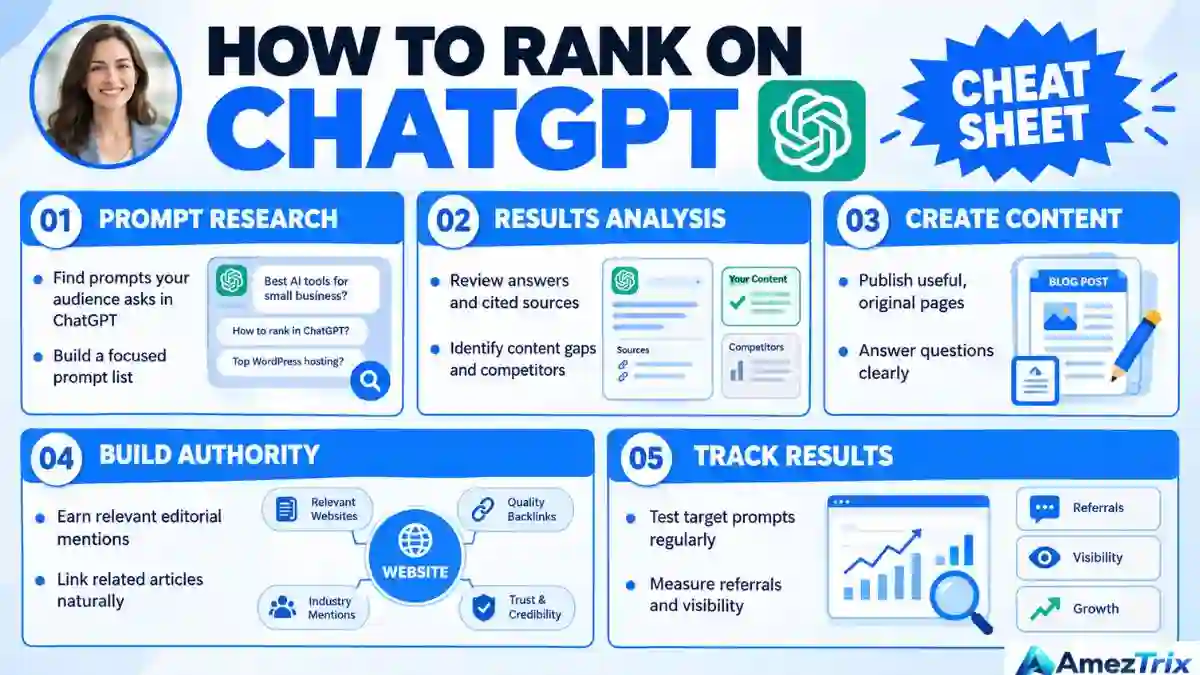
Rank in ChatGPT: 10 Steps to Get Your Site Cited (2026)
Learn how to rank in ChatGPT in 10 steps: crawler access, answer-first content, tracking and red flags. Free checklist and 30-day plan inside.
Quick Summary (TL;DR)
- There is no form to fill out and no fee to pay. ChatGPT cites pages it can read, trusts and finds useful for a specific question.
- Start by letting OAI-SearchBot reach your pages. Then lead with direct answers and add something other sites don’t have: your own data, tests or examples.
- Measure with GA4 referrals plus a monthly set of test prompts.
- Nobody can promise you a citation. Treat anyone who does with caution.
Picture this: a potential customer asks ChatGPT for the best option in your niche. Three sources appear. Yours isn’t one of them.
That moment is why rank in ChatGPT has become such a popular search. And the honest answer is more practical than most guides admit.
Below you’ll find a step-by-step plan, comparison tables, a checklist and a 30-day schedule. I’ve also flagged what nobody can prove yet, because this topic attracts a lot of confident guesswork.
What Does Ranking in ChatGPT Really Mean?
Imagine a librarian who has read millions of books. Ask a question and the librarian may answer from memory. Or they may walk to the shelves, pull a few titles and say, “Here’s what these say.”
Ranking in ChatGPT means being one of the titles pulled from the shelf. It shows up in three different ways:
| Outcome | What it looks like | Why it matters |
|---|---|---|
| Citation | Your page is linked as a source | Can send qualified visitors |
| Mention | Your brand name appears in the answer | Builds awareness, even without a click |
| Recommendation | ChatGPT suggests your product or service | Closest to a sales lead |
Track these three separately. A mention is not a citation, and a citation is not a recommendation.
Also, forget the idea of “position #1.” ChatGPT answers vary by wording, by user and over time. Your realistic goal is showing up across many relevant questions.
ChatGPT vs Google: What Changes for You?
| Area | Google Search | ChatGPT Search |
|---|---|---|
| Results format | Ranked list of links | Written answer with optional sources |
| What you optimize for | A keyword | A question and its context |
| Rank tracking | Standard tools show positions | No fixed position; results vary |
| Best measurement | Search Console | Referral analytics and prompt tests |
| Guaranteed placement | No | No |
Why Are People Searching for This for Rank in ChatGPT? (Search Intent)
Most people arrive here for one of three reasons: their organic traffic has stalled, they’ve noticed customers asking AI tools for advice, or they want a head start before competitors catch on.
| Intent | The reader is thinking… | Where to look in this guide |
|---|---|---|
| Informational | “How does ChatGPT choose sources?” | Steps 1-10 |
| Commercial | “Which approach or service is worth paying for?” | Red flags, comparison tables, measurement |
| Transactional | “Give me a plan I can start today.” | Checklist and 30-day plan |
How ChatGPT Reaches Your Page
ChatGPT can respond in three broad ways, depending on the product and the question:
- Training knowledge: no live lookup, so a brand-new page can’t appear.
- Web search: it fetches current pages and may link to them.
- A page the user supplies: someone pastes or opens your URL.
Web search is where most publishers can compete. In simple terms, your page must be found, readable by the crawler, relevant to the question and useful enough to use. That’s a working model. OpenAI hasn’t published its full selection process.
Key Points
- Access, relevance and usefulness drive eligibility.
- Publishing a page doesn’t mean ChatGPT will use it.
- No official list of ranking factors exists. Be wary of anyone quoting exact percentages.
Step 1: Open the Door for OpenAI’s Search Crawler
This is the quickest win, and it’s surprisingly easy to get wrong. A crawler that can’t read your page can’t consider it.
OpenAI documents several crawlers. These are the ones to know:
| User agent | Used for | Your decision |
|---|---|---|
| OAI-SearchBot | Surfacing pages in ChatGPT Search | Allow it if you want search eligibility |
| GPTBot | Content collection that may support model training | Separate choice from search access |
| ChatGPT-User | Fetches triggered by a user’s request | Read OpenAI’s current documentation |
Visit yourdomain.com/robots.txt and look for rules that might block these agents. An allow rule is short:
User-agent: OAI-SearchBot
Allow: /
Don’t overwrite your file with this snippet. WordPress and SEO plugins often add their own rules, so read everything first. Then check your firewall, CDN and security plugin. They can block bots even when robots.txt looks fine.
Tip: retest after every hosting or security change. A single “block bots” switch can undo your work quietly.
Step 2: Confirm Your Pages Are Indexed Properly
Classic SEO hygiene still counts. In Google Search Console, make sure your key pages are indexed, return a 200 status, use the right canonical tag and carry no accidental noindex.
Many practitioners also add their site to Bing Webmaster Tools because ChatGPT’s search is believed to draw on outside search partners. OpenAI hasn’t published a full list, so view this as cheap insurance, not a requirement.
Step 3: Find the Questions Your Audience Really Asks
Keyword tools favor short phrases. Chat prompts are longer and more personal. Someone might search “rank in ChatGPT” on Google, then ask ChatGPT, “How can my small WordPress blog get cited in AI answers?”
Good places to collect real questions:
- Search Console queries that already earn impressions.
- Autocomplete, related searches and People Also Ask.
- Emails, comments, support tickets and sales calls.
- Niche forums and communities.
- Your own test prompts inside ChatGPT.
Cluster questions by intent. When several share one answer, serve them on one strong page instead of several thin ones.
Step 4: Write Answer-First Content
Answer, then the explanation. Readers get what they came for, and so does any system scanning your page.
Slow start: “Technology keeps changing how people look for information online.”
Direct start: “To appear in ChatGPT Search, allow OAI-SearchBot, answer specific questions clearly and keep your site technically healthy.”
A simple pattern for each important question:
- State the answer in one or two sentences.
- Explain the reasoning briefly.
- Cite a source or show evidence.
- Give a concrete example.
- Tell the reader what to do next.
Keep paragraphs short and use question-style headings where they read naturally. That said, don’t chop every idea into soundbites. Complex topics deserve real depth.
Step 5: Add Something Original (Your Biggest Advantage)
If ten sites repeat the same advice, there’s no reason to pick the eleventh. Give readers and AI systems a reason to choose you.
- Run a small test. Describe the method, the date and what happened.
- Use screenshots from your own accounts.
- Offer a decision guide: “If you’re X, do A. If you’re Y, do B.”
- Admit trade-offs and limits.
- Display a real author name, short bio and update date.
One firm rule: never fake experience. If you haven’t tried a tool, say your comparison relies on published specifications. Readers notice invented testing, and it costs you trust fast.
Step 6: Design for People First (SXO)
Search Experience Optimization, or SXO, simply means the page should satisfy the visitor after the click. A cited page that frustrates visitors wastes the opportunity.
- Use one H1, then logical H2 and H3 headings.
- Use tables for comparisons and numbered lists for procedures.
- Define terms the first time they appear. Example: “Google Search Console is Google’s free tool for checking how a site performs in search.”
- Keep the mobile layout clean and load times short.
No proof exists for a magic number of bullets, words per paragraph or keyword density. Write clearly and move on.
Step 7: Build a Topic Cluster With Smart Internal Links
One post rarely builds authority. A connected set of posts does. For this subject, you might publish a pillar guide plus supporting articles on:
- ChatGPT SEO basics.
- Generative Engine Optimization (GEO) explained.
- AEO vs GEO vs LLMO.
- Configuring crawler access in robots.txt.
- Tracking AI referral traffic in GA4.
Link them with descriptive anchor text, such as “GA4 AI traffic setup,” instead of “read more.” Add links only where they genuinely help, and confirm each URL loads.
Step 8: Strengthen Your Brand Beyond Your Own Site
AI answers likely reflect what the wider web says about a brand. That’s a sensible assumption, though OpenAI hasn’t shared how any single signal is weighted.
Honest ways to build recognition:
- Publish original research or data worth quoting.
- Offer expert comments to respected publications.
- Keep your About page, author pages and social profiles consistent.
- Collect real customer reviews.
Avoid bought reviews, link farms and automated “brand mention” packages. They invite penalties and rarely deliver.
Step 9: Fix Technical Health and Use Schema Honestly
| Area | What to confirm |
|---|---|
| Robots.txt | Important folders aren’t blocked |
| HTTP status | Key pages return 200, with no loops or 404s |
| Canonical tags | One preferred URL per page |
| Noindex | Absent from pages you want found |
| XML sitemap | Contains only canonical, indexable URLs |
| Speed and mobile | Compressed images, readable mobile layout |
| Server response | Fast for visitors and bots alike |
For schema, use Article or BlogPosting, Organization, Person and BreadcrumbList markup that mirrors what’s visible on the page. Google has stated that no special markup is required for its AI features, and no evidence shows schema forces ChatGPT citations. Think of it as tidy housekeeping, not a trick.
The same goes for llms.txt, a proposed file meant to guide AI systems. Major platforms haven’t confirmed they depend on it. Add one if you like, but don’t expect a jump in visibility.
Step 10: Measure Your ChatGPT Visibility
No single method tells the whole story, so combine three.
Method 1: GA4 referral traffic
Open the traffic acquisition report and look for sources like chatgpt.com. Source labels can change, so check raw values. Review sessions, landing pages, engagement and conversions. Some AI-driven visits won’t be attributed, so treat the totals as a minimum.
Method 2: A monthly prompt test
Write 20-30 questions your audience would ask. Run them each month with identical wording. Log the date, whether you were cited, mentioned or absent, and which competitors appeared. Look for trends, not one-off wins.
Method 3: Google Search Console
Watch impressions, clicks and queries for the same pages. Healthy search performance supports discovery, though it doesn’t directly reveal ChatGPT citations.
| Metric | Baseline | Day 30 | Day 60 |
|---|---|---|---|
| ChatGPT referral sessions | Record | Measure | Measure |
| Prompts that cite your site | Record | Retest | Retest |
| Prompts that mention your brand | Record | Retest | Retest |
| Organic clicks (Search Console) | Record | Compare | Compare |
This is a blank tracking template, not real performance data.
SEO, AEO, GEO, SXO, AIO and LLMO: What Each Term Means
| Term | Meaning | Practical focus |
|---|---|---|
| SEO | Search Engine Optimization | Crawlability, relevance, links, page quality |
| AEO | Answer Engine Optimization | Clear, direct answers to specific questions |
| GEO | Generative Engine Optimization | Becoming a trusted source in AI-written answers |
| SXO | Search Experience Optimization | Satisfying visitors after they click |
| AIO | AI Optimization (also used for AI Overviews) | Fitting content to AI-driven result features |
| LLMO | Large Language Model Optimization | Clear entities, definitions and consistent facts |
These are industry labels, not six separate ranking systems. They overlap heavily, and good fundamentals cover most of them.
Quick Self-Audit: Why Am I Not Showing Up?
| Symptom | Likely cause | First fix |
|---|---|---|
| Never cited for anything | Crawler blocked or pages not indexed | Review robots.txt, firewall and indexing |
| Competitors cited, you aren’t | Your content is generic | Add original data, examples and sources |
| Cited once, then gone | Normal variation in AI answers | Retest monthly and track the trend |
| Mentioned but not linked | Brand known, page not chosen | Make key pages more specific and answer-first |
| Traffic arrives but doesn’t convert | Poor page experience | Improve layout, speed and clear next steps |
Rank in ChatGPT Visibility Checklist
- ☐ OAI-SearchBot isn’t blocked in robots.txt, firewall or CDN.
- ☐ Key pages are indexable, return 200 and use correct canonicals.
- ☐ Every key page answers its main question in the opening lines.
- ☐ Claims link to official or primary sources.
- ☐ Each article includes something original: a test, example, framework or data.
- ☐ Author name, bio and update date are visible.
- ☐ Pages connect through a topic cluster with descriptive anchors.
- ☐ Schema matches visible content and isn’t duplicated by multiple plugins.
- ☐ GA4 and Search Console are active.
- ☐ A prompt-testing sheet holds your baseline.
Your 30-Day Action Plan
| Days | Focus | Finished when |
|---|---|---|
| 1-3 | Technical audit: robots.txt, indexing, status codes | Key pages are reachable |
| 4-7 | Content audit: spot thin, outdated or overlapping posts | Priority list is ready |
| 8-14 | Rewrite top pages with direct answers, sources and original value | Updates are live |
| 15-21 | Add supporting posts and internal links | Cluster is connected |
| 22-26 | Set up GA4 tracking and your prompt sheet | Baseline is recorded |
| 27-30 | Review results and plan month two | Next actions are listed |
Treat this as a working schedule, not a promise. Crawling and citations can take longer than a month, and some pages may never be cited.
Common Mistakes to Avoid
- Blocking the crawler by accident. Check robots.txt, firewall and CDN settings.
- Publishing generic content. If it adds nothing new, there’s little reason to cite it.
- Keyword stuffing. Repeating “rank in ChatGPT” hurts readability and gains nothing.
- Counting on schema or llms.txt alone. Neither is a proven citation trigger.
- Ignoring indexing errors. A noindexed or broken page can’t compete.
- Tracking only mentions. A mention without a link isn’t a citation.
- Mass-producing AI pages. Near-duplicate content can run into spam policies.
Red Flags When Hiring Help
- Promises of a guaranteed spot or “#1 in ChatGPT.”
- Claims of exact ranking factors or weights with no source.
- “Submit your site to ChatGPT” services. No official form guarantees placement.
- Packages built on fake reviews, link spam or invented brand mentions.
- Case studies with no method, dates or screenshots.
The Honest Downsides
Optimizing for ChatGPT comes with real trade-offs.
| Benefit | Limitation |
|---|---|
| A discovery channel for detailed questions | Citations are unpredictable and can shift weekly |
| Pushes you toward clearer, more useful content | Referral volume may be small for many sites |
| Complements Google SEO | Doesn’t replace Google or other channels |
| Uncovers real audience questions | Measurement and attribution remain incomplete |
Also keep in mind that AI answers can reduce clicks, because users sometimes get what they need without visiting. That’s why brand recognition and a loyal direct audience matter alongside citations.
Frequently Asked Questions
How do I rank in ChatGPT?
Let OAI-SearchBot access your pages, answer specific questions near the top of each section, add original insight and sources, and keep your site technically healthy. Track referrals and test prompts monthly. These steps improve your odds, but no one can guarantee a citation.
Can I submit my website to ChatGPT?
No official submission form guarantees inclusion. OpenAI says public sites can appear in ChatGPT Search and advises allowing OAI-SearchBot for pages you want discovered. Concentrate on crawl access, indexing and genuinely useful content instead of searching for a shortcut.
What is OAI-SearchBot?
OAI-SearchBot is OpenAI’s crawler for finding pages used in ChatGPT Search. If your robots.txt, firewall or CDN blocks it, your pages may not be eligible to appear. Always check OpenAI’s current documentation, since details can change.
How to help Google rank in ChatGPT search?
Strong Google visibility can support discovery and signals quality, but the two systems work differently. Ranking on Google doesn’t guarantee a ChatGPT citation, because queries, sources and retrieval methods aren’t identical. Test both channels separately.
How long does it take to get cited by ChatGPT?
There’s no fixed timeline. Some pages may surface within weeks, while others never do. Results depend on crawl access, relevance, competition and the exact question. Measure monthly and judge the trend over several months rather than a single week.
Do FAQ schema or llms.txt help?
Neither is a proven way to earn ChatGPT citations. A well-written FAQ helps readers, and schema helps search engines interpret a page. Use both as supporting details, not shortcuts, and put content quality and crawl access first.
Can a small or new website get cited?
Yes, it’s possible. A focused niche, original testing, clear tutorials and accurate answers give smaller sites a fair chance. Expect it to take time, and don’t expect to outrank large publishers on every topic.
How do I track ChatGPT traffic?
Check GA4 traffic acquisition for chatgpt.com referrals, then add monthly prompt tests and Search Console data. Attribution is incomplete, so combine all three and keep your test prompts word-for-word identical each month.
Sources and Further Reading
- OpenAI: Publishers and Developers FAQ
- OpenAI: Searching the web with ChatGPT
- Google Search Central: Creating helpful, reliable, people-first content
Last updated: October 2026. Crawler rules and search features change, so recheck official documentation before making major changes.
Final Verdict
The best path to rank in ChatGPT is plain: make your site easy to reach, make your content genuinely helpful and make your brand easy to trust. Fix crawler access first, then improve content with direct answers and original value, then connect your pages and measure.
There is no secret trick. But these improvements compound, and they help you on Google too.
About Author
Rajendra Parmar is the Founder and Editor of AmezTrix, where he covers Artificial Intelligence, Technology, WordPress, Web Hosting, Digital Marketing, Gadgets, and Software. His mission is to simplify complex technology through practical tutorials, honest reviews, and well-researched guides that help readers make smarter digital decisions.

Rajendra Parmar
Founder & Editor • AmezTrix
Rajendra Parmar is the Founder and Editor of AmezTrix, a platform covering Artificial Intelligence, Technology, WordPress, Web Hosting, Digital Marketing, Gadgets, Software Reviews, and emerging innovations. His mission is to simplify complex technology through practical tutorials, honest reviews, and well-researched guides that help readers make smarter digital decisions.