Discover the 10 best AI agents for businesses in 2026. Compare features, pricing, automation, use cases, and capabilities to find the right AI agent for your team.
10 Best AI Agents for Business in 2026: Tested & Ranked
AI agents have quietly become essential business tools for wiping out repetitive tasks, boosting productivity, supporting customers around the clock, and running complex workflows without constant supervision. This guide compares the 10 strongest AI agents for business in 2026, judged on automation depth, integrations, real-world use cases, security, scalability, and overall value for money.
Every year, companies burn thousands of hours on low-value, repetitive work — data entry, email sorting, chasing leads, generating reports, and endless status check-ins. AI agents are rewriting that math. Unlike basic chatbots, today’s agents can plan multi-step tasks on their own, plug into your existing software stack, and carry out entire workflows with barely any human input.
If you’re trying to work out which AI agent genuinely earns a place in your 2026 tech stack, this breakdown covers the 10 strongest contenders — what each one nails, where it comes up short, and exactly who should be buying it.
What Is an AI Agent, Really?
Before comparing platforms, it’s worth pinning down what actually separates a “smart chatbot” from the best AI agents for businesses — because the term gets thrown around far too loosely.
A chatbot answers one question and stops there. An AI agent behaves closer to an independent worker: it takes a goal, breaks it into a sequence of steps, pulls data from multiple systems at once, carries out actions inside connected software, and adjusts its approach based on what it discovers along the way.
Think of it less like a search engine and more like a tireless new hire — one who never needs a coffee break, never forgets an instruction, and gets noticeably sharper the longer it works alongside you. It can draft correspondence, update internal records, condense hour-long meetings into a few bullet points, answer customer queries, and hop between different apps without a human bridging the gap manually.
The real difference from older “if-this-then-that” automation is adaptability. Classic automation snaps the moment something unexpected happens. The best AI agents for businesses, by contrast, read context, tolerate ambiguity, and make a reasonable judgment call instead — which is exactly why adoption has taken off so fast across nearly every sector.
How AI Agents Work Under the Hood
You don’t need a technical background to use any of these platforms, but understanding the basic architecture makes it far easier to judge which one actually deserves your budget.
- Natural language processing is the entry point — it’s the reason you can type “summarize this week’s support tickets” instead of writing a script.
- Large language models (the engines behind tools like ChatGPT, Claude, and Gemini) handle the actual reasoning, drafting, and analysis.
- Machine learning lets the system sharpen its accuracy the more it processes your organization’s data and feedback.
- Integrations are what turn a clever chatbot into a genuinely operational tool — links into email, messaging apps, your CRM, project boards, and internal databases.
Combine all four, and you get a system that can read an incoming customer message, cross-check order history, draft a reply, and route it for approval — without a single human bouncing between five browser tabs to make it happen.
Why Businesses Are Rushing to Adopt AI Agents
Rising costs, leaner teams, and higher customer expectations have created real pressure — and AI agents happen to attack that pressure from several directions at once.
They free up time. Routine emails, data entry, scheduling, and report writing quietly swallow hours every single week. Automating them hands that time back to work that genuinely needs human judgment.
They cut overhead. Automated support, document processing, and admin work mean you don’t need to keep expanding headcount just to keep pace with rising volume.
They never clock out. A properly configured agent handles a request at 2 a.m. with the exact same consistency it shows at 2 p.m.
They elevate customer experience. Instant, multilingual, consistently accurate replies translate directly into better satisfaction scores.
They sharpen decision-making. Agents can chew through datasets that would take a human analyst days, surfacing patterns useful for forecasting and planning.
They keep departments in sync. Shared summaries, automatic task tracking, and consistent documentation cut down the miscommunication that slows down cross-team projects.
What to Check Before You Buy
Not every AI agent suits every business, and picking the wrong one wastes both budget and momentum. Before committing, confirm the platform genuinely offers:
- Real contextual understanding, not just keyword-triggered responses
- Full workflow automation rather than isolated, one-off actions
- Integration with the tools you already run — Slack, Salesforce, HubSpot, Microsoft 365, Google Workspace, Zoom, Notion, Jira, Zapier
- Genuine security infrastructure — encryption, access controls, and recognized certifications such as SOC 2 or ISO 27001
- Room to scale as your headcount and use cases grow
- Built-in reporting so you can actually prove — or disprove — the tool’s ROI
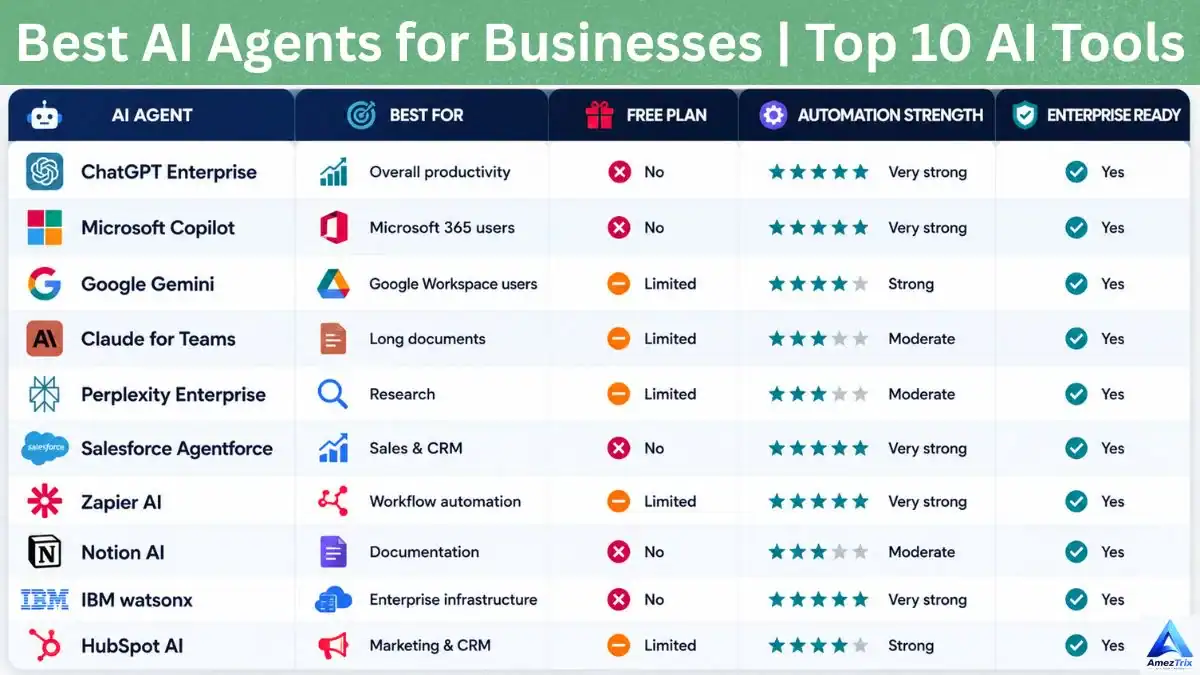
Comparison Table: Top AI Agents for Business (2026)
| AI Agent | Best For | Automation | Integrations | Enterprise-Ready |
|---|---|---|---|---|
| ChatGPT Enterprise | Overall team productivity | ⭐⭐⭐⭐⭐ | ⭐⭐⭐⭐⭐ | ✅ |
| Microsoft Copilot | Microsoft 365 users | ⭐⭐⭐⭐⭐ | ⭐⭐⭐⭐⭐ | ✅ |
| Google Gemini | Google Workspace teams | ⭐⭐⭐⭐ | ⭐⭐⭐⭐⭐ | ✅ |
| Claude | Long documents & reasoning | ⭐⭐⭐⭐ | ⭐⭐⭐⭐ | ✅ |
| Perplexity Enterprise | Business research | ⭐⭐⭐ | ⭐⭐⭐⭐ | ✅ |
| Salesforce Agentforce | Sales & CRM automation | ⭐⭐⭐⭐⭐ | ⭐⭐⭐⭐⭐ | ✅ |
| Zapier AI | Workflow automation | ⭐⭐⭐⭐⭐ | ⭐⭐⭐⭐⭐ | ✅ |
| Notion AI | Knowledge management | ⭐⭐⭐ | ⭐⭐⭐⭐ | ✅ |
| IBM watsonx | Enterprise-grade AI governance | ⭐⭐⭐⭐⭐ | ⭐⭐⭐⭐ | ✅ |
| HubSpot AI | Marketing & CRM | ⭐⭐⭐⭐ | ⭐⭐⭐⭐⭐ | ✅ |
Top AI Agents for Business in 2026
Here’s a grounded look at the platforms worth your time, judged on real-world capability, depth of integration, security posture, and price-to-value ratio.
1. ChatGPT Enterprise — Best All-Round Productivity Tool
A flexible workhorse combining strong writing, coding help, and data analysis inside a secured team workspace.

Strengths: Polished output, dependable coding assistance, wide file-format support, useful across marketing, HR, sales, and engineering alike.
Trade-offs: Advanced features sit behind paid tiers; larger teams may need a short ramp-up period.
Best for: Companies that want one flexible tool for writing, research, coding, and reporting instead of juggling five separate subscriptions.
2. Microsoft Copilot — Best for Microsoft 365 Environments

If your company already lives inside Word, Excel, Outlook, and Teams, Copilot slots in almost invisibly — drafting documents, mining spreadsheet data, and summarizing meetings inside the same apps your staff already use daily.
Strengths: Deep native integration, solid enterprise-grade security, minimal learning curve.
Trade-offs: Value drops sharply outside the Microsoft ecosystem; some features require specific licensing tiers.
Best for: Corporate offices, finance teams, and enterprises standardized on Microsoft tools.
3. Google Gemini for Workspace — Best for Google-Native Teams
Gemini embeds directly into Gmail, Docs, Sheets, Slides, and Meet, making it a natural fit for teams running their operations on Google Workspace.

Strengths: Fast responses, smooth collaboration features, strong support for distributed teams.
Trade-offs: Most valuable inside Google’s own ecosystem; some capabilities are locked to higher-tier plans.
Best for: Small businesses, agencies, schools, and remote-first companies already on Workspace.
4. Claude for Teams — Best for Long, Complex Documents
Claude has built a reputation for handling lengthy, dense material — contracts, research papers, policy documents — with a depth that shorter-context tools genuinely struggle to match.

Strengths: Strong comprehension of long content, natural writing tone, solid analytical reasoning.
Trade-offs: Fewer pre-built business integrations than some rivals; feature sets vary by plan.
Best for: Legal teams, researchers, consultants, and knowledge-heavy enterprise roles.
5. Perplexity Enterprise — Best for Business Research
Built specifically for fast, source-backed research, pulling from both the open web and internal documents while showing exactly where each answer came from.

Strengths: Citation-backed answers, strong competitive analysis, real time savings for research-heavy roles.
Trade-offs: Leans toward research over full workflow automation; deeper features sit behind higher pricing.
Best for: Analysts, executives, and strategy or marketing teams needing fast, reliable answers.
6. Salesforce Agentforce — Best for Sales and CRM Automation
Agentforce builds AI directly into the sales pipeline — qualifying leads, forecasting deals, and clearing out the admin work that eats into a rep’s day.
Strengths: Tight CRM integration, genuinely useful forecasting, enterprise-grade security.
Trade-offs: Pricing can be steep for smaller businesses; works best fully inside the Salesforce ecosystem.
Best for: Large enterprises, B2B sales teams, and customer success organizations.
7. Zapier AI — Best No-Code Workflow Automation
Zapier connects thousands of apps, letting you build AI-driven workflows across Gmail, Slack, HubSpot, Notion, Sheets, and Shopify — no developer required.
Strengths: Easy setup, an enormous integration library, fast payback in hours saved.
Trade-offs: Complex multi-step workflows may need a premium plan; costs scale with usage.
Best for: Startups, agencies, e-commerce brands, and marketing or HR teams stitching tools together.
8. Notion AI — Best for Documentation and Knowledge Management
Notion AI turns scattered notes into organized documentation — drafting content, summarizing meetings, and keeping institutional knowledge searchable.
Strengths: Clean interface, strong collaboration features, solid writing support.
Trade-offs: Limited automation compared to dedicated workflow tools; shines mainly within Notion itself.
Best for: Startups, product teams, HR, and documentation-heavy marketing departments.
9. IBM watsonx — Best for Enterprise-Grade AI Infrastructure
Built for organizations that need serious governance and compliance — a full deployment platform, not just a chat interface.
Strengths: Enterprise-grade security, strong compliance tooling, scalability for regulated industries.
Trade-offs: Steeper learning curve; better suited to companies with in-house technical teams.
Best for: Financial institutions, healthcare organizations, manufacturers, and government bodies.
10. HubSpot AI — Best for Marketing and CRM
HubSpot AI automates content creation, email marketing, and lead management, all tied directly into HubSpot’s CRM.
Strengths: Strong fit for inbound marketing, straightforward CRM integration, user-friendly design.
Trade-offs: Some advanced features locked to higher tiers; most valuable for businesses already on HubSpot.
Best for: Marketing agencies, SaaS companies, and small businesses building an inbound strategy.
Matching the Right Tool to Your Business
Small businesses typically see the fastest returns from ChatGPT, Gemini, Claude, Zapier AI, and HubSpot AI — all affordable and quick to deploy without a dedicated IT department.
Startups benefit from tools that stretch a lean team: ChatGPT Enterprise, Notion AI, Zapier AI, and Claude cover documentation, communication, and automation without heavy overhead.
Marketing agencies lean on HubSpot AI, ChatGPT Enterprise, Gemini, and Perplexity Enterprise for content, campaign planning, research, and reporting.
Sales teams get the most value from Salesforce Agentforce, Microsoft Copilot, and HubSpot AI — all built around pipeline management and follow-up automation.
Developers typically reach for ChatGPT Enterprise, Microsoft Copilot, and Claude for coding help and technical documentation.
Large enterprises generally need the compliance depth and scale of IBM watsonx, Salesforce Agentforce, Microsoft Copilot, and ChatGPT Enterprise.
Rolling Out AI Agents Without the Chaos
Buying the software is the easy part — getting real value out of it takes an actual plan.
- Identify repetitive work first. Customer FAQs, scheduling, routine emails, report generation, invoice processing, and meeting notes are usually the easiest wins.
- Set measurable goals before purchasing. Are you trying to cut response times, boost conversions, or reduce operating costs? Vague goals make ROI impossible to track later.
- Choose the tool that fits the job, not the flashiest demo. Content-heavy teams lean toward ChatGPT Enterprise; office-based teams do better with Copilot; sales-driven businesses should test Agentforce; workflow-heavy operations should trial Zapier.
- Pilot with one department. Rolling AI out company-wide on day one invites confusion. Test with a single team, measure the results, then expand from there.
- Train your people properly. Output quality depends heavily on how well your team writes prompts and reviews results. Skipping training is the single biggest reason rollouts underperform.
- Track what actually matters — time saved, cost reduction, satisfaction scores, revenue impact, and adoption rates — and revisit the numbers every month.
Best Practices That Separate Success From Wasted Budget
Keep a human in the loop for anything customer-facing or high-stakes; AI should support decisions, not replace judgment where it genuinely matters. Never upload sensitive company or customer data to a platform that can’t demonstrate real security credentials. Focus automation on genuinely repetitive tasks rather than trying to automate everything at once — that’s usually where the real ROI actually lives. Treat your prompts as a living document, and review performance on a fixed schedule rather than assuming silence means success.
Common Mistakes That Quietly Sink Adoption
A surprising number of companies buy AI tools without a clear strategy, then wonder why usage stalls out. Skipping employee training is another frequent culprit — a powerful AI tool used poorly still produces mediocre output. Some leaders expect these platforms to replace people outright, which misreads what they’re actually good at: supporting expertise, not eliminating it. Ignoring data security until something goes wrong is a costly and entirely avoidable mistake. And trying to automate everything at once, instead of prioritizing high-volume repetitive tasks, tends to spread resources thin without delivering meaningful returns.
Where AI Agents Are Making the Biggest Impact
- Healthcare: appointment scheduling, documentation, and patient communication
- Finance: fraud detection, risk analysis, and reporting
- E-commerce: product recommendations, inventory management, and customer service
- Education: personalized learning, lesson planning, and student support
- Marketing: SEO, content writing, email campaigns, and analytics
- HR: resume screening, onboarding, and policy support
What’s Coming Next
The next phase of this shift is likely to move away from a single general-purpose assistant and toward multiple specialized agents working in coordination — a marketing agent running campaigns, a sales agent qualifying leads, a finance agent generating reports, and an HR agent managing recruitment, all operating behind the scenes together.
Expect more autonomous decision-making within clearly defined guardrails, deeper integration with robotics in manufacturing and logistics, sharper personalization for customers, and stronger predictive intelligence for forecasting demand and risk. Businesses building AI fluency now will have a genuine head start once these capabilities mature further.
Frequently Asked Questions
What is the best AI agent for businesses?
There’s no single universal answer — it depends on your existing tech stack and the problem you’re trying to solve. ChatGPT Enterprise is a strong all-around choice, Microsoft Copilot suits Microsoft 365 shops, Google Gemini fits Workspace users, and Salesforce Agentforce leads for CRM and sales automation.
Are AI agents worth it for small businesses?
Yes. They automate routine work, improve customer support, and cut costs — letting a small team compete with much larger organizations without matching their headcount.
Can AI agents replace employees?
No. They’re designed to handle repetitive tasks and support decision-making, not to replace the judgment, creativity, and relationship-building that human employees bring to the table.
Which AI agent is best for workflow automation?
Zapier AI is generally the strongest pick for connecting different apps and automating multi-step processes without writing a line of code.
Are AI agents secure enough for business data?
Enterprise-grade platforms typically offer encryption, access controls, and recognized compliance certifications — but you should always verify a vendor’s specific security practices before sharing anything sensitive.
Final Thoughts
The AI agent market isn’t slowing down, and the businesses treating these tools as a genuine operational upgrade — rather than a novelty — are already pulling ahead on cost, speed, and customer experience.
There’s no universal winner here: ChatGPT Enterprise covers the broadest range of use cases, Microsoft Copilot and Google Gemini make sense if you’re locked into their ecosystems, Salesforce Agentforce dominates for sales-heavy organizations, and Zapier AI remains the go-to for connecting workflows without a development team.
Across every successful rollout, the same pattern shows up: clear goals before purchase, a focused pilot before a full launch, real employee training, and consistent tracking of results. Get those fundamentals right, and the technology tends to take care of the rest.
About the Author
Rajendra Parmar is the founder of AmezTrix and a passionate AI & technology writer. He shares expert guides, honest reviews, and practical tutorials on AI tools, WordPress, web hosting, SEO, digital marketing, gadgets, and emerging technologies. His mission is to help readers make smarter tech decisions with accurate, up-to-date, and easy-to-understand content.