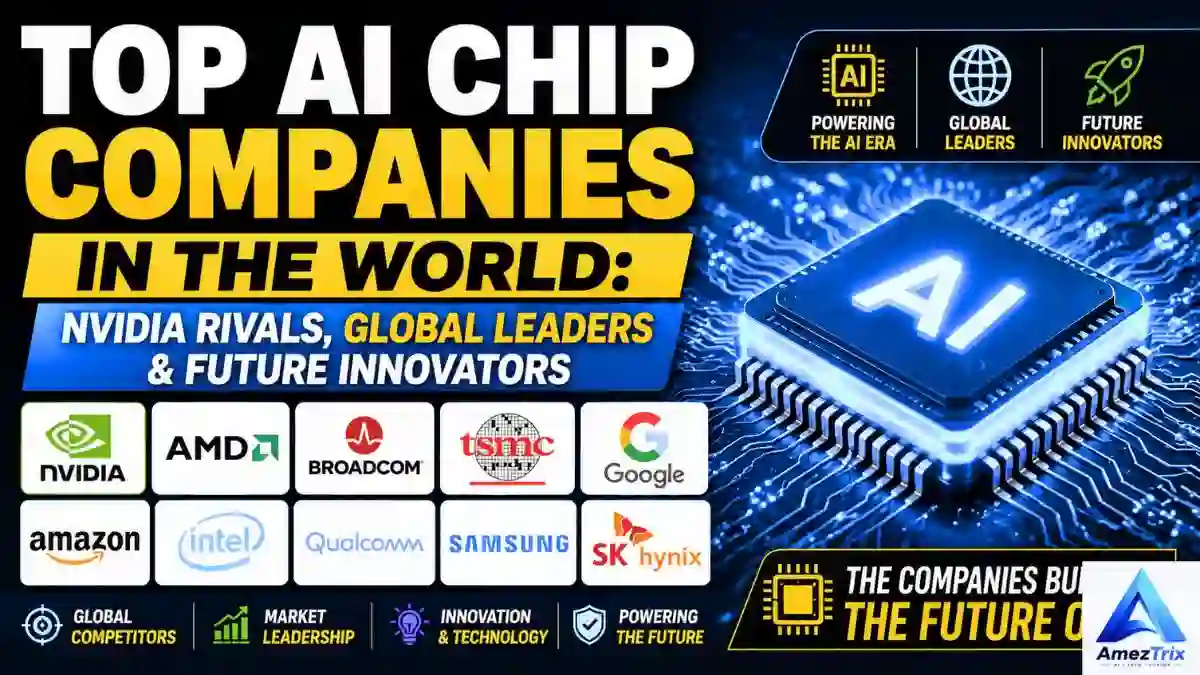
Top AI Chip Companies in the World (2026) — the complete, data-backed rundown of the AI chip makers, AI chip manufacturers, and rising custom-silicon players powering the global AI boom, from NVIDIA and AMD to TSMC, Google, Broadcom, and India’s new fabs.
Top AI Chip Companies in the World: A Complete Guide to AI Chip Makers, Manufacturers & Innovators (2026)
Artificial intelligence looks weightless from the outside — clever algorithms, sprawling neural networks, chatbots that answer in a heartbeat. Look past the interface, though, and something a lot heavier is holding the whole thing up: silicon. That’s precisely why the hunt for the best AI chip companies, the leading AI chip makers, and the most critical AI chip manufacturers has turned into one of the defining stories in tech today.
Here’s a number worth sitting with: training one frontier AI model can keep thousands of accelerator chips running non-stop for weeks. Once that model is ready, serving it to millions of people — fast, dependably, and without breaking the bank — turns out to be the tougher engineering challenge of the two. Neither phase happens without dedicated hardware.
That’s the real driver behind the fierce rivalry among AI hardware companies across the globe. NVIDIA is still the first name most people reach for, and it’s earned that spot fair and square. But framing this as a one-horse race would be a mistake. AMD keeps expanding its data-center AI footprint. Broadcom has quietly turned itself into a must-have partner for custom accelerator design and high-speed networking.
Google, Amazon, Microsoft, and Meta are all designing in-house silicon rather than only shopping for it. TSMC physically builds much of what these companies only sketch out on paper, while Samsung and SK hynix supply the memory that keeps everything running. Toss in Intel, Qualcomm, Marvell, Huawei, hungry startups such as Cerebras, Groq, and Tenstorrent, and India’s freshly commercial fabs, and the picture becomes a genuinely crowded one.
So which companies are actually setting the pace in 2026, and what makes each one different? Here’s the full picture.
What Counts as an “AI Chip”?
There isn’t one tidy definition, and honestly, that’s part of the story. “AI chip” is really an umbrella term for any processor purpose-built to crunch the heavy, repetitive math AI workloads demand. Ordinary CPUs are brilliant generalists, but they were never engineered for that volume of parallel calculation. That gap is what gave rise to a whole category of specialized silicon:
- GPUs (Graphics Processing Units)
- AI accelerators
- ASICs (Application-Specific Integrated Circuits)
- NPUs (Neural Processing Units)
- AI-optimized CPUs
- Networking chips built for AI clusters
- High-bandwidth memory (HBM)
- Custom, cloud-designed silicon
In the real world, a working AI training cluster rarely relies on just one of these. You’ll usually find GPUs or accelerators sitting alongside fast memory, CPUs quietly handling orchestration, and specialized networking stitching it all together. AI hardware, in that sense, isn’t a single market at all — it’s a sprawling ecosystem with a dozen interlocking parts, which is exactly why Omdia’s 2026 semiconductor outlook describes memory, advanced packaging, and cutting-edge manufacturing capacity as all being squeezed at the same time.
Top 10 AI Chip Companies: Market Cap, Workforce & Profit (2025–26)

Numbers cut through the noise better than opinions do, so here’s exactly where the ten biggest names in AI chips stand right now.
| # | Company | Market Cap (Aug 2026) | Employees | Annual Net Profit |
|---|---|---|---|---|
| 1 | NVIDIA | $5.24 trillion | ~42,000 | $120.1 billion (FY2026) |
| 2 | Alphabet (Google) | $4.13 trillion | ~190,820 | $132.17 billion (2025) |
| 3 | Amazon | $2.86 trillion | ~1.56 million | $77.67 billion (2025) |
| 4 | TSMC | $2.14 trillion | ~90,557 | $55.13 billion (2025) |
| 5 | Broadcom | ~$1.6–1.9 trillion | ~33,000 | $23.1 billion (FY2025) |
| 6 | Samsung Electronics | $1.26 trillion | ~262,647 | $31.6 billion (2025) |
| 7 | SK hynix | $859 billion | ~33,600 | ~$30 billion (2025) |
| 8 | AMD | ~$769 billion | ~32,000 | $4.3 billion (2025) |
| 9 | Intel | ~$489 billion | ~85,100 | −$0.27 billion (net loss, 2025) |
| 10 | Qualcomm | ~$169 billion | ~52,000 | $14.4 billion (FY2025) |
A couple of caveats before you treat these as gospel. “Market cap” and “net worth” are effectively the same figure once a company goes public — share price times shares outstanding — so the two terms are used interchangeably here. Fiscal calendars also don’t line up neatly: NVIDIA’s and TSMC’s fiscal years run on their own schedule, which is why NVIDIA’s FY2026 actually wrapped up in January 2026, not December.
Intel deserves a special callout: despite pulling in almost $53 billion in 2025 revenue, it still finished the year in the red, mostly thanks to how costly its foundry turnaround has become. SK hynix and Samsung’s numbers carry some built-in fuzziness too, since their profits originate in Korean won before being converted to dollars, and Broadcom’s market cap has bounced anywhere from $1.6 trillion to past $2 trillion given how turbulent chip stocks have been through 2026.
The Best AI Chip Companies, Ranked
1. NVIDIA — The Company Everyone Else Gets Measured Against
It’s genuinely hard to overstate how much NVIDIA has reshaped the AI hardware landscape. A business that started out selling graphics cards to gamers rebuilt itself into the backbone of large-scale AI computing, and its data-center GPUs now carry the majority of the world’s serious AI training and inference work.
What actually protects that lead isn’t the chip alone — it’s the whole package wrapped around it: CUDA, developer tooling, AI libraries, fast networking, and complete rack-scale systems sold as one unit.
Buyers aren’t just picking up a component; they’re buying into an entire platform, and walking away from that is genuinely painful for any competitor to replicate. Even so, more hyperscalers are steering workloads toward purpose-built accelerators rather than defaulting to general-purpose GPUs for every task.
NVIDIA’s real advantage: the seamless fusion of hardware, software, and a massive developer base that already knows exactly how to build on its platform.
2. AMD — NVIDIA’s Sharpest GPU Rival
AMD remains NVIDIA’s most credible GPU challenger inside the data center. Its Instinct accelerator line targets AI and HPC workloads head-on, while ROCm gives developers a CUDA alternative that gets more polished with every release.
AMD isn’t content just shipping chips anymore — it’s assembling full AI infrastructure. In 2026, the company confirmed that its second-generation Helios AI server platform hit full production, with shipments rolling out through Q3, aimed squarely at NVIDIA’s rack-scale offerings.
There’s a strategic undercurrent here too: large buyers increasingly want a credible second supplier for AI compute, if only to dodge getting locked into a single vendor.
What AMD brings to the table:
- Instinct AI accelerators
- EPYC server CPUs
- ROCm’s open software stack
- Long-standing, deep data-center partnerships
- An actual rack-scale AI systems strategy, not just a chip roadmap
AMD probably isn’t dethroning NVIDIA anytime soon, but it hands large buyers a genuine second option — and that alone shifts how the entire market negotiates pricing and supply.
3. Broadcom — The Custom-Silicon Specialist
Broadcom plays an entirely different game. Instead of chasing general-purpose GPU dominance, it has staked out a central role in custom AI silicon, high-speed networking, and data-center connectivity — territory that matters enormously once you’re operating at hyperscale.
Not every hyperscaler wants an off-the-shelf chip; plenty want silicon engineered specifically around their own workloads, and Broadcom has become the partner of choice for exactly that, including a fairly well-documented hand in Google’s own AI chip programs.
Why this matters: as custom silicon keeps looking more attractive at scale, Broadcom is well-positioned to be one of the biggest beneficiaries of that shift.
4. TSMC — The Foundry Behind Nearly Everyone
Taiwan Semiconductor Manufacturing Company doesn’t design AI chips at all — it builds them for almost everyone else. As the planet’s leading contract foundry, TSMC manufactures processors for nearly every major AI hardware name out there, NVIDIA, AMD, and Apple included.
That role has only grown more essential as AI chips demand ever more advanced process nodes and packaging. Manufacturing capacity has become just as strategically valuable as the chip design itself — Omdia’s research flags advanced packaging and leading-edge fabrication as two of the tightest chokepoints in the entire AI supply chain.
Put simply: a company like NVIDIA sketches the design, TSMC physically builds it, and memory specialists finish the job — which makes TSMC arguably the single most irreplaceable name in AI hardware, even though most people outside the industry have never heard of it.
5. Google — The Original TPU Believer
Google was among the earliest tech giants to bet seriously on custom AI silicon, and its Tensor Processing Unit (TPU) reflects that early conviction. Purpose-built for machine-learning workloads, TPUs let Google tune hardware and software together instead of forcing general-purpose chips to fit its needs — and increasingly, it’s opening that infrastructure up to outside customers rather than keeping it locked inside its own walls.
6. Amazon Web Services — Trainium and Inferentia
Amazon has walked a similar path through AWS, building two distinct chip families: Trainium, aimed at large-scale AI model training, and Inferentia, purpose-built for AI inference. Trainium in particular has become central to AWS’s AI infrastructure strategy, reportedly already running at serious scale with AI labs like Anthropic among its users.
Amazon’s presence on this list is proof the AI chip race isn’t limited to traditional semiconductor companies anymore — cloud providers have every reason to design their own hardware once small efficiency gains get multiplied across millions of chips.
7. Intel — Fighting Its Way Back
Intel is working hard to claw back relevance in AI computing, and its strategy spans CPUs, accelerators, networking, and manufacturing all at once. Its long-standing dominance in server CPUs leaves it with a massive installed base already sitting inside data centers worldwide. The real question is whether Intel can convert that footprint into meaningful growth in accelerated computing, and its manufacturing ambitions make it strategically important to the wider chip industry, far beyond its own product lineup.
Intel’s opening: as AI data centers lean harder on heterogeneous computing — CPUs, GPUs, accelerators, and networking chips working in concert — Intel has a real shot at competing across several layers of the stack rather than betting everything on one processor type.
8. Samsung Electronics — The Memory Backbone
Samsung’s importance to AI hardware runs through its memory business just as much as anywhere else. AI accelerators are only ever as good as the memory feeding them, which is exactly why High Bandwidth Memory (HBM) has become such a decisive piece of the puzzle. Omdia’s research names Samsung, SK hynix, and Micron as the three companies producing HBM at real scale, making all three essential regardless of who ultimately wins the processor race.
9. SK hynix — Quietly Running the HBM Show
SK hynix has quietly turned into one of the most strategically vital semiconductor companies of the AI era, almost entirely on the strength of its HBM leadership. Modern accelerators chew through staggering volumes of data, and ordinary memory simply can’t keep pace — HBM solves that by sitting extremely close to the processor and delivering far greater bandwidth than conventional memory ever could. As AI models keep expanding, HBM demand is expected to stay one of the biggest drivers of semiconductor investment.
10. Qualcomm — The Power Behind Edge AI
Qualcomm built its name in smartphone chips, but its AI ambitions now reach into PCs, cars, and edge computing more broadly. Its real edge is efficiency — squeezing meaningful AI performance out of a tiny power budget is genuinely difficult, and Qualcomm has been doing it for years.
As AI computing spreads beyond massive data centers into phones, vehicles, and industrial devices, that power-efficient design gives Qualcomm a lane to compete in on-device AI without ever needing to out-muscle NVIDIA in the data center.
11. Marvell Technology — The Infrastructure Layer
Marvell profits from AI infrastructure growth in ways that go well beyond compute chips. Its portfolio spans networking, storage, connectivity, and custom silicon design — a mix that rarely gets the press GPUs do.
The company recently deepened its collaboration with Google on custom AI chips, a clear signal of how quickly the custom-silicon space is moving. AI clusters need fast networking and efficient data movement just as urgently as raw processing power, and that’s precisely where Marvell operates.
12. Huawei — Anchoring China’s Domestic AI Chip Push
Huawei has become the anchor of China’s homegrown AI chip ecosystem. With export restrictions limiting Chinese access to some of the most advanced foreign AI processors, domestic alternatives have taken on outsized strategic weight. Huawei’s Ascend chip family reflects a heavy, sustained bet on domestic AI computing capability, and the geopolitical backdrop here — export controls, national security concerns, the push for technological self-reliance — is now deeply intertwined with the AI chip race itself.
Other AI Chip Companies Worth Keeping an Eye On
The AI semiconductor world stretches well past the household names.
Cerebras Systems takes an unconventional route, building enormous wafer-scale processors designed to cut down the communication bottlenecks that crop up when you wire together many smaller chips.
Groq made its name around inference speed, which matters more with every passing quarter as the industry’s focus tilts from training models toward actually serving them to users at scale.
Tenstorrent is building AI processors around open, scalable architectures — part of a broader wave of startups pushing back against the established chipmakers.
Microsoft has its own silicon ambitions through the Maia accelerator family, and reports from August 2026 suggest a next-generation Maia 300 chip is already in development.
Meta has poured real money into its MTIA accelerator line to support its enormous internal AI workloads — a pattern that keeps repeating across the industry once a company reaches enough scale that custom hardware simply pencils out better than buying general-purpose chips off the shelf.
Complete List of AI Chip Companies (Quick Reference)
If a scannable list of AI chip companies grouped by function is what you’re after, here it is:
- GPU and AI accelerator designers: NVIDIA, AMD, Intel, Qualcomm
- Custom silicon built in-house by hyperscalers: Google (TPU), Amazon (Trainium/Inferentia), Microsoft (Maia), Meta (MTIA)
- Custom ASIC and networking specialists: Broadcom, Marvell
- Foundries and contract manufacturers: TSMC, Samsung Foundry, Intel Foundry
- HBM and advanced memory suppliers: SK hynix, Samsung, Micron
- China’s domestic AI chip ecosystem: Huawei, SMIC
- AI accelerator startups: Cerebras, Groq, Tenstorrent
- India’s emerging semiconductor players: Tata Electronics, Micron India, CG Power, Kaynes Technology
That’s essentially the entire AI chip stack condensed into one scrollable list — handy if you’re mapping out the industry quickly instead of reading company by company.
AI Chip Manufacturers by Country
No single nation builds AI chips start-to-finish on its own — design, fabrication, memory, and packaging are scattered across a handful of countries that each own one link in the chain.
| Country | Key Companies | What They’re Known For |
|---|---|---|
| United States | NVIDIA, AMD, Intel, Qualcomm, Broadcom, Micron, Cerebras, Groq | Chip design, GPUs, custom silicon, memory |
| Taiwan | TSMC, MediaTek | Advanced foundry manufacturing |
| South Korea | Samsung, SK hynix | HBM and advanced memory, foundry services |
| China | Huawei, SMIC | Domestic AI accelerators, mature-node fabrication |
| Netherlands | ASML | EUV lithography equipment that makes advanced chips possible in the first place |
| Japan | Renesas, Kioxia | Power semiconductors, NAND memory |
| India | Tata Electronics, Micron (India operations), CG Power, Kaynes Technology | Fast-growing fabrication and assembly-and-test capacity |
AI Chip Manufacturers in India: The 2026 Turning Point
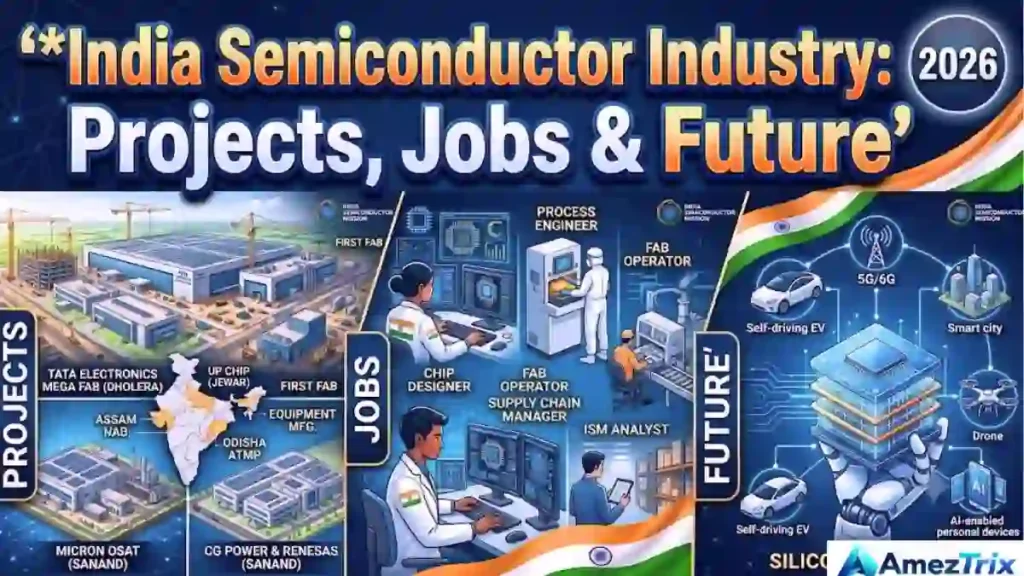
For well over a decade, India supplied the world’s chip industry with engineering talent while manufacturing almost nothing at home. That’s finally shifting in 2026, with Union Minister Ashwini Vaishnaw confirming that four semiconductor facilities are moving into commercial production this year.
Tata Electronics is spearheading the push on two fronts: a roughly $11 billion wafer fab in Dholera, Gujarat, built alongside Taiwan’s Powerchip Semiconductor Manufacturing Corporation (PSMC), targeting the 28nm process node with capacity for 50,000 wafers a month, plus a separate assembly-and-test facility in Jagiroad, Assam, that’s already up and running and handling packaging and testing for mature-node logic chips and display drivers.
Micron Technology became the first major US semiconductor company to build in India, and its $2.75 billion assembly-and-test plant in Sanand, Gujarat is now in volume production, packaging and testing DRAM and NAND memory chips.
CG Power, partnering with Japan’s Renesas, is standing up its own OSAT (outsourced assembly and test) facility, also in Sanand, while Kaynes Technology completes the group of four companies driving India’s first wave of commercial chip production.
Taken together, these projects represent well over ₹1.6 lakh crore in approved investment. It’s worth being exact about what that means in practice: most of this is assembly, testing, and mature-node capacity rather than cutting-edge AI GPU fabrication, so India isn’t about to out-produce TSMC or Samsung on leading-edge silicon overnight.
But it is becoming a genuine link in the global AI hardware supply chain, and the design side is advancing too — IIT Madras’ RISC-V-based Shakti processor is targeting the 7nm node for high-performance server and AI workloads, alongside a growing wave of fabless chip-design startups.
Top AI Companies in India (2026)
Separate from the hardware story, India’s software-and-model layer of AI has grown at a striking pace — more than 170 AI startups have collectively raised upwards of $2.6 billion, with most of that capital flowing into application-layer products rather than chips themselves. A few of the names leading that charge:
- Ola Krutrim — India’s first homegrown AI unicorn, building large language models across roughly 22 Indian languages alongside its own AI cloud infrastructure.
- Sarvam AI — a Bengaluru-based foundation-model company focused on Indian languages, now valued at around $1.5 billion.
- Kore.ai — an enterprise conversational-AI platform built for customer service and virtual assistants.
- Fractal Analytics — a well-established AI and analytics firm serving large global enterprises.
- Uniphore — enterprise conversational and agentic AI aimed at customer-experience teams.
- CoRover (BharatGPT) and Gnani.ai — building India-centric conversational and voice-AI models.
Alongside these AI-first companies, India’s IT majors — TCS, Infosys, and Wipro — are also scaling up their AI practices and partnering directly with NVIDIA to build out AI computing infrastructure.
Top 5 AI Companies in India at a Glance
| # | Company | Focus | Notable Milestone |
|---|---|---|---|
| 1 | Ola Krutrim | LLMs & AI cloud | India’s first AI unicorn (2024) |
| 2 | Sarvam AI | Indian-language foundation models | ~$1.5 billion valuation |
| 3 | Kore.ai | Enterprise conversational AI | $220M+ in funding |
| 4 | Fractal Analytics | Enterprise AI & analytics | Long-established, global client base |
| 5 | Uniphore | Agentic & conversational AI | Enterprise customer-experience focus |
Chip Designers vs. Chip Manufacturers: A Distinction Worth Knowing
Here’s something that trips people up constantly: designing an AI chip and physically manufacturing one are two entirely different jobs.
| Company | Primary Role | AI Contribution |
|---|---|---|
| NVIDIA | Chip designer/platform | GPUs, accelerators, software |
| AMD | Chip designer | Instinct accelerators, CPUs |
| Broadcom | Custom silicon/infrastructure | AI ASICs, networking |
| Technology company | TPU accelerators | |
| Amazon | Cloud/technology company | Trainium, Inferentia |
| Microsoft | Technology/cloud company | Maia accelerators |
| TSMC | Semiconductor foundry | Advanced chip manufacturing |
| Samsung | Semiconductor manufacturer | Memory, foundry, HBM |
| SK hynix | Memory manufacturer | HBM and advanced memory |
| Intel | Chip designer/manufacturer | CPUs, accelerators, foundry |
| Qualcomm | Chip designer | Edge and AI processors |
| Marvell | Semiconductor company | Custom silicon, networking |
| Huawei | Technology/semiconductor company | Ascend AI processors |
This split matters because the AI supply chain only works when every one of these roles connects properly. A brilliant chip design counts for nothing without the manufacturing capacity, memory supply, and networking infrastructure needed to actually bring it to life.
Why NVIDIA Still Dominates the AI Chip Market
If dozens of companies are building AI chips today, why is NVIDIA still sitting comfortably on top? It isn’t just raw GPU horsepower — it’s a stack of advantages, layered one on top of another:
Hardware — massive parallel processing power engineered specifically for AI workloads.
CUDA — a mature, battle-tested software environment developers have relied on for over a decade.
AI libraries — pre-optimized tools that make building and shipping models noticeably faster.
Networking — high-speed interconnects that let thousands of chips behave like a single system.
Full systems — complete rack-scale data-center solutions, not just standalone chips.
Developer familiarity — millions of engineers already know exactly how NVIDIA’s ecosystem works.
Stack those together and you get a serious network effect — the kind that’s genuinely hard to break from the outside. The real question any company faces isn’t “which chip is fastest” but “which platform lets our team build, deploy, and scale AI with the least friction?” That’s a far harder problem for any single rival to crack, no matter how strong its silicon is.
Could AMD Ever Become NVIDIA’s Biggest Threat?
AMD’s position is genuinely compelling because it can compete on multiple fronts at once. Its EPYC processors already hold a solid data-center foothold, Instinct accelerators go straight after AI and HPC workloads, and ROCm remains AMD’s long-term wager on closing the software gap with CUDA — still a work in progress, but a serious one.
Increasingly, AMD isn’t simply pitching a rival GPU; it’s selling an entire alternative AI infrastructure platform backed by its Helios rack-scale systems. Whether AMD can eventually build a software ecosystem strong enough to match CUDA’s decade-long head start is the single question that could reshape one of the most consequential rivalries in AI computing.
The Rise of Custom AI Silicon
The biggest long-term threat to the traditional GPU model probably isn’t a better GPU at all — it’s custom silicon. Companies running massive data centers genuinely have different workloads: Google’s search infrastructure looks nothing like Amazon’s cloud operations, and Meta’s recommendation engines are a completely different beast from Microsoft’s AI services.
Rather than buying an identical general-purpose chip for every job, hyperscalers with enough scale can afford to design hardware tailored to their exact needs, and at that scale, the economics start making real sense fast.
Industry data from 2026 shows custom ASIC development becoming an increasingly central pillar of AI infrastructure strategy across every major hyperscaler. Does this spell the end for GPUs? Not really — it more likely points toward a blended future in which GPUs, custom ASICs, CPUs, networking chips, HBM, and advanced packaging all work side by side, rather than any one architecture winning outright.
Why High-Bandwidth Memory Matters So Much
A powerful processor is only ever as useful as the data it can actually reach, which is exactly why High Bandwidth Memory has become one of the hottest, quietest corners of the semiconductor industry. AI accelerators grind through enormous volumes of calculations, and that demands memory bandwidth far beyond anything standard chips ever needed — which is where SK hynix, Samsung, and Micron step in, all three critical links in the AI supply chain whether or not most people outside the industry realize it.
When advanced memory or packaging capacity runs tight, it directly caps how many AI accelerators companies can actually produce. Put simply: the AI chip race is, in large part, a memory race in disguise.
Why TSMC and Advanced Packaging Quietly Run the Show
There’s a bottleneck that gets far less attention than it deserves: manufacturing. Designing a groundbreaking AI processor is only half the job — it still has to be built at scale, and that’s harder than it sounds. Modern accelerators increasingly rely on advanced packaging that fuses processor dies, memory, and other components into one tightly engineered system, and TSMC sits right at the center of that entire process. As AI demand keeps climbing, available manufacturing and packaging capacity increasingly dictates how fast companies can actually ship new hardware. The real competitive map isn’t simply “NVIDIA vs. AMD” — it’s design, manufacturing, memory, packaging, networking, and software, all competing and cooperating simultaneously.
How Are AI Chips Actually Manufactured?
It’s easy to toss around the phrase “chip manufacturing” without ever explaining what it involves. Here’s the process broken down in plain terms:
- Design. Engineers use specialized EDA (electronic design automation) software to lay out a chip’s architecture — cores, memory blocks, and the billions of transistors that will eventually sit on a few square centimeters of silicon.
- Wafer fabrication. A thin silicon wafer goes through hundreds of steps of photolithography, etching, and material deposition. For the most advanced AI chips, that means EUV (extreme ultraviolet) lithography, precise enough to print patterns fine enough to fit tens of billions of transistors onto a single die.
- Wafer testing. Every individual chip (die) is electrically tested while still attached to the wafer, so defective dies get flagged before any more time or material is wasted on them.
- Packaging and assembly. Good dies are cut from the wafer and packaged. Modern AI accelerators increasingly rely on advanced packaging — techniques like TSMC’s CoWoS — that bond the compute die directly to stacks of HBM memory for maximum bandwidth.
- Final testing and binning. Finished chips get tested once more for performance and power draw, then sorted (“binned”) into different product tiers based on how well they hold up.
- Integration. Packaged chips are mounted onto boards, cards, or server modules and shipped off to data centers, PCs, or devices.
One distinction worth remembering: fabless companies like NVIDIA, AMD, and Qualcomm only handle the design step and hand off fabrication to foundries such as TSMC, while IDMs (integrated device manufacturers) like Intel and Samsung both design and manufacture their own chips in-house.
Who Are NVIDIA’s Real Competitors?
There’s no single answer here, because NVIDIA faces a different rival depending on the category:
- GPU competition: AMD is the clearest large-scale rival, hands down.
- Custom accelerators: Google, Amazon, Microsoft, Meta, and Broadcom all compete on this front.
- AI networking: Broadcom and Marvell are the major infrastructure suppliers here.
- Memory: SK hynix, Samsung, and Micron dominate this layer completely.
- Chinese AI chips: Huawei leads domestic competition by a wide margin.
- AI accelerator startups: Cerebras, Groq, and Tenstorrent are exploring architectures that look nothing like the mainstream approach.
Calling any single company “the NVIDIA killer” misses the point entirely — NVIDIA is being challenged from multiple directions at once, not by one clear successor waiting in the wings.
Top AI Chip Companies — Quick Comparison Table
| Company | Main AI Focus | Biggest Strength |
|---|---|---|
| NVIDIA | GPUs & AI systems | CUDA ecosystem, complete platforms |
| AMD | GPUs & AI servers | Instinct + ROCm |
| Broadcom | Custom AI silicon | ASICs and networking |
| TSMC | Manufacturing | Advanced foundry capacity |
| Custom accelerators | TPU ecosystem | |
| Amazon | Custom cloud chips | Trainium & Inferentia |
| Intel | CPUs & AI silicon | Data-center footprint |
| Samsung | Memory & semiconductors | HBM and manufacturing |
| SK hynix | HBM | AI memory leadership |
| Qualcomm | Edge AI | Power-efficient processors |
| Marvell | Custom silicon | Networking and infrastructure |
| Huawei | AI accelerators | Chinese domestic ecosystem |
| Microsoft | Custom AI chips | Cloud infrastructure |
| Meta | Custom accelerators | Internal AI workloads |
| Cerebras | AI accelerators | Wafer-scale architecture |
| Groq | AI inference | Specialized inference chips |
| Tenstorrent | AI processors | Open, alternative architecture |
NVIDIA and Other AI Chip Companies Worth Researching for Investment
A common follow-up question is which AI chip companies deserve a closer look from an investing angle. Here’s a quick, factual snapshot of the publicly traded names that come up most often in that conversation:
- NVIDIA — the largest and most profitable pure-play AI chip company, with the CUDA ecosystem as its moat.
- AMD — the main alternative GPU supplier, smaller in scale but growing its data-center AI revenue steadily.
- Broadcom — exposure to custom AI silicon and networking rather than GPUs directly.
- TSMC — manufactures chips for nearly every major AI chip designer, which is why some investors treat it as a broad bet on the whole industry rather than any single company.
- Samsung Electronics and SK hynix — direct exposure to the HBM memory side of the AI buildout.
- Qualcomm and Marvell — narrower, more specialized bets on edge AI and networking, respectively.
- Micron — a US-listed memory maker with direct exposure to HBM demand.
This is general information, not financial advice. Market caps, earnings, and valuations shift constantly; chip stocks have been especially volatile through 2026, and this article is no substitute for independent research or guidance from a licensed financial advisor before making any investment decision.
What’s Driving the Next Phase of the AI Chip Market?
1. Inference at scale. Training grabs most of the headlines, but inference could end up being the far bigger market — every query, image, and summary an AI model produces eats up compute, and that demand quietly adds up in the background.
2. Agentic AI. AI agents that reason through multiple steps, call tools, and act on their own consume dramatically more compute per interaction than a simple chatbot reply ever would.
3. Energy efficiency. AI data centers already draw staggering amounts of electricity. Future chips won’t be judged on raw speed alone — useful computation per watt, per dollar, is the metric that actually matters.
4. Custom silicon. Expect hyperscalers to keep expanding their own chip programs as the economics keep getting more attractive at scale.
5. Edge AI. AI is steadily moving out of massive data centers and into phones, cars, robots, and industrial equipment — real opportunity for companies focused on low-power design, which is exactly where Qualcomm’s bet pays off.
6. Advanced memory. As models keep getting larger, memory bandwidth becomes an ever-tighter constraint, and HBM isn’t going anywhere.
Where Does the AI Chip Industry Go From Here?
The AI hardware industry is entering a genuinely interesting phase — arguably its most interesting yet. The first wave of generative AI created explosive demand for high-performance accelerators, and NVIDIA happened to be perfectly positioned to catch it.
What comes next looks far more fragmented — cloud providers building their own chips, semiconductor companies designing specialized accelerators, memory manufacturers racing to expand HBM production, networking companies working to move data faster between processors, and foundries pouring money into advanced manufacturing years ahead of demand actually materializing.
NVIDIA will almost certainly stay central to this story, but the ecosystem around it keeps getting more competitive month over month. AMD keeps pushing into AI infrastructure. Broadcom keeps growing through custom silicon. Google and Amazon keep expanding their own accelerator programs.
Microsoft and Meta are following a similar playbook. TSMC remains essential to advanced manufacturing; Samsung, SK hynix, and Micron anchor the memory supply chain beneath everything else, and India’s new fabs are adding one more link to a global chain that keeps getting longer.
Frequently Asked Questions
Which company is the No. 1 AI chip maker?
NVIDIA currently holds the strongest position among AI chip makers, particularly in data-center GPUs. Its combination of hardware, CUDA software, networking, and complete systems gives it a lead that’s genuinely tough to challenge right now.
Who are Top AI Chip Companies in the World?
NVIDIA, AMD, Broadcom, TSMC, Intel, and Qualcomm design AI chips, while specialized foundries — most notably TSMC — physically manufacture many of the most advanced processors. Samsung and SK hynix round out the list as the leading manufacturers of AI memory.
Who is NVIDIA’s biggest rival?
AMD is NVIDIA’s most direct large-scale GPU competitor. NVIDIA also faces growing pressure from custom chips built by Google, Amazon, Microsoft, and Meta — a different kind of threat altogether.
Is TSMC considered an AI chip company?
Not exactly. TSMC is a semiconductor foundry, not a chip designer, but it’s arguably one of the most strategically critical companies in the entire AI supply chain since it manufactures advanced chips for nearly every major AI hardware company out there.
Who supplies HBM for AI chips?
Samsung, SK hynix, and Micron are the three major HBM suppliers, and HBM has become essential to high-performance AI accelerators.
Are Google and Amazon really NVIDIA competitors?
Yes, though their approach differs quite a bit. Google and Amazon build custom accelerators mainly for their own infrastructure and cloud platforms, while NVIDIA sells a broad, general-purpose AI computing platform to customers worldwide.
Will custom AI chips eventually replace NVIDIA’s GPUs?
Probably not entirely. Custom accelerators will likely capture a bigger share of specific workloads, but general-purpose GPUs stay valuable because of their flexibility and mature software support — that’s not something anyone replaces overnight.
Which AI chip companies are worth watching in 2026?
NVIDIA, AMD, Broadcom, TSMC, Intel, Qualcomm, Marvell, Samsung, SK hynix, and the major tech companies building custom silicon are all worth following. Treat this as an industry overview, not financial advice — do your own research before making investment decisions.
What are the top AI chip manufacturers in India?
Tata Electronics, Micron (through its Sanand assembly-and-test plant), CG Power, and Kaynes Technology are leading India’s first wave of commercial semiconductor production in 2026, alongside IIT Madras’ Shakti processor project on the design side.
Is India manufacturing its own AI chips yet?
Not at the cutting edge yet. India’s current facilities focus mainly on assembly, testing, and mature-node fabrication (28nm and above) rather than the leading-edge nodes used in the newest AI GPUs, though that capacity is expected to expand meaningfully through 2027–2028.
Which are the top AI companies in India?
Ola Krutrim and Sarvam AI are currently India’s most-funded AI companies, followed by Kore.ai, Fractal Analytics, and Uniphore in the enterprise AI space.
How are AI chips actually manufactured?
In short: design, wafer fabrication using photolithography, wafer testing, advanced packaging (often bonding the chip to HBM memory), final testing, and integration into boards or server modules. See the manufacturing breakdown earlier in this guide for the full step-by-step process.
Which country manufactures the most AI chips?
Taiwan, through TSMC, manufactures the largest share of the world’s most advanced AI chips, while South Korea (Samsung, SK hynix) leads on AI memory and the United States leads on chip design.
Final Thoughts: Is There a Single Winner Coming?
Probably not. The AI semiconductor industry has grown too large, and too layered, for any single company to control every piece of it. NVIDIA still holds an extraordinary lead in accelerated computing, AMD is building a legitimate alternative, and Broadcom has carved out real strength in custom silicon and networking. Google, Amazon, Microsoft, and Meta are all cutting their dependence on outside vendors through in-house chips, TSMC remains irreplaceable on the manufacturing side; and Samsung,
SK hynix, and Micron control the memory layer that makes any of this actually work. Startups like Cerebras, Groq, and Tenstorrent prove there’s still room for genuinely new ideas in chip architecture, even up against giants this large — and India’s entry into commercial fabrication shows the map is still being redrawn.
The real AI chip race is much bigger than “NVIDIA vs. AMD.” It spans processors, memory, manufacturing, packaging, networking, software, cloud infrastructure, and energy efficiency, all at once — which is exactly what makes it one of the most important technology markets to watch right now, arguably more important than most people outside the industry realize.
As AI models grow more capable and AI tools work their way into everyday business and daily life, understanding the companies building the hardware behind it all matters just as much as understanding the models themselves.
Key Takeaways
- NVIDIA remains the clear leader among AI chip companies and AI chip makers.
- AMD is the strongest traditional GPU challenger at scale.
- Broadcom is increasingly central to custom AI silicon and networking.
- Google and Amazon have built serious custom-chip ecosystems of their own.
- Microsoft and Meta are investing heavily in proprietary accelerators too.
- TSMC’s manufacturing capacity is essential to nearly every advanced AI chip.
- Samsung, SK hynix, and Micron anchor the HBM supply chain.
- Qualcomm and others are pushing AI further into edge devices.
- Huawei anchors China’s domestic AI chip ecosystem.
- Cerebras, Groq, and Tenstorrent represent the next wave of AI chip startups.
- India is emerging as a new link in the AI chip supply chain, with Tata Electronics, Micron, CG Power, and Kaynes Technology driving its first wave of commercial semiconductor production in 2026.
- The future of AI infrastructure will likely blend GPUs, ASICs, CPUs, HBM, networking, and custom silicon rather than settling on one architecture.
The biggest winner in this race may not turn out to be the company that builds the single fastest chip — it might simply be whoever solves the entire AI computing puzzle: silicon, memory, networking, software, manufacturing, and energy efficiency, all together.
About Author
Rajendra Parmar is the Founder and Editor of AmezTrix, where he covers Artificial Intelligence, Technology, WordPress, Web Hosting, Digital Marketing, Gadgets, and Software. His mission is to simplify complex technology through practical tutorials, honest reviews, and well-researched guides that help readers make smarter digital decisions.

Rajendra Parmar
Founder & Editor • AmezTrix
Rajendra Parmar is the Founder and Editor of AmezTrix, a platform covering Artificial Intelligence, Technology, WordPress, Web Hosting, Digital Marketing, Gadgets, Software Reviews, and emerging innovations. His mission is to simplify complex technology through practical tutorials, honest reviews, and well-researched guides that help readers make smarter digital decisions.