Discover 25 profitable AI automation business ideas for 2026, including AI agents, marketing automation, chatbots, and small-business services.
Most people hear “AI business” and picture a startup training the next giant model. You don’t need that. The real money right now sits in something far less glamorous: helping ordinary companies stop doing boring, repetitive work by hand.
That’s the heart of every good AI automation business idea. You find a task that eats a team’s hours, connect an AI model to the software they already use, and turn the mess into a workflow that runs by itself. This guide covers 25 ideas, what each one costs to start, how to price it, which tools to use and how to land your first client.
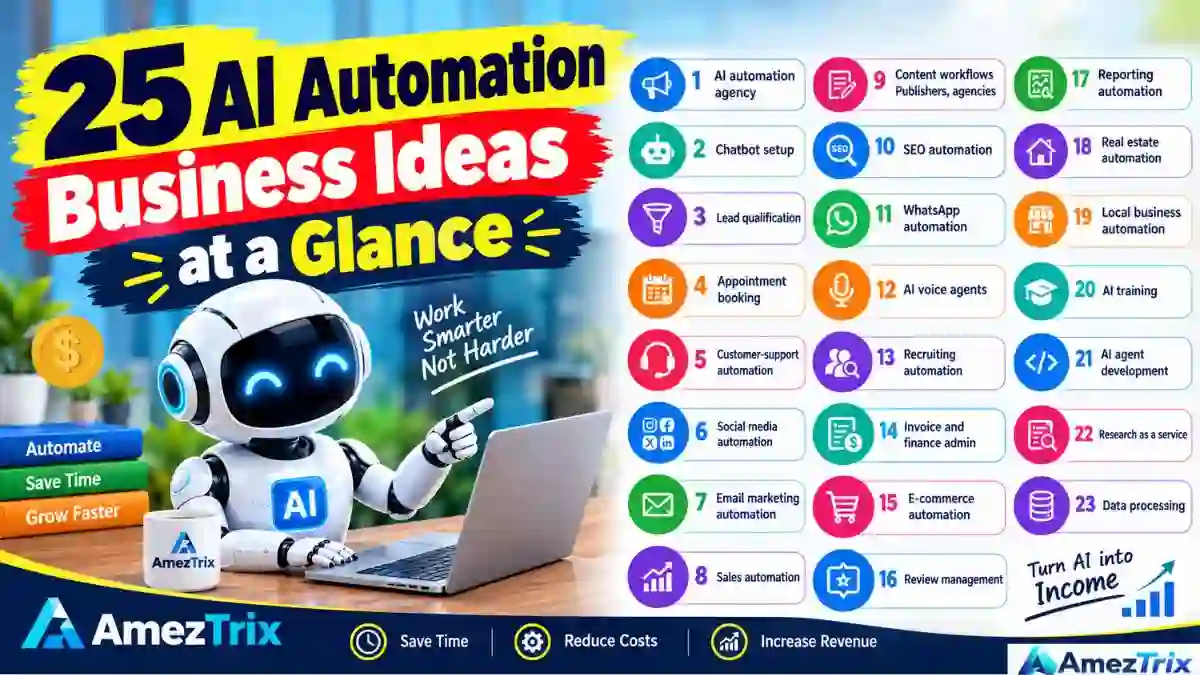
AI Automation Business Ideas: 25 Profitable Ideas
Quick Answer: What Are the Best AI Automation Business Ideas?
The best AI automation business ideas are services that use AI and workflow tools to remove repetitive work for a specific type of company. Top picks for 2026 include an AI automation agency, chatbot setup, lead qualification, appointment booking, customer-support automation, WhatsApp automation, AI voice agents and reporting automation. Start with one niche and one workflow, then grow.
| Start here if you… | Best first idea |
|---|---|
| Have little money and no coding skills | AI consulting, AI training, AI content workflows |
| Can use no-code tools | Chatbot setup, lead follow-up, appointment booking |
| Want recurring income | AI automation agency with monthly retainers |
| Know how to code | AI agent development, voice agents, vertical SaaS |
| Prefer a local, face-to-face market | Automation for clinics, salons, restaurants, real estate |
One rule runs through all of them: don’t sell “AI”. Sell the result. More leads, faster replies, fewer hours lost to admin.
What’s Inside This Guide
- What an AI automation business is
- Why 2026 is a good time to start
- All 25 ideas compared in one table
- The 25 ideas in detail
- Tools you’ll need
- How to start, step by step
- Pricing and earnings
- How to find your first customers
- Service business vs SaaS
- Opportunities in India and other fast-growing markets
- How to calculate ROI
- Mistakes to avoid
- FAQ
What are AI automation business ideas?
An AI automation business sells products or services that use artificial intelligence to complete tasks people would otherwise do manually, such as answering customer questions, qualifying leads, booking appointments or building reports.
Old-style automation follows fixed rules: if this happens, do that. It works until something unexpected shows up, and then it breaks. AI automation is looser. It can read a message, work out what the person wants, pick a next step and carry it out.
Picture a new sales lead. A traditional system sends the same “thanks for contacting us” email to everyone. Google AI tools-based one reads the enquiry, rates the lead as hot or cold, checks the CRM, books a call, pings a salesperson and sends a follow-up two days later if nobody answered.
Same lead. Very different outcome.
If you want to see how this goes one step further, our guide to AI agent automation explains how agents plan and act across several tools.
Why 2026 Is a Good Time to Start
A couple of years ago, businesses were curious about AI. Now many are tired of experiments and want something that does a job. They don’t need another chatbot demo. They want enquiries answered at 11 p.m. without hiring a night shift.
Here’s the gap, and it’s the whole opportunity: plenty of owners know AI could help, but very few know what to automate, which tools to pick, how to connect them or how to keep control. If you can bridge that gap, you have a business.
Competition is growing too, so be careful with vague positioning. “We do AI stuff” is crowded. “We handle WhatsApp enquiries for dental clinics” is not.
25 AI Automation Business Ideas at a Glance
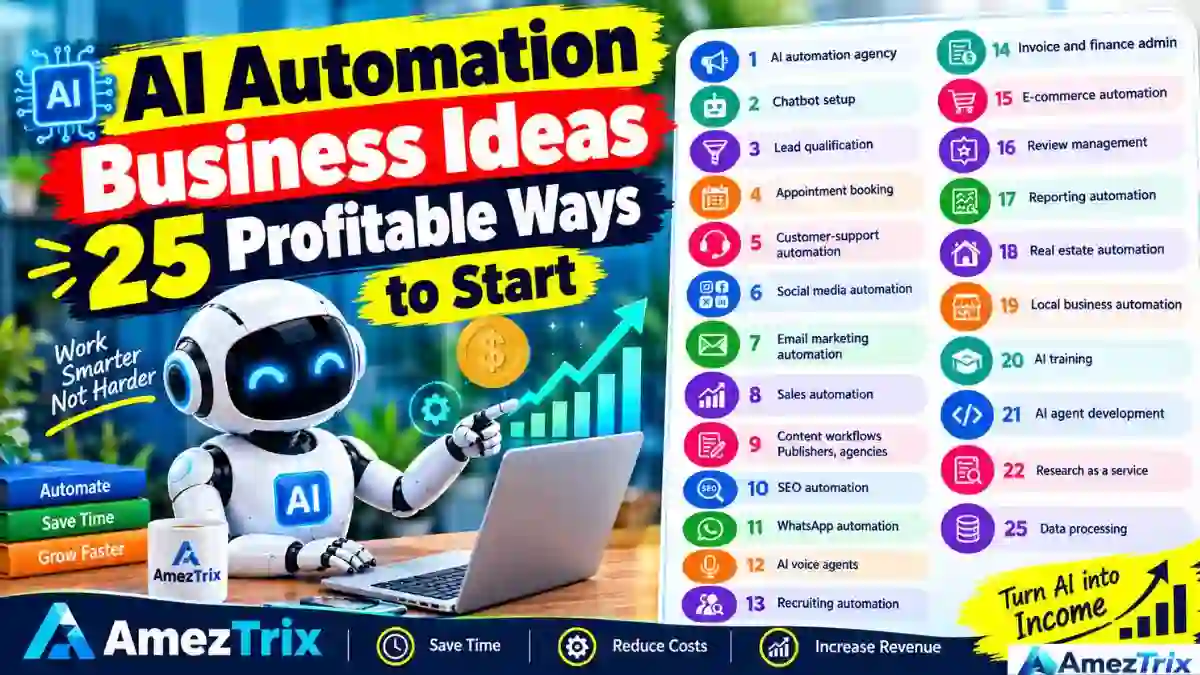
| # | Idea | Best for | Startup cost | Skill level | Common pricing |
|---|---|---|---|---|---|
| 1 | AI automation agency | SMBs, startups | Medium | Medium | Setup + retainer |
| 2 | Chatbot setup | Hotels, clinics, stores | Low to medium | Medium | Project + monthly |
| 3 | Lead qualification | Sales teams | Medium | Medium | Setup + monthly |
| 4 | Appointment booking | Clinics, salons | Low to medium | Low to medium | Project + monthly |
| 5 | Customer-support automation | E-commerce, SaaS | Medium | Medium | Setup + monthly |
| 6 | Social media automation | Small brands | Low | Low to medium | Monthly |
| 7 | Email marketing automation | Online stores, creators | Low to medium | Medium | Project + monthly |
| 8 | Sales automation | B2B teams | Medium | Medium | Setup + monthly |
| 9 | Content workflows | Publishers, agencies | Low | Low to medium | Monthly |
| 10 | SEO automation | Agencies, site owners | Low | Medium | Monthly |
| 11 | WhatsApp automation | Local and mobile-first markets | Medium | Medium | Setup + monthly |
| 12 | AI voice agents | Clinics, real estate, services | Medium | Medium to high | Setup + usage |
| 13 | Recruiting automation | HR teams, staffing firms | Medium | Medium | Monthly |
| 14 | Invoice and finance admin | Small businesses | Medium | Medium | Project + monthly |
| 15 | E-commerce automation | Online stores | Medium | Medium | Setup + monthly |
| 16 | Review management | Restaurants, hotels | Low | Low to medium | Monthly |
| 17 | Reporting automation | Marketing teams | Low to medium | Medium | Project + monthly |
| 18 | Real estate automation | Brokers, developers | Medium | Medium | Setup + monthly |
| 19 | Local business automation | Neighborhood businesses | Low | Low to medium | Project + monthly |
| 20 | AI training | Companies, teams | Low | Medium | Per workshop |
| 21 | AI agent development | Mid-size firms | Medium to high | High | Custom project |
| 22 | Research as a service | Consultants, founders | Low | Medium | Per report or monthly |
| 23 | Data processing | Document-heavy firms | Low to medium | Medium | Project |
| 24 | Industry-specific automation | One chosen sector | Medium | Medium | Setup + retainer |
| 25 | AI automation SaaS | Many customers, one problem | High | High | Subscription |
Treat the cost and skill columns as rough guides. Your numbers will move with your country, your tools and how much you build yourself.
25 AI Automation Business Ideas in Detail
1. AI Automation Agency
The classic starting point. You don’t build a new model. You study how a company works today and automate the painful parts: lead capture, support, email, bookings, CRM updates, reports and follow-ups.
| Revenue model | How you earn |
|---|---|
| Setup fee | One-time build |
| Monthly retainer | Running and improving the system |
| Consulting | Workflow audits and strategy |
| Training | Teaching staff to use the tools |
| Custom projects | Bigger one-off builds |
The retainer is where agencies find stability. Setup fees pay this month’s bills; monthly fees pay next year’s.
2. AI Chatbot Setup Service
Businesses answer the same questions all day: opening hours, prices, delivery times, return policy. A well-trained chatbot handles most of it and hands tricky cases to a person.
Good targets are hotels, restaurants, clinics, coaching centers, online stores and real estate firms. Pick one and you’ll sell faster than any generalist.
3. AI Lead Generation and Qualification
Leads go cold fast. A system that replies within a minute, asks the right questions and scores the answers is worth real money to a sales team.
Take a property business. The bot asks about budget, location, timeline and financing, then labels each enquiry hot, warm or cold. The agent only calls the hot ones.
4. AI Appointment Booking
Doctors, dentists, salons, lawyers, coaches, repair shops, personal trainers. They all lose time to back-and-forth scheduling. An AI booking assistant answers questions, offers open slots and confirms the visit. Add reminders and you cut no-shows too.
5. AI Customer Support Automation
Support is the most obvious use case and still one of the best. The system can search a knowledge base, tag tickets, draft replies, flag urgent issues and summarize long threads.
Don’t try to replace people completely. The setup that works: AI takes routine requests, humans take sensitive or complicated ones.
6. AI Social Media Automation
Small brands struggle to post consistently. Build a workflow that turns one long article into a LinkedIn post, an Instagram caption, a Facebook update and a short-video script, then add a content calendar and performance summaries.
Keep a human in the loop for brand voice and facts. Fully automated accounts tend to sound like nobody.
7. AI Email Marketing Automation
Most email sequences are blunt: everyone gets the same message. With AI you can group subscribers by purchases, clicks and questions asked, then adjust the follow-up for each group. Online stores, course creators and SaaS companies are natural buyers.
8. AI Sales Automation
Salespeople hate admin, and admin eats a big slice of their week. Automate meeting notes, CRM updates, follow-up reminders, proposal drafts and basic prospect research. The rep still closes the deal; the software handles the paperwork.
It’s easy to price, because you can tie it to hours saved or deals followed up.
9. AI Content Automation
Workflows for keyword research, briefs, outlines, drafts, repurposing and metadata can save a content team plenty of time. But there’s a trap.
Google’s published spam policies target large volumes of low-value pages made mainly to manipulate rankings, whether a human or a machine wrote them. So the sensible offer is AI-assisted content with real expertise and editing on top, not thousands of generic articles. Quality is the product.
10. AI SEO Automation
A lot of SEO work is repetitive: clustering keywords, classifying search intent, spotting content gaps, suggesting internal links, writing reports. Automate the grunt work and keep the judgment calls human.
11. AI WhatsApp Automation
In many countries, including India, Brazil and Indonesia, plus large parts of Europe and Africa, WhatsApp is where customers actually talk to businesses. A bot that handles product questions, bookings, order updates and lead qualification there is genuinely useful.
Pitch it well. “I build WhatsApp bots” is forgettable. “I turn your WhatsApp enquiries into booked customers” gets a reply. One practical note: messaging platforms update their rules for business bots and AI features often, so read the current policy before you build.
12. AI Voice Agents
Voice AI has improved a lot. An agent can answer calls, handle FAQs, qualify callers, book appointments, summarize each call and route urgent ones to a person.
It suits clinics, real estate, hospitality, home services and car dealers. For anything sensitive, plan for human handoff, privacy controls and a clear statement that the caller is talking to an AI. Some regions also have rules on recording calls, so check local law.
13. AI Recruiting Automation
Recruiters drown in applications. AI can sort resumes, extract details, match skills to a role, schedule interviews and write candidate updates.
One caution: don’t let software make the hiring decision. AI assists, the recruiter reviews, a person decides. That’s safer legally and ethically.
14. AI Invoice and Finance Admin
Small companies lose hours to invoices, receipts and payment chasers. Automation can pull data from documents, sort them, spot missing details and send reminders. Money mistakes are costly, so require human approval before anything financial actually happens.
15. AI E-Commerce Automation
Online stores have endless repeat tasks: product descriptions, order-status questions, review analysis, abandoned-cart messages, stock alerts, customer segments. Charge a setup fee plus monthly management.
16. AI Review Management
Reviews make or break local businesses. A system can watch for new ones, flag unhappy customers, draft replies and summarize what people keep complaining about. The owner approves anything sensitive before it goes live. Restaurants, hotels, clinics and salons are an easy first market.
17. AI Reporting and Dashboard Automation
Ask any marketing manager how they feel about monthly reports and you’ll get a sigh. Pull data from analytics, ads, CRM and sales tools, let AI write the summary, and send it by email or Slack every Monday.
Customers understand this at once: “Your weekly report, without the spreadsheet pain.”
18. AI Real Estate Automation
Capture enquiries, ask about budget, suggest listings, book site visits, update the CRM, follow up. Real estate is repetitive, high-value and full of slow follow-ups, which makes it a strong niche. A specialist stands out from generic AI consultants.
19. AI Automation for Local Businesses
The easiest market for a beginner to grasp. Choose a city and an industry: dentists in your town, salons, gyms, restaurants, tutoring centers.
You can meet owners face-to-face, show a quick demo and hear their problems first-hand. Local trust still beats a fancy website.
20. AI Training and Workshops
Not every company wants a custom system. Some just want their team to stop fumbling with AI tools. Run workshops on practical prompting, workflow design, AI usage policies and department-specific use cases. Training often leads to bigger build projects.
21. AI Agent Development
The more advanced end. Where a chatbot answers, an agent works toward a goal: it picks tools, takes actions, checks the result and tries the next step.
Typical projects are research agents, support agents, reporting agents, internal knowledge agents and data-analysis agents. You’ll need real technical skill and careful limits on what the agent can touch. If you want to go deeper, see how to automate work with AI agents.
22. AI Research as a Service
Companies constantly need competitor checks, market scans and product research. AI speeds up collecting and summarizing. Your value is verification. Anyone can generate a summary; far fewer people check the facts before it reaches a client.
23. AI Data Processing
Messy spreadsheets, scanned PDFs, long email chains. Many firms sit on information they can’t use. You can extract, classify, clean, de-duplicate and summarize it. Dull work, steady demand.
24. Industry-Specific AI Automation
Instead of serving everyone, pick one field and learn it deeply.
| Industry | What you can automate |
|---|---|
| Healthcare admin | Appointment requests, patient messages, reminders |
| Real estate | Lead qualification, enquiries, site-visit booking |
| E-commerce | Support, order updates, product workflows |
| Education | Student questions, admissions follow-up |
| Hospitality | Bookings, FAQs, guest communication |
| Legal | Intake and document organization, with professional review |
| Marketing agencies | Reporting, research, content operations |
A narrow offer is easier to explain, easier to sell and easier to price higher.
25. AI Automation SaaS
The scalable version. Instead of building something custom every time, you make one product for one problem, such as an AI lead follow-up tool that plugs into a customer’s CRM.
It needs more money, more development, more support and more security work. In return, one product can serve hundreds of customers. Most people do better starting with services and turning a repeated workflow into software later.
Tools You’ll Need to Run an AI automation business ideas
You don’t need a huge stack. Most early projects use a handful of tools from the categories below. Check each vendor’s current pricing and terms before you commit a client to it.
| Category | Examples | What it does |
|---|---|---|
| Workflow automation | n8n, Make, Zapier | Connects apps and runs the steps |
| AI models | Claude, GPT models, Gemini | Reads, reasons and writes |
| Messaging | WhatsApp Business Platform, Twilio | Handles customer conversations |
| CRM | HubSpot, Zoho, Pipedrive | Stores leads and customer history |
| Scheduling | Calendly, Cal.com, Google Calendar | Manages bookings |
| Voice | Dedicated voice-agent platforms | Answers and places calls |
| Data and reporting | Google Sheets, Looker Studio, Airtable | Stores data and builds dashboards |
Want a longer comparison? Browse our list of the best AI automation tools before you pick a platform.
How to Start an AI Automation Business: 7 Steps
Step 1: Pick one niche
Resist the urge to target everyone. Choose one market, such as real estate, clinics, e-commerce, education or local services.
Step 2: Find a repetitive problem
Ask owners one question: “What does your team do over and over every single day?” Good targets are repetitive, time-consuming, digital and frequent enough to matter.
Step 3: Map the workflow on paper
Write it out: trigger, input, AI step, action, human approval, result. If it won’t fit on a napkin, it’s too complicated for version one.
Step 4: Build the smallest useful version
One workflow, one clear outcome. For example: website enquiry, then AI qualifies it, then the CRM updates, then a salesperson gets a message.
Step 5: Test it properly
Check accuracy, odd inputs, API failures, wrong answers, data handling and what happens when the AI is unsure. “Set it and forget it” is how you lose a client.
Step 6: Run a pilot with one real business
Offer a short, low-risk trial. Measure something simple, like response time or hours saved, and write down the result.
Step 7: Package it and repeat
Turn the pilot into a named service with a clear price, then sell the same thing to similar businesses.
For beginners, here’s the contrast that matters. This pitch sells badly:
“We provide advanced artificial intelligence automation solutions.”
This one sells well:
“I make sure every enquiry your dental clinic gets on its website is answered within a minute and booked into your calendar.”
How Much Can an AI Automation Business Earn?
Honestly, there’s no fixed number. A freelancer might sell single workflows. An agency might charge a setup fee plus a monthly retainer. A SaaS founder lives on subscriptions. Results depend on niche, pricing, sales skill and delivery quality, so be wary of anyone who promises a figure.
| Offer | Typical pricing model |
|---|---|
| Consultation | Per session |
| Basic automation | One-time project |
| Full business automation | Setup plus monthly fee |
| AI agent | Custom quote |
| Managed automation | Monthly retainer |
| SaaS | Monthly subscription |
Try not to compete on being cheapest. Compete on a result the client can measure.
How to Find Your First Customers
| Channel | What to do | Why it works |
|---|---|---|
| Local outreach | Walk in, call or message nearby businesses with a small demo | Trust builds quickly face to face |
| Post real examples of workflows you built | Shows proof instead of claims | |
| Cold email | Mention one specific problem you spotted | Specific beats generic |
| Content | Publish case studies, tutorials and templates | Builds trust and search traffic over time |
| Partnerships | Team up with web developers, agencies, CRM consultants, accountants | They already know businesses with the problem |
Skip “We are an AI company.” Try this instead: “I noticed your site gets enquiries through a contact form. I built a quick workflow that qualifies them and alerts your team. Want to see it?”
AI Service Business vs AI SaaS
| Factor | AI service | AI SaaS |
|---|---|---|
| Starting cost | Lower | Higher |
| Launch speed | Faster | Slower |
| Customization | High | Medium |
| Scalability | Medium | High |
| Technical complexity | Medium | High |
| Recurring revenue | Possible | Built in |
| How you get customers | Relationships | Product and marketing |
For most beginners, services come first. After you’ve solved the same problem for several clients, you’ll know exactly which software is worth building.
How AI Agents Change the Game
A traditional workflow: new lead, send email A, wait, send email B. Done.
An agent-style workflow: new lead, understand the request, look up context, work out intent, choose the right action, reply, update the CRM, follow up, and escalate to a human if something looks off.
That flexibility is powerful, and it’s riskier too. Give every agent clear permissions, spending limits, logging and a simple way for a person to step in.
AI Automation Opportunities in India and Other Fast-Growing Markets
Markets where businesses already run on mobile, messaging and digital payments suit this work well. India is a good example. Ideas that fit include WhatsApp automation, local-language support, real-estate lead handling, coaching-center enquiries, clinic bookings, invoice workflows and review management.
The same logic applies in Southeast Asia, Latin America, Africa and the Middle East. Combine AI with deep local knowledge (language, payment habits, the apps people actually use) and you get an edge that a global tool can’t easily copy.
How to Calculate the ROI of AI Automation
Stop asking how impressive the AI is. Ask how much value it creates.
Automation value = time saved + extra revenue + fewer errors − automation cost.
| Input | How to measure it |
|---|---|
| Time saved | Hours per month multiplied by the employee’s hourly cost |
| Extra revenue | Additional leads or sales from faster replies |
| Fewer errors | Cost of past mistakes, refunds or rework |
| Automation cost | Setup fee, tools, AI usage and maintenance |
If someone spends 20 hours a month on repetitive reporting, you can estimate the savings quickly. If faster lead replies also win more deals, the value climbs further. Measure the client’s baseline before you promise anything.
Mistakes to Avoid
- Selling AI instead of results. Clients want more customers, faster support and less workload. They rarely care about the model.
- Automating everything. Some decisions need a human.
- Ignoring data security. You’ll touch customer details, emails, CRM records and finances. Limit access, collect only what you need and follow the privacy laws in your client’s country.
- Building before validating. Months spent on a platform nobody asked for is a painful lesson. Find the customer first, then prototype.
- Relying on a single AI provider. Models and prices change. Design workflows so you can swap tools.
Is an AI Automation Business Worth Starting in 2026?
Yes, with a condition. “AI is popular” is not a business plan. A business plan is: this specific kind of company has this specific painful task, and I can fix it reliably.
The opportunity lives in the distance between what AI can do and what businesses can actually put into practice. People who close that distance, and keep it working, will do well.
Frequently Asked Questions About AI Automation Business Ideas
What is the most profitable AI automation business idea?
Agencies, AI agent development, specialist consulting and vertical SaaS usually have the highest ceilings. Profit depends on your niche, pricing, sales skill and delivery quality. A narrow, well-priced service for one industry often beats a broad offer.
What is the easiest AI automation business to start?
Chatbot setup, simple lead follow-up, appointment booking, AI content workflows, social media automation and consulting are the easiest starting points. They need fewer technical skills and less money than building a full software product.
Can I start an AI automation business with no coding?
Yes. Many useful workflows can be built with no-code or low-code tools. Custom agents, deep integrations and SaaS products usually need real programming skills, so most people start no-code and learn more as projects grow.
How much does it cost to start an AI automation business?
A service business can start with a laptop, a few software subscriptions and some demo workflows, so costs can stay low. Voice agents, custom development and SaaS need more budget. Your tool bills mostly depend on how many clients you run.
Is AI automation good for small businesses?
Very much so. Small teams carry a heavy load of repeated admin, sales and support work. Target one specific workflow instead of trying to automate the whole company at once.
How do AI automation agencies make money?
They earn through setup fees, monthly retainers, consulting, maintenance, training and custom development. Monthly retainers give the steadiest income because clients keep paying for monitoring and improvements.
Is AI automation still profitable with so much competition?
It can be. Generic “AI services” are getting crowded, but specialized offers tied to measurable results still stand out. Focus on one industry, show proof and price on value rather than hours.
Which industries need AI automation most?
E-commerce, real estate, healthcare administration, education, hospitality, marketing, professional services and local businesses all show strong demand. Look for industries with high enquiry volume and slow manual follow-up.
Will AI automation replace employees?
It changes repetitive tasks and will affect some jobs. The better approach for most companies is to automate routine work and keep people in charge of judgment, relationships and exceptions.
What is the difference between AI automation and AI agents?
AI automation connects fixed triggers, logic and actions. AI agents work toward a goal, choose between tools and adapt to what they find along the way. Agents are more flexible but need tighter controls.
Final Verdict: Where Should You Start?
Not with the fanciest idea. With the one that fixes a painful problem for a specific customer.
If you’re a beginner, follow this path: choose a niche, find one repetitive workflow, build one automation, show the result, charge for setup, add a monthly support plan, repeat, and then think about turning it into a product.
If you’re a developer, the bigger play is probably agents connected to business data and tools, eventually packaged as vertical SaaS.
Either way, the shift is the same. AI is moving from writing things to doing things, and that makes monitoring, permissions and human oversight part of the product, not an afterthought.
So the question isn’t “what can AI generate?” It’s “which business process can AI safely run from start to finish?” Answer that well, and you’ve found your idea.
Key Takeaways
- An AI automation business idea solves repetitive problems with AI and workflow tools.
- Agencies are among the easiest models to start.
- Lead handling, support, WhatsApp, sales and bookings are strong niches.
- Agents open the door to more advanced, higher-priced services.
- Local knowledge and language support are real advantages in many markets.
- Services can grow into SaaS once a workflow repeats.
- Sell outcomes, not AI features.
- Keep humans involved in sensitive or high-impact decisions.
- Build security, permissions and monitoring in from day one.
- Original, useful content beats mass-produced pages. Google’s guidance favors people-first content and cautions against hunting for “GEO” or “AEO” shortcuts.
Bottom line: pick a repetitive task that costs a company time or money, turn it into a reliable and measurable workflow, and get paid for the result.
About the author: Rajendra Parmar is the Founder and Editor of AmezTrix, where he writes about AI, technology, WordPress, web hosting, digital marketing, gadgets and software. His goal is to turn complex tech into practical tutorials, honest reviews and well-researched guides.