Discover how satellite internet works, real-world speeds, costs, pros and cons, and the best providers for rural homes, RV travelers, and businesses.
Last updated: October 1, 2026 · Reviewed against the latest regulatory news from India and current provider pricing, how it works, what it really costs, which providers are worth your money, and exactly where Starlink, Jio, and Airtel stand in India today.

A few years ago, “satellite internet” meant a slow, laggy connection you settled for only when nothing else worked. That picture is out of date. Thousands of low-orbit satellites, cheaper rocket launches and smarter ground software have changed what a dish on your roof can do.
If fiber doesn’t reach your street, a village home, a farm, a hill-station homestay or a construction site, satellite broadband is now a serious option rather than a last resort. It is also a handy backup for anyone whose main line goes down during storms.
This guide covers how the technology works, real-world speeds, honest pricing, the main providers, and what is actually happening with satellite internet in India.
Want the quick version? Jump to a section:
- Where satellite internet stands in India (October 2026)
- Pricing, contracts and latency
- Provider comparison and rankings
- How satellite internet works
- The dish and hardware
- Disadvantages of satellite internet
- Satellite vs fiber vs 5G
- FAQ
[Read more about Latest Technology News: AI, Gadgets & Future Tech | AmezTrix.]
What Is Satellite Internet, Really?
Satellite internet delivers your connection through satellites in orbit instead of buried fiber, copper phone lines or coaxial cable. A small dish at your home talks to a satellite overhead, and the satellite passes your traffic to a ground station (a “gateway”) that is plugged into the wider internet.
Nothing needs to be dug up, which is exactly why it suits places that wired networks skip:
- Farms, villages and hill-station homes
- Remote offices, mines and construction sites
- Ships, cargo vessels and offshore platforms
- In-flight Wi-Fi on commercial airlines
- Disaster-relief and emergency teams
- Research stations and border outposts
As dishes get smaller and cheaper, a service that once belonged to oil rigs and military bases is turning into ordinary consumer broadband.
World Best Satellite Internet Providers: The Real Status in October 2026
This is the question behind most searches, so here is the straight answer. Is satellite internet available in India for a regular household today? Not yet. Three big names hold the licences they need, but none has switched on a commercial consumer service.

| Operator | Satellite Type | Licence Status | Commercial Launch | Likely Customers |
|---|---|---|---|---|
| Starlink | LEO | GMPCS licence granted June 2025; IN-SPACe clearance followed in July 2025 | Waiting on spectrum and security clearance | Direct to consumers, rural homes |
| Eutelsat OneWeb (Bharti-backed) | LEO | First to receive a GMPCS licence | Seeking security approval, then spectrum | Businesses, telecom operators |
| Jio-SES (Orbit Connect India) | MEO + GEO | Licensed | Waiting on spectrum | Enterprise first, consumers later |
| Amazon Leo (formerly Project Kuiper) | LEO | Still working toward Indian approvals | No date | Not announced |
The most recent movement came in early September 2026, when the Digital Communications Commission reportedly cleared TRAI’s recommendations on assigning satellite spectrum. That is a meaningful step, because every operator needs spectrum before it can sell a single plan. Security conditions, including rules around gateway placement and lawful interception, remain the other sticking point.
What does this mean for you? Anyone promising an “instant Starlink connection in India” is jumping the gun. Check the DoT, TRAI and IN-SPACe websites for official notices before paying a deposit or a pre-order fee to anyone.
Satellite Internet Jio and Airtel: Who Does What?
The two telecom giants are playing different roles, and it helps to keep them apart.
Satellite internet from Jio is being built through a joint venture with Luxembourg-based SES, which runs a medium-earth-orbit constellation. Jio has also agreed to stock Starlink equipment in its stores.
Satellite internet from Airtel comes through the Bharti group’s stake in Eutelsat OneWeb, which targets businesses first. Airtel has also signed on to distribute Starlink hardware. In short, both companies will sell Starlink dishes while quietly competing with their own satellite arms.
Satellite Internet India Price: What Is Reported So Far
No operator has published an official tariff yet, so every figure below is an estimate from press reports. Here is how the numbers have moved around.
The satellite internet India price picture is murky. Starlink’s own site briefly showed a figure of ₹8,600 a month, which was pulled within hours and described as a technical glitch. Later reports suggested a retail range of roughly ₹2,500 to ₹3,500 per month. For comparison, Starlink lists Bangladesh plans at about $40 to $50 (around ₹3,400 to ₹4,300) with hardware near $300 to $400.
| Cost Item | Reported Estimate (India) | Status |
|---|---|---|
| Monthly plan (Starlink) | ₹2,500 – ₹3,500 | Unconfirmed |
| Dish and router kit | ₹30,000 – ₹35,000 | Unconfirmed |
| Entry-level Jio or Airtel fiber / FWA | ₹500 – ₹1,000 | Current market price |
| Proposed urban surcharge (TRAI) | ₹500 per month | Proposal stage |
| Early capacity cap on connections | About 20 lakh | Reported |
The takeaway: satellite will cost three to five times what a basic wired plan does. It is built to fill coverage gaps, not to undercut city broadband. If you want the full pricing discussion in one place, see our Starlink India price guide.
Satellite Internet Provider Comparison (2026)

| Provider | Coverage | Starting Price* | Download | Upload | Data | Best For |
|---|---|---|---|---|---|---|
| Starlink | 100+ countries | $55/month | 100–400 Mbps | 10–40 Mbps | Unlimited | Homes, gaming, remote work |
| Viasat | Americas, Europe, parts of Asia | $39.99/month | 25–150 Mbps | 3–10 Mbps | Unlimited (fair use) | Rural households |
| HughesNet | USA, Latin America | $39.99/month | 50–100 Mbps | Up to 5 Mbps | Unlimited (priority tiers) | Browsing and streaming |
| OneWeb | Enterprise and government | Custom quote | Up to 195 Mbps | Varies | Custom | Businesses, telecoms |
| Kacific | Asia-Pacific | Varies by country | Up to 120 Mbps | Up to 20 Mbps | Plan-based | Remote communities, small businesses |
*Prices vary by region, hardware and promotions.
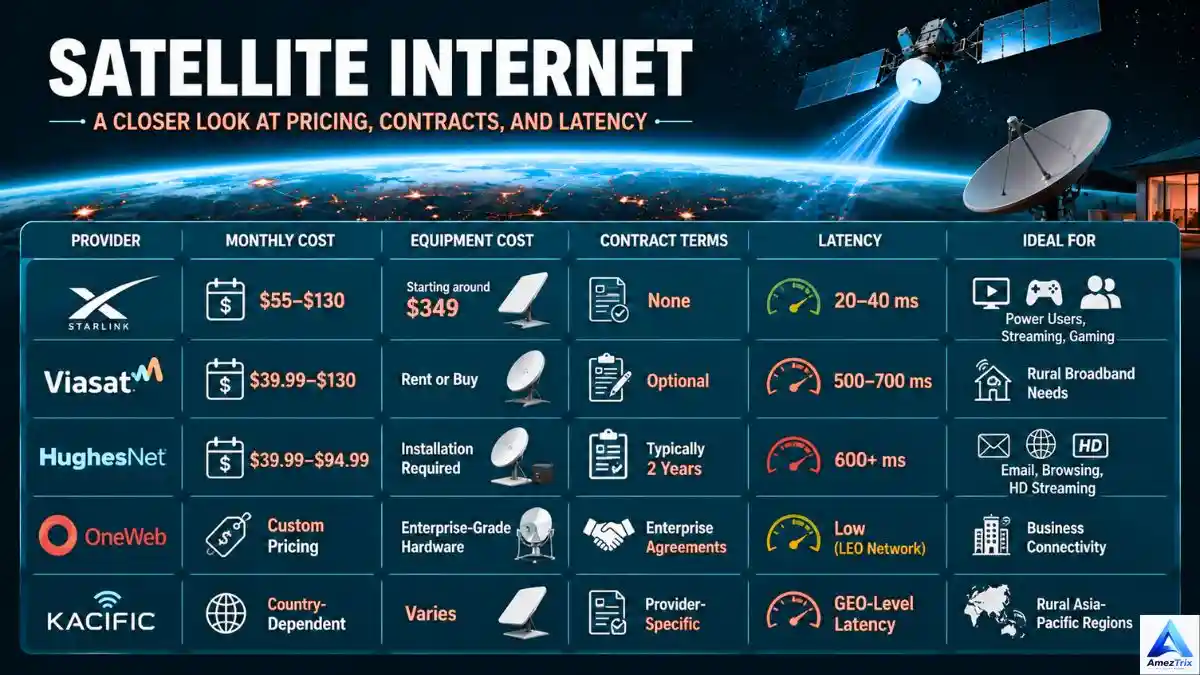
Pricing, Contracts and Latency: A Closer Look
| Provider | Monthly Cost | Equipment | Contract | Latency | Ideal For |
|---|---|---|---|---|---|
| Starlink | $55–$130 | About $349 | None | 20–40 ms | Streaming, gaming, power users |
| Viasat | $39.99–$130 | Rent or buy | Optional | 500–700 ms | Rural broadband |
| HughesNet | $39.99–$94.99 | Installation required | Typically 2 years | 600+ ms | Email, browsing, HD video |
| OneWeb | Custom | Enterprise hardware | Enterprise agreements | Low (LEO) | Business connectivity |
| Kacific | Country-dependent | Varies | Provider-specific | GEO-level | Rural Asia-Pacific |
Which Satellite Internet Provider Should You Pick?
| Use Case | Top Pick |
|---|---|
| Fastest overall speeds | ⭐ Starlink |
| Best for rural homes | ⭐ Starlink |
| Most budget-friendly (US) | ⭐ Viasat / HughesNet |
| Best for business use | ⭐ OneWeb |
| Best in Asia-Pacific | ⭐ Kacific |
| Best for RVs and travel | ⭐ Starlink Roam |
World’s Leading Satellite Internet Providers by Customer Base
Here is how the biggest names stack up by estimated subscribers. For monthly costs, see the pricing table above.
| Rank | Provider | HQ | Est. Customers | Coverage | Orbit | Max Download | Best For |
|---|---|---|---|---|---|---|---|
| 1 | Starlink | United States | 7+ million | 100+ countries | LEO | 300+ Mbps | Homes, RVs, businesses |
| 2 | HughesNet | United States | 1+ million | North and South America | GEO | 100 Mbps | Rural homes |
| 3 | Viasat | United States | 600,000+ | Americas, Europe, Asia-Pacific | GEO | 150 Mbps | Residential, aviation |
| 4 | SES Networks | Luxembourg | 500,000+ (enterprise) | Global | GEO + MEO | 1 Gbps (enterprise) | Enterprise, government |
| 5 | Eutelsat OneWeb | UK / France | Enterprise and telecom | Global | LEO | 195 Mbps | Businesses, telecoms |
| 6 | Xplore (Xplornet) | Canada | 300,000+ | Canada | GEO + fixed wireless | 100 Mbps | Rural Canada |
| 7 | Kacific | Singapore | 100,000+ | Asia-Pacific | GEO | 120 Mbps | Rural communities |
| 8 | YahClick | UAE | 100,000+ | Middle East, Africa, Asia | GEO | 50 Mbps | Home and SME users |
| 9 | NBN Sky Muster | Australia | 90,000+ | Australia | GEO | 100 Mbps | Rural Australia |
| 10 | Gilat Satellite Networks | Israel | Enterprise and government | Global | GEO | Custom | Defense, enterprise |
What Separates These Providers
Starlink is in a different league. With well over 7 million subscribers in more than 100 countries and a low-orbit fleet behind it, it combines reach and speed in a way older geostationary rivals can’t match. If you are hunting for a Starlink satellite internet guide, that scale is the first thing to grasp, because it lets the network add capacity about as fast as demand grows.
HughesNet and Viasat remain the default names across the Americas for households that want something dependable rather than cutting-edge. They were serving customers long before LEO constellations existed.
SES Networks and Eutelsat OneWeb sell mostly to governments, telecoms and enterprises, which is why their consumer numbers look small.
[Read more about Best Web Hosting for Beginners: Fast, Secure & Affordable.]
Regional specialists such as Kacific, YahClick, NBN Sky Muster and Xplore cover the corners the giants overlook: Pacific islands, parts of Africa and the Middle East, rural Australia and remote Canada. Their numbers are modest, but they are often the only broadband option in their territory.
Key Takeaways
- Starlink pairs high speed with low latency and growing coverage, making it the default pick for most homes.
- Viasat suits buyers who want a lower entry price and steady regional coverage.
- HughesNet still handles email, browsing and video calls well in rural areas.
- OneWeb is built for enterprise, government and telecom customers rather than households.
- Kacific is the go-to for underserved Asia-Pacific communities.
How Does Satellite Internet Actually Work?
It sounds like science fiction, but the whole journey fits into five steps.
- Your device sends a request. Opening a page or an app sends data through your Wi-Fi router to the satellite modem.
- The dish beams it up. The modem hands the signal to the outdoor dish, which points it at a satellite.
- The satellite relays it down. It forwards the signal to a gateway ground station wired into the internet backbone.
- The gateway fetches your data. The request reaches whichever server you need, whether that’s Netflix, Gmail or a cloud app.
- The reply travels back. Server, gateway, satellite, dish, device. On modern LEO networks that round trip often finishes in well under a tenth of a second.
A simple satellite internet example: imagine a homestay owner near a forest reserve who has never had anything better than patchy mobile data. After installing a LEO dish, guests can join video calls and upload photos from their rooms. Nothing was dug, no tower was built, and the only prerequisite was an open view of the sky.
Satellite Internet Dish and Hardware: What’s in the Box
A satellite internet dish is only one piece of a five-part setup:
- Satellite: the orbital relay handling traffic for millions of users at once.
- Dish: mounted outside; a clear view of the sky matters more than almost anything else.
- Modem: turns the satellite signal into usable data for your network.
- Wi-Fi router: shares the connection with your phones, laptops and TVs.
- Gateway: the ground station that bridges orbit and the terrestrial internet.
Modern LEO dishes use flat phased-array antennas that find and track satellites on their own, which is why many can be self-installed. Older GEO dishes are fixed and usually need a professional to align them.
How Satellite Internet Evolved
Early days: slow, costly and laggy. It worked, but nobody enjoyed it.
Middle era: better compression and hardware brought faster plans and friendlier pricing.
Today: low-orbit constellations, phased-array antennas, reusable rockets and smarter traffic routing have cut latency sharply and made connections far more dependable.
The Three Satellite Orbit Types, Explained
Geostationary (GEO)
Parked about 35,786 km above the equator, GEO satellites hover over one spot, so a handful can cover a whole continent. The catch is distance: signals travel so far that lag is noticeable, which hurts gaming and video calls.
Medium Earth Orbit (MEO)
Sitting between roughly 2,000 km and 35,786 km, MEO satellites respond faster than GEO while covering more ground than LEO. SES, the partner in Jio’s venture, uses this layer.
Low Earth Orbit (LEO)
Flying at about 160 to 2,000 km, LEO satellites shorten the signal’s trip dramatically, which cuts latency and boosts speed. The trade-off is that they race across the sky, so operators need thousands of them for continuous coverage. This is the technology that changed the industry.
Why Demand Keeps Rising
- Remote and hybrid work
- Online education reaching smaller towns
- Disaster-resilient connectivity
- Smart farming and agricultural sensors
- Maritime and aviation needs
- Steadily improving LEO speeds
Space-based broadband also appears in exam preparation. Students following India’s satellite communication programs will find satellite internet UPSC questions turning up in current affairs, where it is cited as a tool for bridging the digital divide.
Key Advantages of Satellite Internet
1. Coverage almost anywhere
No buried cable or cell tower is required, so service reaches deserts, forests, islands, mountains and offshore rigs.
2. Huge geographic reach
Laying fiber across difficult terrain is slow and costly. Satellites skip the problem by covering vast areas from above.
3. Fast installation
Instead of waiting months for cable crews, you typically need a dish, a modem, a router and, at most, one technician visit.
4. A dependable backup
Hospitals, banks, retailers and government offices keep satellite service as a failover in case the primary line is cut.
5. Real remote-work support
Video meetings, cloud files and team tools now run comfortably on modern satellite links.
6. Far better than older systems
Compared with a decade ago, streaming is sharper, downloads are faster and connections are steadier, mostly thanks to LEO.
7. A lifeline in disasters
When floods, cyclones or earthquakes knock out ground infrastructure, satellite links often keep working, which is critical for rescue coordination.
Disadvantages of Satellite Internet: Where It Still Falls Short
1. Latency on older networks
GEO systems still add heavy delay because of the distance involved, which frustrates gamers, traders and video callers. LEO has largely fixed this, but it remains one of the most-searched disadvantages of satellite internet for first-time buyers.
2. Weather sensitivity
Heavy rain, snow or thick cloud can trigger “rain fade”, a temporary drop in signal quality. In monsoon-heavy regions, that is worth planning for.
3. Upfront equipment cost
Dishes, mounts and modems raise the starting bill, although some providers now bundle hardware into monthly plans.
4. Data caps on some plans
Unlimited plans are becoming standard, yet a few providers still slow speeds after a threshold.
5. Line-of-sight requirements
Trees, buildings or hills that block the dish’s view of the sky can weaken the signal. Good placement or professional installation solves most cases.
Real-World Speeds You Can Expect
Common speed tiers include 25, 50, 100 and 200 Mbps, with 300+ Mbps on premium LEO plans. Upload speed matters just as much for video calls, cloud backups and live streaming, and newer networks keep improving there too. For India, the early reports quote a range of about 25 to 225 Mbps depending on location and congestion.
Latency Comparison
| Connection Type | Typical Latency |
|---|---|
| Fiber | 5–20 ms |
| Cable | 15–35 ms |
| 5G | 10–40 ms |
| LEO satellite | 20–50 ms |
| GEO satellite | 500–700 ms |
That gap is the reason LEO is considered such a big upgrade over legacy satellite systems.
Satellite Internet vs Fiber vs 5G: Which Should You Choose?
| Feature | Satellite | Fiber | 5G |
|---|---|---|---|
| Coverage | Near-global | Wired areas only | Urban and suburban |
| Setup | Dish install | Underground cable | Wireless receiver |
| Speed | 25–300+ Mbps | Up to multi-gigabit | 100–1,000 Mbps |
| Latency | Medium (LEO) / high (GEO) | Very low | Low |
| Rural access | Excellent | Limited | Moderate |
| Weather impact | Possible | Minimal | Moderate |
| Mobility | Moderate | None | Yes |
Choose fiber if it reaches you and you want the lowest latency and highest speeds. Choose 5G if you live somewhere well covered and want flexibility. Choose satellite if you’re rural, remote or simply outside the wired grid.
Satellite Internet for Home: Is It Worth It?
For a household with no fiber or reliable 4G/5G, satellite internet for home use can be worth every rupee. It handles HD and 4K streaming, schoolwork, video calls and remote jobs on modern LEO plans.
If you already have decent fiber or fixed wireless, the premium is hard to justify, unless you want a standby line for outages. A good rule of thumb: pay for satellite when your alternative is nothing, not when your alternative is ₹700 a month.
Leading Satellite Internet Providers at a Glance
Starlink: one of the largest LEO constellations in the world, known for strong speeds and comparatively low latency. It offers no long-term contracts and self-install kits. See the official Starlink satellite internet site for current plans in your country.
HughesNet: a long-running provider serving rural regions through geostationary satellites.
Viasat: serves homes, businesses, aviation and maritime clients with a focus on wide-area coverage.
OneWeb: building a global LEO network aimed largely at enterprise and government customers.
Amazon Leo (formerly Project Kuiper): Amazon’s LEO broadband network, still expanding its constellation and service footprint.
[Read more about How to Make Money Using AI: 25 Proven Ways to Earn Online.]
Where Satellite Internet Makes the Biggest Difference
Rural households: streaming, school and remote jobs become possible where no cable exists.
Agriculture: sensors, GPS-guided machinery and smart irrigation need a stable signal.
Maritime: ships and rigs use it for navigation, weather data and crew contact.
Aviation: in-flight Wi-Fi lets passengers browse and work at altitude.
Emergency response: during floods or earthquakes, satellite links often stay up when everything else fails.
Travelers and nomads: RV owners and remote workers carry portable terminals far beyond cell range.
Business continuity: more companies treat satellite as insurance against fiber cuts.
Challenges the Industry Still Has to Solve
- High infrastructure costs for launches, satellites and ground stations
- Space debris as constellations grow
- Regulation that differs from country to country (India’s security rules are a live example)
- Weather disruption, even if reduced from the old days
- Congestion as subscriber numbers climb
What’s Next for Satellite Broadband
- Bigger LEO constellations for steadier global coverage
- Multi-gigabit speeds that rival fiber in some markets
- AI-driven network management that predicts congestion before it happens
- Direct links with 5G and future 6G
- Truly universal coverage reaching oceans, polar regions and the last unconnected villages
If these goals are met, satellite broadband could meaningfully narrow the global digital divide within the next decade.
Before You Sign Up: A Quick Checklist
- Confirm availability at your exact address, not just on a regional coverage map
- Compare real-world speeds, not advertised maximums
- Check for data caps and fair-use throttling
- Add up equipment and installation costs
- Read recent customer reviews about reliability
- Review contract length and cancellation terms
- In India, wait for an official launch notice and never pay pre-order fees to unverified sellers
Frequently Asked Questions
1. What is satellite internet, in simple terms?
It’s broadband delivered through orbiting satellites instead of fiber, cable or phone lines.
2. Is satellite internet available in India right now?
Not for regular consumers. As of October 2026, Starlink, Eutelsat OneWeb and Jio-SES hold licences, but commercial launch still depends on security clearance and spectrum assignment.
3. How much will satellite internet cost in India?
There is no official price. Press reports suggest about ₹2,500 to ₹3,500 a month for Starlink, plus a dish costing roughly ₹30,000 to ₹35,000. Treat these as estimates.
4. Is satellite internet expensive?
Globally, plans run about $40 to $130 a month plus equipment, as shown in the pricing table. That’s more than city fiber, but often cheaper than having no broadband at all.
5. Is satellite internet better than cable?
Where cable exists, it usually wins on price and latency. Where it doesn’t, modern LEO service wins on availability. See the full satellite vs fiber vs 5G comparison.
6. Can I stream HD or 4K video?
Yes. Most modern plans handle HD and 4K comfortably, depending on provider and tier.
7. Is it good enough for online gaming?
LEO services with 20 to 50 ms latency work well for most games. Older GEO services can lag too much for competitive play.
8. Does bad weather affect it?
Heavy rain, snow or storms can weaken the signal for a short time, though current hardware copes much better than older systems.
9. Who benefits most from satellite internet?
Rural households, remote businesses, travelers, ships, aircraft and anyone without reliable fiber or cable. Compare options by region in the provider ranking above.
10. What equipment do I need?
A dish, a modem and a Wi-Fi router. Many LEO kits bundle all three, and some can be self-installed.
11. Will Jio or Airtel sell satellite internet?
Both are involved. Jio is building a service with SES, Airtel is tied to Eutelsat OneWeb through the Bharti group, and both have agreed to stock Starlink hardware once it launches.
12. Where is satellite internet headed next?
Expect larger constellations, faster speeds, AI-optimized networks and tighter integration with 5G and 6G.
Related Reading on AmezTrix
- Starlink India price, plans and launch expectations
- Latest technology news: AI, gadgets and future tech
- Best web hosting for small business, handy if you run an online business from a remote location
Final Thoughts
Satellite internet has grown from a clunky, expensive fallback into a competitive broadband choice for millions of people. Low-orbit constellations closed most of the speed and latency gap with fiber and cable.
Challenges remain: weather, hardware costs and, in India, a regulatory process that hasn’t finished. But the direction is clear. Once spectrum and security approvals land, India’s rural homes, border regions and island communities stand to gain the most. Until then, check official sources, ignore pre-order scams, and bookmark this page. We’ll update it the moment a commercial launch is confirmed.
Last updated: October 1, 2026.
About the Author
Rajendra Parmar is the Founder and Editor of AmezTrix, where he covers artificial intelligence, technology, WordPress, web hosting, digital marketing, gadgets and software. His goal is to simplify complex technology through practical tutorials, honest reviews and well-researched guides that help readers make smarter digital decisions.

Rajendra Parmar
Founder & Editor • AmezTrix
Rajendra Parmar is the Founder and Editor of AmezTrix, a platform covering Artificial Intelligence, Technology, WordPress, Web Hosting, Digital Marketing, Gadgets, Software Reviews, and emerging innovations. His mission is to simplify complex technology through practical tutorials, honest reviews, and well-researched guides that help readers make smarter digital decisions.