Discover how AI marketing automation boosts leads, personalizes campaigns & cuts costs. Real tools, steps & tips from Ameztrix. Read now!
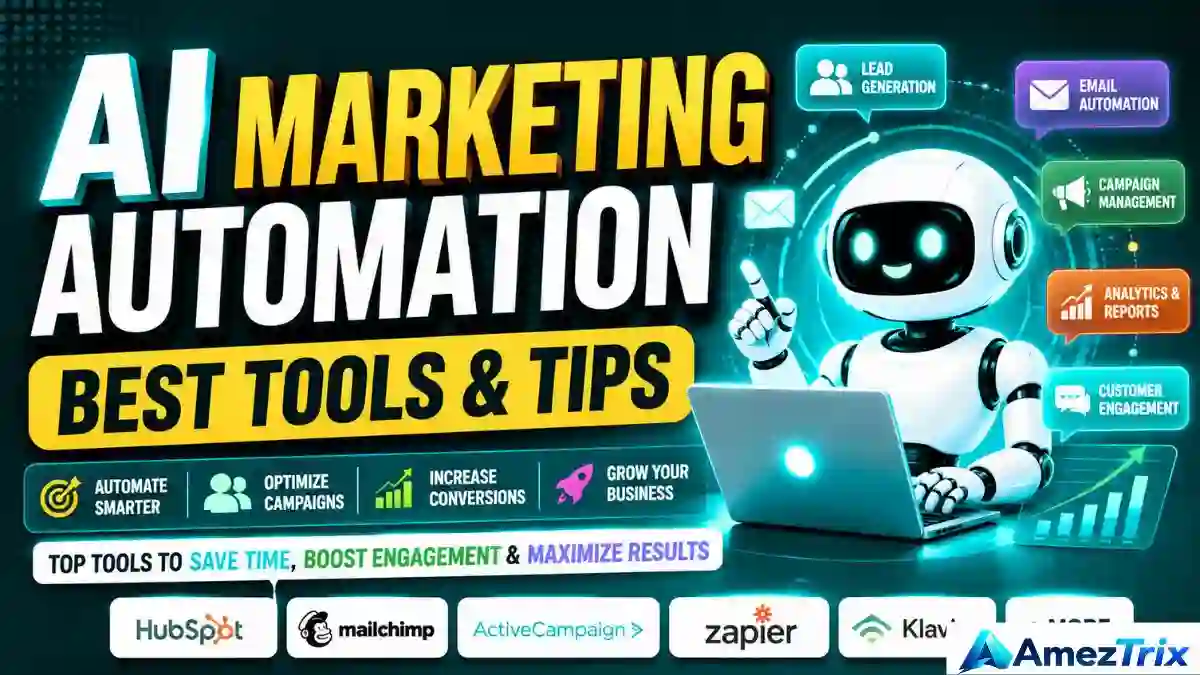
AI Marketing Automation: A No-Fluff Guide for 2026
Ask any marketer what’s eating their week, and you’ll hear some version of the same list: emails to send, ads to check, leads to sort, reports nobody reads. Somewhere along the way, AI marketing automation stopped being a pitch-deck buzzword and became the thing quietly holding a lot of these teams together.
What is it, in plain terms? It’s old-fashioned marketing automation — the trigger-and-response kind — paired with AI’s knack for spotting patterns and predicting what a customer might do next. Together, they let a business react to a customer almost instantly, often faster than a person watching a dashboard ever could.
This piece covers what that looks like day-to-day, where it genuinely earns its budget, where it doesn’t, and how to set it up without handing over every decision to a machine.
What AI Marketing Automation Actually Means
Cut through the buzzwords, and it’s this: software using AI — prediction models, pattern recognition, content generation — to run marketing work with minimal hands-on effort.
The old way was rule-based. Someone downloads your ebook, and a day later, an email lands in their inbox. One event, one reaction. Nothing clever about AI marketing automation.
AI-based automation looks at several things at once instead of one trigger:
- Which pages someone spent real time on
- Repeat visits to a pricing or checkout page
- How they’ve responded to past emails
- What they’ve bought or asked about before
- Whether their behavior matches people who ended up buying
Put that together, and the system can decide on its own — score the lead, surface the right content, flag a rep, send a personalized follow-up — without waiting on someone to notice and act manually.
Basically: old automation reacts. AI-driven automation reads context first, then reacts.
Rule-Based Automation vs. AI-Driven Automation

| What’s Compared | Rule-Based Automation | AI marketing automation |
|---|---|---|
| How it decides | One fixed trigger | Weighs several signals together |
| Personal touch | Name and basic tag | Behavior, intent, journey stage |
| Content creation | Written manually | AI drafts and adapts it |
| Scoring leads | Fixed point values | Adjusts predictions on its own |
| Audience groups | Built and updated by hand | Refreshes itself automatically |
| Getting better over time | Needs manual A/B testing | Keeps learning from results |
| Reports | Show what already happened | Try to show what’s likely next |
To be fair, rule-based automation still has its place — a shipping confirmation doesn’t need AI weighing in. It’s the harder calls, like which of fifty leads to prioritize this morning, where the AI layer really pulls its weight.
Why Businesses Aren’t Skipping This Anymore
A few years back, marketing meant maybe three or four channels. Now a single customer might interact with your brand through search, a paid ad, an email, a WhatsApp message, and a chatbot — sometimes all in the same week. Keeping track of that by hand isn’t really an option anymore.
Survey data supports this shift. Adoption numbers for AI marketing automation have climbed sharply — most marketers now say AI plays some role in how they build campaigns or generate content. Similar studies in fast-growing markets, India included, show a strong majority of marketing teams already using AI tools. However, disconnected or messy customer data keeps showing up as the main thing slowing them down.
Worth repeating, because it gets overlooked constantly: AI is only as useful as the data you give it. Hook up a well-built AI system to fragmented, outdated customer records, and it won’t magically fix that — it’ll just make bad calls faster. A retailer I read about once had their “smart” system recommending a product to someone who’d returned it twice, purely because the return data never made it back into the customer profile.
What Businesses Actually Gain From It
Time comes back to the team first. Scheduling posts, tagging leads, building weekly reports, drafting a first version of an email — none of that needs a human to do it start to finish anymore, freeing people for the work AI genuinely can’t do well yet.
Personalization gets real instead of theoretical. Rather than lumping everyone into “new visitor” or “returning customer,” the system can build far narrower segments based on what people actually do, and those groups shift as behavior shifts — no manual list-cleaning required.
Lead scoring stops being a rough guess. The old model of assigning arbitrary points for an email open never told the full story. Predictive scoring pulls in dozens of signals and gives sales a much more honest read on who’s close to buying.
Costs tend to come down too. When budget quietly shifts toward whatever’s actually converting, a lean team can run campaigns that would otherwise need a much bigger headcount to manage.
Response times shrink. A chatbot answering “do you have this in stock?” at 11pm matters more than it sounds — in a market where the next tab is always one click away, speed genuinely affects whether someone buys.
And decisions get backed by more than instinct. Which subject line actually performs, which channel is worth the spend, what lifetime value looks like by segment — that becomes something you can check anytime, not a quarterly guess.
Where This Pays Off the Most
Email is usually the easiest starting point — AI can time sends per subscriber, adjust subject lines, personalize the message body, and quietly re-engage people who’ve stopped opening anything.
Lead generation benefits just as much. Someone hitting your pricing page twice and grabbing a product guide isn’t random — a good system catches that combination and routes them straight into a sales-ready flow.
Chatbots have come a long way from the frustrating scripted bots of a few years ago. A decent one now fields routine questions on its own and only hands off the genuinely tricky stuff to a person.
For content, AI is a solid research and drafting partner — outlines, first drafts, repurposing one article into a handful of social posts. But the final read, the fact-check, the actual brand voice — that still needs a human eye, or the content ends up sounding like everyone else’s.
SEO is changing shape too, with more searchers getting answers directly from AI summaries instead of clicking through results. AI tools are handy for keyword clustering and spotting gaps in your content, but what actually ranks still comes down to whether the page is genuinely useful.
Social media automation can stretch one blog post into a week of posts and flag which comments need a real response — just keep a person reviewing anything that goes out publicly.
Ecommerce is arguably where the ROI shows up fastest, since product recommendations and cart-abandonment flows work directly off purchase data the AI already has in front of it.
AI Marketing Automation Setup – Mapping AI to the Customer Journey

| Stage | Where AI Steps In |
|---|---|
| Awareness | Suggests relevant content |
| Discovery | Recommends products or reading |
| Consideration | Scores buying likelihood |
| Intent | Personalizes the offer |
| Conversion | Times the follow-up |
| Retention | Runs behavior-based campaigns |
| Advocacy | Prompts reviews and referrals |
The real value isn’t in automating each stage on its own — it’s in connecting them, so what happens at one stage informs what a customer sees at the next.
A Few Tools Worth Looking At
- CRM and marketing platforms: HubSpot, Salesforce, ActiveCampaign, Zoho, Marketo
- Email automation: Klaviyo, Mailchimp, Brevo
- AI writing and content help: Claude, ChatGPT, Gemini, Jasper
- Analytics: Google Analytics, Looker Studio, Adobe Analytics
Skip the tool with the flashiest AI badge on its homepage. Look instead at how easily it plugs into what you already run, how it handles customer data security, whether its reports tell you anything useful, and how much say you get over what it’s allowed to do without asking first.
Setting This Up Without Making a Mess of It
- Pick one specific goal — more qualified leads, a lower cost per lead — not a vague “automate everything.”
- Walk through the actual customer journey and be honest about where people drop off.
- Clean up your data before anything else. Duplicates, missing fields, outdated records — sort that first.
- Start with one workflow. A welcome sequence or cart-abandonment flow is safer than automating the whole funnel at once.
- Connect your systems so the AI isn’t working off half the picture.
- Keep humans in charge of anything sensitive — complaints, pricing, big accounts.
- Test it properly before it goes live. Click through the triggers and time yourself.
- Track results against your starting point, not just vanity numbers like open rate.
AI marketing automation Formula worth keeping close: ROI = (Revenue Generated − Marketing Cost) ÷ Marketing Cost × 100
Where People Usually Go Wrong
Automating a broken process just makes the mess move faster — fix the process first.
Bad data in means bad personalization out, no matter how good the AI is.
Sending too many triggered messages backfires — people unsubscribe fast when it feels like spam with a personal touch. A frequency cap helps.
Skipping human review on AI-written copy is a gamble; it can be quietly wrong or off-tone in ways that only show up once a customer notices.
And chasing likes over revenue is an old mistake AI just makes easier to keep making.
What’s Coming Next: AI Agents
The step beyond current automation is the AI agent — something that works toward a goal instead of just firing a fixed trigger. It checks the leads it has, picks a next move, acts across whatever tools it’s connected to, and adjusts based on what happened.
Recent surveys in fast-adopting markets suggest most sales and marketing professionals already see this as important to where their business is headed. That doesn’t remove the need for people, though — it just shifts them further toward strategy and oversight, while the agent handles the legwork.
Quick Questions People Ask
What is AI marketing automation, in one line?
Using AI to run marketing tasks — scoring, personalizing, drafting content — with far less manual effort.
How is it different from plain automation?
Plain automation follows one rule. AI weighs several signals together and adapts as behavior changes.
Do small businesses actually need this?
Not “need” exactly, but many find value starting small — an automated welcome email or cart reminder before anything bigger.
Does this replace a marketing team?
No. It removes repetitive tasks. Strategy and brand judgment still need a person behind them.
Will it help my SEO?
It helps with research and finding gaps. Whether content actually ranks still depends on quality and human review.
What’s the single biggest risk?
Bad or messy data — it undercuts even the best AI tool.
Final Verdict
There’s no version of AI marketing automation that works on autopilot forever. What actually works is clean data, sensible automation, AI applied where it fits, and a person still making the final call. Let AI handle scale and repetition — keep humans responsible for everything that shapes how the brand actually feels to a customer.
About Author
Rajendra Parmar is the Founder and Editor of AmezTrix, where he covers Artificial Intelligence, Technology, WordPress, Web Hosting, Digital Marketing, Gadgets, and Software. His mission is to simplify complex technology through practical tutorials, honest reviews, and well-researched guides that help readers make smarter digital decisions.

Rajendra Parmar
Founder & Editor • AmezTrix
Rajendra Parmar is the Founder and Editor of AmezTrix, a platform covering Artificial Intelligence, Technology, WordPress, Web Hosting, Digital Marketing, Gadgets, Software Reviews, and emerging innovations. His mission is to simplify complex technology through practical tutorials, honest reviews, and well-researched guides that help readers make smarter digital decisions.