AI Agents vs AI Chatbots: discover how they differ in automation, tools, reasoning, and use cases—and learn which AI tool is best for your needs.
AI Agents vs AI Chatbots: What’s the Real Difference (And Which One Actually Fits Your Business)?
If you’ve spent any time online in the last year, you’ve probably noticed two buzzwords fighting for attention: “AI chatbot” and “AI agent.” Marketers throw both terms around so loosely that it’s easy to assume the AI agents vs AI chatbots debate is just two names for the same thing.
They’re not.
Chatbots and agents solve different problems, cost different amounts, carry different risks, and honestly — they’re built for different jobs entirely. When you actually break down AI agents vs AI chatbots, the gap becomes obvious fast, and picking the wrong one means you either overpay for capability you don’t need, or you underdeliver on a task that needed real automation.
This guide settles the AI agents vs AI chatbots question in plain language: what each one actually does, how they work under the hood, where they shine, where they fall short, and how to decide which one (or both) makes sense for you.
Difference Between AI Agent and Chatbot
AI chatbots exist to talk. They take your question, pull from a knowledge base or model, and hand you an answer.
AI agents exist to finish things. Give them a goal, and — depending on what tools and permissions they’ve been given — they can plan out the steps, pull data from other systems, make decisions along the way, and carry a task through to completion.
| AI Chatbot | AI Agent | |
|---|---|---|
| Core job | Talk and answer | Plan and finish tasks |
| Who drives it | You, prompt by prompt | The goal you set |
| Independence | Low-to-moderate | Moderate-to-high |
| Uses outside tools | Rarely, or lightly | Constantly — it’s the whole point |
| Handles multi-step work | Not really | Yes, that’s its specialty |
| Remembers past sessions | Sometimes | Often, by design |
| Makes real decisions | Limited | More advanced, within set boundaries |
| Good for | Support, FAQs, content, quick answers | Automation, research, ops work |
| Setup complexity | Low | Higher |
| Typical cost | Lower | Higher |
The one-line way to remember it: a chatbot can tell you how to do something — an agent can go do it.
What Is an AI Chatbot?
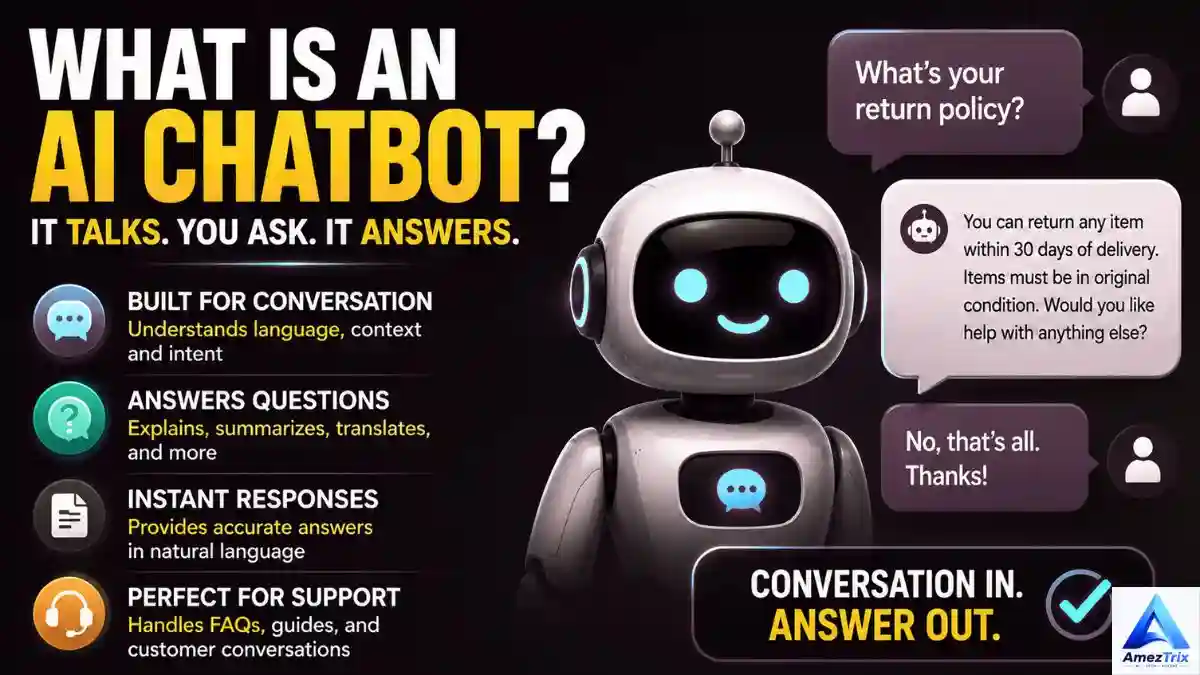
At its core, an AI chatbot is software built to hold a conversation. Older bots leaned on rigid scripts and decision trees. Today’s versions run on large language models, which means they actually understand phrasing, context, and intent instead of just matching keywords.
People use chatbots to ask questions, get explanations, brainstorm, summarize a long document, translate something, get a hand with code, or just get quick customer support.
Picture a shopper typing: “What’s your return policy?” The bot pulls the answer and hands it over. Conversation done — unless there’s a follow-up question, nothing else happens on the back end.
That’s the defining trait of a chatbot: even a very smart one is still fundamentally built around back-and-forth conversation, not independent action.
What is an AI agent?

An AI agent is built to chase a goal, not just answer a question. Where a chatbot stops at “here’s the info,” an agent keeps going — it figures out what needs to happen, breaks it into steps, decides which tools to use, pulls in outside data, takes action, and checks its own work along the way.
So instead of asking, “How do I check my website traffic?” — you’d tell an agent, “Pull my last 30 days of traffic, flag the pages that are losing visitors, compare against the prior period, and put it in a report.”
Assuming it has the right access and integrations, the agent can go fetch that data, run the comparison, build the report, and hand you a finished document — not a set of instructions for doing it yourself.
That’s the real shift: chatbots respond, agents deliver.
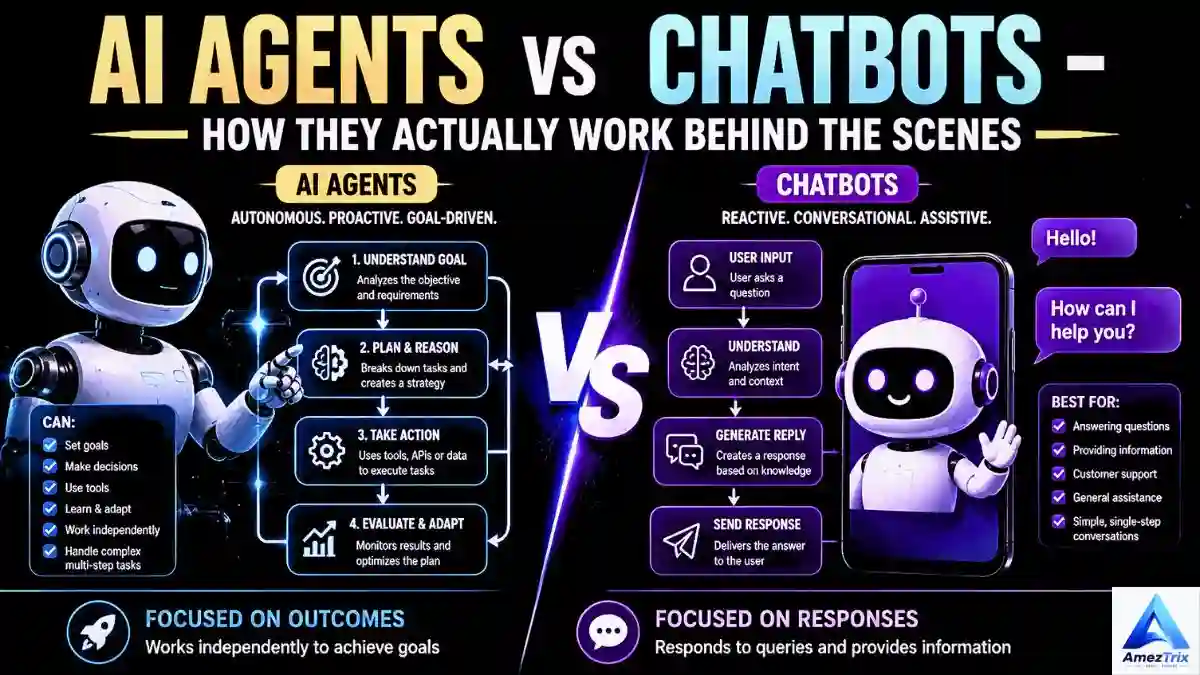
AI Agents vs Chatbots – How They Actually Work Behind the Scenes
A chatbot’s flow is fairly linear:
You type a prompt → the model reads it → it checks context or a knowledge source → it replies. That’s the whole loop. Some chatbots lean on retrieval-augmented generation or connect to a database, but the interaction is still built around the conversation itself.
An agent’s flow has more moving parts:
Goal → reasoning → planning → picking a tool → taking action → checking the outcome → repeating if needed → wrapping up the task.
Say you told an agent, “Find qualified leads for our hosting service and build a personalized outreach list.” It could define what “qualified” even means for your business, search approved sources, filter down the list, write tailored messages, log everything in your CRM, and hold off sending anything until a human signs off.
That kind of workflow needs more than clever writing — it needs a model paired with real tools and clear instructions, which is exactly how most agent frameworks are structured today.
Seven Ways Agents and Chatbots Actually Differ
1. What they’re built for. A chatbot’s job is to respond. An agent’s job is to get something done. Simple as that.
2. How independent they are. Ask a chatbot for something new and you’ll need to type a new prompt. An agent, once pointed at a goal, can often figure out its next move on its own — though for anything sensitive, a human should still be reviewing or approving the final step.
3. Access to tools. This is the big one. A basic chatbot only produces text. An agent can be wired into your CRM, inbox, calendar, databases, spreadsheets, code environments, or even a web browser — giving it the ability to actually do things instead of just describing them.
4. Handling multi-step work. A chatbot answers the question in front of it. An agent can take something like “build me a competitor analysis” and break it into research, comparison, feature mapping, and a finished write-up — all without you managing each step.
5. Memory. Both AI Agents vs AI Chatbots can technically have memory, so this alone doesn’t separate them. But agents are more often built to carry context across separate tasks — pulling in a customer’s ticket history, account details, or past interactions when it’s relevant.
6. Decision-making. A chatbot might say, “Looks like you qualify for a refund — contact support.” An agent, given the right permissions, could verify the order, confirm eligibility against policy, process the refund, update the record, and send confirmation — no human needed for the routine cases.
7. Automating full workflows. Chatbots are great at automating conversation. Agents are built to automate the process behind the conversation — verify, check, decide, act, update, notify.
Chatbots vs AI Agents – Real Examples Side by Side
Customer support: A chatbot walks a user through resetting their password. An agent, told “I can’t log in,” can verify the account, diagnose the actual issue, kick off an approved recovery process, and update the support ticket without a rep touching it.
Online shopping: A chatbot lists laptops under $1,000. An agent asked for “a laptop under $1,000 good for video editing” can search product data, compare specs, rank the options, and hand back a shortlist with reasoning.
Marketing: A chatbot gives you 20 blog topic ideas. An agent can research trending searches, study competitor content, spot content gaps, cluster keywords, write briefs, and build out a full content calendar.
The gap isn’t intelligence — it’s how much of the actual work gets done without you.
When Should a Business Use Each One?
Chatbots make sense for: FAQs, on-site support, lead capture, product questions, basic troubleshooting, internal knowledge lookups, and general content generation. They’re usually quicker and cheaper to stand up.
Agents make more sense for: process automation, sales workflows, deeper support resolution, research and data analysis, dev and IT operations, CRM automation, document handling, scheduling, and anything repetitive that currently eats up staff hours.
The right pick isn’t about which sounds more impressive — it’s about how much of the job is “give me info” versus “handle this for me.”
Why Chatbots Are Still Worth Using
- Fast to launch — most platforms plug into a website or app without much setup.
- Simpler to run — fewer integrations, fewer things that can break.
- Cheaper — narrower scope generally means lower cost per interaction.
- Always on — instant replies around the clock.
- Handles volume well — one bot, thousands of conversations at once.
- Perfect for repetitive questions — the classic FAQ workload.
Where Chatbots Fall Short
- They can explain a task without ever completing it.
- Complex processes still need a human to finish the job.
- Weak setups can lose the thread of a conversation.
- Like any LLM-based tool, they can occasionally get facts wrong if not properly grounded.
- Some have limited reach into other business systems.
Why Businesses Are Investing in Agents
- They can chain together multi-part processes.
- They cut down on repetitive manual work.
- They actually reach into your other systems and tools.
- They free up your team for higher-value work.
- They can factor in customer or business context to make sharper calls.
- Done well, they scale across an entire organization.
That said, more capability means more moving parts to manage — especially around security and oversight.
Where Agents Get Risky
- They’re harder to build. It’s not just an LLM behind a chat box — there’s real engineering involved.
- They cost more. Multiple model calls, tool executions, and API hits add up fast.
- Bigger attack surface. Giving software permission to act introduces real security exposure.
- Mistakes carry more weight. A chatbot might tell you something wrong. A poorly governed agent might actually do something wrong.
- Guardrails are non-negotiable. Clear permission boundaries, monitoring, and escalation paths matter a lot here.
- Testing is trickier. Since an agent can take several different paths to the same result, evaluating it isn’t as straightforward as grading a single response.
So Which One Should You Actually Pick?
There’s no universal winner — it comes down to what you need the system to produce.
Go with a chatbot if you mainly need: answers, conversations, FAQ handling, content ideas, basic support, or simple lead qualification.
Go with an agent if you need: multi-step automation, access to outside systems, independent task execution, real decision-making, or workflow orchestration.
Rule of thumb: if the output you want is information, a chatbot covers it. If the output you want is finished work, look at an agent.
Do Agents Replace Chatbots?
Not really — in most setups, they end up working together. A website might keep a conversational chatbot as the front door. Simple questions get answered instantly. Anything more involved gets quietly routed to an agent working in the background.
That hybrid setup — chat interface up front, agent doing the heavy lifting behind it — lets a business use exactly as much AI horsepower as each task actually needs.
Are Agents Just “Smarter” Chatbots?
Not necessarily, and this trips people up. An agent might be running the exact same underlying model as a chatbot. What makes it an agent isn’t a bigger brain — it’s everything wrapped around that brain: the tools, the instructions, the planning layer, the permissions, the ability to act.
In other words: agent = model + tools + instructions + workflow + the ability to actually act.
Chatbot vs Agent vs AI Assistant — Aren’t They the Same?
Close, but not quite. A chatbot is built around conversation. An AI assistant helps you get things done — info, productivity, content. An AI agent goes further and pursues goals through tools and connected systems on its own.
These lines blur constantly in real products, so the smartest way to judge any AI tool isn’t its label — it’s what it can actually do.
What About Cost?
Chatbots typically rack up costs from model usage, hosting, knowledge-base storage, API calls, platform fees, and upkeep — generally manageable for standard support and FAQ use.
Agents add costs on top: extra model calls, tool executions, database and API access, browsing, code execution, longer-running tasks, monitoring, and any human-approval steps built in.
The smarter way to evaluate either is cost per completed task, not cost per message. An agent that costs more per interaction can still deliver better ROI if it’s replacing hours of manual work.
Security Deserves a Serious Look
A chatbot that only spits out text has a fairly small attack surface. An agent that can read customer data, touch a database, send emails, generate documents, update your CRM, run code, or interact with websites is operating with real authority — and that authority needs guardrails.
Before deploying an agent, businesses should think through authentication, least-privilege access, human sign-off for sensitive actions, audit trails, encryption, defenses against prompt injection, tool restrictions, rate limits, and error handling. The more power you hand an AI system, the more these controls matter.
A Simple 5-Step Framework to Decide
- Define the goal. Do you need an answer, or completed work?
- Count the steps. One step, one decision? A chatbot’s probably fine. Several steps and decisions? Look at an agent.
- List the tools required. Does this need CRM, email, calendar, database, or API access? That points toward an agent.
- Weigh the risk. Anything touching money, legal exposure, security, or customer impact needs real human oversight.
- Run the ROI math. Weigh total cost (build + maintenance + monitoring) against time saved, efficiency gained, and the customer experience improvement.
Don’t reach for an agent just because it’s the newer, shinier option.
Where This Is All Heading
The line between AI Agents vs AI Chatbots is already starting to blur, and it’ll likely keep blurring. Newer AI products increasingly blend conversation, tool access, memory, and task execution into one system — so users just talk, and the system quietly decides whether to answer, search, analyze a file, hit an API, update a record, or ask for a human’s approval.
The future probably isn’t “chatbot vs. agent” as a hard either/or. It’s most AI products doing both, seamlessly, without the user needing to know which mode they’re in.
Frequently Asked Questions
What’s the main difference between AI chatbot vs AI agent for business?
Chatbots are built around conversation and generating responses. Agents are built to pursue goals — using AI tools, making decisions, and completing multi-step tasks.
Is ChatGPT a chatbot or an agent?
It depends on what’s being used in the moment. ChatGPT can function as a straightforward conversational assistant, but with browsing, tool access, and task execution enabled, it starts behaving like an agent.
Are AI agents better than chatbots?
Not automatically. Chatbots win for simple conversations, FAQs, and quick support. Agents win for complex, multi-step automation.
Can a chatbot turn into an agent?
Yes — bolt AI Agents vs AI Chatbots on tools, APIs, memory, planning, and permissions, and a chatbot starts functioning like an agent.
Do agents rely on chatbots?
Often, yes — the chatbot handles the conversation up front while the agent does the work behind it.
Are agents more expensive to run?
Generally, yes, because of extra model calls, integrations, and monitoring — but the automation payoff can easily outweigh the added cost.
What do businesses actually use agents for?
Support resolution, sales workflows, research, data analysis, dev and IT tasks, business process automation, document handling, and scheduling.
What are chatbots best used for?
Support, FAQs, lead generation, on-site assistance, content creation, and general knowledge lookups.
Can agents run without any human involvement?
Some tasks, yes. But for anything sensitive or high-stakes, human review should stay in the loop — good agent systems build in permissions, guardrails, and approval steps.
How’s an AI agent different from an AI assistant?
An assistant generally helps with info and productivity. An agent is built specifically to pursue goals and take action through connected tools and systems — though in practice, the terms often overlap.
Final Verdict
The gap between AI Agents vs AI Chatbots really comes down to purpose, independence, tool access, and the ability to act.
Chatbots are excellent conversational tools — they answer, explain, support, and create content. Agents go further: they pursue goals, reason through multiple steps, pull in outside tools, and carry workflows through to completion with real autonomy.
Pick a chatbot when you need communication and information. Pick an agent when you need automation and action. For a lot of businesses, the winning setup is both — a conversational front end paired with an agent layer doing the actual work underneath.
Going forward, the smarter question isn’t “is this a chatbot or an agent?” It’s: what can this system actually do, what can it touch, how much freedom does it have, and what’s keeping it in check?
Key Takeaways
- Chatbot = conversation. Agent = goal-driven action.
- Chatbots respond to prompts; agents plan and execute multi-step work.
- Agents typically need tool and API access; chatbots usually don’t.
- Chatbots are cheaper and faster to deploy.
- Agents need stronger security, permissions, and monitoring.
- Neither is universally “better” — the right choice depends on the task.
- Expect more AI products to blend both approaches going forward.
In one line: chatbots help you talk to AI — agents help AI get the work done.
About Author
Rajendra Parmar is the Founder and Editor of AmezTrix, where he covers Artificial Intelligence, Technology, WordPress, Web Hosting, Digital Marketing, Gadgets, and Software. His mission is to simplify complex technology through practical tutorials, honest reviews, and well-researched guides that help readers make smarter digital decisions.

Rajendra Parmar
Founder & Editor • AmezTrix
Rajendra Parmar is the Founder and Editor of AmezTrix, a platform covering Artificial Intelligence, Technology, WordPress, Web Hosting, Digital Marketing, Gadgets, Software Reviews, and emerging innovations. His mission is to simplify complex technology through practical tutorials, honest reviews, and well-researched guides that help readers make smarter digital decisions.