Last updated: September 24, 2026 | Reading time: about 12 minutes | Written by Rajendra Parmar
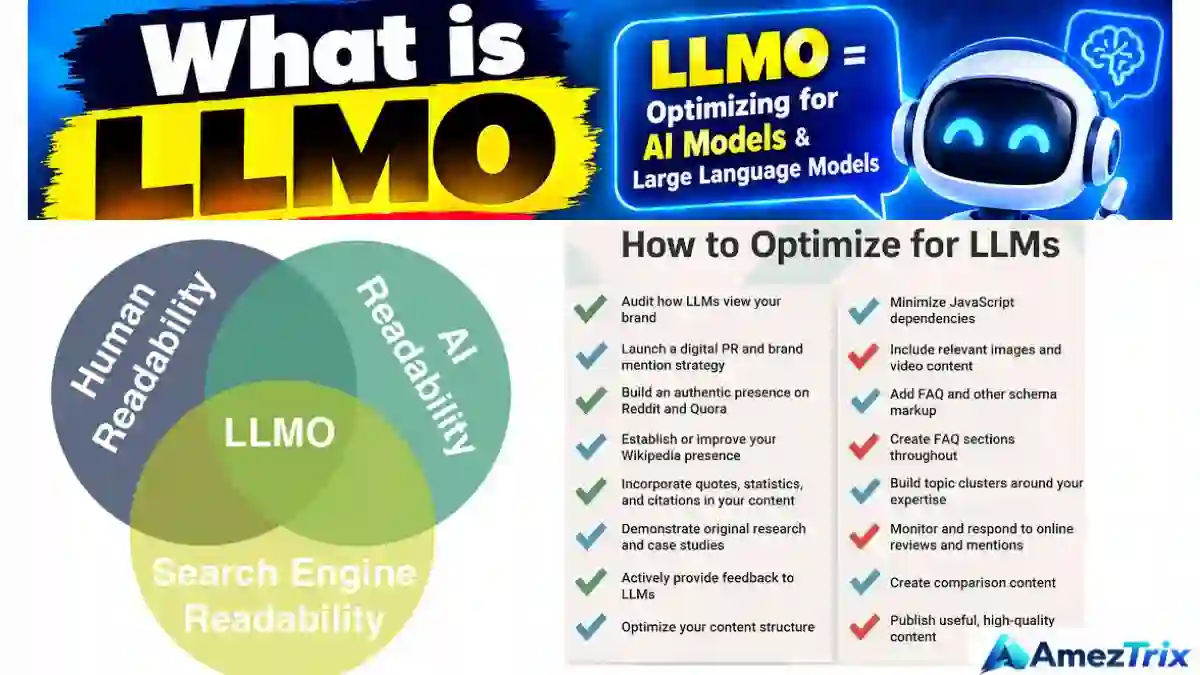
Quick answer: LLMO (Large Language Model Optimization) is the practice of making your website’s information clear, consistent, well-sourced and easy to extract, so AI tools like ChatGPT, Gemini, Perplexity and Google’s AI Overviews can understand it and cite it when they answer a question. It works alongside SEO. It does not replace it.
Think about how you search today. Not long ago you’d type a query, open six tabs and stitch the answer together yourself. Now Google, ChatGPT or Gemini often hands you the answer directly, built from a few sources it trusted enough to quote.
That shift is why LLMO has gone from a niche buzzword to something every content team talks about. In this guide you’ll get a plain-English definition, a comparison with SEO, GEO, AEO, SXO and AIO, an 8-step strategy, ways to measure AI visibility, and a checklist you can use on your next post.
What Is LLMO in SEO?
LLMO is an optimization approach that makes website content clear, accurate, structured and useful for systems built on large language models. The goal is simple to state: when someone asks an AI tool a question in your field, your page should be easy to read, easy to trust and easy to quote.
Traditional SEO, the kind covered in our guide to how to rank a website on Google’s first page, is about being found and ranked. LLMO cares about what happens next: how an AI reads, interprets and represents your information inside a generated answer.
Here’s the difference in practice. A user searching the old way types:
best AI SEO tools
The same person asking an AI assistant might write:
Which AI SEO tools work best for a small tech blog, and what are the trade-offs of each?
The answer usually blends several sites. That’s your opening, and your challenge: to be one of those sources, you have to earn the trust.
An honest disclaimer: nobody can guarantee a citation from ChatGPT or a spot in an AI Overview. Each platform uses its own retrieval methods and changes them often. What works, again and again, is unglamorous: strong SEO fundamentals, helpful writing, original information, credible sourcing and a technically sound site. Stack those and your odds go up.
What Does LLMO Stand For?
LLMO stands for Large Language Model Optimization. A large language model (LLM) is an AI system trained on huge amounts of text so it can understand and generate human-like language. When it answers a question, it may draw on its training data, on a retrieval system that fetches fresh pages, or on live context passed into the conversation.
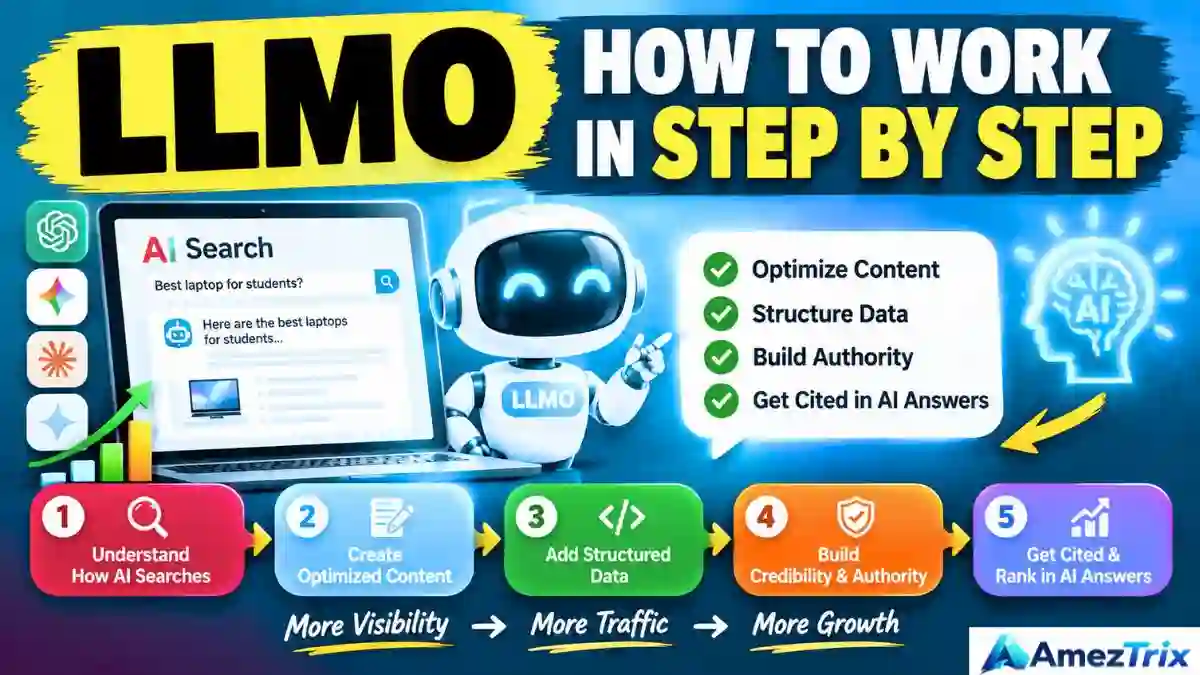
LLMO’s job is to make your information easy for those systems to digest. That means clear definitions, consistent naming, verifiable facts and a page structure a machine can parse without guessing.
Why LLMO Matters Now
Old search gave you a list of links. AI search gives you one synthesized answer. That single change rewires how people discover brands.
| Stage | Traditional search journey | AI-assisted journey |
|---|---|---|
| 1 | Type a keyword | Ask a full question |
| 2 | Scan a list of blue links | Read one generated answer |
| 3 | Open several sites and compare | Check the cited sources |
| 4 | Decide | Ask a follow-up question |
| 5 | Visit your site | Maybe visit your site, later |
A person can now discover your brand without visiting your homepage. If someone asks an AI, “What are the best websites for learning WordPress SEO?” and your site is named in the answer, that’s real visibility, even without an immediate click. So every site is chasing two goals at once: rank in classic search, and get referenced when AI tools do the research for someone.
LLMO vs Traditional SEO: What’s Actually Different?
They’re cousins, not twins. SEO is mostly about discoverability. LLMO is mostly about interpretation and representation once your page has been found.
| Area | Traditional SEO | LLMO |
|---|---|---|
| Main goal | Rank pages in search results | Be understood, quoted and represented accurately by AI |
| Core signals | Keywords, backlinks, page speed, internal links | Clear definitions, consistent entities, verifiable facts, original value |
| Success looks like | Position, clicks, organic traffic | Citations, brand mentions, accurate summaries |
| Tools to start with | Search Console, keyword research tools | Prompt testing, brand-mention tracking, schema validators |
A classic checklist covers keyword research, search intent, title tags, internal linking, technical health, backlinks and page experience. An LLMO-minded checklist adds unambiguous definitions, consistent terminology, entity information, original observations, verifiable claims, transparent methodology and visible author credibility. Both live on the same page. This was never SEO versus LLMO. It’s SEO plus genuinely helpful content plus AI-search readiness.
LLMO vs GEO vs AEO vs SXO vs AIO: Full Comparison
These terms get mixed up constantly, and the overlap is real. Here’s a clean map.
| Term | Full form | Main objective | Simple example |
|---|---|---|---|
| SEO | Search Engine Optimization | Organic search visibility | Ranking for “best AI SEO tools |
| AEO | Answer Engine Optimization | Direct answers to questions | Answering “What is AI SEO?” in two clear lines |
| GEO | Generative Engine Optimization | Visibility inside generative search | Being referenced in an AI-written comparison |
| LLMO | Large Language Model Optimization | Making information understandable to language models | Explaining clearly what your brand and product do |
| SXO | Search Experience Optimization | Matching intent and delivering a great page experience | A fast page that answers the query and guides the next step |
| AIO | AI Optimization (also used for AI Overviews) | Overall readiness for AI-driven search | Structuring a page so it can appear in AI summaries |
One caution on AIO: people use it for both “AI Optimization” and “AI Overviews,” so define it when you use it.
The easiest way to remember it: LLMO makes information understandable to AI models. GEO improves visibility inside generative search. In practice they blend. Want the full breakdown? Read our dedicated guide, SEO vs AEO vs GEO vs LLMO, or go deeper on Generative Engine Optimization, GEO vs SEO and GEO ranking factors.
The smarter question isn’t “which one should I pick?” It’s “how do I build one genuinely good page that supports all of them at once?”
How Do AI Systems Pick Sources?
Each platform works differently, and none of them publish the full recipe. Still, most AI search tools follow a broadly similar path:
- Find: the page has to be crawlable and indexable in the first place.
- Retrieve: the system pulls passages that match the question, not whole articles.
- Judge: it weighs how clear, specific and trustworthy those passages look.
- Compose: it writes an answer, and often links the sources it leaned on.
The takeaway is that individual passages need to stand on their own. A paragraph that answers a question fully, in plain words, is far more usable than one that depends on three earlier paragraphs for context.
How to Optimize Content for Large Language Models
The real challenge is writing for LLMs without producing stiff, robotic copy. The answer is refreshingly plain: write content that’s easy for a person to follow and equally easy for a machine to parse. If you want help with the drafting side, our roundup of AI tools for content creators is a good place to start, as long as a human edits the result.
1. Start with search intent, not just the keyword
Someone searching “LLMO” might want a definition, an explanation of how it works, a comparison with SEO or GEO, implementation steps, or tips to improve AI visibility. An article that only defines the term leaves most of them unsatisfied. Cover the wider intent.
2. Lead with a direct definition
Give the core idea in the first two lines, then expand. Readers and AI summarizers both reward a straight answer up front.
3. Write headings the way people ask questions
Skip keyword-stuffed headers. Use natural phrasing such as “What is LLMO?”, “How does LLMO work?” and “Is LLMO replacing SEO?” These match how AI Overviews and voice assistants phrase answers back.
4. Build real topical depth
One question with one answer isn’t enough. Anticipate the follow-up. Around LLMO, that means AI search optimization, AI citations, generative search, entity optimization and topical authority. Connect those pages into one cluster, and AI digital marketing is a natural hub to link back to.
5. Keep terminology consistent everywhere
If one page calls your product “AmezTrix AI SEO Tool,” another “Amez AI Optimizer” and a third “AmezTrix Platform,” readers and AI systems can’t tell whether these are the same thing. Pick one name and stick to it. Spell out how your brand, products and authors relate to each other.
6. Add something genuinely original
Generic summaries are everywhere, which is exactly why original value stands out. Think first-hand testing, real screenshots, case studies, head-to-head comparisons, original data and transparent methodology. Compare “This is a powerful AI SEO tool” with “We tested it for keyword clustering and content briefs, and its strongest use case turned out to be X.” Only one of those tells you something real.
8-Step LLMO Strategy You Can Actually Follow
- Define your brand clearly. Say plainly who you are, what you cover and who writes the content.
- Build topic clusters. Connect related articles instead of publishing isolated posts.
- Answer real questions. Base content on what your audience asks, using Search Console queries and People Also Ask, not guesses.
- Add original value. Testing, screenshots, comparisons and first-hand insight.
- Strengthen internal linking. Use descriptive anchors that tell the reader, and Google, what the linked page covers.
- Build trust signals. Accurate author bios, visible sources and clear editorial standards.
- Keep technical SEO solid. Crawlability and indexability still come first.
- Monitor AI visibility. Run test prompts regularly and track mentions, accuracy and competitors. One AI response is a data point, not a verdict.
How to Get Cited by AI
The question we hear most is “How do I get ChatGPT to cite my site?” There’s no guaranteed method. Chasing a single platform’s algorithm is a losing game, so focus on becoming a source worth citing.
| What earns citationsWhy it works | |
|---|---|
| Original research | It can’t be found anywhere else |
| Clear explanations | Easy for a model to summarize accurately |
| Specific facts and numbers | Beats vague, hand-wavy claims |
| Reliable sourcing | Builds trust with people and systems |
| Expert perspective | Explains the “why,” not just the “what” |
| Real comparisons | Shows differences, not just feature lists |
| Practical examples | Demonstrates instead of describing |
| Stated limitations | Makes claims more credible and more accurate to summarize |
Compare “this is the best AI tool” with “this tool works well for long-form drafting because of X and Y, though watch out for Z.” The second is more useful to a person and easier for an AI to summarize correctly. If you’re comparing assistants yourself, our breakdown of Gemini vs ChatGPT vs Claude shows how different they behave.
Don’t block the crawlers you want citations from. Check your robots.txt and firewall rules. Search-focused bots such as Googlebot, Bingbot, OAI-SearchBot and PerplexityBot need access if you want to appear in those tools. Whether to allow AI training crawlers is a separate business decision.
Structuring Content for AI-Generated Answers
This six-part pattern works well for both readers and AI-assisted answers:
- Direct answer: no wind-up.
- Explanation: why is that the answer?
- Evidence: a source, a number or a test.
- Example: show it in action.
- Limitations: where it doesn’t apply.
- Next step: what the reader should do now.
Example, “Is LLMO replacing SEO?” Direct answer: no, it complements SEO. Explanation: SEO still handles crawling, indexing and organic visibility, while LLMO focuses on how AI systems understand and represent your information. Add short paragraphs, descriptive H2/H3 headings, lists, tables and a useful FAQ, and the page becomes easy to lift from.
Entity Optimization and Schema for LLMO
Entity clarity is underrated. An entity is a person, brand, product, place, concept or technology, and AI systems build their understanding of a topic around them. For example:
- AmezTrix: a technology and digital marketing tools website
- WordPress: a content management system
- GEO: Generative Engine Optimization
- LLMO: Large Language Model Optimization
Describe your key entities (brand, authors, products, main topics) the same way across your site. Use structured data such as Organization, Person and Article schema where it accurately reflects visible content, and add FAQPage schema only when the FAQ is actually on the page. There is no special “LLMO schema,” and structured data is not a ranking shortcut.
You may also hear about an llms.txt file. It’s an emerging convention, and there’s no solid evidence yet that major AI search tools rely on it. Treat it as optional, never as a substitute for good content.
LLMO Metrics: How to Measure AI Visibility
You can’t improve what you don’t measure, and AI visibility is messy to measure. These are the LLMO metrics worth tracking:
| Metric | What it tells you | How to check it |
|---|---|---|
| Citation rate | How often your URL is linked as a source | Run a fixed set of prompts and count citations |
| Brand mention rate | How often your brand is named, linked or not | Same prompt set, count mentions |
| Answer accuracy | Whether AI describes you correctly | Read the answers and note errors |
| Share of voice | Your mentions compared with competitors | Tally brands named per prompt |
| AI referral traffic | Visits arriving from AI tools | Check referral sources in GA4 |
| Query impressions | Whether you’re appearing for topic queries | Google Search Console |
Run your own 20-prompt citation test
This is the simplest original research any site can do. Write 20 real questions your audience asks, run each in ChatGPT, Gemini, Perplexity and Google, and log the results in a table like this:
| Prompt | ChatGPT | Gemini | Perplexity | Google AI Overview | Notes |
|---|---|---|---|---|---|
| What is LLMO in SEO? | Cited / Mentioned / No | Cited / Mentioned / No | Cited / Mentioned / No | Cited / Mentioned / No | Who was cited instead? |
| How do I get cited by AI? | Cited / Mentioned / No | Cited / Mentioned / No | Cited / Mentioned / No | Cited / Mentioned / No | Was our description accurate? |
Repeat the test monthly with the same prompts. Answers vary from run to run, so look at trends across many prompts, not one lucky result.
LLMO Tools You Actually Need
You don’t need a big software stack to start. A practical setup looks like this:
- Google Search Console: shows the queries and pages where you already appear.
- Google Analytics 4: lets you filter referral traffic from AI tools.
- Manual prompt testing: free, and still the most honest way to see how AI describes you.
- Schema validators: Google’s Rich Results Test and the Schema Markup Validator catch structured-data errors.
- Our free tool: try the GEO and AEO checker for a quick readability review of a page.
- Paid AI-visibility trackers: a growing category. Browse our list of the best AI SEO tools, then test any tool on your own pages before you trust its scores.
Also see our wider list of best AI tools and the latest Google AI tools if you want to explore further.
Do You Need an LLMO Agency or Service?
Many businesses search for “LLMO services” or an “LLMO agency,” so here’s a fair answer: it depends on your team and your goals.
| Situation | Better route |
|---|---|
| Small site, a few key pages, some SEO knowledge | DIY with the checklist below |
| Many products or locations, messy site structure | Consultant or agency for an audit |
| Competitors dominate AI answers in your niche | Agency with proven measurement and research capacity |
| Limited content team but real expertise | Hybrid: outside editors, your own experts |
Red flags when hiring: guaranteed citations, “secret prompts,” a proprietary “LLMO schema,” no reporting plan, or a proposal that ignores technical SEO. Good questions to ask: How will you measure results? Which prompts and platforms will you track? Can you show before-and-after examples from real clients? Who writes the content, and who verifies the facts?
Technical SEO and E-E-A-T Still Matter
It’s tempting to think AI search makes technical SEO irrelevant. It doesn’t. You still need indexable and crawlable pages, an XML sitemap, canonical URLs, mobile usability, decent page speed, working internal links, HTTPS, no broken links, sensible robots directives, structured data and optimized images. No article performs if the page is blocked or inaccessible.
E-E-A-T works the same way in AI search:
- Experience: mention genuine hands-on use where it’s real.
- Expertise: show you understand the subject beyond the surface.
- Authoritativeness: earn mentions and references from respected sources.
- Trustworthiness: be accurate, transparent and consistent.
If you’re reviewing a tool, say plainly whether you tested it. Faked first-hand experience rarely survives scrutiny.
Common LLMO Mistakes to Avoid
- Keyword stuffing. Repeating a term doesn’t help. Write naturally.
- Faking authority. Don’t invent reviews, credentials or citations.
- Publishing generic AI content. AI can help draft, but human review and original value still decide whether a page deserves to be cited.
- Ignoring traditional SEO. Crawlability and quality still come first.
- Promising guaranteed citations. No honest strategy can.
- Using unverified information. Tech facts change fast. Check before you publish.
- Writing only for machines. Your first audience is a human being.
- Bad internal links. Anchors like “click here” or random words in the middle of a sentence tell nobody what the target page is about.
LLMO Checklist for Beginners
| Category | Key questions to ask |
|---|---|
| Content | Is the topic defined in the first two lines? Does it satisfy search intent? Is there real original value? |
| SEO | Compelling title? Clean URL? Logical headings? Indexable page? Optimized images with descriptive alt text? |
| AEO | Are direct answers included? Is the FAQ useful rather than filler? |
| GEO | Does the page offer something unique? Are sources trustworthy? Is the brand clearly identified? |
| SXO | Does the page load fast, read well on mobile and point to a clear next step? |
| LLMO | Is terminology consistent? Are entities explained? Are facts separated from opinions? |
The Future of SEO, AEO, GEO and LLMO
Search is moving from a keyword-ranking game toward a wider information-discovery ecosystem. People now find businesses through Google results, AI answers, chatbots, voice assistants, social platforms and video search, often in the same week. The bigger goal is to be discoverable, understandable, useful, trustworthy and memorable. SEO, AEO, GEO, SXO and LLMO all feed that one goal. They were never really competing.
Frequently Asked Questions About LLMO
What is LLMO in SEO?
LLMO in SEO means optimizing your website’s information so large language model-based systems can understand, interpret and potentially cite it. It works alongside traditional SEO, not in place of it.
What is Large Language Model Optimization?
It is the practice of improving the clarity, consistency, context and usefulness of your information for AI systems built on large language models.
Is LLMO replacing SEO?
No. SEO still handles crawling, indexing, relevance and organic visibility. LLMO builds on top of that foundation.
Is LLMO the same as GEO?
Not exactly, though they overlap heavily. GEO focuses on visibility inside generative search results. LLMO is the broader effort to make information understandable for AI systems in general.
How can I improve AI search visibility?
Publish original, trustworthy content, answer real questions, build topical authority, keep brand information accurate, link internally with purpose and keep your site technically healthy.
Can I guarantee that AI will cite my website?
No. Results depend on the platform, the query, the retrieval process and the other sources available.
Does LLMO require special schema markup?
No. There is no dedicated “LLMO schema.” Use structured data where it accurately reflects your visible content.
What are the most important LLMO metrics?
Citation rate, brand mention rate, answer accuracy, share of voice, AI referral traffic and query impressions in Search Console.
Do I need an LLMO agency?
Not always. Small sites can do most of the work in-house. Larger or more competitive sites may benefit from an audit, as long as the agency can explain how it measures results and doesn’t promise guaranteed citations.
Does keyword density matter for LLMO?
Very little. Clear explanations, context and factual accuracy matter far more than exact-match repetition.
Can small websites benefit from LLMO?
Yes. Original research, honest comparisons and focused resources work at any site size.
How long does LLMO take to show results?
There’s no fixed timeline. It depends on the platform, how fresh your content is and how strong the competing sources are. Publish consistently and track results over time.
Final Verdict: Should You Invest in LLMO?
Yes, but as a layer on top of SEO, never instead of it. SEO gives you the technical and organic foundation, AEO helps you answer questions directly, GEO improves visibility in generative search, SXO keeps the experience useful, and LLMO keeps your information clear for the systems reading it.
Ranking #1 for a single keyword isn’t the finish line anymore. The real opportunity is becoming a source that people, and the AI tools they ask, actually trust. Start with one page: define the topic in two lines, add something original, fix your internal links, and measure what happens.