Discover Tesla Terafab, the massive AI chip factory shaping the future of AI, robotics and computing. Explore its technology, scale and impact.
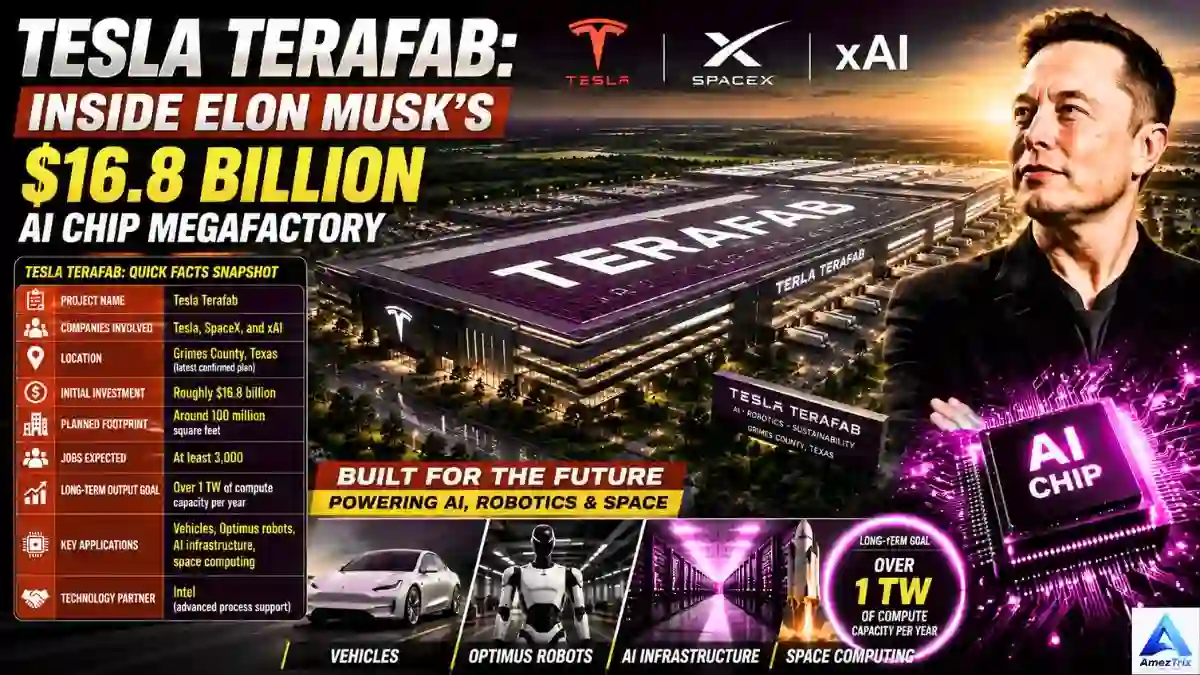
Tesla Terafab: Inside Elon Musk’s $16.8 Billion AI Chip Megafactory (Complete 2026 Guide)
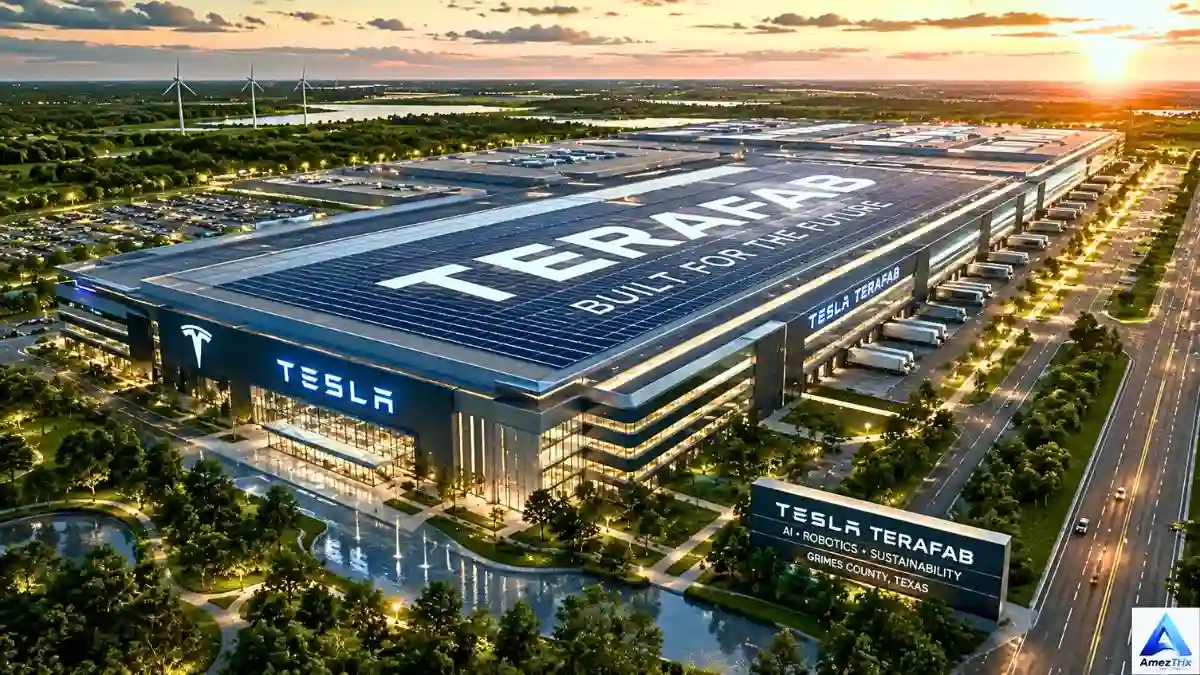
If you’ve been scrolling through tech news lately, chances are you’ve stumbled across the term “Tesla Terafab” and wondered what exactly it is. A new car model? A secret code name? Something SpaceX cooked up? None of the above, actually. Tesla Terafab isn’t a vehicle and it isn’t a robot — in many ways, it’s a far bigger gamble than either one. At its core, Tesla Terafab is Tesla and SpaceX’s joint plan to construct one of the largest semiconductor complexes on Earth, built right in the heart of Texas.
This guide walks through everything worth knowing about Tesla Terafab: what the project actually involves, why Tesla is suddenly stepping into chip manufacturing, just how massive the facility is expected to be, the price tag attached to it, the companies backing it, and how it could eventually shape everything from the AI tools chip inside your next Tesla to the Optimus robot that might one day stand in a showroom near you. No hype, no speculation dressed up as fact — just where things genuinely stand with Tesla Terafab as of 2026, laid out in plain English.
(For more context on how Tesla’s other massive facilities operate, take a look at our As construction and planning move forward, Tesla Terafab is shaping up to be one of the defining pieces of Tesla’s broader AI, robotics, and semiconductor ambitions in the years ahead.
What Exactly Is Tesla Terafab?
Tesla Terafab is a planned, enormous semiconductor manufacturing complex tied to Tesla, SpaceX, and xAI. In simple terms, it’s a factory built specifically to produce the advanced computer chips these companies need — not phones, not laptops, but the specialized processors that power self-driving cars, humanoid robots, and AI systems.
What sets Terafab apart from a typical chip plant is how much it tries to do under a single roof. Most semiconductor supply chains are split across dozens of companies and countries: one firm designs the chip, another fabricates the silicon wafer, a third handles memory, a fourth does packaging, and so on. Terafab’s pitch is different — logic chips, memory, and advanced packaging are all meant to happen in one connected facility, with a long-term goal of churning out more than 1 terawatt of computing capacity every year.
Why does any of this matter? Because Tesla’s roadmap is quietly turning into an AI roadmap. Full Self-Driving, the Cybercab robotaxi platform, Optimus robots, and even SpaceX’s AI ambitions all need serious computing horsepower. Tesla Terafab is Musk’s answer to the question: what happens if the world’s chip supply can’t keep up with what these companies want to build?
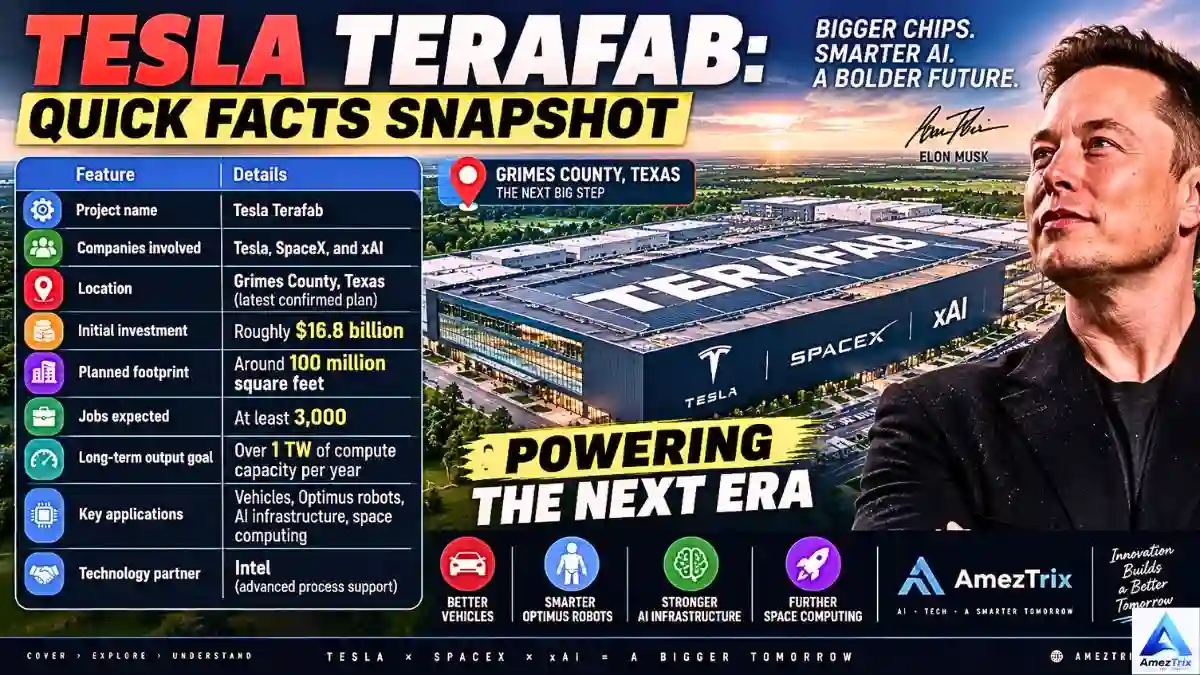
Tesla Terafab: Quick Facts Snapshot
| Feature | Details |
|---|---|
| Project name | Tesla Terafab |
| Companies involved | Tesla, SpaceX, and xAI |
| Location | Grimes County, Texas (latest confirmed plan) |
| Initial investment | Roughly $16.8 billion |
| Planned footprint | Around 100 million square feet |
| Jobs expected | At least 3,000 |
| Long-term output goal | Over 1 TW of compute capacity per year |
| Key applications | Vehicles, Optimus robots, AI infrastructure, space computing |
| Technology partner | Intel (advanced process support) |
It’s worth flagging that earlier reports tied Terafab loosely to Tesla’s existing Austin operations. The most recent and most reliable reporting, however, points squarely to a new site in Grimes County, Texas — so if you’ve read older articles that mention Austin specifically, that detail has since evolved.
Why Is Tesla Even Getting Into the Chip Business?
The short version: demand for AI compute is growing faster than Tesla is comfortable relying on outside suppliers for.
Think about what Tesla is trying to pull off simultaneously — a fleet of vehicles that increasingly drive themselves, a humanoid robot program that Musk has talked about scaling into the millions of units, and a growing appetite for AI training and inference. Every one of those ambitions eats chips for breakfast.
Add SpaceX into the mix, with its own appetite for AI-driven 6G technology and satellite internet and data infrastructure, and you start to see the bigger picture. Musk has said publicly, more than once, that future AI and robotics work could require chip volumes far beyond what today’s global semiconductor industry produces.
So instead of standing in line with everyone else — Apple, Nvidia, and dozens of other giants — for capacity at existing foundries, Tesla wants a slice of manufacturing it actually controls. That control would extend across:
- Chip production itself
- Manufacturing capacity planning
- Packaging and testing
- Supply chain scheduling
- Hardware built specifically around Tesla’s own AI models
If it works, semiconductor manufacturing stops being a line item Tesla pays someone else for and becomes a core part of the business — similar to how the company brought battery cell production in-house years ago.
What Will Tesla Terafab Actually Build?
Don’t expect consumer gadgets rolling off this line. The chip factory is aimed squarely at high-performance computing hardware for Tesla and SpaceX’s own ecosystem.
1. Chips for Tesla vehicles. Tesla already builds custom silicon for its cars, but as autonomous driving gets more capable, the on-board computing needs are only going to climb.
2. Chips for Optimus. A humanoid robot has to process camera feeds, balance itself, interpret voice commands, and make split-second decisions — all of which demands serious onboard compute. If Optimus ever reaches mass production, this alone could become one of the biggest chip-consuming products Tesla makes.
3. Robotaxi and Cybercab processors. Vehicles designed to drive without a human behind the wheel need to process sensor data continuously, not just occasionally — a very different computing load than a normal car.
4. Space-based AI hardware. SpaceX’s future plans reportedly include AI infrastructure in orbit, and Terafab is explicitly framed as a potential supplier for that kind of space computing.
How Big Is the Tesla Terafab Building, Really?
This is the number that tends to stop people mid-scroll: roughly 100 million square feet.
For context, Tesla’s existing Gigafactory Texas — already a massive facility by most standards — covers around 10 million square feet. Terafab’s proposed footprint is roughly ten times that.
But the size isn’t just for show. Semiconductor fabrication is one of the most demanding manufacturing processes on Earth, requiring:
- Ultra-clean production rooms free of even microscopic dust
- Advanced lithography equipment
- Chemical processing and gas distribution systems
- Massive water purification and wastewater treatment capacity
- High-voltage electrical infrastructure and industrial-scale cooling
- Dedicated space for packaging, testing, and logistics
Cramming logic chip production, memory manufacturing, and advanced packaging into one connected complex is exactly why the building needs to be this large. A chip can pass through hundreds of individual manufacturing steps before it’s finished — Tesla Terafab‘s whole premise is shrinking the distance (and time) between those steps.
What Technology Will Terafab Use?
The technical detail getting the most attention is Intel’s involvement. Earlier reporting suggested Tesla was planning to use Intel’s next-generation 14A manufacturing process for some Terafab chips — a process node that’s still considered cutting-edge in the chip world.
That said, it would be a mistake to assume every chip that ever comes out of Tesla Terafab will use one single process. Semiconductor technology moves fast, and manufacturing roadmaps tend to shift as a project like this matures over several years. The bigger takeaway is simpler: Tesla is aiming to produce extremely powerful chips at a scale few companies have ever attempted outside of established foundries like TSMC or Samsung.
How Is Terafab Different From a Normal Chip Factory?
A traditional semiconductor supply chain looks something like this:
Chip design → wafer fabrication → memory production → packaging → testing → final system integration
Each of those stages often happens at a different company, sometimes on a different continent.
Terafab flips that model by trying to pull design, manufacturing, packaging, and testing into one tightly connected ecosystem. The theory is that this setup could give Tesla:
- Better control over supply and timing
- Faster hardware iteration cycles
- Less dependency on outside foundry capacity
- Deeper visibility into production at every stage
- The ability to build AI hardware tailored specifically to Tesla’s own software
This mirrors the same playbook Tesla has used elsewhere — batteries, motors, and power electronics — where the company chose to build in-house rather than depend entirely on suppliers.
Terafab, Optimus, and the Robotics Angle
Optimus deserves its own section here, because it might end up being the single biggest reason Terafab exists.
A genuinely useful humanoid robot has to do a lot at once: see and interpret its surroundings, understand spoken instructions, keep its balance while walking or lifting, manipulate objects with some dexterity, and learn new tasks over time. None of that happens without a serious amount of onboard computing.
If Tesla ever manages to manufacture Optimus at the volumes Musk has floated — potentially millions of units a year down the line — chip supply could quickly become one of the biggest bottlenecks in the entire business. Terafab is essentially Tesla trying to get ahead of that bottleneck before it becomes a crisis.
Terafab and Self-Driving Cars
Autonomous driving is a data-processing problem disguised as a car problem. A self-driving system has to continuously read road markings, track other vehicles and pedestrians, interpret traffic signals, and react to unpredictable conditions like weather — all in real time, with essentially zero room for lag.
Tesla’s approach leans heavily on neural networks running on custom onboard hardware. As the software gets more capable, the chips supporting it need to get more capable too. Terafab gives Tesla a shot at designing and manufacturing processors built specifically around its own self-driving neural networks, rather than adapting general-purpose chips built for someone else’s use case.
Why Is SpaceX Involved Too?
This is where Terafab stops looking like a car-company side project and starts looking like a broader Musk-ecosystem strategy. Tesla, SpaceX, AI, robotics, and satellites are increasingly described as parts of one connected system rather than separate businesses.
Tesla Terafab‘s own project materials describe a future involving solar-powered AI satellites and orbital computing infrastructure. The logic is that space offers huge amounts of solar energy, which could eventually support AI computing hardware in orbit — hardware that still needs to be manufactured somewhere on the ground first.
The 1-Terawatt Goal, Explained Simply
You’ll see “1 terawatt” mentioned constantly in coverage of this project, and it’s easy to misread. Terafab is not claiming it will generate one terawatt of electricity.
It’s referring to the total computing capacity represented by all the chips the facility eventually produces each year. It’s a way of communicating scale — an enormous amount of AI processing power, manufactured annually — rather than a claim about power generation.
Why Texas? Why Grimes County?
Texas has become something of a magnet for large industrial and tech projects, and Tesla already has deep roots there through Gigafactory Texas. A few practical reasons keep coming up:
- Business-friendly policy and incentives that make large industrial buildouts more attractive
- Available land, which a 100-million-square-foot complex desperately needs
- Energy infrastructure, since chip fabs are enormous power consumers
- An existing tech and manufacturing ecosystem, including companies like Texas Instruments, Samsung, and NXP already operating in the state
- Tesla’s existing local presence, which could smooth logistics and hiring
Grimes County specifically has emerged as the confirmed site in the latest plan, further cementing Texas’s position as a serious semiconductor hub — not just an EV manufacturing hub.
How Much Will Tesla Terafab Actually Cost?
The confirmed initial investment sits at approximately $16.8 billion. That figure covers the first phase, not necessarily the full lifetime cost of the project.
Reporting suggests that if Tesla Terafab expands through multiple future phases, total investment could eventually climb toward $119 billion. If that number holds up over time, it would rank among the largest industrial investments connected to Tesla or SpaceX in either company’s history.
Jobs: How Many, and What Kind?
The initial phase is expected to create at least 3,000 jobs, spanning:
- Semiconductor and electrical engineering
- Manufacturing and equipment maintenance
- Chemical engineering and quality control
- Robotics and automation
- Packaging, testing, and facility operations
- Construction and logistics
Beyond direct hiring, a project of this size typically pulls in additional economic activity through contractors, suppliers, and local businesses — which is part of why Texas officials have leaned into the project as a major economic development win.
Water, Power, and the Environmental Reality
Building one of the largest chip complexes in the world isn’t just a construction challenge — it’s an infrastructure challenge. Semiconductor fabs are notoriously thirsty and power-hungry, requiring huge volumes of ultra-pure water, constant cooling, and heavy electricity draw.
Reports indicate the Texas plan involves drawing water from Gibbons Creek Reservoir, alongside dedicated wastewater treatment infrastructure. Tesla is also expected to generate a significant share of its own power on-site, which could help reduce strain on the local grid — though water and environmental questions remain some of the most closely watched aspects of the project.
Intel’s Role: Partner, Not Just Supplier
Intel’s name keeps coming up for a good reason. Reports throughout 2026 pointed to Tesla planning to use Intel’s advanced 14A manufacturing process for portions of Tesla Terafab‘s chip production, with Intel publicly confirming involvement around fabrication and advanced packaging support.
This partnership matters because building an advanced chip fab from a standing start is brutally difficult. Tesla knows vehicles, batteries, and manufacturing automation inside and out — but semiconductor fabrication is a different discipline built on decades of specialized know-how. Leaning on an established partner like Intel reduces some of that execution risk, at least in the early going.
Is Tesla Really Manufacturing Its Own Chips?
The honest answer is: it’s complicated. Designing a chip and manufacturing one at an advanced process node are two very different skill sets. A real fab requires lithography, deposition, etching, ion implantation, metrology, cleanroom discipline, and specialized packaging — none of which Tesla has historically done at scale.
Tesla Terafab represents a genuine push toward bringing much more of that process in-house, but it doesn’t mean Tesla instantly becomes independent from the global chip industry. Partnerships with specialists like Intel remain a critical piece of the puzzle, at least for the foreseeable future.
Tesla Terafab vs. TSMC
| Feature | Tesla Terafab | TSMC |
|---|---|---|
| Primary purpose | In-house AI hardware for Tesla/SpaceX | Contract manufacturing for the industry |
| Customer base | Mostly the Musk ecosystem | Global — Apple, Nvidia, AMD, and more |
| Business model | Vertically integrated | Dedicated foundry |
| Manufacturing experience | Still developing | Decades of proven execution |
| Scale | Planned, unproven | Established global network |
The key distinction: Tesla Terafab isn’t trying to out-compete TSMC across the board. It’s a far more focused bet — secure guaranteed chip supply for one company’s (and its close partners’) future.
Tesla Terafab vs. Gigafactory
| Category | Gigafactory | Terafab |
|---|---|---|
| Main output | Vehicles, batteries, energy products | Semiconductor chips |
| Core discipline | Automotive manufacturing | Semiconductor fabrication |
| Relationship to AI chips | Uses them | Produces them |
| Scale measured in | Millions of vehicles/components | Terawatts of compute capacity |
The two are meant to complement each other — Gigafactories build the robots and vehicles; Terafab, in theory, supplies some of the brains inside them.
The Real Challenges Ahead
It’s easy to get swept up in the scale of Tesla Terafab, but the risks are just as large as the ambition:
- Semiconductor manufacturing is unforgiving. Microscopic defects can wipe out entire production batches — this isn’t like tolerances in car manufacturing.
- Capital requirements are enormous, with the initial $16.8 billion potentially just the opening chapter.
- Technology can age fast. A competitive process node today may not be competitive in five years.
- The supply chain is still global. Equipment, chemicals, and specialty materials still have to come from outside vendors.
- Water and energy demands are significant, and likely to draw continued regulatory and public attention.
- Hiring thousands of specialized semiconductor workers in one region is genuinely hard, especially in an industry already competing for talent.
- Execution risk is massive simply due to the sheer size of the build.
When Will Terafab Actually Start Producing Chips?
As of August 2026, there’s no confirmed, reliable production date, and readers should be skeptical of any article claiming otherwise. Building a facility of this scale involves years of construction, equipment installation, process qualification, yield testing, and workforce training before mass production becomes realistic. The building itself is only step one.
Frequently Asked Questions
What is Tesla Terafab?
A planned massive semiconductor complex tied to Tesla, SpaceX, and xAI, designed to manufacture advanced chips for AI, autonomous vehicles, robotics, and space infrastructure.
Where is Tesla Terafab located?
The confirmed latest plan places it in Grimes County, Texas. Older reports had loosely associated it with Austin.
How big is the Terafab building?
Roughly 100 million square feet — about ten times the size of Tesla’s existing Gigafactory Texas.
How much does Tesla Terafab cost?
An initial investment of about $16.8 billion, with potential long-term expansion pushing total costs toward $119 billion.
What will Terafab actually make?
AI processors and computing hardware for Tesla vehicles, Optimus robots, robotaxis, and SpaceX’s space-based AI infrastructure.
Is Intel involved?
Yes — Intel is a confirmed technology partner, reportedly supporting Terafab with its advanced 14A manufacturing process and packaging capabilities.
Is Terafab bigger than Gigafactory Texas?
Yes, significantly. Tesla Terafab‘s proposed 100-million-square-foot footprint dwarfs Gigafactory Texas’s roughly 10 million square feet.
When will Terafab open?
No confirmed production date exists yet. Expect a multi-year timeline covering construction, equipment installation, and process qualification.
Will Terafab replace TSMC for Tesla?
Not entirely. It could reduce Tesla’s reliance on outside foundries over time, but Tesla will likely still operate within the broader global chip supply chain.
Final Thoughts
Tesla Terafab isn’t just another factory announcement — it’s Tesla trying to lock down control over the resource that its entire AI-driven future depends on: advanced computing hardware. Between self-driving cars, Optimus robots, and SpaceX‘s AI ambitions, chip demand across the Musk ecosystem is only heading in one direction.
Whether Terafab becomes a genuine turning point for the semiconductor industry, or one of the most ambitious — and expensive — manufacturing experiments ever attempted, will come down to execution over the next several years. For now, it stands as one of the boldest bets Tesla has made yet.
About Author
Rajendra Parmar is the Founder and Editor of AmezTrix, where he covers Artificial Intelligence, Technology, WordPress, Web Hosting, Digital Marketing, Gadgets, and Software. His mission is to simplify complex technology through practical tutorials, honest reviews, and well-researched guides that help readers make smarter digital decisions.

Rajendra Parmar
Founder & Editor • AmezTrix
Rajendra Parmar is the Founder and Editor of AmezTrix, a platform covering Artificial Intelligence, Technology, WordPress, Web Hosting, Digital Marketing, Gadgets, Software Reviews, and emerging innovations. His mission is to simplify complex technology through practical tutorials, honest reviews, and well-researched guides that help readers make smarter digital decisions.