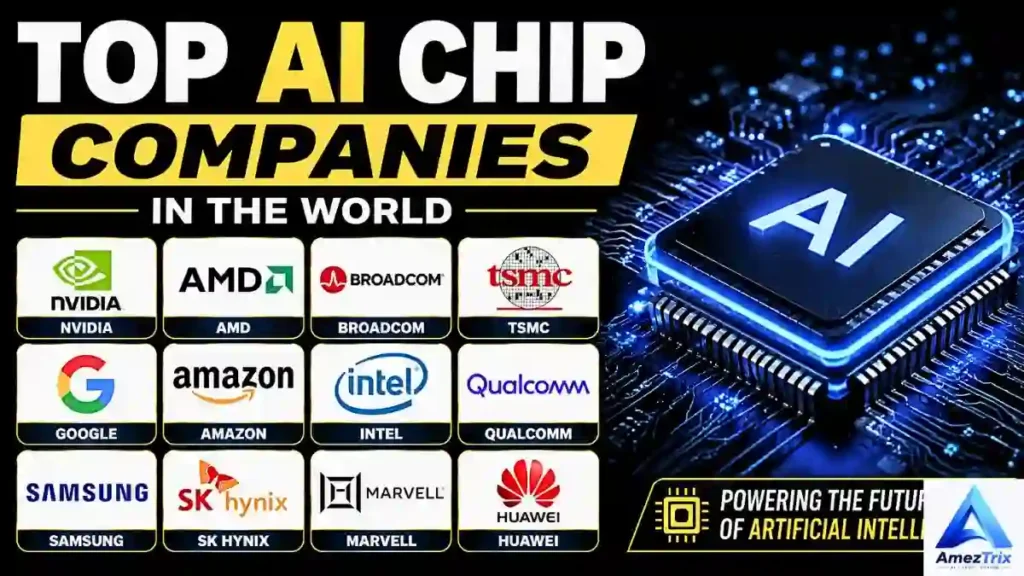
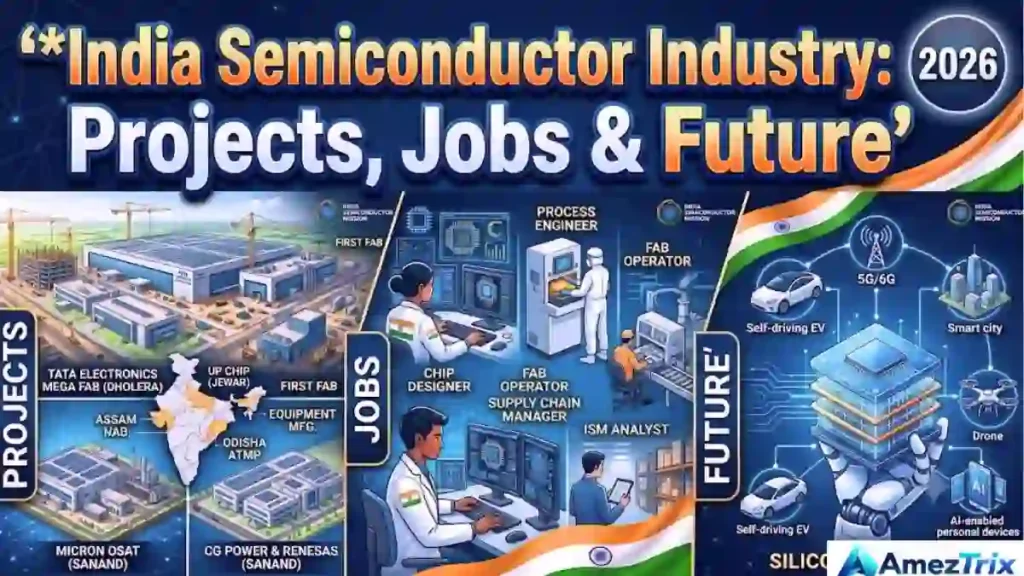
The AI Semiconductor Race India vs China is a contest between two very different chip strategies: one country that already runs the factory floor, and one that is racing to build it. Here is how they compare on manufacturing, money, memory, packaging and supply chains. Full analysis on AmezTrix.
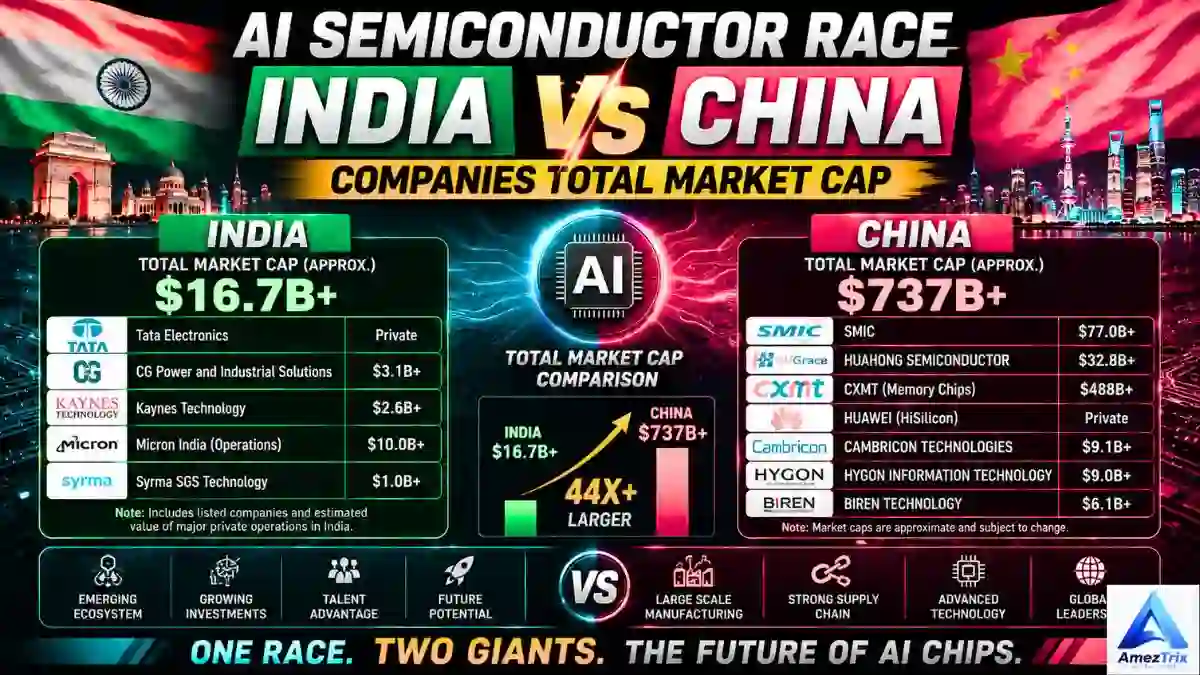
AI Semiconductor Race India vs China: Who Is Really Ahead?
Quick answer: China leads the AI semiconductor race today. It has large-scale fabs, a deep supply chain and record foundry revenue. India is much smaller in manufacturing but is building fabs, packaging plants and design capacity fast. China wins on scale. India wins on momentum and talent.
TL;DR
- China’s SMIC posted $3.0 billion in Q2 2026 revenue, up 36.1% year on year.
- India has 10 approved semiconductor projects worth over ₹1.6 lakh crore.
- China leads in fabs, memory and packaging. India leads in the speed of new announcements and in design talent per rupee spent.
- The real contest is bigger than “who makes more chips.” It covers memory, packaging, equipment and supply-chain trust.
Everything runs on chips now. Generative AI, cars, cloud storage, the phone in your pocket. Strip away the marketing and you are left with silicon, and increasingly it is silicon built for AI.
China spent decades building the whole stack: design, fabrication, packaging, testing and mass electronics. India took another road. It leaned on its huge pool of chip-design engineers and its software strength. Manufacturing is the part it is still catching up on.
So which side is ahead? Today, China, by a clear distance. But I would not write India off over a ten-year view.
AI Chips Explained Like You’re 5
Picture a giant restaurant kitchen. The AI chip (a GPU or accelerator) is a thousand cooks chopping at the same time. Memory is the fridge. The faster the cooks can grab ingredients, the faster dinner is ready.
Advanced packaging is the counter that connects the cooks to the fridge. Networking chips are the waiters moving plates around. A country that can build all four parts wins the kitchen.
China has built most of this kitchen already. India is still putting up the walls, though some stations are now running.
Why So Many People Search for This Topic
The search intent is mostly informational, with a commercial edge. Different readers want different things:
- Investors want to know which chip stocks and IPOs deserve attention.
- Engineers and students want to know where chip jobs are heading.
- Business owners want safer places to source electronics.
- Policy watchers want to know if India can really become a second chip hub.
Most articles on this topic stay at headline level. This one puts numbers, trade-offs and honest limits side by side.
India vs China Semiconductor: Key Figures at a Glance
Numbers cut through opinion. Here is where both countries stand right now. China’s figures come from company filings and wire reports. India’s figures come from government and company announcements, so treat the capacity numbers as stated targets that are ramping up.
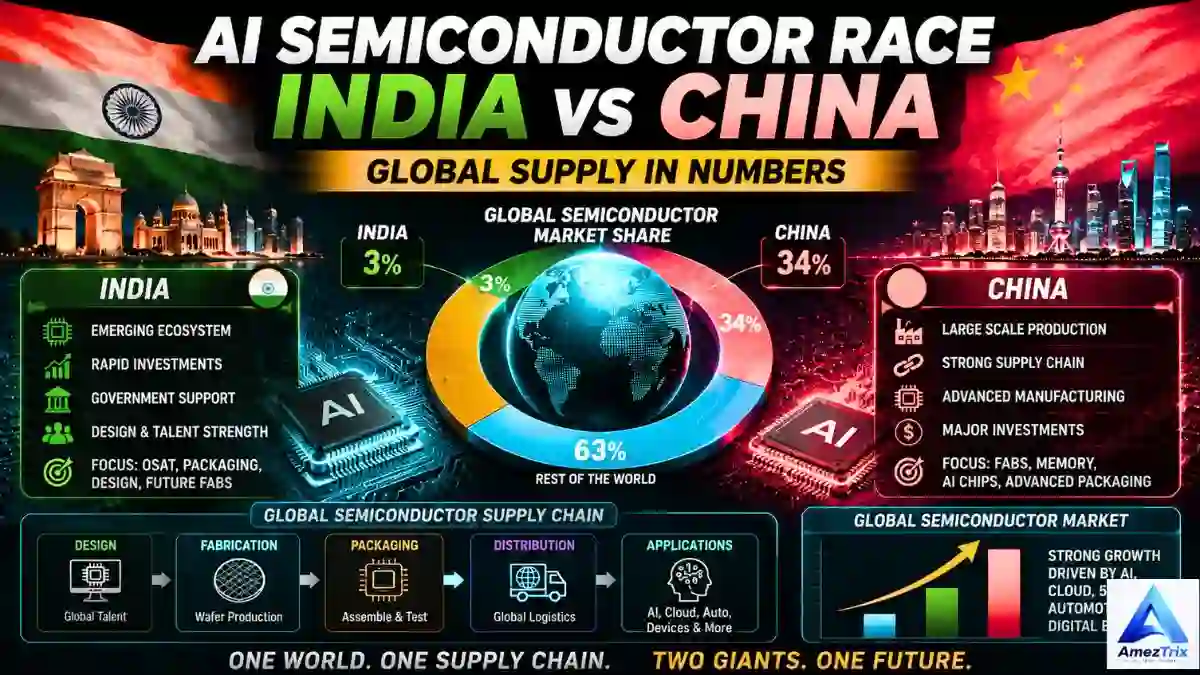
AI Semiconductor Race India vs China comparison table
| Metric | 🇮🇳 India | 🇨🇳 China |
|---|---|---|
| Approved semiconductor projects | 10 | — |
| Total semiconductor investment | ₹1.6 lakh crore+ | — |
| Tata AI-enabled fab investment | ₹91,526 crore | — |
| Tata fab capacity | 50,000 wafers/month | — |
| Micron India capacity | 14 million units/week | — |
| Kaynes capacity | 6.33 million chips/day | — |
| Tata Assam packaging output | 48 million units/day | — |
| SMIC Q2 2026 revenue | — | $3.0B (+36.1% YoY) |
| SMIC Q2 wafer shipments | — | 2.87M (8-inch equivalent) |
| SMIC utilization rate | — | 93.7% |
| SMIC Q2 2026 profit (attributable) | — | $479.2M |
| CXMT IPO size | — | $8.6B |
| CXMT market cap at debut (27 July 2026) | — | ~$487B |
| Manufacturing stage | Emerging | Advanced, large-scale |
| Overall production scale | 🟡 Growing fast | 🟢 Much larger |
Sources: SMIC Q2 2026 results filing; Quartz, citing Reuters, on the CXMT debut. India figures: government and company announcements.
What the India column tells you
₹1.6 lakh crore is not pocket change, and it is spread across only 10 projects. Tata alone is putting ₹91,526 crore into one AI-ready fab. That is a serious bet from a country that bought most of its chips abroad until recently.
Add Micron’s memory assembly, Kaynes’ daily chip output and Tata’s Assam packaging plant, and the picture changes. This is a supply chain taking shape, not just slides in a presentation.
What the China column tells you
SMIC earned just over $3 billion in one quarter. Its fabs ran at 93.7% utilization, which is close to full throttle. Revenue growth came from both more wafers and better pricing, and net profit more than tripled.
Then there is CXMT. Its $8.6 billion IPO was the biggest mainland Chinese chip offering on record, and the stock jumped about 466% on day one. A memory maker went from private to China’s most valuable listed company in a single session.
Putting the two side by side
The gap is easy to see. One quarter of SMIC profit is bigger than many single lines on India’s side of the sheet. Yet India is not standing still. Several companies are building at the same time, across fabs, memory assembly and packaging.
My read: India’s percentage growth will likely run faster than China’s for years. The absolute gap will stay wide for a long time.
Why Is AI Squeezing the Chip Supply So Hard?
Simple answer: AI eats more silicon than anything before it.
Ordinary computing runs fine on a normal CPU and standard memory. AI doesn’t work that way. It needs massive parallel processing, huge memory bandwidth and data that moves faster than older designs ever allowed.
That appetite lifts a whole family of parts, not just GPUs:
- AI accelerators, CPUs and NPUs
- High Bandwidth Memory (HBM)
- Networking and optical interconnect chips
- Power-management silicon
- Advanced packaging
Training a large model takes thousands of processors working together, plus memory, networking, storage controllers and power systems. So AI lifts the whole supply chain, and India’s government has said as much, calling AI a core driver of demand for specialised processors.
The Real Gap in the AI Semiconductor Race India vs China: Maturity
Strip away the noise and one word remains: maturity. China’s ecosystem already covers design, fabrication, memory, packaging and equipment. India has long been stronger in design and engineering services than in large-scale fabrication.
That is changing, slowly, with fresh money going into fabs, ATMP and OSAT plants, and design hubs.
AI Semiconductor Race India vs China comparison
| Factor | India | China |
|---|---|---|
| Semiconductor manufacturing | Emerging | Established and expanding |
| Chip design | Strong | Strong |
| Electronics manufacturing | Growing fast | Very large |
| Advanced AI chips | Early-stage | Building domestic alternatives |
| Mature-node manufacturing | Developing | Large-scale |
| Advanced-node capability | Limited | Developing under restrictions |
| Packaging & testing | Expanding quickly | Established |
| AI demand | Growing fast | Very large |
| Supply chain depth | Still forming | Deep |
| Government support | Strong | Very strong |
| Engineering talent | Major strength | Major strength |
| Global supply-chain opportunity | High | Very high |
China owns the scale today. India owns the story about tomorrow.
What Is Happening Inside China’s Chip Industry
China’s electronics base is one of the biggest on earth. It has pulled in processors, memory, sensors and power chips for years. AI simply added a faster layer on top.
Building Around the Restrictions
Self-reliance is the theme. Export controls have made advanced manufacturing equipment harder to get, so Chinese firms are engineering their way around the problem.
Huawei is the best-known example. Working with SMIC, it leans on advanced packaging and system-level design to squeeze out performance without the sharpest fabrication nodes. That matters, because transistor size is only one lever. Architecture, memory bandwidth, packaging and software tuning all move the needle.
SMIC Carries a Lot of Weight
SMIC’s Q2 2026 results show how hot demand is. Revenue grew 20% over the previous quarter and 36.1% over last year, helped by higher shipments and better average prices. Utilization reached 93.7%.
The company also guided for a smaller 2% to 4% rise next quarter. With fabs already this full, further growth needs new capacity, not just more orders.
The lesson is that AI demand lifts the boring chips too: power management, controllers, networking and mature-node parts. China’s opportunity goes well beyond the GPU headlines.
Who Is Actually Building This
A handful of names anchor the push: Huawei, SMIC, CXMT, Cambricon, Hua Hong Semiconductor, JCET, Hygon and Biren Technology. Huawei is the most visible. CXMT is turning into a major memory player, which matters while global memory supply is tight.
HBM4 and China’s Memory Challenge
High Bandwidth Memory sits at the core of AI computing. Accelerators constantly move huge chunks of data to and from memory, and HBM was built for that job. This is why HBM4, HBM3E and memory packaging are such a big deal.
China has built real domestic memory capability. But the leading edge of AI memory is brutally competitive. To cut its reliance on outside suppliers, China needs stronger home-grown HBM.
What Is Happening Inside Semiconductor Companies in India
India’s story looks different. It has a giant tech market, expanding digital infrastructure, rising data-centre investment and plenty of engineers. The catch is that it has imported most of the chip components inside its electronics.
Government money is now flowing into manufacturing, packaging, testing and design to change that. The push is tied to AI, which officials describe as a key reason for rising demand for advanced chips.
The India Semiconductor Mission
A real chip ecosystem needs many layers working together — design, fabrication, packaging, testing, equipment, materials, R&D and a trained workforce. India is building these one layer at a time, with new packaging and testing plants and a growing focus on ATMP and OSAT.
Design Talent: India’s Sharpest Card
If one area is not starting from zero, it is design. India has been a base for global companies’ chip work for years: ASIC design, verification, VLSI, embedded systems, firmware and architecture.
That skill grows more valuable as AI chips become more specialised. India’s best opening may not be traditional manufacturing at all. It could be AI chip design, verification and embedded AI.
Where India’s Real Opportunity Sits
India will not out-manufacture the biggest foundries overnight, and that is not the smart goal anyway. The better play is to pick niches and get very good at them:
- AI accelerator design for inference and edge workloads
- Edge AI chips for India’s large auto, telecom and consumer markets
- Automotive semiconductors riding the EV and ADAS wave
- Advanced packaging that combines chiplets and memory without a leading-edge fab
- Design services for global chip companies
Manufacturing: Where Things Actually Stand
China runs large fabs inside a mature electronics ecosystem. India is still assembling the pieces. China has depth and scale now. India has upside, talent and appeal as an alternative location.
As Indian fabs, OSAT plants and design firms grow up together, the gap could narrow. Not overnight, though. Chip industries take years, sometimes decades, to mature.
Advanced Packaging Is the New Battleground
Shrinking transistors gets harder and costlier each generation. So packaging has become a performance lever on its own: chiplets, 2.5D and 3D stacking, HBM integration, fast interconnects and co-packaged optics.
China is investing heavily here as a workaround for restrictions. India is building a packaging and testing base too. And here is the interesting part: India does not need to dominate leading-edge wafers to matter. Strong OSAT, testing and system integration carry real weight.
Supply Chains and Why Diversification Matters
Resilience now shapes where chip money flows. The industry long clustered in a few places, and geopolitical tension pushed companies to spread their bets.
China’s huge domestic electronics base keeps it central to global demand. India is positioning itself as the alternative, with new capacity, packaging plants, R&D centres and design talent for companies that want less concentrated risk.
Which Market Is Bigger? It Depends What You Measure
- Manufacturing scale: China, no contest.
- Established ecosystem: China again.
- Design talent: India holds its own.
- Growth trajectory: India has real upside.
- AI demand in absolute terms: China, though India is growing fast from a smaller base.
Why India Could Become a Serious AI Chip Hub
Several forces could speed things up: a big domestic market in phones, EVs, cloud and data centres; fast AI adoption in Indian businesses; steady government backing; a deep engineering pool; and global firms hunting for options beyond the usual hubs.
One pattern stands out in industry reports. The language keeps shifting from “India could” to “India is.” That usually means momentum is real.
Why China Is Not Giving Up the Lead Anytime Soon
China’s advantages are hard to copy quickly: huge fabs, giant electronics makers, established chip designers, memory companies, packaging capability, enormous domestic demand and heavy state investment.
It is also working to cut dependence on foreign chip tools, including efforts in domestic lithography. Performance and reliability gaps versus top global suppliers remain, and closing them is a different challenge entirely.
Strengths and Weaknesses Side by Side
| Country | Strengths | Weaknesses |
|---|---|---|
| India | Design talent, large tech market, fast-growing electronics output, AI and software base, strong government backing, supply-chain appeal | Thin fabrication history, unfinished supply chain, limited advanced nodes, reliance on imported equipment, infrastructure gaps |
| China | Massive manufacturing base, powerful electronics industry, major chip companies, huge domestic demand, strong state support | Restricted access to advanced equipment, geopolitical exposure, ongoing lithography challenges |
How to Judge Any Country’s Chip Progress (Checklist)
Headlines can mislead. Use this quick checklist whenever you read about a “chip breakthrough”:
- Is the fab producing, or only announced? Production beats pledges.
- What is the utilization rate? Over 90% means demand is real.
- Which node is it? Mature nodes and leading-edge nodes are different games.
- Is packaging covered? Chips that cannot be packaged locally still depend on others.
- Who are the customers? Domestic-only demand is a different risk from global demand.
- Where does the equipment come from? Tool access limits how far a fab can grow.
Common Mistakes When Reading the India vs China Chip Story
- Comparing plans with output. India’s capacity figures are ramp-up targets. SMIC’s are reported results.
- Treating GPUs as the whole story. Memory, packaging and power chips matter just as much.
- Trusting first-day IPO prices. CXMT’s valuation is a snapshot, not a verdict.
- Expecting a single winner. The two countries are strong in different parts of the chain.
Red Flags to Watch For
- Capacity numbers with no start date or production proof
- Claims of “leading-edge” chips with no node or customer named
- Valuations that jump far faster than revenue
- Articles that never mention equipment restrictions
The Honest Downsides: What This Comparison Can’t Tell You
No comparison is perfect, and this one has limits:
- SMIC leans on China. Reports show more than 90% of its revenue now comes from Chinese customers. That helps in good times and hurts if domestic demand cools.
- CXMT’s valuation is a snapshot. The memory sector is cyclical, and the company itself warned that demand could weaken if AI spending slows.
- India’s numbers are early. New fabs take years to reach steady output, and India still imports much of its equipment and materials.
- Figures change fast. Check the latest filings before you make any investment or business call. This is information, not financial advice.
What Comes Next in the AI Semiconductor Race
The next phase will not be decided by who shrinks a transistor the most. It will come down to compute efficiency, memory bandwidth, HBM, chiplets, packaging, power use, networking and manufacturing scale, all together.
China’s approach is to build an ecosystem it does not need to borrow from anyone. India’s approach is to enter the global chip value chain through what it already does well: design, engineering and technology services.
Looking Ahead to 2030
By 2030, the picture could look different. China will probably remain one of the biggest chip markets and manufacturing centres. India, if today’s investments turn into commercial-scale production, could become a far larger hub for packaging, manufacturing and design.
Watch these areas closely: AI accelerators, HBM, advanced packaging, chiplets, automotive and power chips, edge AI, data-centre silicon, chip equipment and silicon photonics. India’s angle is unusual because AI adoption, electronics manufacturing and chip demand are all rising together.
AI Chip India vs China: Who Is Better Positioned?
There is no single winner across every category, and framing it as winner-take-all misses the point. China has the stronger manufacturing ecosystem right now. Its scale, home demand and established players are hard to match.
India has the stronger growth story, built on engineering talent, digital infrastructure, AI adoption and steady policy support. China is strengthening an ecosystem that is already huge. India is building a broader one from a different starting point.
Frequently Asked Questions: AI Semiconductor India vs China
Is China ahead of India in AI chip manufacturing?
Yes, by a wide margin. China runs large fabs, a mature packaging industry and a deep electronics supply chain. India is still scaling up fabrication, packaging and testing. India is stronger on design talent than on manufacturing output today, and it is closing that gap gradually.
Does India manufacture AI chips?
Not at large scale yet. India has strong chip-design and AI hardware talent, and several fabs and packaging plants are under construction or ramping up. Its nearer-term strengths are design, packaging, testing and specialised applications rather than leading-edge AI processors.
Is AI increasing semiconductor demand in India?
Yes. Growing AI adoption is pushing demand for servers, data centres and specialised processors across the country. The Indian government has linked AI growth directly to rising demand for advanced chips, which is one reason new semiconductor projects keep getting approved.
What is HBM, and why does it matter for AI?
High Bandwidth Memory is a type of stacked memory that moves data to processors at very high speed. AI accelerators constantly shuttle large amounts of data, so HBM often limits real performance. That makes it one of the most valuable and tightly supplied chip components.
What is India’s biggest semiconductor advantage?
Design and engineering talent. India already supports global chip companies with ASIC design, verification, VLSI and embedded work. Add a large domestic tech market, fast-growing electronics manufacturing and strong government backing, and India has a solid base to build manufacturing on.
What is China’s biggest semiconductor advantage?
Scale and depth. China combines a massive electronics industry, extensive manufacturing capacity, major chip companies and a supply chain built over decades. Strong domestic demand keeps its fabs busy, as SMIC’s 93.7% utilization in Q2 2026 shows.
Will India overtake China in semiconductors?
It is too early to say. China’s ecosystem is far larger and more mature today. India has real long-term potential, but closing the gap needs sustained investment and years of steady execution. A more realistic outcome is that each leads in different parts of the chain.
Final Verdict
This was never really a race about who makes the most chips. It is a wider contest covering AI computing, chip design, manufacturing, memory, packaging, electronics, data centres and supply-chain resilience, all tangled together.
China leads on manufacturing scale and ecosystem maturity, and SMIC’s latest numbers show its self-reliance push still accelerating. India is becoming an important chip destination, backed by engineering talent, design depth, software strength and a fast-growing AI economy. New packaging and manufacturing projects could move it from a design-and-services hub toward something more complete.
The realistic read: China leads on scale today, and India has real potential to become one of the world’s important emerging AI chip hubs over the next decade, if it keeps executing.
If you track this space as an investor, engineer or researcher, keep watching AI chips, HBM4, advanced packaging, chiplets, 2nm process technology, automotive semiconductors, silicon photonics and the build-out in both countries.
About Author
Rajendra Parmar is the Founder and Editor of AmezTrix, where he covers Artificial Intelligence, Technology, WordPress, Web Hosting, Digital Marketing, Gadgets, and Software. His mission is to simplify complex technology through practical tutorials, honest reviews, and well-researched guides that help readers make smarter digital decisions.

Rajendra Parmar
Founder & Editor • AmezTrix
Rajendra Parmar is the Founder and Editor of AmezTrix, a platform covering Artificial Intelligence, Technology, WordPress, Web Hosting, Digital Marketing, Gadgets, Software Reviews, and emerging innovations. His mission is to simplify complex technology through practical tutorials, honest reviews, and well-researched guides that help readers make smarter digital decisions.