India Semiconductor Industry 2026: Explore Tata, Micron, Kaynes & CG Power, chip plants, jobs, investments, and India’s tech future with AmezTrix.
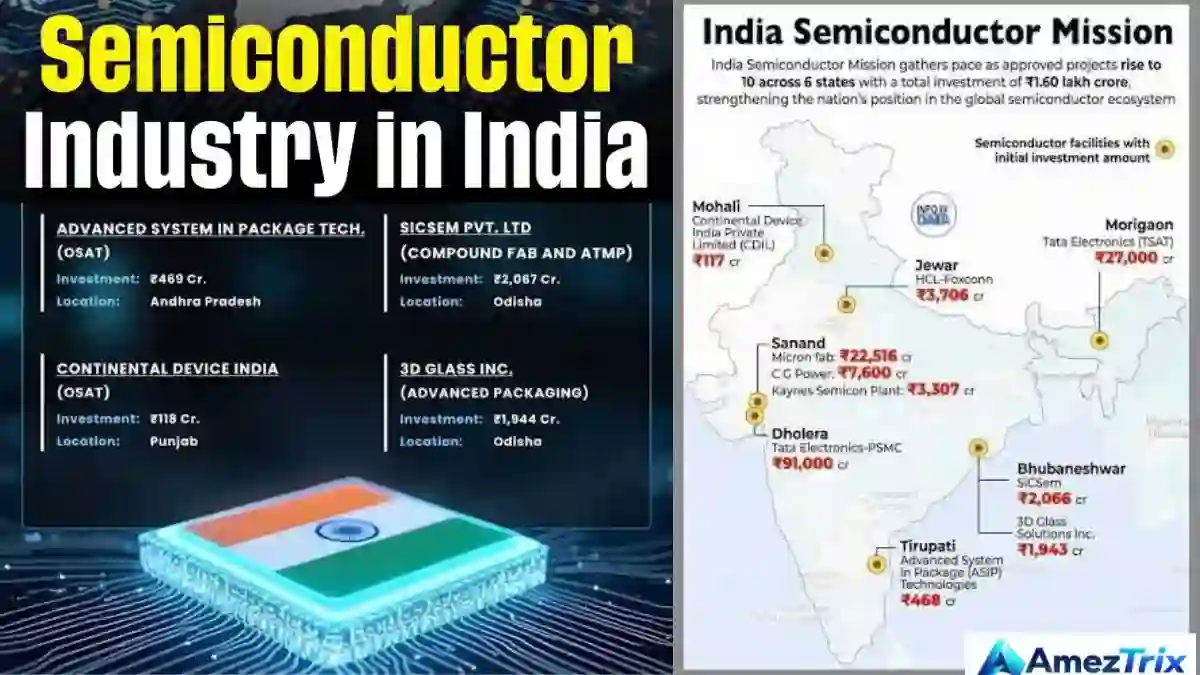
India Semiconductor Industry: Projects, Companies, Jobs, Investment and the Future of Chip Manufacturing
Something quietly shifted in India’s tech story this year. For as long as most of us can remember, India was the place where chips got designed — brilliant engineering, sure, but the actual manufacturing always happened somewhere else. Taiwan. South Korea. Sometimes the US.
That’s no longer the full picture for the India Semiconductor Industry.
By September 2026, wafers are actually moving through Indian fabs. Memory chips are shipping out of Gujarat. Packaging lines are running full shifts, not pilot batches. If you’ve been following semiconductor manufacturing in India even loosely, you’ve probably noticed the tone of the coverage changed somewhere in the last year — less “here’s what India plans to do” and more “here’s what India just did.”
This piece walks through what’s genuinely operational, what’s still under construction, who’s footing the bill, and — maybe most usefully — where the actual job opportunities sit if you’re an engineer, a student, or just someone trying to understand where this industry is headed.
India Semiconductor Fabs vs. OSAT: The Complete Company-Wise Breakdown (2026)
Here’s a question that trips up almost everyone following the India Semiconductor Industry: when a headline says the sector is booming, what does that actually mean? Is India making raw chips from scratch, or mostly packaging and testing chips made elsewhere?
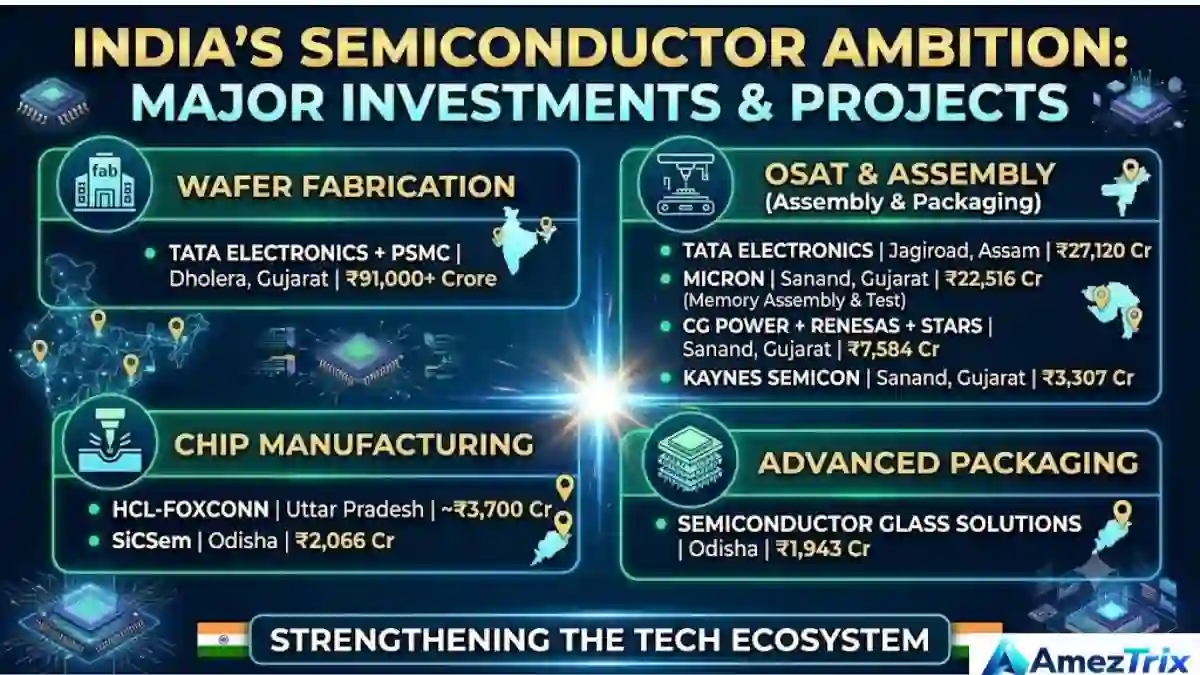
Turns out, the answer is a bit of both — and the difference matters a lot more than most coverage lets on. Below is the complete company-wise breakdown of semiconductor manufacturing projects in India, sorted by what each one actually does, not just how big the investment number sounds.
All the Major Projects, Side by Side
| Company | Location | Investment (Approx.) | What They Do |
|---|---|---|---|
| Tata Electronics + PSMC | Dholera, Gujarat | ₹91,000+ crore | Wafer Fabrication |
| Tata Electronics | Jagiroad, Assam | ₹27,120 crore | Assembly & Packaging |
| Micron | Sanand, Gujarat | ₹22,516 crore | Memory Assembly & Test |
| CG Power + Renesas + Stars | Sanand, Gujarat | ₹7,584 crore | OSAT |
| Kaynes Semicon | Sanand, Gujarat | ₹3,307 crore | Chip Manufacturing |
| HCL-Foxconn | Uttar Pradesh | ~₹3,700 crore | Chip Manufacturing |
| SiCSem | Odisha | ₹2,066 crore | Semiconductor Manufacturing |
| 3D Glass Solutions | Odisha | ₹1,943 crore | Advanced Packaging |
A quick caveat worth repeating: these numbers reflect India Semiconductor Mission announcements as of September 2026. Projects shift as they move from construction to full-scale output, so treat the capacity figures as targets, not locked-in guarantees.
Full Company Data: Fab vs. OSAT/ATMP Classification
| Company | Location | Investment (Approx.) | Planned Capacity | Core Activity | Classification | Partners | Jobs Expected | Key Timeline | Current Status |
|---|---|---|---|---|---|---|---|---|---|
| Tata Electronics + PSMC | Dholera, Gujarat | ₹91,000+ crore | ~50,000 wafer starts/month | Wafer Fabrication | Fab | Powerchip Semiconductor Manufacturing Corp (Taiwan) | ~21,000 (per SEZ notification) | Notified as SEZ in April 2026; 300mm fab construction confirmed on track at SEMICON India 2026 | Under construction |
| Tata Electronics | Jagiroad, Assam | ₹27,120 crore | ~48 million units/day | Assembly & Packaging | OSAT/ATMP | — | Not disclosed | Not disclosed | Development stage |
| Micron | Sanand, Gujarat | ₹22,516 crore | ~14 million units/week | Memory Assembly & Test (DRAM, NAND) | OSAT/ATMP | — | Not disclosed | Live production confirmed at SEMICON India 2026 | Commercial production live |
| CG Power + Renesas + Stars | Sanand, Gujarat | ₹7,584 crore | ~15 million chips/day | OSAT | OSAT/ATMP | Renesas Electronics, Stars Microelectronics | Not disclosed | Production started July 2026 | Commercial production live |
| Kaynes Semicon | Sanand, Gujarat | ₹3,307 crore | 6.33+ million chips/day | Semiconductor Manufacturing (Assembly/Test) | OSAT/ATMP | — | Not disclosed | Inaugurated March 2026 | Production underway |
| HCL-Foxconn | Jewar/Noida, Uttar Pradesh | ~₹3,700 crore | ~20,000 wafers/month (~36 million units/year) | Semiconductor Manufacturing | Fab (wafer-based capacity cited) | HCL, Foxconn | Not disclosed | Not disclosed | Development stage |
| SiCSem | Odisha | ₹2,066 crore | Not disclosed | Compound Semiconductor Manufacturing | Fab (compound semiconductors) | — | Not disclosed | Not disclosed | Approved project |
| 3D Glass Solutions | Odisha | ₹1,943 crore | Not disclosed | Advanced Packaging (glass panel substrates) | OSAT/ATMP (specialized packaging) | — | Not disclosed | Not disclosed | Approved project |
| Applied Materials | Pan-India (multiple sites) | Up to $5 billion | N/A — equipment/R&D | Equipment, R&D, Supply Chain, Talent | Neither — Equipment/Materials Supplier | — | Not disclosed | 10-year investment horizon; announced September 2026 | Announced |
Every figure here comes from official India Semiconductor Mission and government announcements as of September 2026. Where a cell says “Not disclosed,” that’s simply because no public number exists yet — not because the project lacks one.
Reading Between the Rows: What This Table Actually Reveals
Scan that Classification column slowly, and a pattern jumps out that most news coverage tends to gloss over.
Only two projects — the Dholera chip factory and HCL-Foxconn — sit in the true Fab category. And even HCL-Foxconn comes with an asterisk, honestly, because the public data leans on wafer-count language without fully confirming whether it’s a complete front-end fab or something closer to a hybrid facility. Everything else on this list — Micron, CG Semi, Kaynes, Tata’s Assam unit — falls under OSAT/ATMP.
Is that a problem? Not really. It’s actually the smarter sequencing.
Building assembly and testing capacity first, then scaling toward raw fabrication, is more or less the same playbook Taiwan and South Korea followed decades back. You get manufacturing muscle, trained workers, and export revenue flowing in before you attempt the far riskier, far more capital-intensive job of building a fab from scratch. India’s approach to semiconductor manufacturing seems to be following that same logic here, whether intentionally or not.
But here’s the part worth sitting with: most of what’s commercially live right now in India — Micron’s memory output, CG Semi’s chips, Kaynes’ production — is packaging and testing work, not raw silicon fabrication. The Dholera chip factory remains the only genuine fab in the pipeline, and construction there is still ongoing.
So if someone reads this table and walks away thinking, “wait, exactly how many real fabs does India have?” — the honest answer is one, still under construction, plus a second (HCL-Foxconn) whose exact classification remains a little murky based on public disclosures alone.
Why This Distinction Matters More Than the Investment Numbers
Here’s something I’ve noticed reading through these announcements — the crore figures grab headlines, but they don’t tell you much about what is actually being manufactured. A ₹91,000 crore fab and a ₹22,516 crore OSAT plant sound comparable in scale, but they represent completely different points on the value chain.
A quick way to think about it:
- Fabs create chips from raw silicon wafers — the hardest, most capital-heavy, most strategically valuable step
- OSAT/ATMP units take chips that already exist and prepare them for real-world use — faster to build, lower risk, still genuinely valuable
Neither one is “better.” A functioning semiconductor economy needs both, running in parallel. But when a headline says the India Semiconductor Industry is thriving, it’s worth asking which side of that split it’s actually referring to.
Quick Reference: Semiconductor Manufacturing India by Classification
| Classification | Companies Involved | What This Signals |
|---|---|---|
| True Fab | Tata Electronics + PSMC (Dholera chip factory) | Full wafer fabrication — the hardest, most strategic capability |
| Fab (Partial/Unconfirmed) | HCL-Foxconn | Wafer-based capacity cited, but full fab status not clearly confirmed publicly |
| OSAT/ATMP | Micron, CG Power + Renesas, Kaynes Semicon, Tata (Assam), 3D Glass Solutions | Assembly, testing, and packaging — faster to scale, already commercially live in most cases |
| Fab (Specialized) | SiCSem | Compound semiconductor fabrication, not standard silicon |
| Equipment/Supplier | Applied Materials | Not a fab or OSAT — supplies the tools and materials both categories depend on |
So Where Does India’s Semiconductor Industry Actually Stand Right Now?
Short version: five semiconductor facilities under the India Semiconductor Mission have already started commercial production. Not announced — actually running.
The big one, the project everyone points to, is the Tata semiconductor fab — built with PSMC — coming up in Dholera, Gujarat. It’s under active construction, backed by an investment north of ₹91,000 crore. Alongside it, the government has rolled out something called Semicon 2.0 — a second phase that’s less about building one more giant factory and more about strengthening design, materials, equipment, R&D, and skilled workers across the whole chain at once.
Okay, But What Even Is a Semiconductor?
A semiconductor, at its most basic, is a material — almost always silicon — whose electrical conductivity you can control precisely. That control is what lets engineers pack billions of tiny switches onto something the size of your fingernail.
You’ll find these chips inside pretty much anything that has a power button:
- Phones, laptops, and PCs
- Electric and regular cars
- AI servers and data centers
- Medical devices, satellites, industrial machinery
- Smart TVs, robotics, telecom towers, IoT sensors
Here’s the thing that’s changed the stakes, though — AI. Training and running large models eats up staggering amounts of specialized compute, and all of that compute runs on chips. Semiconductors have basically become what oil was to the 20th century, minus the smell.
Why Is India Pushing So Hard on Semiconductor Manufacturing?
India already has a huge electronics market and no shortage of engineering talent. What was missing was the manufacturing piece — actually making the chips domestically instead of relying on imports.
| Reason | What It Actually Means |
|---|---|
| Supply-chain resilience | Less scrambling when overseas fabs face shortages or delays |
| Electronics manufacturing boost | Stronger local backing for phones, EVs, appliances made in India |
| High-skill jobs | Demand for process engineers and technicians, not just coders |
| Strategic security | Chips matter for defense, telecom, and energy systems |
| Investment magnet | A working ecosystem pulls in more global R&D and manufacturing money |
The Chain: How a Chip Actually Gets Made
It helps to picture this as a pipeline rather than one single step:
Chip Design → Wafer Fabrication → Assembly → Testing → Packaging → Electronics Manufacturing
India has always been solid at the design end — that part was never in question. What the India Semiconductor Mission‘s Semicon 2.0 phase is really trying to do is connect that design strength to actual physical manufacturing inside the country: fabs, packaging units, material suppliers, equipment makers, all of it. The policy leans on six pillars — design, materials and machines, more fabs, more ATMP units, R&D, and talent.
The Projects Actually Powering India’s Semiconductor Industry
1. Tata semiconductor fab, Dholera, Gujarat — India’s First Real Fab
This is the one everyone’s watching. Tata Electronics teamed up with Taiwan’s Powerchip Semiconductor Manufacturing Corporation (PSMC) to build the Tata semiconductor fab, targeting roughly 50,000 wafer starts a month, with an investment sitting around ₹91,000 crore.
The government notified the Dholera chip factory as a Special Economic Zone back in April 2026 and called it — officially — India’s first true chip fabrication plant. The project is expected to create close to 21,000 jobs. At SEMICON India 2026, Tata confirmed the 300mm fab is on schedule and announced new partnerships covering wafers, packaging, chemicals, and worker training.
Why does this actually matter? Because a fab isn’t the same thing as an assembly plant. This is where raw silicon wafers go through hundreds of precision steps and come out as actual semiconductor devices. India has plenty of packaging capacity already — this is the piece that was genuinely missing.
2. Micron’s Memory Plant, Sanand, Gujarat
Micron’s Sanand facility handles assembly and testing for memory chips — an investment of about ₹22,516 crore, with planned output near 14 million units a week. Micron’s CEO stated at SEMICON India 2026 that commercial DRAM and NAND production is already live at this site. Not a pilot run — live.
3. CG Power + Renesas + Stars Microelectronics, Sanand
This joint venture runs an OSAT facility (more on what that means shortly) backed by roughly ₹7,584 crore, with a targeted output of about 15 million chips daily. Commercial production kicked off here in July 2026, aimed largely at automobiles, two-wheelers, industrial equipment, and export markets.
4. Kaynes Semicon, Sanand, Gujarat
Worth flagging separately, because it’s not a multinational — Kaynes is homegrown. The Sanand plant was inaugurated in March 2026, backed by around ₹3,307 crore, targeting more than 6.33 million chips a day. Indian companies are building manufacturing capability, not just design capability — that’s a meaningful shift for semiconductor manufacturing in India.
5. Tata Electronics, Jagiroad, Assam
Tata’s second big site sits in Assam — an investment near ₹27,120 crore, planned output around 48 million units daily. What makes this one interesting isn’t just the numbers; it pushes India’s semiconductor map past Gujarat and could spark a whole new electronics cluster in the Northeast.
6. HCL-Foxconn, Uttar Pradesh
Near the Jewar/Noida stretch, an HCL-Foxconn venture is building a facility worth roughly ₹3,700 crore, targeting about 20,000 wafers a month (around 36 million units yearly). Its location near the upcoming Jewar Airport gives it a genuine logistics edge.
7. Odisha’s Niche Play
Odisha isn’t chasing the same silicon-fab model as Gujarat — it’s going after advanced packaging and compound semiconductors instead, through approved projects from 3D Glass Solutions and SiCSem. Think glass panel substrates and heterogeneous integration. It’s a sign India’s ambitions stretch beyond standard silicon chips.
Why Everyone Keeps Talking About Gujarat
The Dholera-Sanand stretch has basically turned into India’s version of Taiwan’s Hsinchu belt. A handful of reasons this corridor got so far ahead of everywhere else:
- Plenty of ready-to-develop industrial land
- Solid port and highway links for importing raw materials
- An electronics and auto manufacturing base already sitting nearby
- Steady state-level policy support with fewer bureaucratic delays
- A growing pool of technicians trained specifically for fab-floor work
The Dholera chip factory anchors the fabrication side. Sanand has turned into the assembly-testing-packaging hub. And once one facility lands, suppliers and vendors tend to follow — that clustering effect is already visible.
OSAT and ATMP — What Do These Terms Even Mean?
You’ll run into these acronyms constantly in any coverage of semiconductor manufacturing in India, so it’s worth clearing them up.
OSAT stands for Outsourced Semiconductor Assembly and Test. Once a chip comes off a wafer, someone has to cut it apart, package it, wire it up, test it, and get it ready for actual use. That’s OSAT’s job.
ATMP — Assembly, Testing, Marking and Packaging — covers roughly the same post-fabrication territory under a different name.
India is leaning hard into OSAT and ATMP right now, mostly because these facilities go up faster than a full fab, while still building real manufacturing know-how and putting people to work.
Where the Jobs Actually Are in India’s Semiconductor Industry
This buildout isn’t just about factories going up — it’s opening up career paths across a few distinct lanes:
| Track | What You’d Be Doing |
|---|---|
| Engineering | Process engineering, electrical/electronics work, materials science |
| Manufacturing | Fab technician roles, equipment operation, quality control |
| Chip Design | VLSI, ASIC, FPGA design and verification |
| Software | EDA tooling, factory automation, manufacturing analytics |
| Research | Advanced packaging, compound semiconductors, power electronics |
The government reported in September 2026 that roughly 70,000 design engineers have been trained over the past four years under the India Semiconductor Mission. Semicon 2.0 is now trying to widen that funnel to include manufacturing technicians too — a group India genuinely doesn’t have enough of yet.
If You’re a Student, Here’s What Actually Helps
- Verilog and SystemVerilog basics
- Solid grounding in digital and analog electronics
- Python and C/C++ for automation work
- PCB design and embedded systems
- FPGA and ASIC design flows
- Semiconductor physics and testing fundamentals
Honestly, this is worth repeating: the industry needs technicians and process specialists far more than it needs another batch of software developers. That’s a different hiring pattern than what India’s IT sector trained a generation of engineers for, and it’s going to take some adjustment.
It’s Not Just About Fabs — Here’s the Bigger Picture
There’s a common misunderstanding that “building semiconductors” simply means putting up a factory. It’s a lot messier than that. The actual chain looks more like:
Raw Materials → Chemicals → Equipment → Wafer Manufacturing → Chip Design → Fabrication → Packaging → Testing → Electronics Assembly → Finished Products
That’s exactly why Semicon 2.0 pours as much attention into materials and equipment as it does into fabs themselves. A world-class fab is dead weight without a steady supply of ultra-pure chemicals and precision machinery — and that’s where global suppliers are starting to show up.
The Applied Materials Signal
In September 2026, Applied Materials — a major US equipment maker — announced plans to invest up to $5 billion in India over the next decade, covering research, supply chains, and workforce training. For an industry where tolerances are measured in nanometers, this kind of equipment-side commitment probably matters as much as any single fab announcement. It’s the companies that build the machines saying they’re in this for the long haul.
India Semiconductor Industry – What’s Actually Driving Demand
AI Changes Everything
Every AI system — chatbots, autonomous vehicles, whatever comes next — runs on specialized silicon: GPUs, accelerators, high-bandwidth memory. As India builds out its own AI infrastructure, domestic appetite for this hardware is only going one direction.
EVs Need Chips in Places You Wouldn’t Expect
An electric vehicle isn’t really a mechanical object anymore — it’s closer to a computer with wheels. Battery management, motor controllers, charging systems, driver-assist sensors — all of it runs on chips. As India’s EV market grows, this quietly becomes one of the steadiest demand sources around.
Smartphones Are Still the Steady Anchor
India’s already a serious smartphone assembly hub. Processors, display drivers, camera sensors, power-management chips — all of it flows through here, and local testing and packaging capacity means more of that value gets captured domestically instead of leaking overseas.
The Part Nobody Likes Talking About: Real Challenges Ahead
Announcements are cheap. Execution isn’t. Here’s what India’s semiconductor industry is genuinely up against:
- Massive capital needs — modern fabs cost tens of billions to build and equip
- Technical difficulty — manufacturing tolerances here are measured in nanometers, not millimeters
- Power and water demands — fabs need round-the-clock electricity and extremely pure water
- Talent shortages — far more trained technicians are needed than currently exist
- Tough global competition — Taiwan, South Korea, the US, and Japan have decades of head start
- Fragile supply chains — one fab depends on dozens of specialized suppliers running smoothly
- Long build times — large fabs typically take three to five years, sometimes more, before full yield
None of this is unique to India, to be fair — every country trying to build a chip industry from nothing hits the same walls. It’s exactly why announced investment numbers shouldn’t be mistaken for guaranteed output.
So — Can India Actually Pull This Off?
India’s got real cards to play: a huge domestic market, established design talent, active government backing through the India Semiconductor Mission, and rising demand from AI and EVs. But whether any of that turns into a genuine global manufacturing hub comes down to execution, and execution across every part of the chain at once — design, fabrication, packaging, equipment, materials, and people.
What’s encouraging about the September 2026 momentum is that India doesn’t seem to be chasing the “one giant fab and we’re done” approach. It’s building the ecosystem piece by piece — slower, admittedly, but arguably the more durable path. Taiwan didn’t build TSMC’s dominance overnight either; it took decades of supplier networks growing alongside the fabs.
What’s Worth Watching Through 2027
| Trend | Why It Matters |
|---|---|
| Advanced packaging | Becoming nearly as critical as fabrication for complex AI chips |
| AI chip demand | Probably the single biggest growth driver going forward |
| Power semiconductors | Essential for EVs, renewable energy, industrial systems |
| Compound semiconductors | Gallium nitride and silicon carbide unlock new use cases |
| Domestic materials & gases | Still a genuine gap India needs to close |
| Equipment manufacturing | Could quietly become its own growth sector |
The Names Worth Knowing in India Semiconductor Industry
- Tata Electronics — fabrication and assembly, behind the Tata semiconductor fab in Dholera
- Micron — memory assembly and testing
- CG Power & Renesas — OSAT
- Kaynes Semicon — Indian-led manufacturing
- HCL-Foxconn — UP-based venture
- 3D Glass Solutions & SiCSem — advanced technology and compound packaging
- Applied Materials — global equipment and R&D backing
- India Semiconductor Mission (ISM) — the government body steering all of this
Frequently Asked Questions
Which company is building India’s first semiconductor fab?
Tata Electronics, working with Taiwan’s PSMC, is building the Tata semiconductor fab at the Dholera chip factory site — officially recognized by the government as India’s first proper chip fabrication plant.
Where exactly are these India Semiconductor Industry plants located?
Mostly Gujarat — Dholera and Sanand specifically — plus major sites in Assam, Uttar Pradesh, and Odisha.
What do OSAT and ATMP actually mean?
OSAT is Outsourced Semiconductor Assembly and Test; ATMP is Assembly, Testing, Marking and Packaging. Both describe the stage where raw chips get turned into finished, usable components.
Is semiconductor manufacturing in India actually happening, or is it still mostly plans on paper?
It’s real. As of September 2026, five facilities under the India Semiconductor Mission have started commercial production, with live DRAM and NAND output already flowing out of Micron’s Sanand plant.
What is Semicon 2.0, in plain terms?
It’s the next phase of the India Semiconductor Mission‘s strategy — moving away from building isolated factories toward strengthening the whole ecosystem: design, materials, equipment, more fabs, ATMP capacity, R&D, and people.
Are there real India semiconductor industry jobs for freshers, or is this hype?
Real jobs exist, but expect demand to lean toward fab technicians and process engineers rather than pure software or design roles—a genuine shift from India’s usual IT hiring pattern.
Is India manufacturing advanced AI chips yet?
Not at the cutting edge, no. Right now, India’s strength is packaging, testing, and mid-range fabrication. Large-scale advanced-node wafer fabrication — the kind the Tata semiconductor fab is building toward — is still under construction.
Final Verdict
India’s semiconductor industry has moved past the announcement stage. Wafers are running through real fabs, memory chips are shipping commercially, and the India Semiconductor Mission‘s Semicon 2.0 phase signals a deliberate shift toward building out the whole chain, not just chasing the next headline investment figure.
The next couple of years will tell us whether semiconductor manufacturing in India becomes a genuine global hub or stalls as another partially finished policy push. If you’re tracking this space — as an engineer, a student, or an investor — the number to watch isn’t the size of the next announcement. It’s whether projects like the Dholera chip factory keep converting from construction sites into steady, sustained output.
About Author
Rajendra Parmar is the Founder and Editor of AmezTrix, where he covers Artificial Intelligence, Technology, WordPress, Web Hosting, Digital Marketing, Gadgets, and Software. His mission is to simplify complex technology through practical tutorials, honest reviews, and well-researched guides that help readers make smarter digital decisions.