Quick answer: NVIDIA is the world’s largest semiconductor company by chip revenue, followed by TSMC, Samsung Electronics, Broadcom, SK hynix, Micron, AMD, Qualcomm, ASML, and Intel. NVIDIA and AMD design chips, TSMC and Samsung manufacture them, and ASML builds the lithography machines that make advanced manufacturing possible in the first place. Looking for the top 10 semiconductor companies in India, the top semiconductor companies in the USA, or the top 20 semiconductor companies? Those are covered below too.
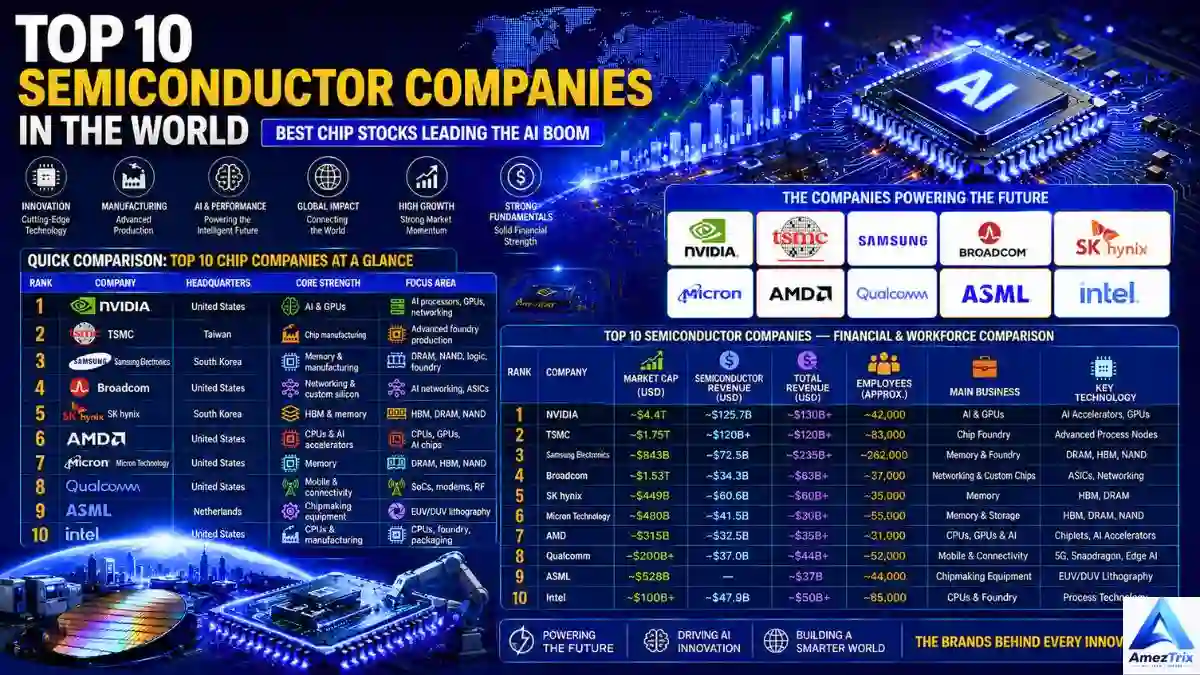
Top 10 Semiconductor Companies in the World (2026): Best Chip Stocks Leading the AI Boom
Semiconductors are the quiet engine behind almost everything we touch. The phone in your pocket, the AI chatbot you talk to, the electric car you drive, and the data center streaming your favorite show all run on chips built by a small group of companies locked in one of the most capital-intensive industries on the planet.
The stakes keep rising. Gartner puts global semiconductor revenue at roughly $793 billion in 2025, up about 21% from the year before. NVIDIA alone captured more than $125 billion of that, putting it well ahead of Samsung and SK hynix in the race for chip supremacy.
Ranking the top semiconductor companies isn’t as simple as lining up revenue figures, though. Some firms design remarkable chips but never touch a factory floor. Others run fabrication plants around the clock, every day of the year. And a few — ASML is the clearest case — don’t manufacture a single chip themselves; instead, they build the machines that make advanced chip production possible at all.
What follows is a clear look at the top 10 semiconductor companies in the world, weighing semiconductor revenue, market capitalization, manufacturing strength, AI exposure, and overall importance to the global supply chain — and why these players will keep shaping Google AI Tools, cloud computing, electric vehicles, smartphones, and next-generation computing for years to come, alongside the broader AI tools race they’re powering.
If you want to go beyond the global top 10, this guide also includes a list of semiconductor companies ranked 11 to 20, a look at the top semiconductor manufacturing countries, a section on semiconductor companies in the USA, and a full breakdown of semiconductor companies in India, including the listed ones investors watch. You will also find a quick guide to semiconductor companies’ stocks and a note on finding semiconductor companies near me.
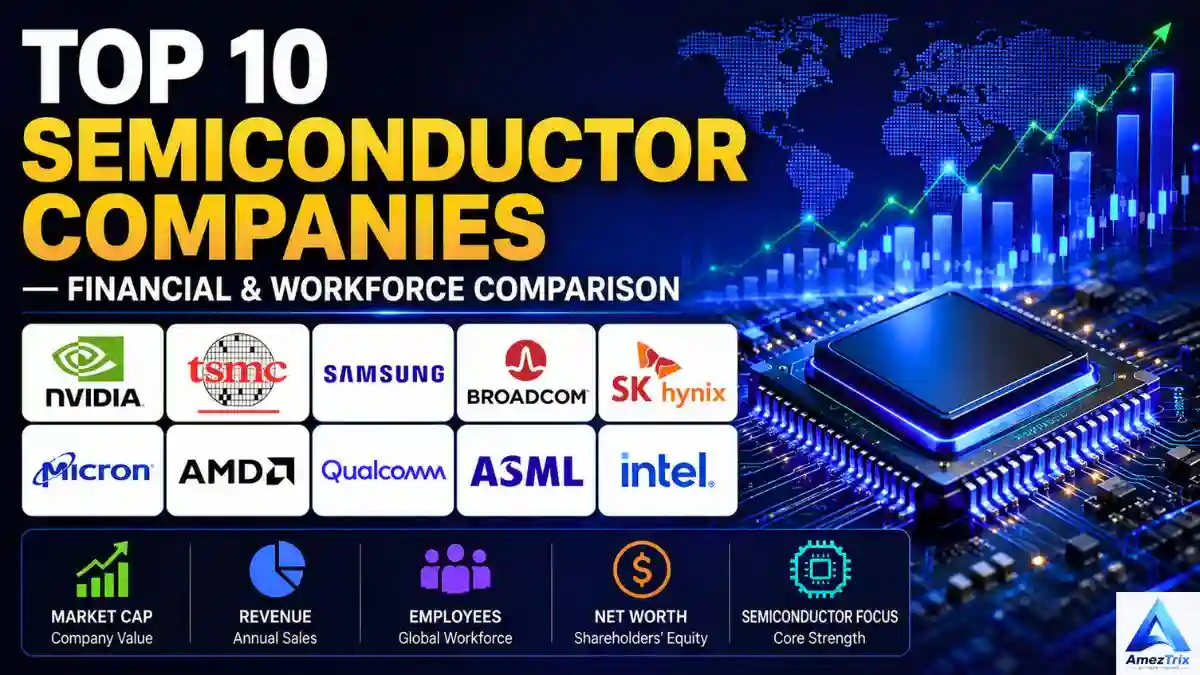
Top 10 Semiconductor Companies — Financial & Workforce Comparison
| Company | Country | Market Cap | Semiconductor Revenue | Total Revenue | Employees | Main Business | Key Technology |
|---|---|---|---|---|---|---|---|
| NVIDIA | 🇺🇸 USA | ~$4.4T | ~$125.7B | ~$130B+ | ~42,000 | AI & GPUs | AI Accelerators, GPUs |
| TSMC | 🇹🇼 Taiwan | ~$1.75T | ~$120B+ | ~$120B+ | ~83,000 | Chip Foundry | Advanced Process Nodes |
| Samsung Electronics | 🇰🇷 South Korea | ~$843B | ~$72.5B | ~$235B+ | ~262,000 | Memory & Foundry | DRAM, HBM, NAND |
| Broadcom | 🇺🇸 USA | ~$1.53T | ~$34.3B | ~$63B+ | ~37,000 | Networking & Custom Chips | ASICs, Networking |
| SK hynix | 🇰🇷 South Korea | ~$449B | ~$60.6B | ~$60B+ | ~35,000 | Memory | HBM, DRAM |
| Micron Technology | 🇺🇸 USA | ~$480B | ~$41.5B | ~$30B+* | ~55,000 | Memory & Storage | HBM, DRAM, NAND |
| AMD | 🇺🇸 USA | ~$315B | ~$32.5B | ~$35B+ | ~31,000 | CPUs, GPUs & AI | Chiplets, AI Accelerators |
| Qualcomm | 🇺🇸 USA | ~$200B+ | ~$37.0B | ~$44B+ | ~52,000 | Mobile & Connectivity | 5G, Snapdragon, Edge AI |
| ASML | 🇳🇱 Netherlands | ~$528B | — | ~$37B | ~44,000 | Chipmaking Equipment | EUV Lithography |
| Intel | 🇺🇸 USA | ~$100B+ | ~$47.9B | ~$50B+ | ~85,000 | CPUs & Foundry | Process Technology |
A Quick Note on the Data
A few clarifications before you take these figures at face value.
Market cap moves daily. Every market-cap figure here is a snapshot, not a fixed value — stock prices shift every trading session, so treat these numbers as directional rather than exact.
Semiconductor revenue comes from Gartner’s 2025 vendor rankings. For consistency, the chip-specific figures in this article are pulled from Gartner’s latest semiconductor-vendor data: roughly $125.7B for NVIDIA, $72.5B for Samsung, $60.6B for SK hynix, $47.9B for Intel, $41.5B for Micron, $37.0B for Qualcomm, $34.3B for Broadcom, and $32.5B for AMD.
Why is ASML on this list at all? ASML doesn’t manufacture a single chip, so why include it among the world’s top semiconductor companies? Because its lithography systems are, quite literally, irreplaceable. Every leading-edge chip from NVIDIA, TSMC, or Samsung depends on equipment ASML builds. Strategic importance, not chip output, earns it a seat at this table.
Semiconductor revenue vs. total revenue — know the difference. Market cap reflects what investors currently believe a company is worth, and it can swing daily. Semiconductor revenue captures only the chip-related business, where that breakdown is available.
Total revenue often includes unrelated segments — Samsung’s consumer electronics arm, for instance, or Broadcom’s enterprise software division — which is why a company’s overall size can look very different depending on which number you’re reading. Bottom line: how you rank these companies — by market cap, semiconductor revenue, manufacturing capability, or broader industry influence — genuinely changes who comes out on top.
Quick Comparison: Top 10 Chip Companies at a Glance
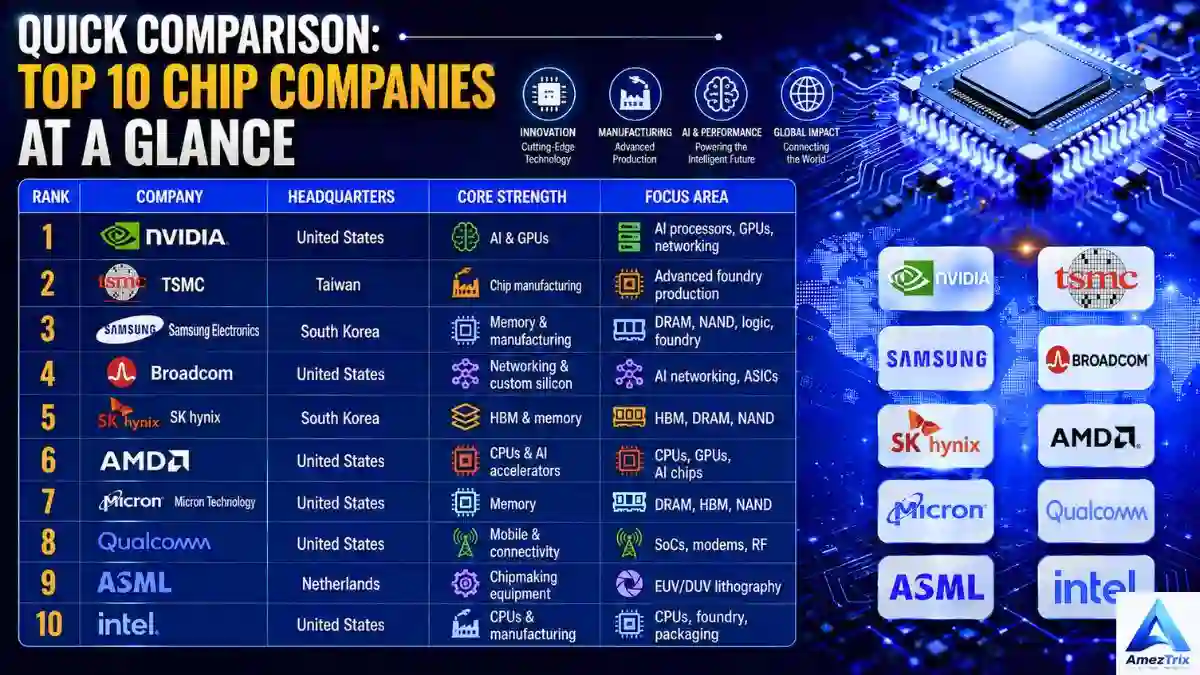
| Rank | Company | Headquarters | Core Strength | Focus Area |
|---|---|---|---|---|
| 1 | NVIDIA | United States | AI & GPUs | AI processors, GPUs, networking |
| 2 | TSMC | Taiwan | Chip manufacturing | Advanced foundry production |
| 3 | Samsung Electronics | South Korea | Memory & manufacturing | DRAM, NAND, logic, foundry |
| 4 | Broadcom | United States | Networking & custom silicon | AI networking, ASICs |
| 5 | SK hynix | South Korea | HBM & memory | HBM, DRAM, NAND |
| 6 | AMD | United States | CPUs & AI accelerators | CPUs, GPUs, AI chips |
| 7 | Micron Technology | United States | Memory | DRAM, HBM, NAND |
| 8 | Qualcomm | United States | Mobile & connectivity | SoCs, modems, RF |
| 9 | ASML | Netherlands | Chipmaking equipment | EUV/DUV lithography |
| 10 | Intel | United States | CPUs & manufacturing | CPUs, foundry, packaging |
Note: rankings shift constantly. Valuations move with the stock market, and revenue leadership can flip as memory and AI demand cycles evolve.
What Exactly Is a “Best Semiconductor Company”?
Not every chip company does the same job. The industry splits into four broad camps:
1. Fabless companies — design chips, outsource the actual manufacturing. Think NVIDIA, AMD, Qualcomm, and Broadcom.
2. Foundries — manufacture chips designed by others. TSMC is the undisputed heavyweight here.
3. Integrated Device Manufacturers (IDMs) — design and build their own chips in-house, like Intel, Samsung, Micron, and SK hynix.
4. Equipment makers — build the specialized machinery chipmakers rely on. ASML’s extreme ultraviolet (EUV) lithography systems fall squarely in this bucket, and nothing at the cutting edge gets built without them.
1. NVIDIA — The AI Kingmaker
NVIDIA used to be “the graphics card company.” That description stopped being accurate years ago. Today its GPUs sit at the core of nearly every serious AI training and inference cluster on the planet, used by hyperscalers, research labs, and enterprises alike.
Gartner puts NVIDIA’s 2025 semiconductor revenue at roughly $125.7 billion, good for a 15.8% share of the entire global market — the largest slice held by any single vendor.
What NVIDIA builds:
- Data-center GPUs and AI accelerators
- Gaming GPUs
- Networking silicon
- Automotive computing platforms
- High-performance computing hardware
NVIDIA’s real moat isn’t just hardware — it’s CUDA, the software layer developers have built entire careers and codebases around. That chips-plus-software combination is what makes NVIDIA extraordinarily hard to dislodge.
2. TSMC — The Factory Behind Everyone Else’s Chips
Taiwan Semiconductor Manufacturing Company doesn’t design flashy consumer chips. It doesn’t need to. TSMC runs the foundry network that most of the industry’s biggest names quietly depend on — including NVIDIA itself.
Its customer list spans smartphones, AI accelerators, data centers, PCs, automotive electronics, and high-performance computing. TSMC’s edge comes down to raw manufacturing capability: leading-edge process nodes and advanced packaging that few competitors can match at scale.
By market capitalization, TSMC regularly ranks just behind NVIDIA and ahead of nearly every other chip company on the planet.
Why it matters: TSMC’s production schedule effectively sets the pace for the entire tech industry. A delay at TSMC ripples into delayed launches everywhere else.
3. Samsung Electronics — The Vertically Integrated Giant
Samsung is the rare company that touches almost every layer of the semiconductor stack — memory, logic, foundry services, and consumer electronics, all under one roof.
Gartner ranked Samsung second globally in 2025 semiconductor revenue, at approximately $72.5 billion (9.1% market share).
Samsung’s strongest categories:
- DRAM and NAND flash
- High-bandwidth memory (HBM)
- SSDs
- Mobile processors and image sensors
- Foundry and advanced logic
As AI data centers hunger for faster memory, Samsung’s HBM business has become one of its most strategically valuable assets.
4. Broadcom — The Quiet Backbone of AI Infrastructure
Broadcom rarely gets consumer-facing attention, but its Ethernet switches, custom ASICs, and optical connectivity chips are what let massive AI clusters actually talk to each other efficiently.
Gartner ranked Broadcom seventh among semiconductor vendors for 2025, at roughly $34.3 billion in chip revenue — a figure that undersells the company’s overall market value, since its broader business also includes enterprise software.
Why AI needs Broadcom: GPUs are useless if they can’t move data fast enough between each other, memory, and storage. Broadcom builds the plumbing that makes hyperscale AI clusters function.
5. SK hynix — The HBM Powerhouse
SK hynix has ridden the AI memory wave harder than almost anyone. Its High Bandwidth Memory (HBM) has become essential for AI accelerators that need to move enormous volumes of data at extreme speed.
Gartner placed SK hynix third globally in 2025, with about $60.6 billion in semiconductor revenue — up a striking 37.2% year-over-year.
The company has also committed to major new capacity expansion, betting that AI-driven memory demand isn’t slowing down anytime soon.
6. AMD — NVIDIA’s Sharpest Rival
AMD has spent the last decade clawing back relevance in CPUs and now AI accelerators. Its Ryzen chips compete hard in consumer PCs, EPYC dominates in data-center CPUs, and the Instinct line is AMD’s answer to NVIDIA’s AI dominance.
Gartner estimated AMD’s 2025 semiconductor revenue at roughly $32.5 billion, about 4.1% of the global market.
AMD’s chiplet-based architecture — building processors from smaller, modular pieces rather than one giant die — has become influential across the industry, not just within AMD’s own product line.
7. Micron Technology — America’s Memory Champion
Micron is one of the few large-scale, U.S.-based memory manufacturers, competing directly with Samsung and SK hynix in DRAM, NAND, and HBM.
Gartner ranked Micron fifth in 2025, with roughly $41.5 billion in revenue — up more than 50% year-over-year, reflecting just how hungry the market is for advanced memory right now.
Micron’s core lineup:
- DRAM and NAND
- High-bandwidth memory
- Data-center and automotive-grade SSDs
- Mobile memory
8. Qualcomm — Powering the World’s Smartphones
Qualcomm built its empire on Snapdragon processors and cellular modem technology, and it still dominates premium and mid-range smartphone chips worldwide.
Gartner ranked Qualcomm sixth in 2025 semiconductor revenue at approximately $37.0 billion (4.7% share).
Qualcomm isn’t standing still, though — it’s pushing hard into automotive chips (infotainment, driver assistance, digital cockpits) and edge AI, trying to cut its historic dependence on smartphone cycles.
9. ASML — The Company Nobody Can Route Around
ASML doesn’t design or manufacture a single processor, and it’s arguably still one of the most important companies in the entire industry. Its EUV lithography machines are the only viable way to etch the ultra-fine circuit patterns modern advanced chips require.
ASML’s fiscal 2025 net sales hit approximately €32.7 billion, up 15.6% year-over-year, with €4.7 billion poured into R&D.
Without ASML’s machines, none of the leading-edge chips from NVIDIA, TSMC, Samsung, or anyone else at the cutting edge would be physically possible to produce.
10. Intel — The Fallen Giant Fighting Back
Intel practically invented the modern PC/server CPU market and dominated it for decades. Competition from AMD, NVIDIA, TSMC, and Samsung has since eaten into that lead, and Intel’s semiconductor revenue actually declined 3.9% in 2025, landing around $47.9 billion (still good for fourth place, per Gartner).
Intel’s comeback strategy centers on becoming a legitimate third-party foundry player while pushing forward on AI hardware and advanced packaging. Whether that bet pays off will likely determine Intel’s standing for the next decade.
Top 20 Semiconductor Companies: Ranks 11 to 20
Plenty of readers searching for the top 20 semiconductor companies or a broader list of semiconductor companies want to see who sits just behind the big ten. The names below are not ranked by a single strict metric, because revenue, market cap, and strategic importance all point in slightly different directions. Think of them as the next tier of the global chip industry.
| # | Company | Country | What It Is Known For |
|---|---|---|---|
| 11 | Texas Instruments | 🇺🇸 USA | Analog and embedded chips for industrial and automotive use |
| 12 | Infineon Technologies | 🇩🇪 Germany | Power semiconductors and automotive chips |
| 13 | STMicroelectronics | 🇨🇭 Switzerland / 🇫🇷 France | Microcontrollers, sensors, and power devices |
| 14 | NXP Semiconductors | 🇳🇱 Netherlands | Automotive processors and secure connectivity |
| 15 | MediaTek | 🇹🇼 Taiwan | Smartphone, TV, and connectivity chips |
| 16 | Analog Devices | 🇺🇸 USA | High-performance analog and mixed-signal chips |
| 17 | Renesas Electronics | 🇯🇵 Japan | Automotive microcontrollers and power management |
| 18 | Applied Materials | 🇺🇸 USA | Chip manufacturing equipment and materials engineering |
| 19 | Lam Research | 🇺🇸 USA | Etch and deposition equipment for fabs |
| 20 | Tokyo Electron | 🇯🇵 Japan | Coater/developer and other wafer-processing equipment |
Notice how many of these names are equipment suppliers or analog and power-chip specialists. They rarely make headlines the way NVIDIA does, but they supply the tools and the “boring” chips that every electronic device still needs.
What about the top 100 semiconductor companies? Beyond the top 20, the field opens up into hundreds of firms: fabless design houses, specialty foundries like GlobalFoundries and SMIC, packaging and test providers, materials suppliers, and chip-design software vendors. Most “top 100” lists change from year to year depending on whether they rank by revenue, market value, or R&D spending, so always check the methodology before quoting one.
Top 10 Semiconductor Manufacturing Countries: Which Country Makes the Most Chips?
People often ask which country is the biggest chip manufacturer. The honest answer depends on what you mean by “manufacture.” Leading-edge logic chips, memory, older mature-node chips, and packaging and testing are all concentrated in different places. Here is how the top semiconductor manufacturing countries compare by role, not by a single ranked number.
| Country | Where It Leads | Key Companies |
|---|---|---|
| 🇹🇼 Taiwan | Leading-edge foundry manufacturing | TSMC, MediaTek |
| 🇰🇷 South Korea | Memory chips (DRAM, NAND, HBM) | Samsung, SK hynix |
| 🇨🇳 China | Large-scale mature-node capacity and assembly | SMIC and many domestic firms |
| 🇺🇸 United States | Chip design, IDMs, and fab equipment | NVIDIA, Intel, Micron, Applied Materials |
| 🇯🇵 Japan | Materials, equipment, and specialty chips | Tokyo Electron, Renesas |
| 🇳🇱 Netherlands | Lithography equipment | ASML, NXP |
| 🇩🇪 Germany | Power and automotive semiconductors | Infineon |
| 🇲🇾 Malaysia | Chip packaging, assembly, and testing | Many global OSAT and IDM plants |
| 🇸🇬 Singapore | Specialty fabs and regional manufacturing hub | Global foundries and IDMs with local plants |
| 🇮🇳 India | Fast-growing design talent, new fab and packaging projects | Tata Electronics, Micron India, CG Semi |
In short, Taiwan makes the most advanced logic chips, South Korea dominates memory, the United States leads in design and equipment, and China has huge capacity at older process nodes. India is the newcomer to watch, which brings us to the next section.
Top 10 Semiconductor Companies in the USA
The United States remains the center of chip design and chip-related software, and it hosts several of the largest IDMs and equipment makers. If you are searching for the top 10 semiconductor companies in the USA, this is a practical shortlist based on the rankings above:
- NVIDIA — AI GPUs and accelerators
- Broadcom — networking, custom ASICs, and connectivity
- Micron Technology — DRAM, NAND, and HBM
- AMD — CPUs, GPUs, and AI accelerators
- Qualcomm — mobile and edge AI processors
- Intel — CPUs, foundry services, and packaging
- Texas Instruments — analog and embedded processing
- Applied Materials — wafer fabrication equipment
- Lam Research — etch and deposition tools
- Analog Devices — high-performance analog chips
Note that many U.S. companies, including NVIDIA, AMD, Qualcomm, and Broadcom, are fabless, so much of their actual manufacturing happens in Taiwan and elsewhere. Government incentives are now pushing more fabrication back to American soil.
Top 10 Semiconductor Companies in India
India does not yet have a leading-edge chip factory on the scale of TSMC or Samsung, but it is building one of the fastest-growing semiconductor industries in India, backed by the India Semiconductor Mission, state incentives, and a huge pool of chip-design engineers. If you are looking up semiconductor companies in India, the picture splits into three groups: companies building fabs and packaging plants, listed companies that investors follow, and global chipmakers with large Indian design centers.
Companies building manufacturing capacity in India:
- Tata Electronics — the Tata Group’s chip arm, working on a fab project in Gujarat and an assembly and test facility in Assam, with a technology partner for the fab.
- Micron Technology (India) — an assembly, test, and packaging plant in Sanand, Gujarat.
- CG Power and Industrial Solutions — building an outsourced semiconductor assembly and test (OSAT) facility with global partners.
- Kaynes Semicon — the semiconductor arm of Kaynes Technology, focused on chip packaging.
- HCL–Foxconn — a joint venture aimed at display-driver and related chip assembly.
Other well-known Indian semiconductor and chip-design names:
- MosChip Technologies — chip design and embedded services.
- SPEL Semiconductor — semiconductor packaging and testing.
- Tata Elxsi — engineering and design services with semiconductor exposure.
- Polymatech Electronics — optoelectronic semiconductors and related components.
- Vedanta and other groups — announced plans for displays and semiconductors, with timelines that keep evolving.
Global chipmakers with major Indian design centers: Intel, Qualcomm, Texas Instruments, AMD, NVIDIA, NXP, and Micron all run large engineering teams in cities such as Bengaluru, Hyderabad, Noida, and Pune. A large share of the world’s chip design talent already works from India, even when the fab sits elsewhere.
Project timelines, partners, and approval status change often, so verify the latest updates with official announcements before making business or investment decisions.
Semiconductor Companies in India Listed on the Stock Market
Investors often search for semiconductor companies in India listed on the NSE or BSE. Pure-play chip stocks are still limited, and most listed names are in design, packaging, electronics manufacturing, or related components. Examples that people commonly follow include CG Power, Kaynes Technology, MosChip Technologies, SPEL Semiconductor, Tata Elxsi, and Polymatech Electronics. Because the sector is young and many projects are still under construction, these stocks can be volatile and heavily driven by news about government incentives and project approvals.
Semiconductor Companies’ Stocks: What Investors Should Know
Interest in semiconductor companies’ stocks has exploded alongside the AI boom, but chip stocks are cyclical. Memory prices swing sharply, customers order in waves, and export controls or geopolitical tension can hit revenue overnight. Here are practical ways to think about it:
- Know the business model. A fabless designer like NVIDIA, a foundry like TSMC, a memory maker like Micron, and an equipment supplier like ASML respond to very different demand cycles.
- Look beyond market cap. A huge valuation already prices in years of growth. Compare it with actual semiconductor revenue and margins.
- Watch AI exposure. Companies tied to AI accelerators, HBM, and networking currently carry the strongest growth expectations, and also the highest expectations to live up to.
- Consider diversification. Some investors prefer semiconductor ETFs over single stocks to reduce the risk of one company’s bad quarter.
This article is for information only and is not financial advice. Do your own research or speak with a licensed advisor before investing.
Semiconductor Companies Near Me: How to Find Them
If you searched for semiconductor companies near me, you are probably looking for jobs, internships, suppliers, or a plant to visit. Chip companies cluster in specific regions, so your best bet is to look at the major hubs:
- In India: Bengaluru, Hyderabad, Noida and Delhi NCR, and Pune for design centers; Gujarat (Sanand and Dholera) and Assam for new manufacturing and packaging projects.
- In the USA: Silicon Valley, Austin, Phoenix and Arizona, Boise, and Oregon.
- In Asia: Hsinchu in Taiwan, Gyeonggi Province in South Korea, Penang in Malaysia, and Singapore.
Search on LinkedIn or Google Maps using terms like “semiconductor,” “VLSI,” “chip design,” or “OSAT” plus your city name, and check the careers pages of the companies listed in this guide.
Market Cap vs. Revenue: Why They Tell Different Stories
It’s easy to confuse market capitalization with semiconductor revenue, but they measure very different things.
- Market cap reflects what investors believe a company is worth right now, including future growth expectations.
- Revenue reflects money actually earned today.
That’s why a fast-growing, AI-exposed company can carry a market cap that looks disproportionately large next to its current sales — investors are pricing in tomorrow, not just today. Current market-cap leaders in the space include NVIDIA, TSMC, Broadcom, Micron, Samsung, AMD, and SK hynix, though daily stock swings can reshuffle that order quickly.
Chip Designers vs. Chip Manufacturers: Don’t Confuse the Two
A common misconception is assuming every big semiconductor name actually builds its own chips. In reality:
- TSMC manufactures for a huge share of the industry, including fabless giants like NVIDIA and AMD.
- Samsung both designs and manufactures — memory, logic, and foundry- all in-house.
- Intel runs its own fabs and is expanding into third-party foundry work.
- SK hynix and Micron are dedicated memory manufacturers.
Understanding this distinction matters because a bottleneck at a single foundry can delay products from a dozen different “designer” brands simultaneously.
Why AI Is Rewriting the Rules of the Chip Industry
AI has turned semiconductors into one of the hottest sectors in the global economy. A typical large-scale AI infrastructure buildout touches nearly every company on this list:
AI accelerator → HBM → networking → storage → CPU → power management → advanced packaging → manufacturing equipment
- NVIDIA supplies the accelerators.
- SK hynix, Samsung, and Micron supply the HBM.
- Broadcom supplies networking and custom silicon.
- TSMC manufactures the latest technology chips.
- ASML supplies the lithography equipment that makes it all physically possible.
- AMD competes head-on in accelerators and server CPUs.
Gartner estimates AI-related semiconductors — processors, HBM, and networking components combined — made up nearly one-third of total semiconductor sales in 2025. That share is only expected to grow.
What Actually Makes a Semiconductor Company Successful?
Revenue alone doesn’t tell the whole story. Analysts and investors typically weigh:
- Process technology — smaller, more efficient manufacturing nodes
- Chip architecture — how well a design performs specific workloads
- Manufacturing capacity — access to leading-edge fabs
- Software ecosystem — critical for AI chips especially
- R&D investment — staying ahead requires constant, expensive innovation
- Supply-chain position — controlling a critical chokepoint carries enormous leverage
- AI exposure — arguably the single biggest growth lever right now
Semiconductor Trends Worth Watching in 2026 and Beyond
- AI accelerators remain the industry’s biggest growth engine
- High-bandwidth memory keeps becoming more critical as AI models scale
- Advanced packaging (chiplets, 2.5D/3D integration) is now central to performance gains
- Edge AI is pushing processing power into phones, PCs, cars, and IoT devices
- Automotive semiconductors are exploding alongside EVs and software-defined vehicles
- Manufacturing diversification — governments, including India’s, are pouring money into domestic fabs and packaging plants to reduce geopolitical risk
- Energy efficiency — as AI data centers guzzle electricity, performance-per-watt is becoming a competitive battleground
Frequently Asked Questions
Which is the No. 1 semiconductor company in the world?
NVIDIA currently holds the strongest claim, leading global semiconductor vendors with roughly $125.7 billion in 2025 revenue, according to Gartner.
What are the largest semiconductor companies in the world?
NVIDIA, TSMC, Samsung Electronics, Broadcom, SK hynix, AMD, Micron, Qualcomm, ASML, and Intel consistently rank among the largest, though the exact order depends on whether you measure by revenue, market cap, or manufacturing scale.
What are the top 20 semiconductor companies?
After the top 10 above, the next tier commonly includes Texas Instruments, Infineon, STMicroelectronics, NXP, MediaTek, Analog Devices, Renesas, Applied Materials, Lam Research, and Tokyo Electron. Exact rankings vary by revenue, market cap, and methodology.
Which country is the biggest chip manufacturer?
It depends on the type of chip. Taiwan leads in advanced logic manufacturing through TSMC, South Korea leads in memory, the United States leads in design and equipment, and China has very large capacity in mature-node chips.
What are the top semiconductor companies in India?
Key names include Tata Electronics, Micron’s India plant, CG Power, Kaynes Semicon, and HCL–Foxconn on the manufacturing side, plus listed companies such as MosChip, SPEL Semiconductor, Tata Elxsi, and Polymatech. Global chipmakers like Intel, Qualcomm, and Texas Instruments also run large design centers in India.
Which are the top semiconductor companies in the USA?
NVIDIA, Broadcom, Micron, AMD, Qualcomm, Intel, Texas Instruments, Applied Materials, Lam Research, and Analog Devices are among the leading U.S. semiconductor companies.
Which company makes the most advanced chips?
No single company owns the whole process. NVIDIA and AMD design cutting-edge processors; TSMC and Samsung manufacture them; ASML supplies the lithography equipment that makes advanced manufacturing possible in the first place.
Which semiconductor company is best positioned for AI?
NVIDIA leads thanks to its GPUs, AI accelerators, and CUDA software ecosystem — but AMD, Broadcom, TSMC, SK hynix, Samsung, and Micron all play essential supporting roles in AI infrastructure.
Which companies manufacture NVIDIA’s chips?
NVIDIA designs its processors in-house but relies on external foundries — primarily TSMC — for actual manufacturing.
Is ASML a chip manufacturer?
No. ASML is a semiconductor equipment company. It builds the lithography systems chipmakers use to produce advanced semiconductors — it doesn’t manufacture chips itself.
Why is TSMC so important to the global tech industry?
TSMC operates the world’s most advanced foundry network, manufacturing chips for a huge share of the industry’s biggest names. Its production capacity effectively sets the pace for the entire tech sector.
Which companies produce HBM memory?
Samsung, SK hynix, and Micron are the three major producers of high-bandwidth memory, a technology now considered essential for AI accelerators.
Are semiconductor company stocks a good investment?
Semiconductor stocks can offer strong growth, especially with AI demand, but they are cyclical and volatile. Compare valuation with real revenue, understand each company’s business model, and consider professional advice before investing.
Final Takeaway
There’s no single “correct” way to rank semiconductor companies. Revenue favors high-volume chipmakers. Market cap reflects investor optimism about future growth. Strategic importance can elevate companies like TSMC and ASML that occupy irreplaceable chokepoints in the supply chain, even when their headline numbers look smaller than NVIDIA’s or Samsung’s.
What’s undeniable is that artificial intelligence has become the gravitational center pulling this entire industry forward — from GPUs and HBM to networking silicon, advanced packaging, and the lithography machines that make it all possible. Whether you are tracking the global top 10, the top 20 semiconductor companies, the leaders in the USA, or the rising semiconductor companies in India, understanding these players is, in a very real sense, understanding the infrastructure behind the entire modern computing stack.
About Author
Rajendra Parmar is the Founder and Editor of AmezTrix, where he covers Artificial Intelligence, Technology, WordPress, Web Hosting, Digital Marketing, Gadgets, and Software. His mission is to simplify complex technology through practical tutorials, honest reviews, and well-researched guides that help readers make smarter digital decisions.

Rajendra Parmar
Founder & Editor • AmezTrix
Rajendra Parmar is the Founder and Editor of AmezTrix, a platform covering Artificial Intelligence, Technology, WordPress, Web Hosting, Digital Marketing, Gadgets, Software Reviews, and emerging innovations. His mission is to simplify complex technology through practical tutorials, honest reviews, and well-researched guides that help readers make smarter digital decisions.