Quick Answer: Starlink hasn’t announced an official India price and isn’t taking orders yet. The company said the ₹8,600 monthly and ₹34,000 hardware figures were dummy test data. Licences are in place, but spectrum assignment and security clearances are still pending.

Starlink India Price 2026: Launch Date, Plans & Jio vs Airtel Fiber
Last updated: October 14, 2026
Is the Starlink India price ₹8,600? No, that was test data. Get the 2026 launch status, plan guesses and Jio vs Airtel AirFiber comparison.
Key points at a glance
- Price: Not announced. Treat every number online as a guess.
- Launch date: Not confirmed. A government panel cleared satellite spectrum rules in September 2026, but final steps remain.
- Best for: Villages, hill areas and remote offices where fiber and 5G don’t reach.
- Skip if: You already have decent fiber or strong AirFiber. It will almost certainly cost more.
Open any tech forum or family WhatsApp group and someone will ask it: what will the Starlink India price actually be? It’s a fair question. SpaceX has spent years preparing for India, and people are tired of rumours.
The follow-up questions come fast. When can I order? Will it beat my current broadband? And is it worth paying more than Jio AirFiber or Airtel Xstream AirFiber once the price is finally out in the open?
This guide answers all of that honestly, including the parts nobody can confirm yet. If fiber never reached your street, or your Wi-Fi dies every time it rains, read on.
In this guide
- Starlink India Price at a Glance
- Starlink India Price: What Will It Really Cost?
- Starlink India Launch Date
- What Exactly Is Starlink?
- Why Does India Need Starlink?
- What Plans Might Starlink Offer?
- Where Will Starlink Make the Biggest Difference?
- Speed, Latency and Gaming
- How to Prepare for Starlink
- Pros and Cons
- Starlink vs Jio AirFiber
- Starlink vs Airtel Xstream AirFiber
- The Full Comparison
- Is Starlink Worth It for You?
- Common Mistakes and Checklist
- Frequently Asked Questions
- TL;DR and Final Verdict
Starlink India Price at a Glance
| Detail | Information |
|---|---|
| Company | SpaceX (Starlink) |
| Service type | Satellite broadband |
| Technology | Low-Earth-Orbit (LEO) satellites |
| Indian approvals so far | DoT licence (June 2025) and IN-SPACe authorization (July 2025) |
| Still pending | Spectrum assignment and security clearances |
| Official India price | Not announced |
| Orders open in India | No |
| Equipment needed | Starlink dish (terminal) plus Wi-Fi router |
| Cable or fiber needed | No |
| Main rivals | Jio AirFiber, Airtel Xstream AirFiber, local fiber ISPs |
Starlink India Price: What Will It Really Cost?
This is the question everyone cares about, and the honest answer is that nobody knows yet.
The ₹8,600 Screenshot Story
In December 2025, Starlink’s India webpage briefly showed a residential plan at ₹8,600 per month plus a ₹34,000 hardware kit. Screenshots spread everywhere. Then Starlink’s VP of business operations, Lauren Dreyer, said a configuration glitch had exposed dummy test data and that the numbers don’t reflect what service will cost in India.
So if a blog or video calls ₹8,600 “the Starlink India price,” the writer is repeating a mistake.
What Will Shape Your Final Bill
- The monthly subscription
- The one-time cost of the satellite terminal
- Installation or setup fees, if any
- GST and other taxes
- Shipping on the equipment
- Optional extras and accessories
- Whether you pick a home plan or a business plan
The smartest move is patience. Wait until ordering opens for your exact address, then trust the live price on Starlink’s own site.
How Starlink Is Likely to Compare on Cost
| Option | Monthly price (reported) | Notes |
|---|---|---|
| Starlink India | Not announced | Plus a hardware cost |
| Jio AirFiber | From ₹599 plus GST, up to ₹3,999 for the 1 Gbps tier | Prices as reported in May 2026 |
| Airtel Xstream AirFiber | ₹699, ₹799 and ₹899 plus GST | About 1 TB high-speed data, then throttled |
| City fiber | Usually the cheapest per Mbps | Only where cable exists |
Plans and offers change by city, so confirm on the Jio and Airtel websites before you decide.
Starlink India Launch Date: Where Things Really Stand
Here’s the blunt truth. No government-confirmed launch date exists for the whole country, and anyone quoting one is guessing.
The paperwork, however, is real. India’s telecom department granted Starlink its licence in June 2025. The space regulator IN-SPACe gave commercial authorization in July 2025, valid for five years.
The latest step came in September 2026. News reports say the Digital Communications Commission approved most of TRAI’s recommendations on how satellite spectrum should be priced and allocated. The proposal still has to go to the Union Cabinet, and companies need security clearances before they can switch on service.
| Milestone | Status (October 2026) |
|---|---|
| Telecom licence | Done |
| Space-regulator authorization | Done |
| Spectrum rules cleared by DCC | Done (September 2026) |
| Cabinet approval and spectrum assignment | Pending |
| Security clearances | Pending |
| Commercial launch and orders | Not yet |
Five Milestones People Keep Mixing Up
- Getting a telecom licence: done.
- Getting space-regulator authorization: done.
- Getting spectrum and security clearance: still in progress.
- Officially launching commercially: not yet.
- Being available at your own address: not yet.
Can You Order Starlink Today?
No. Starlink has said its India website isn’t live and that it isn’t taking orders from Indian customers. If someone offers to “book it early” for a fee, walk away. Scams love hype like this, and the only safe place to check status is Starlink’s official website.
What Exactly Is Starlink? (The Simple Version)
Forget the usual picture of an internet provider. Starlink isn’t digging up roads or running cable under your street. Your internet arrives from space.
SpaceX keeps thousands of small satellites in low orbit, close enough that a dish on your roof can talk to them directly. The dish picks up the signal, passes it to your router, and your devices do the rest.
Normal broadband: Internet backbone, fiber network, local exchange, your router.
Starlink: Internet backbone, satellite network, your dish, your router, your devices.
Because nothing has to be laid across mountains, forests or a hundred kilometres of empty land, Starlink can reach places regular ISPs skipped because they weren’t profitable.
Why Does India Need Starlink?
India has one of the largest internet populations on Earth. But ask someone in central Mumbai and someone in a Himachal village what “good internet” means, and you’ll get two very different answers.
Cities have fiber, 5G and fixed wireless. Plenty of other places still deal with the same old problems:
- Fiber that never reached them
- Hills, forests and rivers that make cable-laying a nightmare
- Homes too spread out to justify the infrastructure cost
- Patchy last-mile connections
- Broadband that vanishes when it rains
- No fast alternative worth paying for
That gap is exactly why satellite broadband exists. It was built for the places everyone else skipped.
What Plans Might Starlink Offer in India?
Abroad, Starlink sells several tiers, from basic home internet to mobility plans for RVs, boats and vehicles. Its support pages describe residential plans as tied to a fixed address, usually with unlimited data. Some countries even split this into a standard tier and a cheaper “Lite” option.
None of that guarantees India gets the same names or numbers. Treat the list below as an educated guess, not a confirmed lineup.
- Standard residential internet
- A lighter, cheaper home tier
- Business and enterprise connectivity
- Priority plans for businesses that can’t afford downtime
- Mobility plans for travel, vehicles or boats
- Special packages for institutions
Where Will Starlink Make the Biggest Difference?
Starlink‘s biggest strength was never price. It’s reach.
A fiber plan can be cheap, but only if the cable has physically reached your street. Starlink skips that problem entirely.
Who Gains the Most
Think rural households, hill villages and farms far from any town. Think small businesses outside city limits, schools and clinics bigger ISPs never reached, and resorts or homestays with no fiber. Field offices and remote workers belong on the list too.
One thing is non-negotiable: your dish needs a clear view of the sky. Tall trees, a neighbour’s building or a cluttered rooftop can hurt your signal.
Speed, Latency and Gaming: What to Expect
How Fast Is Starlink Likely to Be in India?
No single number describes Starlink speed. It shifts with your plan, local network load, location, weather and anything blocking your dish.
Pre-launch reports have suggested Indian speeds between roughly 25 and 220 Mbps. Some reports also mention a cap on total connections in the early phase. None of this is confirmed, so use it as a rough range, not a promise.
Good Enough for 4K and Video Calls?
Quite possibly. With a stable link, HD and 4K streaming, video calls, online classes, cloud-based work tools, browsing and a house full of devices should all be fine. Your real experience depends on where you live and how clear your sky view is.
What About Gaming and Latency?
Old satellite internet earned its bad reputation. Those satellites sat in geostationary orbit, tens of thousands of kilometres up, so every request travelled a huge distance and back.
Starlink’s satellites orbit far closer to Earth, which cuts that delay sharply. That makes it much better for smooth video calls, AI tools, cloud apps, remote work and casual online gaming.
Still, if split-second competitive gaming is your priority, wired fiber is the safer bet wherever you can get it.
How to Prepare for Starlink: A Simple Step-by-Step
- Check your sky view. Stand where the dish would go and look for trees, walls or buildings blocking the view.
- Pick a mounting spot. A roof, pole or open balcony usually works best.
- Plan power and Wi-Fi. You’ll need a power point nearby and a router position that covers your home.
- Compare your alternatives. Check Jio, Airtel and any local fiber ISPs for your PIN code first.
- Watch official channels. Check Starlink’s own website for your address when orders open.
- Compare the total cost. Add hardware, taxes and any setup fees to the monthly price before deciding.
A typical kit includes the dish, mounting hardware, a router and a power adapter. Unlike fiber, installation is mostly about placement.
Starlink: Pros and Cons Worth Knowing
The Upside
- Reaches places nothing else can. That’s the whole point.
- No fiber cable needed. You skip years of waiting for infrastructure that may never arrive.
- A real option for rural India. Farms, small towns and hill villages finally get a serious choice.
- Far lower latency than old satellite internet. Global user reports show a clear difference.
- Quick to deploy. No trenching or months of work. Set up the dish and go online.
The Downside
- Likely to cost more, especially against a decent city fiber plan.
- Upfront hardware cost. You’ll probably pay for the terminal yourself.
- Sky view isn’t optional. Trees and buildings can hurt performance.
- Weather can interfere. Heavy storms may affect the signal.
- The launch keeps slipping. Several earlier predictions came and went, so don’t plan around a rumour.
- Fiber wins where it exists. If solid fiber reaches you, it’s usually cheaper and steadier.
Starlink vs Jio AirFiber: Which One Should You Pick?
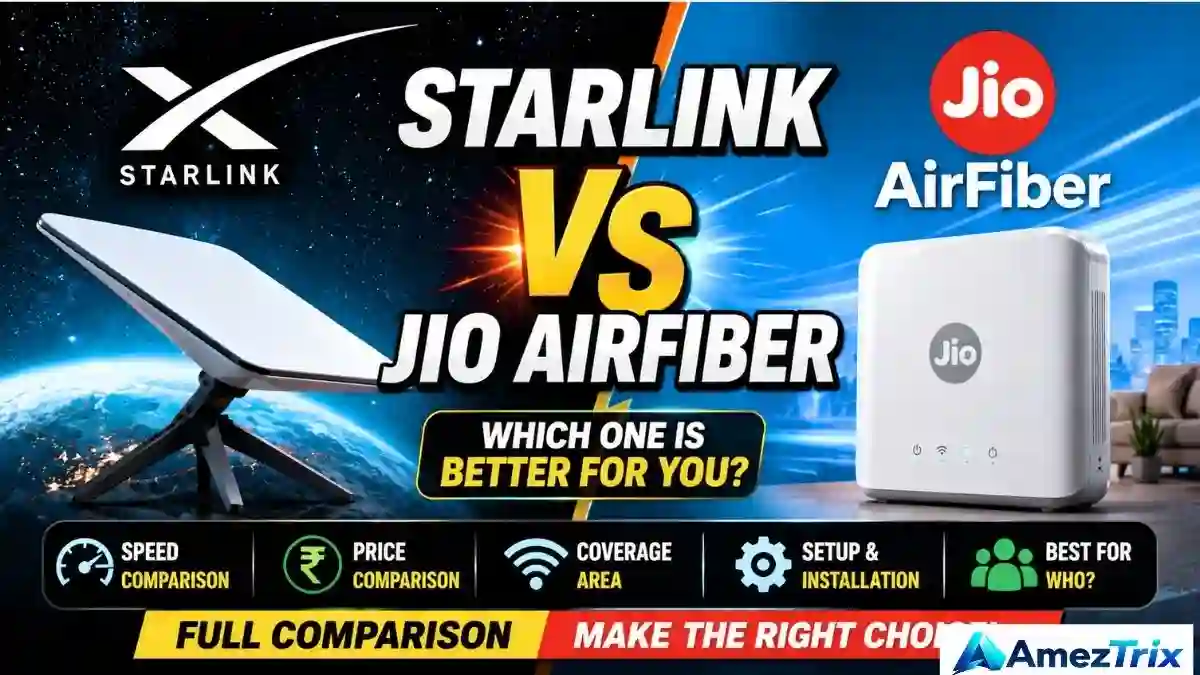
Both skip the fiber cable into your home, but the technology couldn’t be more different. Starlink uses satellites. Jio AirFiber uses 5G Fixed Wireless Access, or FWA.
Jio’s AirFiber plans reportedly start at ₹599 plus GST per month, with higher tiers going up to ₹3,999 plus GST for the 1 Gbps plan. Offers differ by circle, so check Jio’s website for your address.
| Feature | Starlink | Jio AirFiber |
|---|---|---|
| Technology | LEO satellite | 5G Fixed Wireless |
| Fiber cable to home | Not needed | Not needed |
| Needs a nearby mobile tower | No | Yes |
| Strongest use | Remote and rural areas | Areas with strong Jio 5G |
| Expected pricing | Likely premium | Generally more affordable |
| Installation | Satellite dish setup | Wireless receiver plus router |
| Gaming | Good potential | Good, depends on network |
| Best in cities | Possible, not essential | Strong, well established |
| Best in remote areas | Major advantage | Depends on 5G reach |
| OTT bundles | Plan dependent | Well developed |
If strong Jio 5G already reaches your home, AirFiber is probably the smarter, cheaper pick. But if Jio’s towers never reached your area, Starlink starts to make a lot more sense.
Starlink vs Airtel Xstream AirFiber
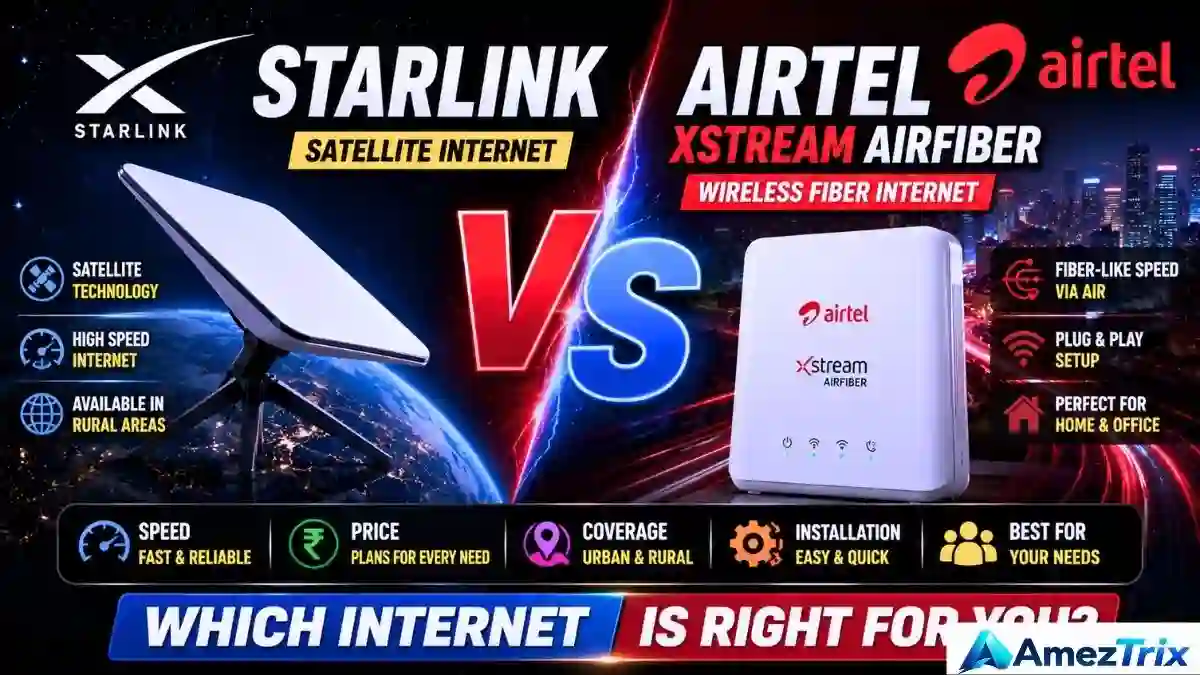
Airtel’s Xstream AirFiber works on a similar idea to Jio’s: 5G-powered fixed wireless sold as home broadband over Airtel’s 5G Plus network. Airtel currently lists three plans at ₹699, ₹799 and ₹899 plus GST per month, with about 1 TB of high-speed data, after which speed is reportedly throttled to 2 Mbps. It’s available in select cities, and a free router and installation are reportedly included.
| Feature | Starlink | Airtel Xstream AirFiber |
|---|---|---|
| Core technology | LEO satellite | Airtel 5G Fixed Wireless |
| Needs local 5G signal | No | Yes |
| Rural and remote potential | Excellent | Depends on 5G coverage |
| Urban presence | Depends on rollout stage | Select cities |
| Hardware | Satellite dish plus router | AirFiber device plus router |
| Monthly price | Not announced | ₹699 to ₹899 plus GST (reported) |
| Data policy | Unlimited home plans are common abroad | About 1 TB high-speed, then throttled |
| Ideal for | Off-grid, remote homes | Homes with solid Airtel 5G |
Starlink vs Jio AirFiber vs Airtel AirFiber: The Full Comparison

| Category | Starlink | Jio AirFiber | Airtel Xstream AirFiber |
|---|---|---|---|
| Technology | Satellite | 5G FWA | 5G FWA |
| Remote area strength | ⭐⭐⭐⭐⭐ | ⭐⭐⭐ | ⭐⭐⭐ |
| Urban area strength | ⭐⭐⭐ | ⭐⭐⭐⭐⭐ | ⭐⭐⭐⭐ |
| Value for money | ⭐⭐ | ⭐⭐⭐⭐⭐ | ⭐⭐⭐⭐ |
| Rural potential | ⭐⭐⭐⭐⭐ | ⭐⭐⭐⭐ | ⭐⭐⭐ |
| Entertainment and OTT | Plan dependent | Strong | Strong |
| Needs local tower | No | Yes | Yes |
| Needs clear sky view | Yes | No | No |
| Best for | Off-grid connectivity | Value plus entertainment | 5G-powered home broadband |
Star ratings are our editorial judgement, not lab scores.
Which Is Better for Rural India?
Picture a village with no fiber, weak mobile signal and the nearest ISP office two hours away. Satellite internet doesn’t care about towers or roadside cable. It just needs open sky.
- Starlink: best where nothing terrestrial reaches at all.
- Jio AirFiber: great if Jio’s 5G is strong nearby.
- Airtel Xstream AirFiber: great if Airtel’s 5G is the stronger one locally.
And for City Dwellers?
In a big metro the priorities flip. If solid fiber already reaches your door, paying extra for Starlink probably won’t buy you anything better.
- Fiber broadband: still the gold standard for price and consistency.
- Jio or Airtel AirFiber: a solid option where fiber hasn’t arrived.
- Starlink: worth a look only if neither wired nor wireless works well at your address.
Is Starlink Worth It for You?
Consider Starlink If:
- You live in a village or genuinely remote settlement
- Fiber has never reached you and probably won’t soon
- 5G coverage is weak or missing
- You run a business or farm well outside city limits
- Your connection drops constantly and you’re tired of it
- You work remotely from an underserved location
Skip Starlink If:
- You already have affordable, dependable fiber
- Your city broadband works fine
- Competitive gaming is your main use
- Your budget is tight
- Jio or Airtel AirFiber already works well where you live
Common Mistakes and Red Flags to Avoid
- Quoting ₹8,600 as the real price. Starlink called it test data.
- Paying anyone for “early access” or “pre-booking.” Starlink says it isn’t taking Indian orders.
- Buying a dish from a reseller before launch. Hardware tied to an unlaunched service may not work.
- Ignoring your sky view. Check for trees and buildings before you plan an install.
- Choosing Starlink over fiber out of hype. Compare total costs first.
- Trusting old launch dates. Several 2025 predictions passed without a launch.
- Using unofficial websites. Check status only on Starlink’s own site and government sources.
Starlink India Checklist
- Check Jio, Airtel and fiber options for your PIN code first.
- Check your roof or balcony for a clear sky view.
- Ignore any “Starlink India price” that isn’t from Starlink itself.
- Never pay for early access or pre-booking.
- Add hardware, taxes and setup to the monthly price before comparing.
- Recheck official pages once the Cabinet and security steps are reported done.
Frequently Asked Questions About Starlink India Price
1. What is the Starlink India price?
It hasn’t been announced. The widely shared ₹8,600 monthly fee and ₹34,000 hardware cost were dummy test data from a website glitch, according to Starlink. Wait for official pricing on Starlink’s own site once ordering opens.
2. When will Starlink launch in India?
No confirmed nationwide date exists. Starlink holds its licences, and a government panel cleared satellite spectrum rules in September 2026. Cabinet approval, spectrum assignment and security clearances still have to follow before commercial orders can open.
3. What plans will Starlink offer in India?
Likely a mix of home and business tiers, similar to other countries, but nothing is confirmed. Exact plan names, speeds and prices will only be final once India ordering officially opens.
4. How fast will Starlink be in India?
It depends on plan, location and network load. Pre-launch reports point to roughly 25 to 220 Mbps, but that range is unconfirmed. Treat any single speed promise before launch with caution.
5. Is Starlink better than Jio AirFiber or Airtel AirFiber?
Not across the board. Jio and Airtel usually win on price in cities with strong 5G. Starlink pulls ahead where there is no reliable terrestrial network at all, especially in remote and rural areas.
6. Does Starlink work without a fiber cable?
Yes, completely. That is the whole idea behind satellite internet. You need a Starlink dish with a clear sky view and a router, but no cable running to your home.
7. Is Starlink good for online gaming?
Its low-orbit design makes it far better than old satellite internet for gaming. Casual play should work fine. For serious competitive gaming, wired fiber still has the edge on stability and latency.
8. Can I pre-order Starlink in India?
No. Starlink has said it isn’t taking orders from customers in India. Anyone selling pre-bookings or early access is not acting on Starlink’s behalf, so avoid paying and check only Starlink’s official website.
TL;DR and Final Verdict
Summary: There is no official Starlink India price, no confirmed launch date and no open ordering. Licences and spectrum rules are moving forward, but final steps remain.
There is no single best option. Choose Starlink if you’re somewhere remote or rural with no reliable broadband, and wait for the official Starlink India price before you commit. Choose Jio AirFiber if Jio’s 5G is strong at your address and you want affordable, entertainment-rich broadband. Choose Airtel Xstream AirFiber if Airtel’s 5G works well near you and its data policy suits your use. If fiber already reaches your home, stay with it.
Starlink’s real opportunity in India was never about undercutting local providers on price. It’s about reaching places they couldn’t. For the final word on pricing, plans and rollout timing, rely on Starlink and government announcements, not on unverified screenshots.
Editorial note: This guide is based on public reporting available on October 14, 2026. Plans, prices and launch status can change quickly, so verify on official pages before you decide.
About Author
Rajendra Parmar is the Founder and Editor of AmezTrix, where he covers Artificial Intelligence, Technology, WordPress, Web Hosting, Digital Marketing, Gadgets, and Software. His mission is to simplify complex technology through practical tutorials, honest reviews, and well-researched guides that help readers make smarter digital decisions.

Rajendra Parmar
Founder & Editor • AmezTrix
Rajendra Parmar is the Founder and Editor of AmezTrix, a platform covering Artificial Intelligence, Technology, WordPress, Web Hosting, Digital Marketing, Gadgets, Software Reviews, and emerging innovations. His mission is to simplify complex technology through practical tutorials, honest reviews, and well-researched guides that help readers make smarter digital decisions.