Compare the cheapest web hosting plans of 2026: intro vs. renewal prices, free domains, refund terms and the best budget host for your site.
Cheapest Web Hosting Plans in 2026: 10 Budget Hosts and What They Really Cost
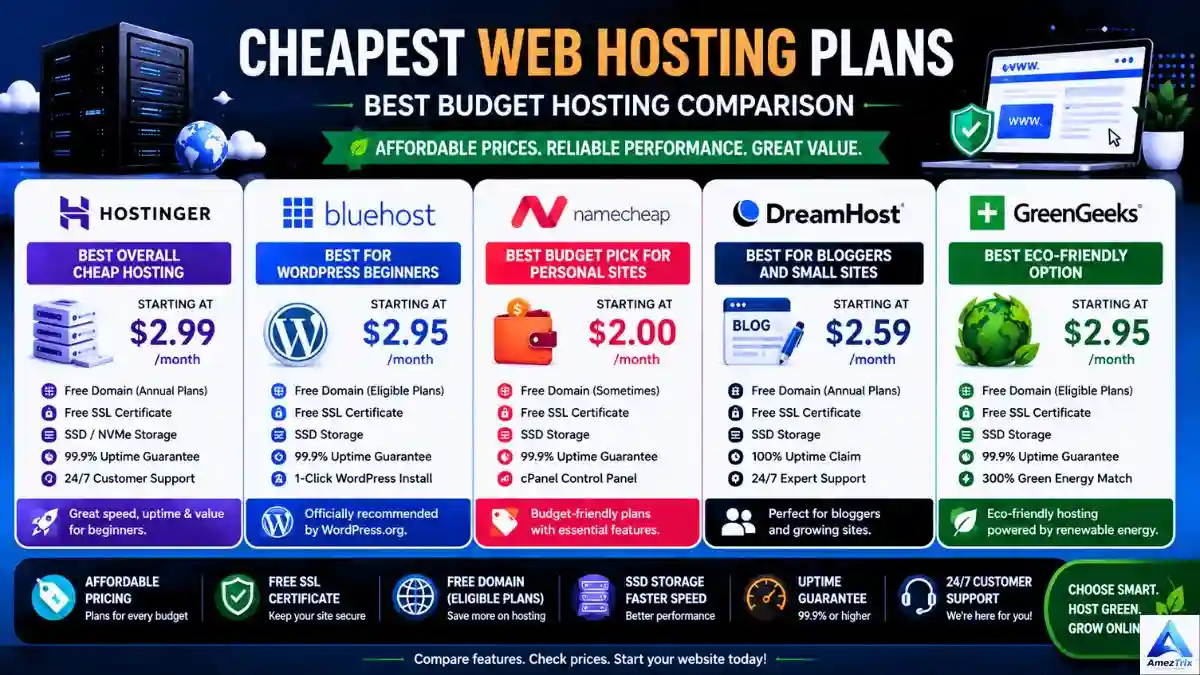
The cheapest web hosting plans in 2026 start at about $2 to $3 a month on long prepaid terms, then renew at roughly $5 to $18. Hostinger is the best all-round value, Bluehost is the easiest WordPress start, and Namecheap has the gentlest renewal jump.
Hosting ads love a tiny number. A plan advertised at $2.99 a month usually means a multi-year prepayment, and the same plan can renew at close to four times that price. This guide compares ten budget hosts, shows what the first-term price hides, and helps you pick a plan that fits your site and your real long-term budget.
Pricing note: Prices below come from provider listings and independent pricing trackers published between August and October 2026. Trackers sometimes disagree, so where figures conflict we say so. Promotions change often, so always confirm the live price, term length and renewal rate at checkout.
Table of Contents
- What Counts as Cheap Web Hosting?
- Free Hosting vs. a Cheap Paid Plan
- How We Compiled This Guide
- How to Choose: 7 Steps Before You Buy
- Comparison Table
- 10 Best Budget Hosts, Reviewed
- First-Term vs. Renewal Prices
- Best Pick for Your Use Case
- Cheapest Web Hosting Plans in India
- Cheapest Hosting with a Free Domain
- Are “Unlimited” Plans Really Unlimited?
- GoDaddy Hosting Plans in India
- Cheapest Plans for Small Business
- Shared vs. VPS vs. Cloud
- Mistakes and Red Flags
- Speed Tips for Budget Plans
- Limitations of This Guide
- FAQs
- Final Verdict
What Counts as Cheap Web Hosting?
Cheap web hosting usually means an entry-level shared plan priced at roughly $2 to $5 a month during the first term. On shared hosting, many websites use the resources of one server. That keeps costs low and works well for small and medium sites.
These plans suit:
- Personal blogs and WordPress sites
- Portfolios and freelancer websites
- Affiliate and niche sites
- Landing pages and early-stage startups
- Local business sites and small online stores
- Student projects (our list of best AI tools for students can help you build them faster)
Why the Sticker Price Misleads
The lowest advertised rate normally needs a 12 to 48-month prepayment. When the term ends, the plan renews at a standard rate that is often two to six times higher. A fair comparison looks at three numbers: the first-term price, the renewal price and the total you pay over the years you plan to keep the site.
Free Hosting vs. a Cheap Paid Plan
Free hosting looks tempting on day one, but it rarely stays free of trouble.
| Feature | Free Hosting | Cheap Paid Hosting |
|---|---|---|
| Custom domain | Limited | Yes |
| Speed and storage | Slow, very limited | Faster, more generous |
| Ads on your site | Often forced | None |
| Support | Minimal or none | Usually 24/7 chat |
| Backups and security | Basic or none | Usually included |
| Room to grow | Almost none | Easy upgrades |
A few dollars a month buys faster loading, a professional email address and support you can reach. It also improves your odds of ranking well, because Google rewards fast, reliable pages. For anything you want to grow, even the cheapest paid plan beats a free host.
How We Compiled This Guide
This is a research-based comparison, not a lab test. We reviewed provider pricing pages where accessible, independent review sites and pricing trackers published between August and October 2026. We did not run our own speed benchmarks or buy every plan. Where trackers disagreed (for example, Hostinger’s renewal is reported anywhere from $8.99 to $10.99, though most list $10.99), we use the most commonly reported figure and label it as reported. Where we could not confirm a number, we say “check the live page” instead of guessing. Treat every price as a snapshot.
How to Choose Cheap Hosting: 7 Steps Before You Buy
- Define your site. A blog needs about 10 GB, a business site 20 GB or more, and a store 50 GB or more.
- Find the renewal price first. Look at the plan card or the checkout page before paying. If it is hidden, treat that as a warning.
- Choose a term you can stand behind. A 48-month price locks in four years of cost. If you are unsure about the project, start with 12 months.
- Read the refund policy. Most hosts advertise 30 days. Check whether it covers renewals and add-ons such as domains.
- Check what is included. Prefer SSD or NVMe storage, free SSL, caching, a CDN option and modern PHP. Check how often backups run, because the cheapest tiers sometimes back up only weekly.
- Test support before you need it. Look for 24/7 live chat. Some budget hosts offer no phone support.
- Confirm location and upgrade path. Pick a data center near your audience and make sure you can move to VPS or cloud later.
Cheapest Web Hosting Plans: Comparison Table
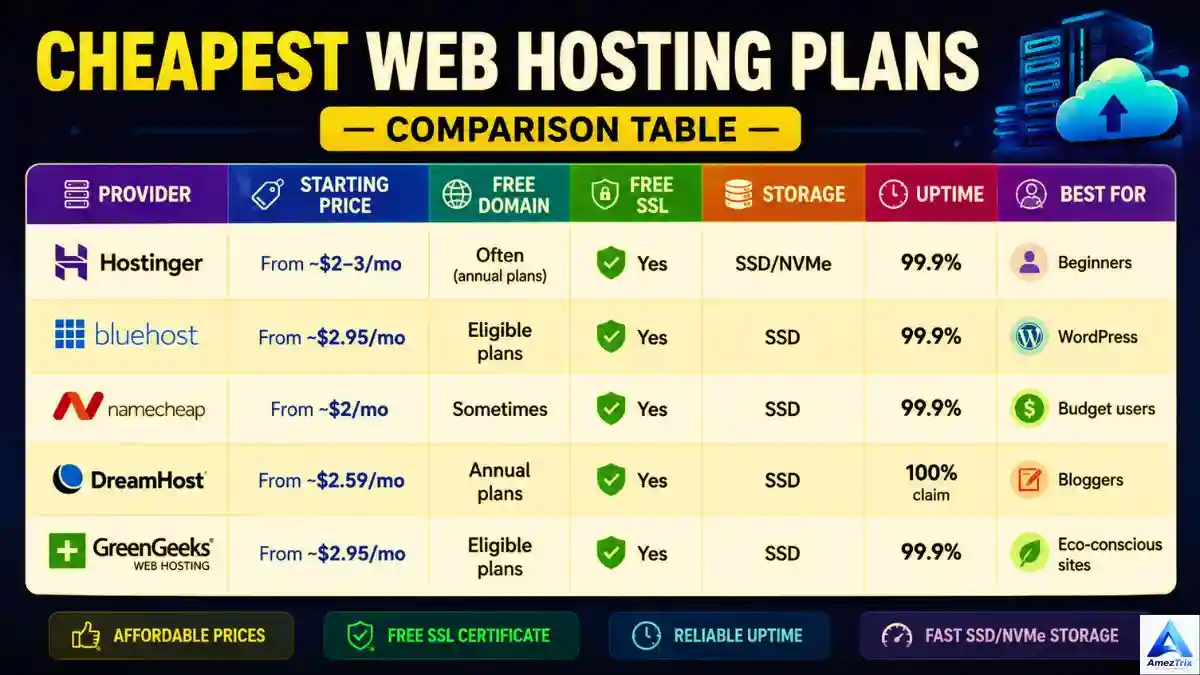
| Provider | Intro Price | Renewal | Free Domain | Refund | Best For |
|---|---|---|---|---|---|
| Hostinger | About $2.99/mo (48 months) | About $10.99/mo | 1 year on 12-month+ plans | 30 days | Overall value |
| Bluehost | About $3.99/mo (36 months) | About $9.99/mo (reported up to $11.99) | Eligible plans | 30 days | WordPress beginners |
| Namecheap | About $2.28/mo (first year) | About $4.66/mo ($55.88/yr) | Selected offers | Varies by signup route | Lowest renewal |
| DreamHost | About $2.59 to $2.95/mo (long term) | About $10.99/mo (older trackers lower) | Some annual plans | Confirm: 30 or 97 days | Flexible billing |
| GreenGeeks | About $2.95/mo (12 months) | About $10.95 to $13.95/mo | Eligible plans | Check | Eco-minded sites |
| hosting.com (ex-A2 Hosting) | From about $1.99/mo | About $10.99/mo (one tracker) | Check | Check | Performance |
| HostArmada | From about $1.99/mo | Higher; check | Check | 45 days | Cloud-based budget |
| ScalaHosting | Check live page | Higher; check | Check | Check | Managed VPS growth |
| ChemiCloud | From about $2.99/mo | Higher; check | Plan-dependent | Check | Support |
| SiteGround | About $2.99/mo (12 months) | About $17.99/mo | Not typical | 30 days | Premium support |
Figures are approximate and drawn from trackers dated August to October 2026. Confirm each price on the provider’s own page.
10 Best Budget Hosting Providers, Reviewed
1. Hostinger: Best Overall Cheap Hosting

Hostinger sits near the top of most budget hosting lists because it is cheap without feeling cheap. The Premium shared plan starts around $2.99 a month on a 48-month term and includes free SSL and a free domain for the first year on 12-month-plus plans.
Pros: low entry price, easy hPanel dashboard, 30-day refund. Cons: renewal is about $10.99 a month (roughly 3.7 times the intro rate), the cheapest tier reportedly uses weekly backups, and the lowest price needs a four-year commitment.
Best for: beginners, bloggers, portfolios and small WordPress sites.
2. Bluehost: Best for WordPress Beginners

Bluehost is built around simple WordPress setup. The Starter plan is listed around $3.99 a month on a 36-month term and renews near $9.99, though some trackers show $2.95 to $4.99 intro prices and $10.99 to $11.99 renewals depending on term. It is also on WordPress.org’s recommended hosts list, according to a tracker snapshot from April 2026.
Pros: easy onboarding, WordPress-focused plans, 30-day refund window. Cons: renewal roughly 2.5 times the intro rate, weekly backups on entry plans, and add-ons that can push the real total up.
Best for: first-time WordPress users and small business sites.
3. Namecheap: Best for the Lowest Renewal

Namecheap suits people who already buy domains there. An August 2026 snapshot lists the Stellar plan at about $26.88 for the first year and $55.88 a year at renewal, which works out to roughly $4.66 a month. That is about double the intro rate, a much gentler jump than most rivals.
Pros: low renewal, familiar cPanel, one login for domain and hosting. Cons: refund and trial terms do not apply identically to every signup route, and entry plans are resource-limited.
Best for: personal sites, portfolios and small blogs.
4. DreamHost: Best for Flexible Billing

DreamHost renamed its entry shared plan Web Hosting Launch in late 2025. Intro pricing is reported at roughly $2.59 to $2.95 a month on long terms, and one 2026 comparison lists the renewal at $10.99. Older trackers show lower renewals for the former Starter plan, so verify before buying. DreamHost is also on WordPress.org’s recommended list (April 2026 snapshot).
Pros: flexible billing options, bundled daily backups reported by some reviewers, strong privacy tools. Cons: no cPanel, and sources disagree on the refund window (30 days versus the older 97), so confirm it at signup.
Best for: bloggers, personal sites and small businesses that want billing flexibility.
5. GreenGeeks: Best Eco-Friendly Option

GreenGeeks matches its energy use with renewable energy credits, a real differentiator if sustainability matters to you. The Lite plan is listed at about $2.95 a month on a 12-month term. A June 2026 price reading shows renewal at $10.95, while other trackers report $11.95 to $13.95, so budget for the higher end.
Pros: eco-friendly positioning, LiteSpeed and cPanel included, daily backups reported by reviewers. Cons: renewal is about 3.7 times the intro rate or more, and entry plans are resource-limited.
Best for: green-focused businesses, bloggers and WordPress users.
6. hosting.com (Formerly A2 Hosting): Best for Performance
If you remember A2 Hosting, note the name change. World Host Group acquired it in January 2025, and it rebranded as hosting.com in April 2025. Old a2hosting.com addresses now redirect. One 2026 tracker lists plans from about $1.99 a month renewing near $10.99, but faster boost tiers cost more, so the cheapest plan is not the fastest one.
Pros: performance-focused heritage, developer-friendly tools. Cons: renewals climb, and older reviews published under the A2 name may be out of date.
Best for: speed-focused sites and developers.
7. HostArmada: Best Newer Budget Option
HostArmada pairs cloud-based infrastructure with cPanel. Trackers list entry pricing from about $1.99 a month, NVMe storage on shared plans, daily backups with up to 21 days of restore points and a 45-day money-back guarantee, which is longer than most rivals offer.
Pros: long refund window, NVMe storage, strong support reputation. Cons: renewal prices rise, and entry plans carry restrictions.
Best for: small businesses, bloggers and startups.
8. ScalaHosting: Best for Managed VPS on a Budget
ScalaHosting makes sense if you expect to outgrow shared hosting. It sells managed VPS alongside shared plans, so upgrading is smoother than moving to a new provider. It uses its own SPanel instead of cPanel. We could not confirm a current entry price, so check the live page.
Pros: easy upgrade path, strong security tools. Cons: smaller brand, and intro prices rise at renewal.
Best for: growing sites, online businesses and agencies.
9. ChemiCloud: Best Support at This Price
ChemiCloud earned its following mainly through support quality. Plans start from about $2.99 a month and include a free domain on some tiers and 24/7 support.
Pros: responsive support, fast servers. Cons: limited backups on the lowest tier, higher renewals and no phone support.
Best for: bloggers, freelancers and WordPress users.
10. SiteGround: Best Premium Option Worth the Extra Cost
SiteGround is the priciest name here over time. The StartUp plan is listed at about $2.99 a month for the first term but renews at about $17.99, roughly six times the intro rate, according to several 2026 comparisons. In return you get Google Cloud infrastructure, managed WordPress features and well-regarded support.
Pros: strong support and security, 30-day guarantee. Cons: steep renewal and modest storage on the entry plan.
Best for: business sites, professional blogs and WooCommerce stores.
First-Term vs. Renewal: What You Will Really Pay
This is where cheap hosting gets expensive. Here are the entry plans where at least two sources agreed on both prices:
| Host (Entry Plan) | First-Term Rate | Renewal Rate | Approx. Jump |
|---|---|---|---|
| Namecheap (Stellar) | $2.28/mo | $4.66/mo | About 2.0x |
| Bluehost (36-month Starter) | $3.99/mo | $9.99/mo | About 2.5x |
| Hostinger (Premium) | $2.99/mo | $10.99/mo | About 3.7x |
| GreenGeeks (Lite) | $2.95/mo | $10.95/mo | About 3.7x |
| SiteGround (StartUp) | $2.99/mo | $17.99/mo | About 6.0x |
Four-Year Cost Example
Using the rates above, here is the approximate four-year total for each entry plan, before tax:
| Host | How the Four Years Break Down | Approx. Total |
|---|---|---|
| Hostinger | 48-month prepay at $2.99 | $143.52 |
| Bluehost | 36 months at $3.99, then 12 at $9.99 | $263.52 |
| Namecheap | $26.88 year one, then three years at $55.88 | $194.52 |
| GreenGeeks | 12 months at $2.95, then three years at $10.95 | $429.60 |
| SiteGround | 12 months at $2.99, then three years at $17.99 | $683.52 |
Hostinger wins on four-year cost, but only because you prepay for the full four years. Its first renewal year then costs about $132, nearly the same as the entire first 48 months combined. Entry plans also differ in resources, so use this table to understand pricing patterns, not to declare a winner.
To protect yourself, set a calendar reminder at least 30 days before renewal, compare competitors’ new-customer deals at that point, and check whether the refund policy covers renewals. If you are comfortable moving a site, migrating to a fresh promo is a common way to keep costs low.
Best Cheap Hosting for Your Use Case
| Use Case | Recommended Pick |
|---|---|
| Best overall budget hosting | Hostinger |
| Best for WordPress beginners | Bluehost |
| Lowest renewal price | Namecheap |
| Best for flexible billing | DreamHost |
| Best eco-friendly hosting | GreenGeeks |
| Best for performance | hosting.com |
| Best refund window | HostArmada |
| Best for growing businesses | ScalaHosting |
| Best customer support | ChemiCloud |
| Best premium value and WooCommerce | SiteGround |
Cheapest Web Hosting Plans in India
If your audience is in India, a few details change. Visitors load your site faster when the server is in or near India, and paying in rupees through UPI, net banking or Indian cards avoids currency-conversion surprises.
- GST: Many Indian listings show prices before 18% GST, so your checkout total can be noticeably higher.
- Sale pricing: A tracker that read Hostinger’s India pages on 14 September 2026 found shared plans from Rs. 69 to Rs. 599 a month, renewing at Rs. 289 to Rs. 1,599, which is 2.6 to 4.2 times the headline rate. Sales end, so check the live page.
- Payment options: UPI, RuPay and net banking support reduce failed payments.
Website Hosting Charges in India: Per Year vs. Monthly
Billing term drives cost more than the brand. Using the same tracker’s figures, Hostinger’s cheapest shared plan works out to about ₹830 a year at the sale price, but renewal at Rs. 289 to Rs. 449 a month means roughly ₹3,500 to ₹5,400 a year for the Single and Premium plans, before GST. That is our arithmetic from tracker data, not a quote, so verify on the provider’s page.
| Billing Type | Cost Pattern | Best For | Watch Out For |
|---|---|---|---|
| Monthly | Highest per month | Testing a host or a short project | Fewer hosts offer it, and setup fees may apply |
| Yearly | Balanced price and flexibility | Blogs and small business sites | Renewal is often much higher |
| 2 to 4 years | Lowest per month | Sites you are sure about | Money is locked in, and the refund window is short |
If you are unsure, start with a yearly plan and upgrade to a longer term once the site proves itself. Our guide to the best web hosting for beginners walks through the first steps.
Cheapest Web Hosting with a Free Domain
A free domain saves you the first-year domain fee. Hostinger includes one for the first year on 12-month-plus plans, and Bluehost, DreamHost, GreenGeeks and ChemiCloud advertise it on selected plans. Before relying on it, check three things:
- Which plans qualify. It usually applies to annual or longer plans, not monthly ones.
- Which extensions are covered. .com is common, while .in and other country extensions may not be.
- The renewal fee. The domain is free for year one only, then renews at the normal price.
Are “Unlimited” Hosting Plans Really Unlimited?
No. Providers apply fair-use policies that cap CPU, RAM, file counts (inodes) and processes, so a busy site can be throttled even when the plan says “unlimited”. Unmetered bandwidth is fine for blogs and small business sites, but it does not turn shared hosting into a VPS. Read the acceptable-use policy, look at the real resource limits, and plan a VPS or cloud upgrade if traffic grows quickly.
GoDaddy Hosting Plans in India: Worth It?
GoDaddy is one of India’s best-known names, thanks to its domain business, local marketing and rupee pricing. Its plans are easy to buy and come with 24/7 support. However, it is often not the cheapest once renewals and add-ons are counted, and several comparison sites list its WordPress plans at higher starting prices than Hostinger or Bluehost. GoDaddy makes the most sense if you want your domain and hosting with a single provider. Compare the final checkout total, including GST and renewal, before deciding.
Cheapest Web Hosting Plans for Small Business
A business site must stay online during working hours, protect customer data and send professional email from your own domain. Look for at least 99.9% uptime, free SSL, daily backups, business email, a firewall with malware scanning and an easy upgrade path. Hostinger works for price, SiteGround for premium support and WooCommerce, HostArmada and ChemiCloud for support, and ScalaHosting if you expect fast growth. Good hosting also supports visibility as search shifts toward AI answers, which we cover in SEO vs GEO vs AEO.
Shared vs. VPS vs. Cloud Hosting
| Feature | Shared | VPS | Cloud |
|---|---|---|---|
| Price | Lowest | Moderate | Moderate to high |
| Performance | Good | Excellent | Excellent |
| Scalability | Limited | High | Very high |
| Management | Easy | Moderate | Moderate |
| Best for | Beginners | Growing sites | High-traffic sites |
Shared hosting suits blogs, portfolios and new business sites. Move to VPS or cloud when traffic grows or you need isolated resources. Browse our web hosting category for deeper comparisons.
Common Mistakes and Red Flags
- Chasing the lowest price only. Support, backups and limits matter as much as the sticker price.
- Ignoring renewal costs. A $2 deal is a first-term promo, not a permanent rate.
- Locking in four years too early. Test with a shorter term if you are unsure.
- Relying on outdated reviews. Brands rename and reshuffle plans (A2 Hosting became hosting.com, and DreamHost renamed its entry plan).
- Overlooking backups. Check how often they run and how to restore them.
- Ignoring server location. Choose a data center near your audience.
- Underestimating security. Free SSL, malware scanning and a firewall should be baseline.
Red flags: a renewal price hidden until checkout, “unlimited everything” with no fair-use policy, no live chat, a refund policy that excludes the hosting itself, and no clear upgrade path.
How to Get More Out of a Budget Plan
- Use a lightweight theme and compress images (WebP or AVIF)
- Turn on page caching and use a CDN
- Minify CSS and JavaScript
- Keep WordPress, themes and plugins updated, and delete unused plugins
- Run a current supported PHP version
Google’s documentation on Core Web Vitals explains the speed and stability metrics worth watching.
Limitations of This Guide
We did not buy every plan or run our own uptime and speed tests, so we make no performance claims beyond what providers and independent reviewers report. Prices vary by country, currency, term and promotion, and trackers sometimes conflict. Treat the rankings as a starting shortlist, then verify the live price, renewal rate and refund terms before you pay.
Cheapest Web Hosting Plans: Frequently Asked Questions
What is the cheapest web hosting plan in 2026?
Entry-level shared plans start at about $2 to $3 a month on 12 to 48-month terms from hosts such as Hostinger, Namecheap, GreenGeeks and DreamHost, and promotions can push some intro prices lower. Renewal prices are higher, so compare both before you pay.
Why is web hosting renewal so much more expensive?
Hosts discount the first term to win customers, then charge the standard rate. Reported jumps range from about 2 times to 6 times depending on the host and plan, so check the renewal price at checkout.
Is cheap hosting bad for SEO?
Not by itself. A budget host with fast load times, solid uptime, free SSL and a CDN can perform well. Google cares about speed and user experience, not what you paid.
Which cheap hosting includes a free domain?
Hostinger includes a free domain for the first year on 12-month-plus plans, and Bluehost, DreamHost, GreenGeeks and ChemiCloud advertise it on selected plans. The domain renews at the regular price after year one.
Are unlimited hosting plans really unlimited?
No. Fair-use policies limit CPU, RAM and file counts. They suit blogs and small sites but do not replace VPS or cloud hosting.
How much does web hosting cost per year in India?
Sale-price plans can work out to under ₹1,000 a year on long terms, while renewals on entry plans can reach roughly ₹3,500 to ₹5,400 a year before 18% GST, based on one September 2026 tracker. Confirm current prices on the provider’s page.
What is the best cheap hosting for a small business?
Look for 99.9% uptime, free SSL, daily backups, business email and an upgrade path. Hostinger, SiteGround, HostArmada and ChemiCloud are common choices.
Do cheap hosts offer money-back guarantees?
Many advertise 30 days, and HostArmada lists 45. Policies change and often exclude domains and renewals, so read the terms before you buy.
Final Verdict
The cheapest web hosting plans in 2026 are good enough for most new sites, but the real price is the renewal rate. Hostinger is the best all-round value, Bluehost is the easiest WordPress start, Namecheap has the gentlest renewal jump, and SiteGround is worth the extra cost only if premium support and managed WordPress matter to you. If you are unsure, take a 12-month term, set a renewal reminder and upgrade only when your traffic needs it.
Key Takeaways
- Compare the first-term price, the renewal price and the total cost.
- Reported renewal jumps run from about 2x (Namecheap) to about 6x (SiteGround).
- Shared hosting is the sensible starting point for most new sites.
- Check the refund policy and whether it covers renewals.
- Prices in this guide are snapshots, so confirm them at checkout.
About the Author
Rajendra Parmar is the Founder and Editor of AmezTrix, where he covers artificial intelligence, technology, WordPress, web hosting, digital marketing and software, with a focus on practical, well-researched guides.

Rajendra Parmar
Founder & Editor • AmezTrix
Rajendra Parmar is the Founder and Editor of AmezTrix, a platform covering Artificial Intelligence, Technology, WordPress, Web Hosting, Digital Marketing, Gadgets, Software Reviews, and emerging innovations. His mission is to simplify complex technology through practical tutorials, honest reviews, and well-researched guides that help readers make smarter digital decisions.