SEO vs GEO vs AEO explained simply: how they differ, where they overlap, and a step-by-step plan to rank on Google and get cited by AI.
SEO vs GEO vs AEO: What’s the Difference and How to Win at All Three in 2026
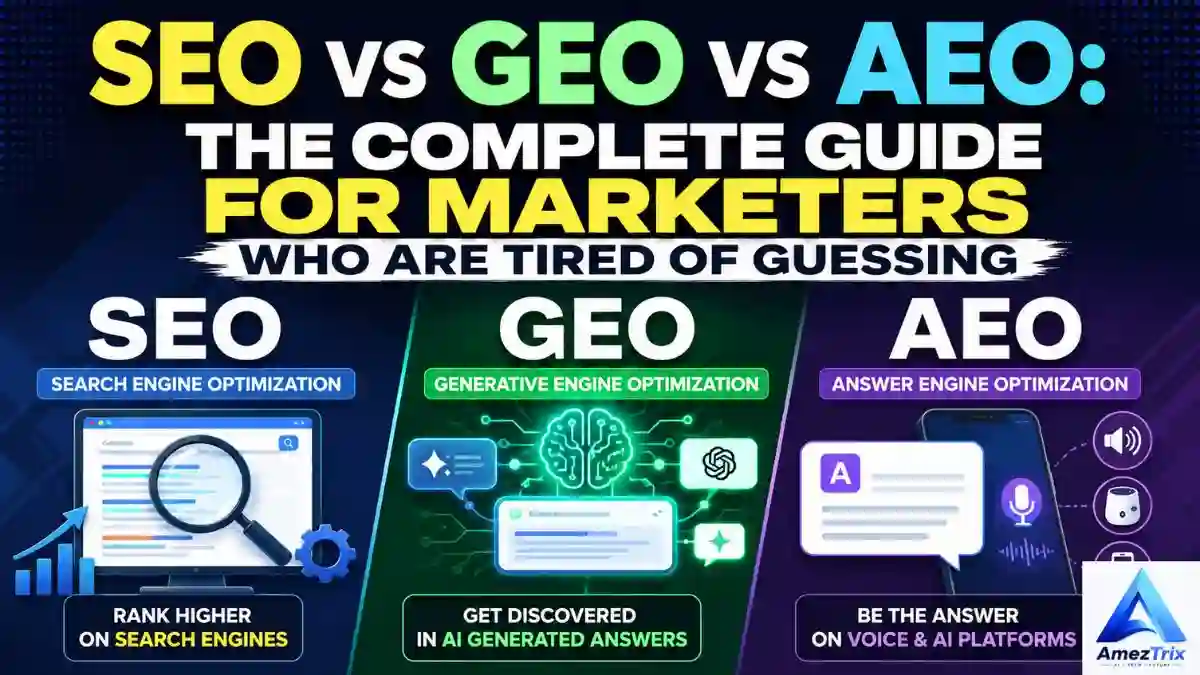
SEO vs GEO vs AEO comes down to where you want to be seen. SEO helps pages rank in search results. AEO structures content to become the direct answer in snippets and voice search. GEO builds trust so AI tools like ChatGPT and Gemini cite or mention your brand.
If you have ever sat in a marketing meeting where someone casually dropped “GEO” or “AEO” and half the room nodded without really knowing what it meant, you are in good company. This guide explains SEO vs GEO vs AEO in plain language, shows where the three overlap, and gives you one practical plan to rank on Google and get cited by AI tools in 2026.
SEO vs GEO vs AEO: The Short Version
These three are not rival strategies. They are layers of the same job: making your content easy to find, easy to understand, and easy to trust.
- SEO (Search Engine Optimization) helps your pages rank in Google, Bing, and other search engines. It is the oldest layer and the foundation for the rest.
- AEO (Answer Engine Optimization) formats your content so it can be lifted out as the answer itself: a featured snippet, a voice answer, or an answer box.
- GEO (Generative Engine Optimization) aims to get your brand cited, quoted, or recommended inside AI-generated answers from tools like ChatGPT, Gemini, Perplexity, and Google’s AI Overviews.
One caution up front: the industry has not fully agreed on where AEO ends and GEO begins. Ask five agencies and you may get five slightly different definitions. Do not get stuck on the label. Focus on what is actually being optimized.
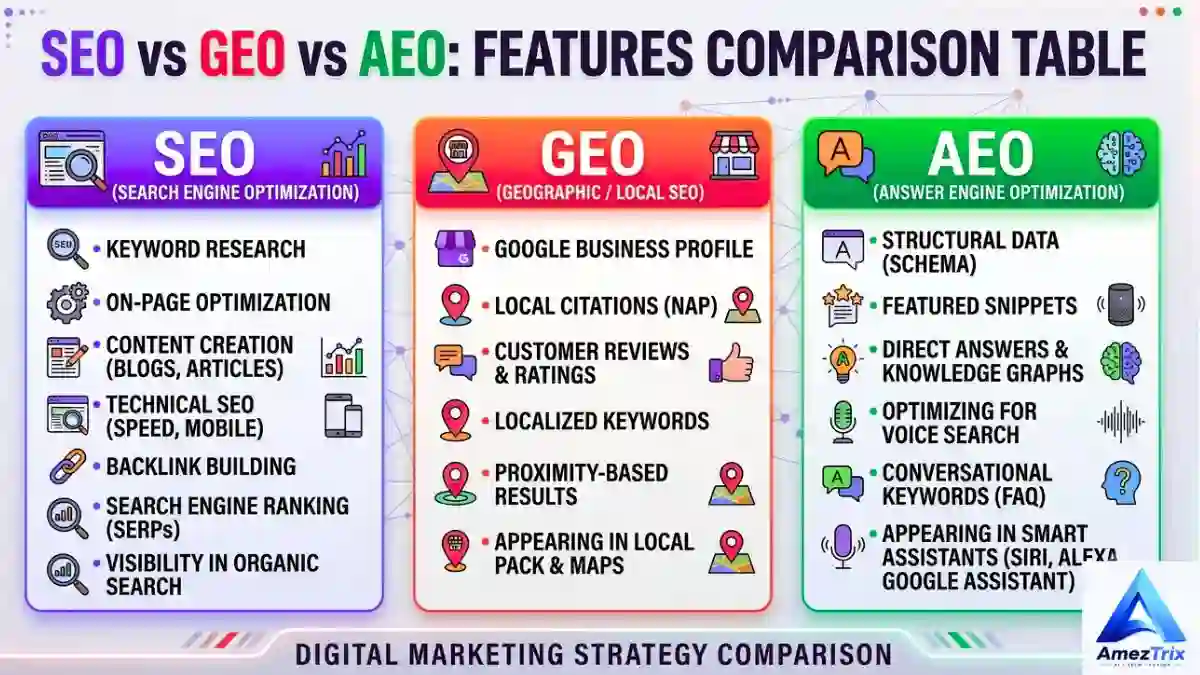
SEO vs GEO vs AEO Comparison Table
| Factor | SEO | AEO | GEO |
|---|---|---|---|
| Full name | Search Engine Optimization | Answer Engine Optimization | Generative Engine Optimization |
| Main goal | Rank higher in results | Become the direct answer | Be cited inside AI answers |
| Where it shows up | Google and Bing organic listings | Featured snippets, voice search, answer boxes | ChatGPT, Gemini, Perplexity, AI Overviews, Copilot |
| Content style | In-depth and thorough | Short, direct, question-first | Specific, sourced, trustworthy |
| Judged mainly on | Relevance, links, technical health | Clarity, structure, formatting | Authority, accuracy, corroboration across the web |
| How you track it | Rankings, clicks, impressions | Snippet wins, answer-box presence | Citations, brand mentions, AI referral traffic |
| Maturity | Established | Established but evolving | New, with fewer standard tools |
What Is SEO, Really?
SEO means making a website easy for search engines to crawl and rank, and also worth clicking for a real person. It breaks into four parts.
On-page SEO
This covers title tags, headings, meta descriptions, URLs, internal links, image alt text, and how well your content matches what the searcher wants. Repeating a keyword fifteen times stopped working years ago. Search engines now interpret intent, not just matching words.
Technical SEO
This is the plumbing: crawlability, page speed, mobile usability, indexing, and Core Web Vitals. Great writing on a technically broken site often goes nowhere, and this happens more often than most people assume.
Off-page SEO
This is your reputation beyond your own domain: backlinks, brand mentions, and digital PR. A few links from respected sites in your field are worth far more than a pile of low-quality ones.
Topical and semantic SEO
Search engines understand entities and relationships, not only exact keywords. A page on SEO vs GEO vs AEO should naturally cover related ideas such as AI Overviews, featured snippets, structured data, and search intent. That breadth signals real topical depth.
What Is AEO (Answer Engine Optimization)?
AEO changes the question. Instead of “how do I rank for this keyword?”, it asks: “if someone types this exact question, can my content be pulled out and shown as the answer?”
Featured snippets are the clearest example. Google takes a definition, a numbered list, or a short table and shows it above the regular results. Voice assistants and answer boxes work in a similar way. To qualify, your content needs to be easy to extract:
- Put a direct answer in the first two or three sentences under a question-style heading.
- Use numbered lists for steps and tables for comparisons.
- Keep one idea per paragraph.
- Match the wording people really use when they ask.
Limitation: no formatting trick guarantees a snippet. Clean structure improves your odds, but the search engine makes the final call.
What Is GEO in SEO?
GEO exists because of a change in behavior. People increasingly ask an AI assistant a full question and read the written answer instead of scanning ten blue links.
The old question was “can I rank for this?” The GEO question is different: “when an AI system builds an answer on this topic, does it trust my content enough to use or mention it?”
AI systems draw on different signals than a classic ranking list. Typically they favor content that is:
- clear and specific, with claims that can be checked
- consistent with what other reputable sources say about you
- written or reviewed by identifiable experts
- recent enough to be reliable
Nobody outside the AI companies knows the exact selection rules, and they change. Treat any “secret GEO formula” with suspicion. What is reliable is the principle: be accurate, original, well-sourced, and easy to quote.
How the Search Journey Has Changed
The old path was simple: search a query, scan results, click a site.
The new path often looks like this: ask a question, read an AI-generated answer, notice a few cited sources, and maybe click one. Sometimes there is no click at all.
So visibility now has several forms:
- A normal organic ranking
- A featured snippet or answer box
- A citation inside an AI Overview
- A brand mention inside a ChatGPT or Gemini reply
All four are real exposure. Each needs a slightly different approach, but they share one base: good content on a healthy site.
SEO vs AEO vs GEO: Where They Actually Differ
SEO vs AEO
SEO earns a ranking position. AEO earns the answer slot. A page ranking third can lose the snippet to a page ranking seventh if the lower page answers the question more cleanly.
SEO vs GEO
SEO vs GEO is mostly about the environment. SEO measures visibility inside a results page. GEO measures whether an AI system trusts your content enough to reference it while composing its own response. The same topic can behave very differently on Google’s organic list and inside an AI assistant that blends many sources.
AEO vs GEO
These two get mixed up because both live in “answer” territory. A simple way to separate them: AEO is about becoming the answer, while GEO is about being cited inside someone else’s answer.
A Real-World Example: One Topic, Three Searchers
Imagine you run a small invoicing software product. Three people find you in three different ways.
- Person one searches “best invoicing software for freelancers” on Google. This is SEO. Your content depth, backlinks, and site health decide whether you appear on page one.
- Person two searches “how to create a GST invoice.” You have a short step-by-step page with a direct answer at the top, so Google may show it as a snippet. This is AEO.
- Person three never opens a search page and asks an AI tool, “which invoicing tool suits a small business that needs GST compliance?” If reputable sources describe your product consistently, the AI may mention it. This is GEO.
The underlying content can be nearly the same in all three cases. What changes is its structure and the trust signals around it.
Brand consistency matters more for GEO than most marketers expect. If your website, a review site, and your social profiles each show different pricing or feature details, an AI system may skip you rather than risk being wrong. It is a small, boring detail with a big effect.
How to Build One Strategy That Covers SEO, AEO, and GEO
Think of the three as layers, not separate campaigns competing for budget.
- Layer 1: SEO foundations. Make the site crawlable, fast, and mobile-friendly. Build content around real search intent. Without this layer, the rest has nothing to stand on.
- Layer 2: AEO structure. Reformat your best content with direct definitions, numbered steps, comparison tables, and question-style subheadings.
- Layer 3: GEO trust signals. Add original data, clear sourcing, expert authorship, regular updates, and consistent brand information across the web.
Step-by-Step: Optimize One Article for All Three
- Define the search intent. Decide whether the reader wants to learn, compare, or buy.
- List the real questions. Use Google’s “People also ask,” related searches, and your own customer questions.
- Answer first. Place a 40–50-word direct answer under each important question heading, then expand with detail.
- Add proof. Include screenshots, test results, case examples, or cited sources.
- Use tables and lists where they make comparison or steps easier to scan.
- Show who wrote it. Add an author bio that explains why this person is qualified.
- Add honest structured data. Markup must match what is visible on the page.
- Link internally to related guides so readers and crawlers see the full topic cluster.
- Update on a schedule. Review key pages regularly and refresh anything outdated.
- Check your brand details (name, descriptions, pricing, links) for consistency across your site and major profiles.
Checklist: Quick Wins That Move the Needle
- Search intent confirmed before writing
- Direct answer near the top of each question section
- Question-style H2 and H3 headings where natural
- Short paragraphs, clean tables, scannable lists
- Original examples, data, or first-hand testing
- Real author name, bio, and publish or update date
- Fast, mobile-friendly, crawlable pages
- Topic clusters instead of isolated posts
- Mentions and links from credible third-party sites
- Consistent brand facts everywhere
How to Make Content GEO-Friendly
- Back up claims. If you say a tool saves time, say how you know. Verifiable statements beat vague marketing lines.
- Make expertise visible. A byline alone is not enough. Explain the author’s experience.
- Keep content current. Stale pages are less useful to both readers and AI tools, especially in fast-moving topics.
- Earn real mentions. Guest articles, podcast appearances, and credible directory listings all add outside confirmation.
- Write naturally. A question phrased the way people speak (“What is the difference between SEO and GEO, and which one do I need?”) often works better than a stiff keyword phrase.
Do You Need Separate Content for SEO, AEO, and GEO?
No. You do not need three articles for three platforms. One well-built article can do all three jobs: depth and research support SEO, clear question-based sections support AEO, and original data plus honest sourcing support GEO.
Where people go wrong is focusing on one layer. Long, padded articles may never give one clean extractable answer. Short listicles may win an occasional snippet but lack the depth that builds authority. Aim for content that is complete without being bloated.
Which Should You Prioritize First?
All three matter, but not all at once and not with equal weight on day one. A sensible order:
- Fix technical SEO basics (crawling, speed, mobile, indexing).
- Publish genuinely useful, well-researched content.
- Build topical authority with a cluster of related pages.
- Restructure your best pages for AEO.
- Strengthen GEO signals: original data, credible mentions, consistent brand facts.
Skipping to “AI optimization” while ignoring fundamentals rarely works. A slow, thin site does not become a trusted source by adding a few buzzwords.
How to Measure SEO vs GEO vs AEO Performance
| Layer | What to track | Typical tools |
|---|---|---|
| SEO | Organic clicks, impressions, rankings, indexed pages, backlinks, conversions | Google Search Console, analytics platform, backlink tools |
| AEO | Featured snippet wins, answer-box presence, performance on question queries | Search Console, rank trackers with SERP-feature reports |
| GEO | Brand mentions and citations in AI tools, AI referral traffic, accuracy of AI descriptions of your brand | Manual prompt testing, analytics referral reports, emerging AI-visibility tools |
Limitation: GEO measurement is the least standardized. AI answers vary by user, location, and time, so treat results as directional, not exact.
Pros and Cons of Focusing on Each Layer
| Layer | Pros | Cons |
|---|---|---|
| SEO | Proven, measurable, drives long-term traffic | Slow to show results, competitive |
| AEO | High visibility at the top of results, helps voice and question searches | No guaranteed placement, may reduce clicks when the answer is shown directly |
| GEO | Reaches people who skip traditional search, builds brand authority | Hard to measure, rules not public, fast-changing |
Common Mistakes That Quietly Hurt Visibility
- Treating GEO as a replacement for SEO. It is not. A weak technical base undermines everything above it.
- Keyword stuffing. Repeating “SEO vs GEO vs AEO” again and again makes writing sound robotic.
- Writing for algorithms instead of people. Both search engines and AI systems are getting better at spotting content made only to game rankings.
- Publishing generic AI-drafted content with no original input. AI can help with drafting, but content with no first-hand insight rarely earns trust.
- Ignoring technical basics. Broken redirects, slow pages, and indexing errors can drag down excellent content.
- Using misleading structured data. Markup that does not match the visible page can make you ineligible for rich results.
Red Flags When Hiring Help or Buying Tools
- Promises of guaranteed rankings or guaranteed AI citations
- A “secret formula” for ChatGPT or Gemini visibility
- Reports that show no method, data source, or date
- Advice to mass-produce AI articles with no editing or fact-checking
- Pressure to abandon SEO fundamentals for “AI-only” tactics
Key Takeaways
- SEO, AEO, and GEO are stacked layers, not competing strategies.
- SEO helps you rank, AEO helps you become the answer, GEO helps you get cited by AI.
- One strong, well-structured article can serve all three.
- Technical health and real expertise come first.
- Measure what you can, and be honest about what you cannot.
Frequently Asked Questions
Is GEO replacing SEO?
No. GEO is an additional visibility layer built on top of SEO fundamentals. AI tools still rely on quality, accessible content, so SEO remains the foundation.
What is the main difference between SEO and GEO?
SEO aims for visibility inside traditional search results. GEO aims for visibility and accurate representation inside AI-generated answers.
How is AEO different from GEO?
AEO makes your content the direct answer shown in snippets and answer boxes. GEO aims to get your brand cited as a trusted source inside an AI-generated response. The line between them is still blurry across the industry.
Do I need separate content for SEO, AEO, and GEO?
No. One well-researched article with clear answers, good structure, and trustworthy sourcing can support all three.
Does structured data guarantee I will appear in AI answers?
No. Structured data helps systems understand your content, but it does not guarantee any specific placement or citation.
Can AI-written content still rank?
It can, if it is accurate, genuinely useful, and adds something readers cannot easily find elsewhere. Low-value content is the problem, not the drafting tool.
Which should a beginner start with?
Start with SEO: a fast, crawlable site and helpful content. Then add AEO formatting, and build GEO trust signals over time.
Final Verdict
SEO vs GEO vs AEO is not a contest. They are three layers of one goal: becoming a source that people, and now AI systems, trust enough to find, quote, and recommend.
Build the technical and content foundation with SEO. Structure your best material around real answers for AEO. Back it with accuracy, originality, and credibility for GEO. Do that consistently and you stop chasing a single ranking position. You become the source that appears however someone chooses to search, speak, or ask.
Note: AI search features and ranking systems change often. Review this guide regularly and verify details against official documentation.
About Author
Rajendra Parmar is the Founder and Editor of AmezTrix, where he covers Artificial Intelligence, Technology, WordPress, Web Hosting, Digital Marketing, Gadgets, and Software. His mission is to simplify complex technology through practical tutorials, honest reviews, and well-researched guides that help readers make smarter digital decisions.

Rajendra Parmar
Founder & Editor • AmezTrix
Rajendra Parmar is the Founder and Editor of AmezTrix, a platform covering Artificial Intelligence, Technology, WordPress, Web Hosting, Digital Marketing, Gadgets, Software Reviews, and emerging innovations. His mission is to simplify complex technology through practical tutorials, honest reviews, and well-researched guides that help readers make smarter digital decisions.