Starlink vs Jio vs Airtel: see what Musk claimed, what India said, who has approval and what satellite internet may cost. Updated October 2026.
Starlink vs Jio vs Airtel: Who Is Ahead in India’s Satellite Race?
Nobody is ahead yet. As of October 9, 2026, no licensed operator (Starlink, Jio Satellite or Eutelsat OneWeb) sells a commercial satellite plan to the public in India. Security clearances, spectrum rules and final approvals are still pending for all three.
Key takeaways
- Elon Musk says unnamed “oligarchs” are blocking Starlink. The Indian government says its process is fair.
- No public evidence shows that Jio or Airtel caused any delay.
- Starlink got its licence in June 2025 but still lacks the final clearances it needs to sell.
- Jio’s planned 1,600-satellite network and Airtel’s OneWeb link are real strategies, but neither is a live consumer service today.
- No official Indian satellite price exists. Anyone quoting one is guessing.
In this guide: Company comparison | Satellite internet basics | What happened | Starlink | Jio | Airtel and OneWeb | Price comparison | Spectrum fight | Launch date | Who should wait? | Scams | FAQ
One post on X can start a national argument. On October 7, 2026, Musk said powerful interests were keeping Starlink out of India. The government replied the next day. On October 9, Telecom Minister Jyotiraditya Scindia said India does not allow monopolies in any sector (Reuters, October 9, 2026).
Loud claims make strong headlines. They don’t make good buying decisions. So this guide keeps what is documented apart from what is only alleged, and tells you what to check before you spend a rupee.
Starlink vs Jio vs Airtel: Customers, Satellites, Market Cap and Staff
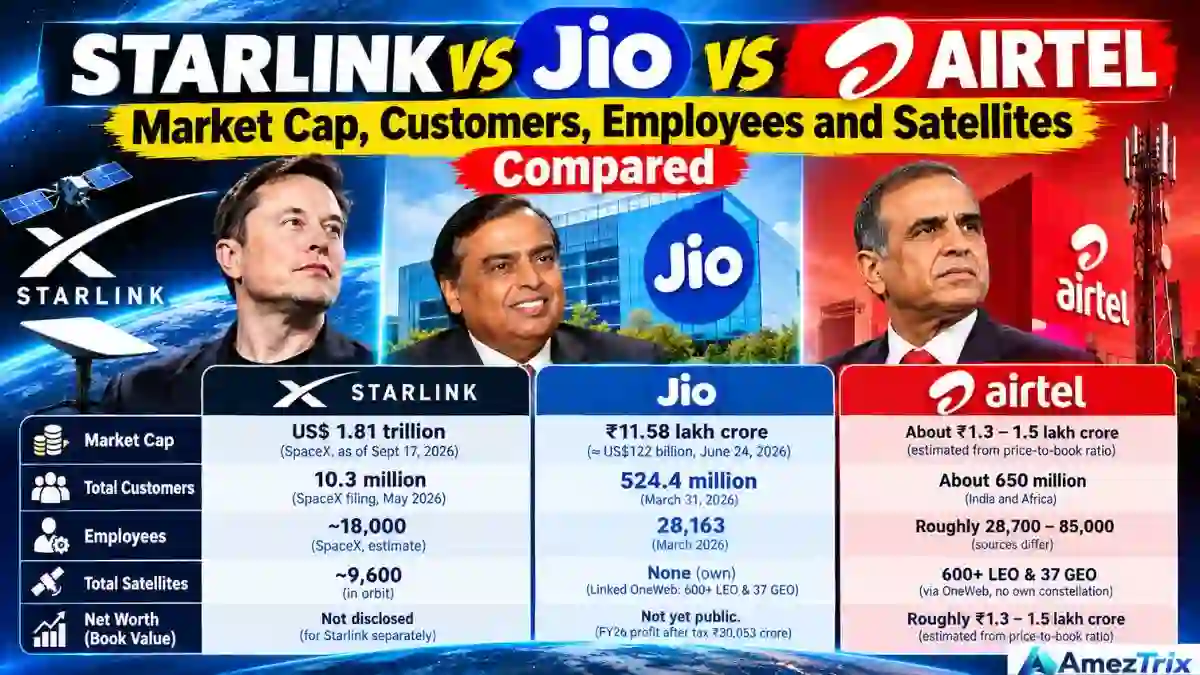
Starlink is the world’s largest satellite internet operator, with about 10.3 million subscribers and roughly 9,600 satellites. Jio has 524.4 million customers and Airtel about 650 million, but neither owns satellites directly. Airtel’s wider group is linked to OneWeb, which operates 600+ low-orbit satellites.
These three are not equals, so read the table with care. Starlink is one division of a space and AI giant. Jio is a telecom arm heading toward a stock market listing. Airtel is an established listed operator.
| Parameter | Starlink (SpaceX) | Jio (Jio Platforms) | Airtel (Bharti Airtel) |
|---|---|---|---|
| Company type | Satellite internet unit of SpaceX, listed on Nasdaq as SPCX | Subsidiary of Reliance Industries, not yet listed | Listed Indian telecom company (NSE/BSE: BHARTIARTL) |
| Market cap | About US$1.81 trillion for all of SpaceX (September 17, 2026). Changes daily | Unlisted. IPO reports point to a valuation near US$137 billion | About ₹11.58 lakh crore (roughly US$122 billion) on June 24, 2026 |
| Total customers | 10.3 million subscribers (SpaceX filing, May 2026) | 524.4 million (March 31, 2026) | About 650 million across India and Africa |
| Employees | About 18,000 for all of SpaceX (estimate). Starlink alone is not disclosed | 28,163 full-time employees (March 2026) | Sources differ, from roughly 28,700 to 85,000 |
| Total satellites | Around 9,600 in orbit | No operating constellation reported. About 1,600 planned | None of its own. Linked OneWeb has 600+ LEO and 37 GEO satellites |
| Net worth (book value) | Not disclosed for Starlink separately | Not yet public. FY26 profit after tax was ₹30,053 crore | Roughly ₹1.3 to 1.5 lakh crore (estimated from price-to-book ratio) |
| India satellite status | Licensed, commercial launch pending | Licensed through Jio Satellite Communications, launch pending | OneWeb licensed, launch pending |
Data as of the dates shown. Sources: SpaceX S-1 filing, Jio Platforms draft prospectus, Eutelsat Group disclosures and public market-data pages.
What the numbers really tell us
On customers, Jio and Airtel win by a mile. They serve hundreds of millions of phone users, while Starlink counts its subscribers in millions. But that is a different business. Starlink sells dishes to people who often have no other option.
On satellites, the story flips. Starlink’s fleet dwarfs anything the Indian players have in orbit. That is a big reason Indian operators talk about partnerships as well as competition.
Four things to remember before you quote this table
- Starlink’s market cap is not Starlink’s alone. It covers SpaceX’s rockets and AI business too.
- Airtel does not own OneWeb. OneWeb sits inside Eutelsat, where Bharti Enterprises is a major shareholder. That is a different company from Bharti Airtel.
- Some figures are estimates. Airtel’s headcount and net worth vary by source.
- Numbers move. Check live data on NSE, Nasdaq or company filings before you publish or invest.
Quick answers
Which is bigger, Starlink or Jio?
It depends on what you measure. Jio has far more customers (524.4 million versus 10.3 million). Starlink’s parent, SpaceX, has a much larger market value and operates thousands of satellites. They compete in different ways, so one “bigger” label can mislead.
How many satellites does Starlink have?
Roughly 9,600 in low Earth orbit, according to recent market data. The count changes as new batches launch and older satellites retire, so check SpaceX announcements for the latest figure.
Does Airtel own satellites?
Not directly. Bharti Airtel has no satellite constellation of its own. Eutelsat OneWeb, in which the wider Bharti group holds a major stake, operates over 600 low Earth orbit satellites. Jio plans about 1,600, but no working fleet has been reported.
How Satellite Internet Works in India
Home internet normally reaches you through a cable under the road (fibre) or a tower (mobile). Both need someone to build them first. In many Indian villages, hill towns and border areas, that has not happened yet.
Satellite internet takes a different route. Satellites circling the Earth beam the signal to a dish at your home, and the dish sends data back up. Starlink, OneWeb and Amazon Leo use low-Earth-orbit (LEO) satellites, which fly much closer to the ground than older satellite systems.
| Term | What it means |
|---|---|
| LEO satellite | A satellite in low Earth orbit, closer to the ground than traditional satellites |
| Gateway | A ground station that links satellites to the wider internet |
| Spectrum | The radio frequencies satellites and dishes use to talk to each other |
| Security clearance | Government checks on network control, data handling and lawful access |
| Commercial launch | The point when a company can legally sell service to the public |
What Happened in October 2026
| Date | Event |
|---|---|
| June 2025 | Starlink receives India’s satellite communications authorization |
| June 2026 | Bloomberg, citing unnamed sources, reports that final launch approvals were effectively frozen over security concerns |
| October 7, 2026 | At India Mobile Congress, Starlink says it is ready to serve once India is ready. Musk blames unnamed “oligarchs” for blocking it |
| October 8, 2026 | The Ministry of Communications rejects claims of discrimination |
| October 9, 2026 | Scindia repeats that India permits no monopolies in any sector |
What did Musk actually say?
He argued that powerful business interests protect a “monopolistic chokehold” on Indian connectivity, and that Starlink could serve people who cannot afford current prices or have no connection at all. As reported, his posts named no company. Some coverage, including the Reuters headline, tied the remarks to Reliance’s Mukesh Ambani, but that is the media’s framing, not proof.
How did the government respond?
Officials said security assessments for all three licensed operators (Starlink, Jio Satellite Communications and Eutelsat OneWeb India) are underway, and that the three sit at broadly the same stage. You can read more in The Economic Times report.
| Claim | Documented reality |
|---|---|
| Powerful interests are blocking Starlink | Allegation only. No public proof ties it to Jio or Airtel |
| The approval process is unfair | Government denies it and says operators are at a similar stage |
| Starlink is ready to launch | Starlink says so, but clearances remain incomplete |
| Jio and Airtel are Starlink’s enemies | Oversimplified. Airtel has announced an arrangement involving Starlink |
Starlink in India: Built, Licensed, Not Yet Cleared
Starlink is SpaceX’s satellite internet service, and its network already covers much of the world. India is a huge prize: a massive population, a growing digital economy and thousands of places where fibre is slow to arrive.
Reports from October 2026 say Starlink has set up 20 gateway sites and hundreds of antennas in India. That shows commitment. It does not show permission.
Why hasn’t Starlink launched? The five steps
- Licence: granted in June 2025. This step is done.
- Security clearance: reports say sign-off, including from the Ministry of Home Affairs, is still pending.
- Other approvals: reports mention a foreign-investment approval linked to Starlink’s ownership structure.
- Spectrum assignment: final rules and charges are not settled.
- Commercial launch: possible only after steps two to four, when it can finally sell dishes and plans.
In June 2026, Bloomberg reported, citing anonymous sources, that Indian security agencies were uneasy about Starlink terminals reportedly used during the Iran war, even though the service is not licensed there. That is an unconfirmed media report. Treat it as background, not an official position.
| Starlink strengths | Starlink weaknesses |
|---|---|
| Proven global network | Indian launch date and Starlink India price not announced |
| Reaches remote locations | Dish and installation may cost more than a basic mobile plan |
| Strong backup option for businesses | Speed varies with congestion, weather and obstructions |
| Airtel arrangement announced | Needs steady power and a clear view of the sky |
Jio Satellite Internet: The Domestic Challenger
Jio rewrote Indian telecom with cheap mobile data and a giant network, then pushed into JioFiber and JioAirFiber. Satellite is its next move, through Jio Satellite Communications.
At India Mobile Congress 2026, Jio showed plans for a constellation of around 1,600 satellites and 23 ground stations, aimed at roughly six lakh villages. Those figures are ambitious. They are not proof of a finished network.
Where could Jio win? It already runs billing, support and distribution at scale. It could bundle satellite with its fibre and AirFiber products, and it knows Indian regulation inside out. Will that make it cheaper or faster than Starlink? Nobody can say yet. Real speed tests will answer that, not keynote slides.
| Jio strengths | Jio weaknesses |
|---|---|
| Huge domestic customer base | Constellation still has to be deployed |
| Possible bundles with existing services | Pricing and real performance unknown |
| Focus on underserved regions | Needs spectrum and final approvals |
Airtel and Eutelsat OneWeb: The Quiet Third Player
Bharti Airtel’s wider group is linked to Eutelsat OneWeb, a low-Earth-orbit operator. OneWeb leans toward enterprise, government and maritime customers rather than home broadband.
Here is the detail that spoils the neat villain story: Airtel has also announced an arrangement with SpaceX around Starlink services in India. It competes with Jio on broadband and partners where it helps. If you want to see what Airtel already sells at home, check the Airtel Xstream AirFiber plans and price guide.
So is Airtel trying to block Starlink? Nothing public says so. Competing through OneWeb is not evidence of interfering with approvals.
| Airtel + OneWeb strengths | Airtel + OneWeb weaknesses |
|---|---|
| Established Indian telecom experience | May focus on businesses more than households |
| Real satellite capability via OneWeb | Consumer pricing unconfirmed |
| Strong fit for enterprise and institutions | Launch depends on pending requirements |
Starlink vs Jio vs Airtel Price: Monthly Cost Compared
Jio and Airtel cost far less than Starlink today. Their Indian home broadband plans run from about $6 to $45 a month. Starlink’s US plans cost $55 to $130, and its unofficial India price is about $98. Neither Jio nor Airtel has announced a satellite plan yet.
Key points before you compare
- Starlink’s India price is unofficial. It came from a test page, and Starlink says nothing has been announced.
- Jio and Airtel prices are for 5G and fibre, not satellite internet.
- Neither Jio nor Airtel sells home internet in the US.
- US dishes may add about $10 a month in hardware costs.
Monthly plan prices side by side
| Provider | Country | Plan | Price per month (USD) |
|---|---|---|---|
| Starlink | USA | Residential 100 Mbps | $55 |
| Starlink | USA | Residential 200 Mbps | $85 |
| Starlink | USA | Residential Max (400+ Mbps) | $130 |
| Starlink | India | ₹8,600 leaked test plan (unofficial) | About $98 |
| Jio AirFiber | India | ₹599 entry to ₹3,999 (1 Gbps) | About $7 to $45 |
| Airtel Xstream AirFiber | India | ₹699 to ₹899 | About $8 to $10 |
| Airtel Xstream Fiber | India | ₹499 entry plan | About $6 |
Rupee prices exclude 18% GST and use roughly ₹88 = $1. Check live rates and prices before you buy.
The leaked Starlink India price is roughly 14 times Jio’s entry plan. If fibre or AirFiber reaches your home, it will almost certainly be cheaper. Satellite earns its price only where nothing else connects.
Amazon Leo and other names to watch
Amazon Leo, formerly Project Kuiper, is another LEO project. A January 2026 reply published by the Press Information Bureau listed Starlink, Jio Satellite and OneWeb among firms with the relevant Indian authorization, while Amazon Kuiper Services India’s application was still being examined. See the Government of India’s satellite communications statement or our Amazon Leo vs Starlink comparison. SES also has ties to India’s connectivity ecosystem, though what it can offer depends on its approvals.
The Real Fight: Spectrum, Security and Rules
Behind the social media noise sits a policy question. How should India hand out satellite spectrum, and what must a company clear before it can sell?
Auction or assignment?
One big debate is whether satellite spectrum should be assigned administratively or auctioned. Jio has argued that satellite operators competing with terrestrial telecom services should face fitting rules. Starlink and others say satellite economics differ sharply from mobile networks.
In September 2026, reports said India’s Digital Communications Commission approved recommendations for a spectrum usage charge of 5% of adjusted gross revenue, dropping to 4% in rural or remote areas. By the latest October reports, the government had not made its decision. Treat it as a proposal until an official notification confirms it.
What do security checks cover?
| Area | Why authorities care |
|---|---|
| Lawful interception | Agencies need legal access to communications when required |
| Network control | Signals and ground stations must follow Indian rules |
| Data handling | Where Indian users’ data is processed and stored matters |
| Border coverage | Satellite beams don’t stop at national borders |
| Telecom compliance | Operators must meet existing Indian requirements |
None of this targets one company. And a disagreement over spectrum policy is not, by itself, proof that one company blocked another.
Starlink India Launch Date and Price: What We Actually Know
This is the most searched question, and the honest answer is short. No official Indian price and no official launch date have been announced. As of October 9, 2026, Starlink says it is ready once India is ready.
When prices do appear, look beyond the monthly fee. Add up the dish and installation, taxes, data limits, power use, replacement costs and contract terms. For anyone with decent fibre, satellite probably won’t be cheaper. For a household with no real alternative, the maths changes completely.
Satellite vs fibre vs mobile broadband
| Factor | Satellite | Fibre | Mobile broadband |
|---|---|---|---|
| Built with | Satellites, gateways, dish | Fibre cable and gear | Towers and backhaul |
| Remote reach | High, where service exists | Depends on cable rollout | Depends on tower coverage |
| Setup | Dish needed | Fibre line and router | Often just a phone or router |
| Latency | Varies with routing and load | Usually low | Varies with conditions |
| Consistency | Depends on capacity and congestion | Often steady where well built | Varies with signal and load |
| Best for | Remote, hard-to-wire places | Homes and offices with fibre | On-the-go use |
These are general differences, not Indian test results.
Who Should Wait, and Who Should Watch Closely?
| If you are… | What to do |
|---|---|
| A city user with reliable fibre | Stay put. Satellite is unlikely to beat your value |
| In a village with weak mobile and no fibre | Watch launches closely. You are the main target |
| A remote business or project site | Plan a mix of fibre, mobile and satellite for resilience |
| A school or clinic in an isolated area | Follow official pricing and institutional plans |
| An investor or industry follower | Track spectrum decisions and clearance news |
Checklist: before you pay for any satellite plan
- Is commercial service officially live in India for this provider?
- What do the dish and installation cost?
- What is the monthly price, including taxes?
- Are there data limits or fair-use rules?
- Do you have steady power and a clear view of the sky?
- What are the contract and cancellation terms?
- Who handles support if the dish fails?
- Have independent speed tests been published for your area?
Common mistakes to avoid
- Mistaking a keynote for a launch. Plans are not service.
- Judging by the monthly fee alone. Hardware and installation add up.
- Dropping good fibre. Where fibre works, it usually wins on value.
- Trusting the loudest voice. An allegation is not evidence, whoever makes it.
- Forgetting the sky. Trees and buildings can hurt the signal.
Red Flags: How to Spot Satellite Internet Scams
Whenever a big launch is rumoured, scammers show up first. Watch for:
- Sellers promising “guaranteed early access” to Starlink in India
- Preorders paid through personal bank transfers or unknown apps
- No official website, authorization details or refund policy
- Prices that look far too good to be true
- “Confirmed slot” screenshots as the only proof
If service is not officially live, nobody can honestly promise you a connection date.
The Honest Downsides of Satellite Internet
- Cost: dishes and plans may cost more than India’s already cheap broadband.
- Performance: congestion, weather and obstructions can affect speed.
- Power: you need steady electricity, which is not guaranteed everywhere.
- Uncertainty: approvals, spectrum charges and launch dates can shift quickly.
- Plans vs reality: Jio’s satellite numbers and the spectrum charge are proposals, not settled facts.
Three Ways This Could Play Out
1. Several providers launch. Once approvals clear, operators chase different customers. Choice widens, though lower prices are not promised.
2. Enterprise comes first. Remote businesses and institutions adopt satellite before ordinary homes. Household uptake depends on dish cost and monthly pricing.
3. Satellite and ground networks team up. This looks the likeliest long-term picture. Fibre and mobile serve most populated areas, and satellite fills the gaps.
Verdict: Who Wins Starlink vs Jio vs Airtel?
Nobody yet. Starlink has a proven network, Jio has Indian reach and a big plan, and Airtel’s OneWeb link adds enterprise strength. All three are waiting on similar approvals.
Musk’s allegations have not shown that Jio or Airtel blocked Starlink, and the government says its process is fair. The real winner should be the Indian user who gets a reliable connection at a fair price, whichever logo sits on the dish.
Frequently Asked Questions
1. Is Starlink available in India?
No, not yet. As of October 9, 2026, Starlink holds an Indian satellite communications authorization from June 2025, but commercial service is still waiting on security clearance and other requirements. Check Starlink’s official website and government announcements before paying for any equipment or subscription.
2. Did Mukesh Ambani block Starlink in India?
There is no publicly established proof that Mukesh Ambani or Reliance Jio blocked Starlink. Musk alleged that unnamed powerful interests were obstructing the launch, and the Indian government rejected claims of unfair treatment. A policy disagreement over spectrum is not evidence of wrongdoing on its own.
3. Which is better: Starlink, Jio or Airtel satellite internet?
Nobody can say yet. Starlink has a working global network, while Jio has local telecom experience and a planned constellation. Neither has published Indian consumer plans. Compare real prices, coverage, installation costs, speed, latency and support once commercial services go live.
4. What is Airtel’s role in satellite internet?
Airtel is linked to Eutelsat OneWeb, a low-Earth-orbit satellite operator strong in enterprise and government use. Airtel has also announced an arrangement with SpaceX around Starlink services in India, so it competes in some areas and cooperates in others.
5. Why hasn’t Starlink launched in India yet?
Starlink received its licence in June 2025, but a licence is not permission to sell. It still needs security clearance, spectrum assignment and other approvals. Authorities are checking network security, lawful access, data handling and cross-border signal coverage for all licensed operators.
6. What will Starlink cost in India?
No official Indian price has been announced. Expect separate costs for the dish, installation and monthly service, plus taxes. Compare the total, not just the monthly fee, and rely only on pricing published by Starlink or Indian authorities, not social media rumours.
7. Will satellite internet be cheaper than fibre in India?
Probably not where fibre already exists. Fibre and mobile broadband are likely to stay cheaper for most urban and semi-urban users. Satellite makes more sense in remote places with no reliable alternative. Real prices cannot be confirmed until providers publish Indian plans.
8. How can I avoid satellite internet scams?
Buy only from official websites or authorized sellers, and confirm that commercial service is actually live in India. Read the pricing and refund terms in full. Never send money to anyone offering guaranteed early access or preorders without verifiable authorization. Screenshots of “confirmed slots” prove nothing.
Sources
- Reuters: India rejects monopoly claim after Musk accusation (October 9, 2026)
- The Economic Times: Government rejects discrimination claims
- Press Information Bureau: satellite communications statement
- Starlink official website
About the author:
Rajendra Parmar is the Founder and Editor of AmezTrix, where he writes about AI, technology, WordPress, web hosting, digital marketing, gadgets and software. His goal is to turn complex tech into practical tutorials, honest reviews and well-researched guides.

Rajendra Parmar
Founder & Editor • AmezTrix
Rajendra Parmar is the Founder and Editor of AmezTrix, a platform covering Artificial Intelligence, Technology, WordPress, Web Hosting, Digital Marketing, Gadgets, Software Reviews, and emerging innovations. His mission is to simplify complex technology through practical tutorials, honest reviews, and well-researched guides that help readers make smarter digital decisions.