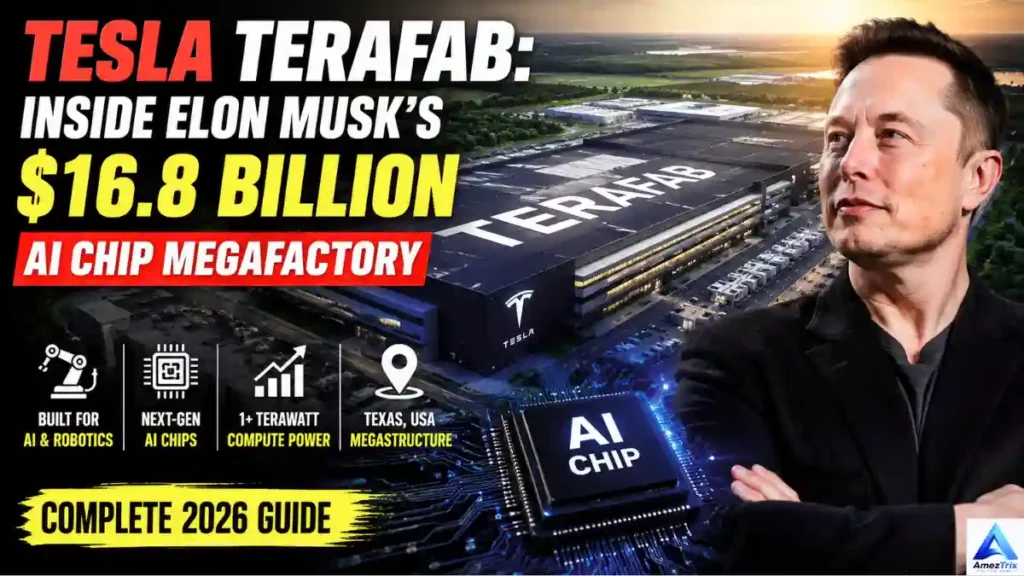
Quick answer: AI supercomputing uses thousands of linked GPUs and AI chips, fast networks, high-bandwidth memory and specialized software to train and run large AI models far faster than ordinary computers can.

What Is AI Supercomputing? A Simple Explanation
Every time you chat with ChatGPT, Gemini or Claude, a huge amount of hardware sits behind that single reply. People call it an AI supercomputer. Most articles on the topic either bury you in jargon or shrug it off as “a very fast computer.” Neither answer helps much.
This guide takes the middle road. You’ll see what AI supercomputing is, how it works, what it costs, and why it matters far beyond chatbots.
Key takeaways:
- It centers on GPUs and AI accelerators, not just CPUs.
- It splits one huge job across thousands of processors working in parallel.
- Networking, memory and cooling matter as much as raw chip power.
- Most small teams rent this power from the cloud instead of building it.
- It powers LLMs, generative AI, drug discovery, self-driving cars and climate science.
AI Supercomputing Meaning: How It Differs from Regular Computing
Think of it as traditional supercomputing with a new job description. The old ingredients are all still here: parallel processing, ultra-fast networking (the same push for speed behind 6G technology) and giant pools of memory. The difference is the target. Everything is tuned for training neural networks, running large language models and handling computer vision.
Here is an easy way to feel the gap. Your laptop copes with email, spreadsheets and video calls. Ask it to train a model with tens of billions of parameters, though, and the timeline stretches from days into years. An AI supercomputer closes that gap by wiring thousands of powerful processors together so closely that they act like one enormous machine.
This is the quiet engine behind generative AI, self-driving cars, drug discovery and climate modeling. These fields outgrew regular hardware long ago.
What Is an AI Supercomputer? Definition and Core Features
An AI supercomputer is a system designed from day one for machine learning at massive scale.
A normal computer leans on a CPU, which is great at switching between many different tasks. An AI supercomputer reverses that priority. It relies on GPUs and other AI accelerators, chips that fire off enormous numbers of simple calculations at the same moment. That suits neural networks perfectly, because training one is really just millions of matrix operations repeated again and again.
What’s inside a typical system?
- High-performance GPUs or purpose-built AI chips
- CPUs that coordinate the work
- Huge RAM and high-bandwidth memory
- Very fast internal networking
- Storage that keeps up with the accelerators
- Heavy-duty cooling
- Distributed computing software
- Frameworks tuned for the hardware
The goal is speed. Rather than one GPU grinding on a model for months, the job is sliced up and shared across hundreds or thousands of accelerators. Months shrink to weeks, and sometimes to days.
How do AI supercomputers work? 5 Steps Explained
The core idea is simple: break a giant job into small pieces and hand them to many processors at once, instead of making one processor work through everything in order.
Step 1: Collect and Prepare the Training Data
A model is only as good as its training data. Depending on the project, that could be text, images, video, audio, sensor logs, genomic data or financial records, sometimes at internet scale. Before training starts, this raw material must be cleaned, formatted and spread across the system. It isn’t glamorous, but skipping it ruins everything that follows.
Step 2: GPUs and AI Accelerators Do the Heavy Lifting
GPUs and specialized chips now do the heavy lifting. Deep learning runs mostly on matrix multiplication, which is exactly what GPUs were built for. CPUs can do the same math, just far more slowly.
Step 3: Split the Workload Across Thousands of GPUs
Instead of pushing a whole training run through one processor, the system spreads it out:
Raw Data → Preprocessing → Distributed Workload → Thousands of GPUs in Parallel → Combined Results
This step is what makes today’s largest models possible at all.
Step 4: Sync Every Processor with High-Speed Networking
Thousands of chips must constantly swap updated parameters, gradients and partial results. High-speed interconnects carry that traffic with almost no delay. There’s a catch, though: when the network is too slow, adding more GPUs stops helping. The machine ends up waiting on communication instead of computing.
Step 5: Software Orchestrates the Whole System
Nothing here runs by itself. Machine learning frameworks, distributed training libraries, job schedulers, container platforms and GPU-tuned compute libraries work out of sight to keep the whole operation stable.
AI Supercomputing vs Traditional Supercomputing: Key Differences
The two share plenty of DNA, but they were originally built for different jobs. Classic supercomputers grew out of scientific work such as weather forecasting, nuclear simulation, aerodynamics and physics. AI supercomputers grew around a narrower but fast-growing need: training and running machine learning models.
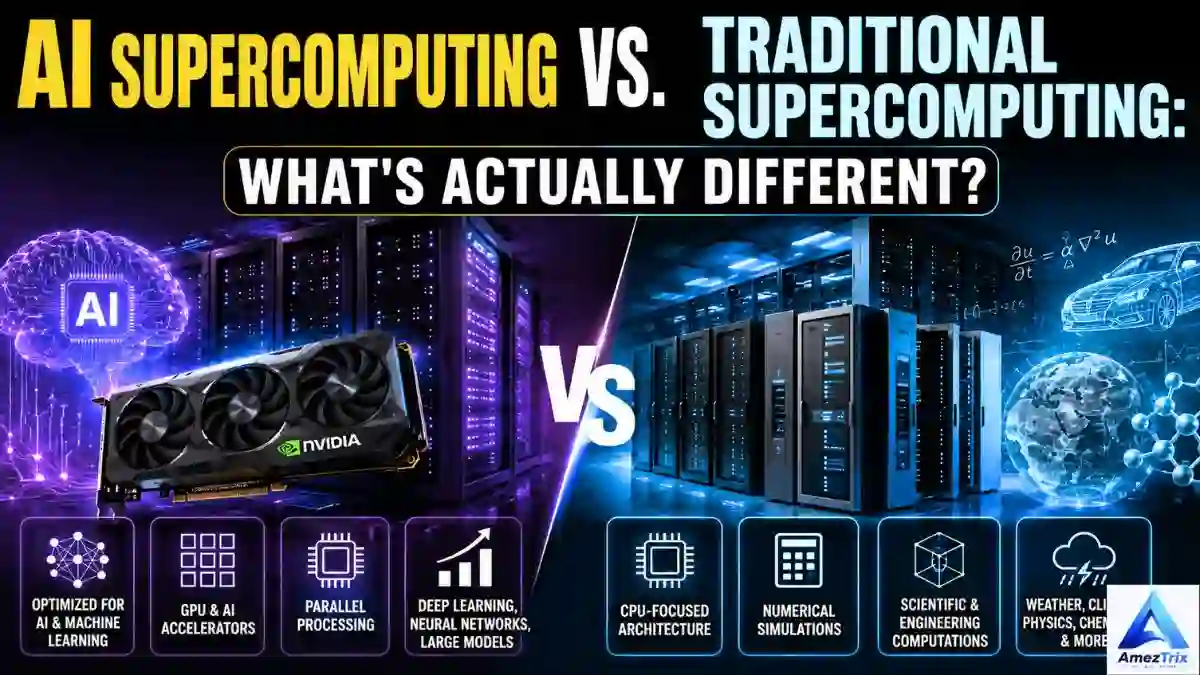
| Feature | Traditional Supercomputing | AI Supercomputing |
|---|---|---|
| Core workload | Scientific and numerical simulation | Machine learning and deep learning |
| Primary processors | CPUs, with growing GPU use | GPUs and AI accelerators, backed by CPUs |
| Core operations | Complex numerical simulation | Matrix and tensor math |
| Main goal | Scientific computation | Model training and inference |
| Memory demand | High | Extremely high |
| Networking needs | Fast | Extremely fast and low-latency |
| Software stack | HPC applications | AI frameworks plus HPC tooling |
| Common use cases | Physics, climate science, engineering | LLMs, generative AI, computer vision |
The boundary is fading every year. Flagship supercomputers now run AI workloads as a matter of routine, while AI clusters borrow techniques straight from the HPC playbook.
Why GPUs Power AI Supercomputing (GPU vs CPU)
Ask someone to picture AI supercomputing and a GPU usually comes to mind.
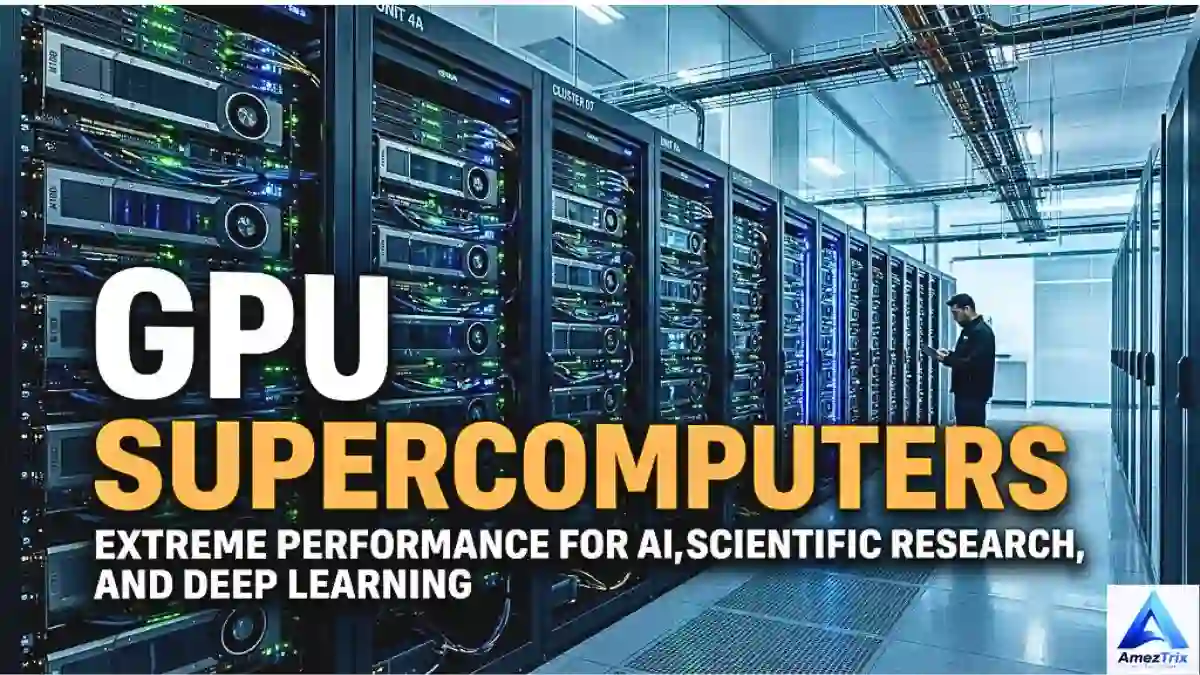
A CPU has a modest number of cores, each one flexible enough to handle almost anything. A GPU makes the opposite trade: many more cores, each simpler, all running together. AI workloads are basically oceans of repetitive parallel math, so that design fits like a glove.
GPUs earn their place in work like:
- Training deep neural networks
- Running large language models
- Generative AI systems, including AI agents and chatbots
- Computer vision and image recognition
- Speech and voice processing
- Recommendation engines
- Scientific machine learning
- Real-time AI inference
- Robotics and autonomous systems
- Code generation, which powers the best AI coding tools
GPUs are not the only option, however. Many systems also mix in tensor processing units, neural processing units and other custom AI silicon (see how the AI chip race between India and China is unfolding). The strongest AI supercomputers usually blend several processor types, choosing the right one for each task.
AI Supercomputer Components: What’s Inside?
Building one means stacking several layers of hardware and software and making them cooperate. Here is each layer at a glance:
| Component | What It Does | Why It Matters |
|---|---|---|
| GPUs and AI accelerators | Run tensor and matrix operations | They do most of the real computing |
| CPUs | Run the OS, prep data, schedule tasks | They coordinate everything the GPUs can’t |
| High-bandwidth memory | Feeds data to the accelerators | Slow memory leaves fast GPUs idle |
| High-speed networking | Links thousands of processors | Weak links stall the whole cluster |
| Storage | Delivers huge datasets quickly | Keeps expensive GPUs busy |
| Cooling | Removes heat from dense racks | Prevents throttling and failures |
| Software stack | Handles scheduling, security, monitoring | Turns loose hardware into one system |
Two of these deserve extra attention. Memory matters more than most people expect, because training pushes enormous amounts of data in and out constantly. Cooling becomes a genuine engineering problem at this density, which is why many modern AI data centers have moved to liquid cooling. Air alone can no longer keep up.
How AI Supercomputers Train Large Language Models (LLMs)
If you want one clear reason these machines exist, look at large language models.
Today’s LLMs carry anywhere from billions to well over a trillion parameters. Training one involves a long chain of steps:
- Collect massive text datasets
- Clean and filter them
- Tokenize the text
- Spread the data across many computing nodes
- Run trillions of calculations
- Update parameters continuously
- Repeat the cycle, then test and fine-tune the result
No single workstation can do this, not realistically and not even close. It takes thousands of accelerators pulling in the same direction.
Once these models are live, they also change how content gets found online. If you publish content, read how LLMO in SEO helps AI tools understand and cite your pages.
How AI Supercomputing Powers Generative AI Models
Generative AI is the other big force behind the rising demand. These systems create text, images, video, music, voice, code and even 3D content, and training them burns through huge datasets and serious compute.
AI supercomputing makes training these foundation models possible. It also keeps them running once millions of people start using them. As the best AI tools grow more capable, the computing demand behind them is unlikely to cool off. Brands that want to appear in these AI answers are already learning generative engine optimization.
AI Supercomputing Use Cases: Where It’s Used Today
This is not infrastructure for chatbot companies alone. It turns up in some surprising places.
| Industry | How It’s Used |
|---|---|
| Healthcare | Protein structure prediction, drug screening, medical imaging, genomic analysis |
| Climate science | Sharper forecasts and pattern detection in massive climate datasets |
| Self-driving cars | Training models on camera, radar, lidar and GPS data from countless driving scenarios |
| Robotics | Teaching machines to read surroundings, recognize objects and plan movement |
| Finance | Fraud detection, risk modeling, trading research, customer analytics |
| Science and research | Physics, chemistry, astronomy and materials science with datasets too large for older methods |
| Cybersecurity | Spotting unusual network behavior faster than manual monitoring |
| Semiconductors | Simulation and design work as chips grow more complex each generation |
Benefits of AI Supercomputing
Speed comes first. Thousands of processors working together finish training jobs in a fraction of the time a single system would need.
Bigger models come next. More compute lets researchers try architectures that simply weren’t practical before.
Large datasets stop being a bottleneck. What would choke a conventional system barely slows a well-built AI cluster.
Faster experiments follow. Teams can test more ideas in less time instead of waiting weeks between attempts, and that iteration speed often separates fast labs from slow ones.
Serving at scale rounds it out. Once a model is trained, the same infrastructure delivers it to millions of users at once, which keeps cloud AI products running smoothly under heavy load.
AI Supercomputing Challenges: Cost, Power and Heat
It isn’t all upside, and pretending otherwise would be dishonest.
- Cost: Accelerators, servers, networking, storage, electricity and cooling all add up. The upfront capital is serious.
- Power use: Large AI clusters draw enormous amounts of electricity, which is why energy efficiency has become a top industry concern.
- Heat: Dense hardware produces more heat than standard air cooling can reliably remove, pushing operators toward liquid cooling.
- Supply: Global demand for advanced AI chips regularly outpaces production, and that shortage isn’t ending soon.
- Complexity: Managing thousands of GPUs takes a different skill set than running normal servers, blending distributed systems, networking, data engineering and machine learning.
- Data quality: Even the best AI supercomputer can’t rescue messy, biased or incomplete data. “Garbage in, garbage out” still applies.
On-Premises vs Cloud AI Supercomputing: Which Is Better?
Most organizations choose between two paths.
| Factor | On-Premises | Cloud |
|---|---|---|
| Upfront cost | Very high | Low |
| Control | Full control and custom hardware | Limited by the provider |
| Scalability | Slow and expensive to expand | Scale up or down on demand |
| Data sovereignty | Strongest | Depends on region and provider |
| Maintenance | Your own team handles it | Handled by the provider |
| Risks | Idle hardware, long setup time | Ongoing usage bills, vendor lock-in, limited capacity during demand spikes |
For most startups and small teams, the cloud is the realistic starting point. Building a full AI supercomputer from scratch usually pays off only at a much larger scale.
You don’t even need a cluster to start experimenting. Tools like Google AI Studio let you build with powerful models in your browser, and our guide on how to build AI agents shows how to put cloud compute to work.
How Much Does an AI Supercomputer Cost?
There is no single number. Costs swing widely with scale, chip choice, memory, networking and cooling.
A modest cluster may cost a small fraction of a national-scale AI supercomputer. Once you include electricity, cooling, real estate, networking, staffing and security, the largest systems can climb into the hundreds of millions of dollars.
That’s why smart buyers look beyond the sticker price and track cost per AI workload, meaning what it actually costs to train or run a given model. It tells you far more than raw hardware spend.
How AI Supercomputing Is Changing Data Centers
Older data centers were designed around CPU-heavy, low-density workloads. AI is rewriting that blueprint.
Modern AI-focused facilities need dense GPU servers, much stronger power delivery, advanced cooling, high-performance storage and software built to orchestrate AI workloads. The whole industry is drifting toward higher power density, which makes energy efficiency and cooling two of the biggest design questions today.
AI Supercomputing vs Edge AI: How They Work Together
AI supercomputing usually means large, centralized systems. Edge AI does the reverse by pushing processing closer to the device or user.
They aren’t rivals. They work as a team:
AI Supercomputer Trains the Model → Deployed to Cloud or Enterprise Systems → Optimized Version Runs on Edge Devices → Real-Time Inference Happens Locally
A massive cluster trains the model. Then a smaller, compressed version runs directly on a phone, car, factory machine or robot, pairing heavy training muscle with fast, efficient inference right where it’s needed.
Future of AI Supercomputing: Trends to Watch
Several trends will likely shape the next few years:
- More specialized chips: Less reliance on general-purpose GPUs and more accelerators built for specific jobs.
- Efficiency over raw power: As models grow, performance per watt matters as much as speed.
- Better cooling: Liquid and other high-density methods will keep spreading as systems pack tighter.
- Bigger clusters: Labs and research institutions keep racing to support more ambitious models.
- Blurring lines: Future machines will handle AI and classic scientific workloads together.
- Growing edge AI: Smaller optimized models will run locally even as training clusters scale up.
- Smarter software: Better scheduling, distributed training, model compression and resource management will quietly lift efficiency.
Why AI Supercomputing Matters for the Future of AI
AI development has become something close to an infrastructure race. Algorithms matter, and so does data quality. Without the raw computing power to train and run models, though, neither gets very far.
AI supercomputing is the foundation under most of what makes headlines right now. Organizations with strong infrastructure move faster, run more experiments, handle larger datasets and deploy AI at a scale others can’t match.
As AI continues to work its way into healthcare, transportation, manufacturing, science, finance, cybersecurity and everyday business, this infrastructure will only grow in importance. It is also opening new income paths, from making money using AI to part-time AI jobs online.
AI Supercomputing FAQs
What is AI supercomputing in simple words?
It means using huge networks of connected GPUs, AI accelerators, memory and specialized software to train and run large AI models far faster than a regular computer could.
What is an AI supercomputer?
It’s a system built specifically for AI work, usually many GPUs or custom AI chips combined with fast networking, high-bandwidth memory and serious cooling.
Why do AI supercomputers use GPUs?
GPUs run enormous numbers of calculations in parallel, and that’s how neural networks learn: through endlessly repeated matrix operations over massive datasets.
How is an AI supercomputer different from a regular supercomputer?
Traditional supercomputers were built for broad scientific computing, while AI supercomputers are tuned for machine learning. The two overlap more every year.
Can an AI supercomputer train models like ChatGPT?
Yes. Large language models and other foundation models are trained on this type of large-scale AI infrastructure, with the exact setup depending on model size and workload.
Is an AI supercomputer expensive to build and run?
It varies a lot. Smaller clusters cost far less, while national-scale systems can reach hundreds of millions of dollars once hardware, power, cooling and facilities are counted.
How much electricity does an AI supercomputer use?
Quite a lot. Thousands of accelerators running together draw serious power, which is why energy efficiency now drives AI infrastructure design.
Do small businesses need an AI supercomputer?
Rarely. Cloud-based AI infrastructure gives smaller companies powerful GPUs without the cost and effort of building and maintaining hardware.
What is the difference between AI computing and AI supercomputing?
AI computing is the broad umbrella for any computing used for AI. AI supercomputing refers to large-scale, high-performance systems built for the heaviest jobs, such as training foundation models.
Conclusion: Why AI Supercomputing Is Shaping the Future of AI
AI supercomputing is the next chapter of high-performance computing, rebuilt around what modern AI demands. Powerful accelerators, fast memory, quick networking, capable storage and purpose-built software all work together to train and run models that would otherwise be out of reach.
Its importance keeps rising because AI models keep growing and keep demanding more compute. From large language models and generative AI to drug discovery, self-driving cars and climate research, this infrastructure does much of the quiet heavy lifting behind what the headlines call “AI progress.”
Algorithms alone won’t decide where AI goes next. Computing power, energy efficiency, hardware design and infrastructure will matter just as much. Understanding AI supercomputing is no longer a niche technical detail. It’s one of the fastest ways to see where the whole field is headed.
About Author
Rajendra Parmar is the Founder and Editor of AmezTrix, where he covers Artificial Intelligence, Technology, WordPress, Web Hosting, Digital Marketing, Gadgets and Software. His mission is to simplify complex technology through practical tutorials, honest reviews and well-researched guides that help readers make smarter digital decisions.

Rajendra Parmar
Founder & Editor • AmezTrix
Rajendra Parmar is the Founder and Editor of AmezTrix, a platform covering Artificial Intelligence, Technology, WordPress, Web Hosting, Digital Marketing, Gadgets, Software Reviews, and emerging innovations. His mission is to simplify complex technology through practical tutorials, honest reviews, and well-researched guides that help readers make smarter digital decisions.