Quick answer: The Tesla flying car is the next-generation Roadster, unveiled on 15 October 2026 with SpaceX cold-gas thrusters. Only the invite-only, single-seat Rocket version is built for aerial manoeuvres. Tesla targets 2028 production, but has announced no final price, and the Rocket is not approved for public roads.
Tesla Flying Car: Roadster Price, Features, India Booking and 2028 Launch Date
Tesla Flying Car Roadster explained: Performance, Thrust and Rocket versions, reservation prices, India booking, 2028 production and safety limits.
That is the short version. The longer version is more interesting, because the Tesla flying car is both a genuine engineering demonstration and a long way from the flying taxi many headlines imply. This guide separates what Tesla showed, what it has promised, and what nobody can confirm yet.
We reviewed Tesla’s reservation listings and coverage from Reuters, CBC, The Next Web, Autocar India and others. Where reports disagree, we say so. Always check Tesla’s official Roadster page before paying anything.
Tesla Flying Car at a Glance: Price, Date and Key Facts
| Item | What is reported |
|---|---|
| Vehicle | Second-generation Tesla Roadster |
| Unveiled | 15 October 2026, at a SpaceX site in McGregor, Texas |
| Flight technology | Cold-gas thrusters developed with SpaceX |
| Versions | Performance, Thrust, Rocket |
| Only version built to “fly” | Rocket (single seat, invite-only) |
| Production target | 2028 |
| Final price | Not announced |
| Reservation payments (US) | $50,000 (Performance), $250,000 (Thrust) |
| Public road approval for Rocket | No, according to Tesla |
What Is the Tesla Flying Car, and Can It Really Fly?
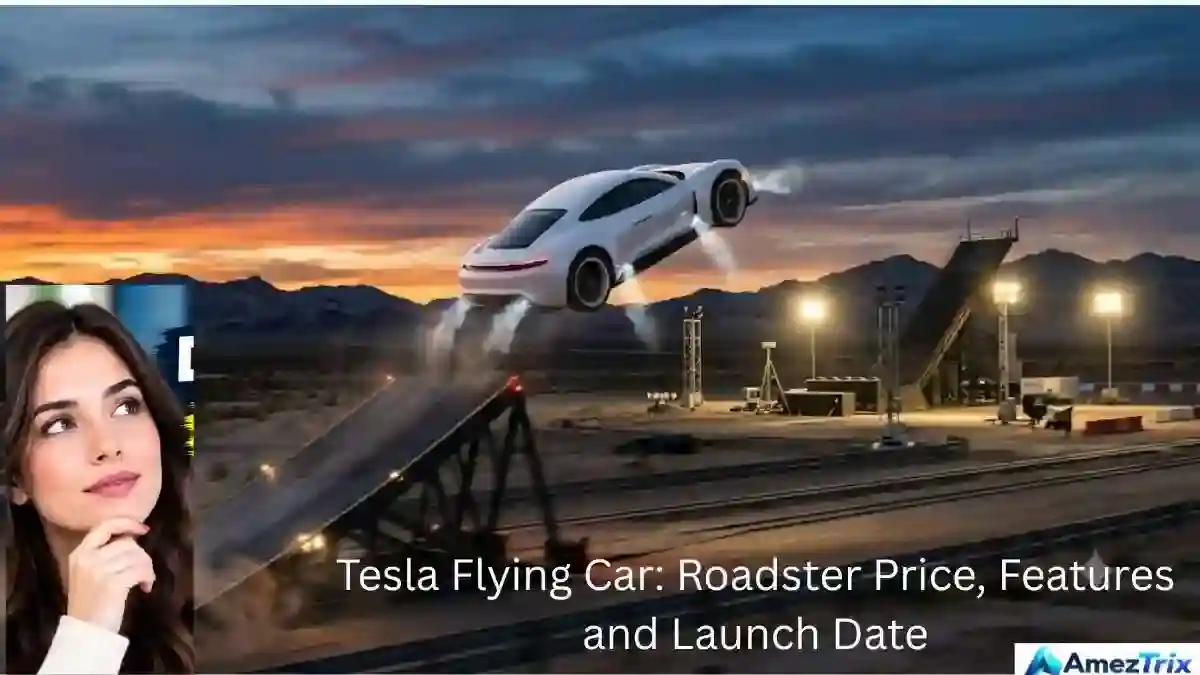
“Tesla flying car” is shorthand for the redesigned Roadster and its thruster options. The base car is a two-seat electric sports car. The flying ability comes from compressed-gas thrusters, built with SpaceX engineers, that push the car off the ground, rotate it and help it land.
It is not an aircraft in the usual sense. It does not have wings, rotors or a flight envelope like a helicopter. What Tesla showed was a controlled jump with rotation, not a commute above traffic.
People use “flying car” for several different things, so it helps to separate them:
- Thruster-assisted sports car: a road car that can make short airborne moves. This is the Tesla Roadster.
- eVTOL aircraft: an electric aircraft that takes off and lands vertically, built for air-taxi services.
- Roadable aircraft: an aircraft that can also be driven, with aviation certification.
What Did Tesla Show at the Roadster Unveiling?
According to Reuters coverage, a white two-seat Roadster drove upside down on a ramp using a suction system, turned in the air and landed using built-in thrusters. Later it jumped over a truck and other vehicles while twisting in mid-air.
Elon Musk said on stage, “Flying cars are real.” He also posted a clip with the line “Turns out the future does have flying cars.”
One detail matters a great deal. Gulf News reported that Tesla said the demo car was operated remotely with no one inside, and that the stunt version will not be street legal. Treat the demo as proof of a concept under controlled conditions. It is not proof that an ordinary owner can do the same.
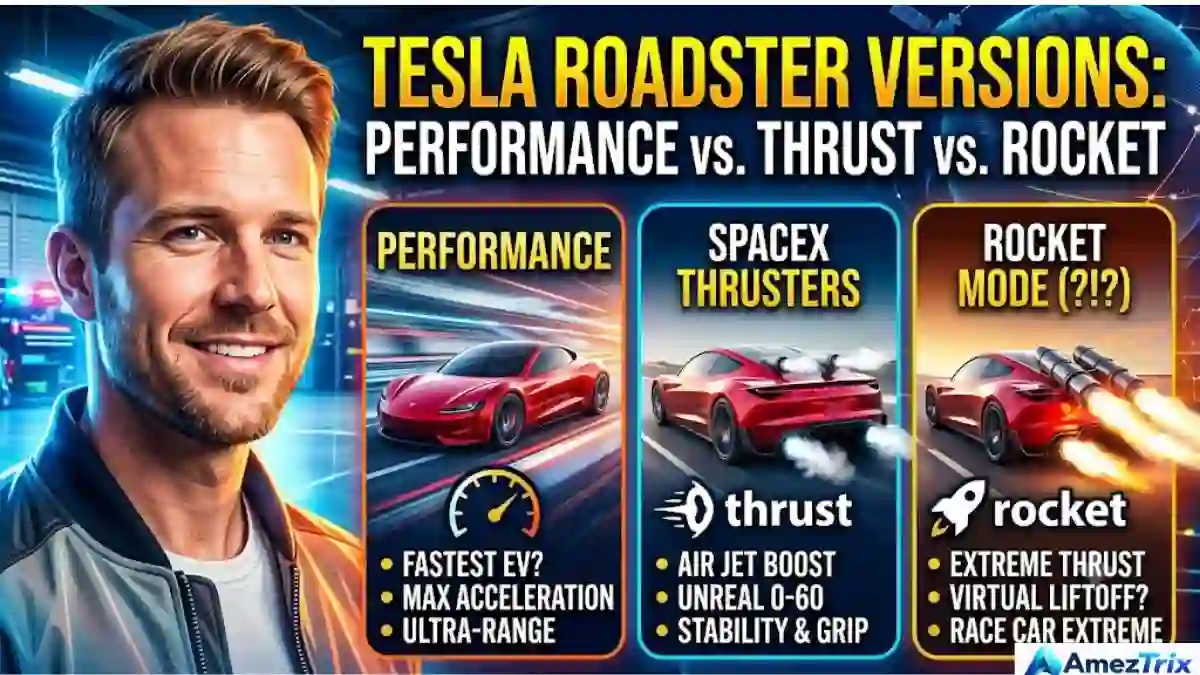
Tesla Roadster Versions Compared: Performance vs Thrust vs Rocket
Tesla’s Roadster page lists three versions. The table below summarises what has been reported. Performance figures come from Tesla’s listings as reported by The Next Web and Electrek, so they are company claims, not independent tests.
| Version | Seats | Flight capability | Reported performance | Access |
|---|---|---|---|---|
| Performance | Two | None. Described as the road-ready version with active aerodynamics and a multi-mode suction system | Under 1.6 seconds to 97 km/h (60 mph), as listed | Open for reservation |
| Thrust | Two | Adds rear acceleration thrusters. Not described as a flight version | Under 1 second to 97 km/h (60 mph), per Tesla’s page | Limited release, reservation open |
| Rocket | One | Perimeter thrusters and a “full flight system” | Under 0.59 seconds to 60 mph and over 370 km/h (230 mph), as listed | Invitation only |
Musk also claimed a 0.81-second sprint to 100 km/h in the demonstration. Because these numbers come from Tesla and Musk, wait for independent testing before treating them as fact.
How Do Tesla’s Cold-Gas Thrusters Work?
Cold-gas thrusters
A cold-gas thruster stores gas under high pressure and releases it through a nozzle. The escaping gas pushes the car in the opposite direction. There is no combustion, which is why Tesla and SpaceX describe the system as cold gas rather than a rocket engine in the traditional sense. Headlines still call it rocket-powered, and the Rocket name is Tesla’s own.
Suction system
Tesla says the Performance car has an underbody fan that pulls air from beneath the vehicle. Autocar India reports it can generate around 2G of grip. This is what let the demo car stay stuck to a ramp while upside down.
Electric drive
Normal driving is still electric. The thrusters are an add-on system, not a replacement for the motors. A Tesla you already own will not gain a flying mode through a software update.
Why a jump is not flight
A jump with a flip is brief and uses a limited gas supply. Sustained flight needs lift, stable control, enough energy and a safe way to land after a failure. Nothing shown on 15 October demonstrated that.
Tesla Flying Car Price: Reservation Cost vs Final Price
Tesla has not announced a purchase price for any version. Executives gave no target prices at the event. In 2017, Tesla quoted a base price of $200,000 for the Roadster, but that figure is nearly a decade old and should not be used as a forecast.
What exists today is a reservation structure. After the event, Tesla’s reservation page showed a $50,000 payment for Performance and a $250,000 payment for Thrust, as reported by CBC and Reuters. Rocket is listed as invite-only.
| Version | Reservation amount reported | Final price |
|---|---|---|
| Performance | $50,000 | Unannounced |
| Thrust | $250,000 | Unannounced |
| Rocket | No public payment schedule found | Unannounced |
A reservation payment is not a purchase price, and it does not guarantee a delivery date. Check the refund terms in writing before you pay.
Tesla Flying Car Launch Date: Will 2028 Production Happen?
Tesla says production starts in 2028. That is a company target, not a delivery promise. The Roadster’s history is the best reason for caution.
| Year | Milestone |
|---|---|
| 2008 | Original Tesla Roadster reaches customers |
| 2012 | Original Roadster discontinued |
| 2017 | Next-generation Roadster shown; $200,000 base price and 2020 deliveries promised |
| 2020 to 2024 | Several delivery targets missed |
| 15 October 2026 | Thruster-equipped Roadster unveiled |
| 2028 | Production target announced |
The 2028 date is eight years after the original 2020 promise. Tesla also has not confirmed that every demonstrated feature will reach production cars. Treat 2028 as a target, not a booking confirmation.
Tesla Flying Car in India: Booking Amount, Price and Availability
Indian readers have the most confusing picture, because reports mix reservation amounts with prices.
According to NewsBytes, Tesla’s India website lists a reservation amount of ₹5,01,000, with the remaining payment due within 10 days. The listing reportedly shows ₹50,06,000 for Performance and ₹2,50,25,000 for Thrust. Autocar India also reports that bookings for Performance and Thrust are open at ₹5 lakh, with Rocket invite-only.
These figures mirror the US reservation payments of $50,000 and $250,000. They should be read as reservation amounts, not final on-road prices. Autocar India shows an expected price of ₹1.25 to 1.30 crore, but that is the publication’s own estimate and not a Tesla announcement.
| Question | Status as of 20 October 2026 |
|---|---|
| Are reservations open in India? | Reported yes, for Performance and Thrust |
| Initial payment | Reported ₹5,01,000 |
| Final Indian price | Not confirmed |
| Indian delivery date | Not confirmed |
| Rocket (flying) version in India | Invite-only; no public route |
| Legal for Indian roads or airspace | Not established |
Import duties, homologation, taxes and any aviation approvals could all affect cost and legality. Do not assume a thruster-equipped car can be driven or flown legally in any country until a regulator says so.
Tesla Flying Car vs eVTOL Air Taxi: Key Differences
| Feature | Tesla Roadster (Rocket) | eVTOL air taxi |
|---|---|---|
| Main purpose | Extreme sports car | Passenger air transport |
| Flight | Short thruster-assisted jumps | Sustained powered flight |
| Seats | One (Rocket) | Typically several |
| Road driving | Core purpose, but not approved for Rocket | Generally not designed for roads |
| Regulation | Unclear for thruster use | Aviation certification |
An eVTOL is built to carry people through the air. The Roadster is built to astonish people on a track. Comparing them directly is like comparing a stunt car with a helicopter.
Tesla Flying Car Pros and Cons
Potential advantages
- A genuinely new mix of electric-car and aerospace engineering.
- Claimed acceleration far beyond conventional road cars.
- A strong halo car that could influence future Tesla technology.
- A multi-mode suction system that could improve grip.
Limitations and risks
- No final price and no confirmed delivery schedule.
- The Rocket version is not approved for public roads.
- Pressurised gas systems add new failure modes.
- The demo car was reportedly unmanned, so passenger safety is unproven.
- A history of missed Roadster deadlines.
- Tesla has not said all demonstrated features will reach production.
Is the Tesla Flying Car Safe and Legal?
Safety has not been established. A remote-controlled stunt in a controlled environment says little about a driver or passenger in ordinary conditions. A production vehicle would need answers on several fronts:
- Pressure systems: inspection, failure detection and containment.
- Control: stability when thrust is applied or when the car leaves the ground.
- Emergency behaviour: what happens if thrusters fail mid-air.
- Occupant protection: restraints and crash performance in every mode.
- Regulation: which authority certifies a car that jumps and flips.
Should You Reserve the Tesla Roadster? Buyer’s Checklist
- Confirm which version the reservation covers. Only Rocket is a flight version, and it is invite-only.
- Read the refund terms before paying.
- Ask what the payment covers, because it is not the purchase price.
- Note that 2028 is a production target, not a delivery date.
- Check local rules on road use, import duty and registration.
- Pay only through Tesla’s official website.
Common Mistakes and Red Flags Before You Pay
Common mistakes
- Assuming every Roadster can fly. Only the Rocket version is built for it.
- Treating the reservation amount as the final price.
- Expecting 2028 deliveries with certainty.
- Believing viral clips without checking what was actually demonstrated.
Red flags
- Anyone selling a “guaranteed” early delivery slot.
- Payment requests outside Tesla’s official channels.
- Claims of a confirmed Indian retail price that Tesla has not published.
- Specs presented as certified when they are company claims.
Will Flying Cars Replace Normal Cars?
The Roadster is best read as an engineering showcase. It will not replace commuter cars, and it does not solve traffic. Its value is more likely to be in the technology it develops, such as suction-based grip and gas thrusters for high-performance cars.
Practical flying transport is more likely to come from eVTOL aircraft on specific routes, subject to aviation approval. The Tesla flying car sits in a different, much narrower niche.
Key Takeaways
- The Tesla flying car is the second-generation Roadster with SpaceX cold-gas thrusters.
- Only the invite-only, single-seat Rocket version is built for aerial manoeuvres.
- Production is targeted for 2028, after years of missed deadlines.
- No final price exists. Reported reservation amounts are $50,000 and $250,000.
- India reservations are reportedly open, but price and delivery are unconfirmed.
- The Rocket version is not approved for public road use.
Frequently Asked Questions About the Tesla Flying Car
Is the Tesla flying car real?
Tesla demonstrated a thruster-equipped Roadster on 15 October 2026 that jumped, flipped and landed. Only the invite-only Rocket version is built for aerial manoeuvres, and the demo car was reportedly operated remotely. It is not a conventional aircraft or a flying taxi.
When will the Tesla flying car launch?
Tesla says production begins in 2028. It has not published delivery dates, and earlier Roadster targets were missed, so treat 2028 as a target rather than a promise.
What is the Tesla flying car price?
No final price has been announced. Tesla’s reservation page lists $50,000 for Performance and $250,000 for Thrust. Rocket is invite-only with no public payment schedule.
Can you book the Tesla flying car in India?
Reports say Tesla’s India site accepts reservations for Performance and Thrust, with an initial payment of ₹5,01,000. Rocket is invite-only. A final Indian price and delivery date are not confirmed.
Can the Tesla flying car really fly?
The Rocket version uses cold-gas thrusters to jump, rotate and land. That is short thruster-assisted movement, not sustained aircraft-style flight.
Is the Tesla flying car fully electric?
The Roadster is an electric sports car. Its thrusters use stored compressed gas rather than battery-powered motors, so the airborne system is not purely electric.
Is the Tesla flying car legal on public roads?
Tesla says the Rocket version is not approved for public road use. The Performance version is described as road-ready, but final approvals depend on each country.
How is the Tesla flying car different from an eVTOL?
The Roadster is a sports car with thruster-assisted jumps. An eVTOL is an aircraft designed for sustained vertical take-off, flight and landing, and it follows aviation certification rules.
Final Verdict: Is the Tesla Flying Car Worth the Hype?
The hype is partly deserved. Tesla did show a car that jumped, flipped and landed, which is a real technical achievement. It is not yet a product you can buy, price, insure or legally fly.
For technology fans, it is worth following. For buyers, it is worth caution. Wait for a final price, written refund terms, independent testing and clear regulatory status before committing money. Our verdict is that the Tesla flying car is a promising showpiece, and a safe purchase decision will only be possible once those missing details arrive.
About the Author
Rajendra Parmar is the Founder and Editor of AmezTrix, where he covers Artificial Intelligence, Technology, WordPress, Web Hosting, Digital Marketing, Gadgets, and Software. His mission is to simplify complex technology through practical tutorials, honest reviews, and well-researched guides that help readers make smarter digital decisions. You can also explore more new Google AI tools on the site.

Rajendra Parmar
Founder & Editor • AmezTrix
Rajendra Parmar is the Founder and Editor of AmezTrix, a platform covering Artificial Intelligence, Technology, WordPress, Web Hosting, Digital Marketing, Gadgets, Software Reviews, and emerging innovations. His mission is to simplify complex technology through practical tutorials, honest reviews, and well-researched guides that help readers make smarter digital decisions.