MG Hector Tomahawk vs Mahindra XEV 9S: both are seven-seat electric SUVs priced at roughly ₹20 lakh (ex-showroom), yet they take very different routes to win your money. Here is the complete 2026 comparison of price, range, battery, charging, performance, features and safety.
Last updated: 29 September 2026. Prices and specifications are manufacturer claims and can change, so confirm final figures with your local dealer.
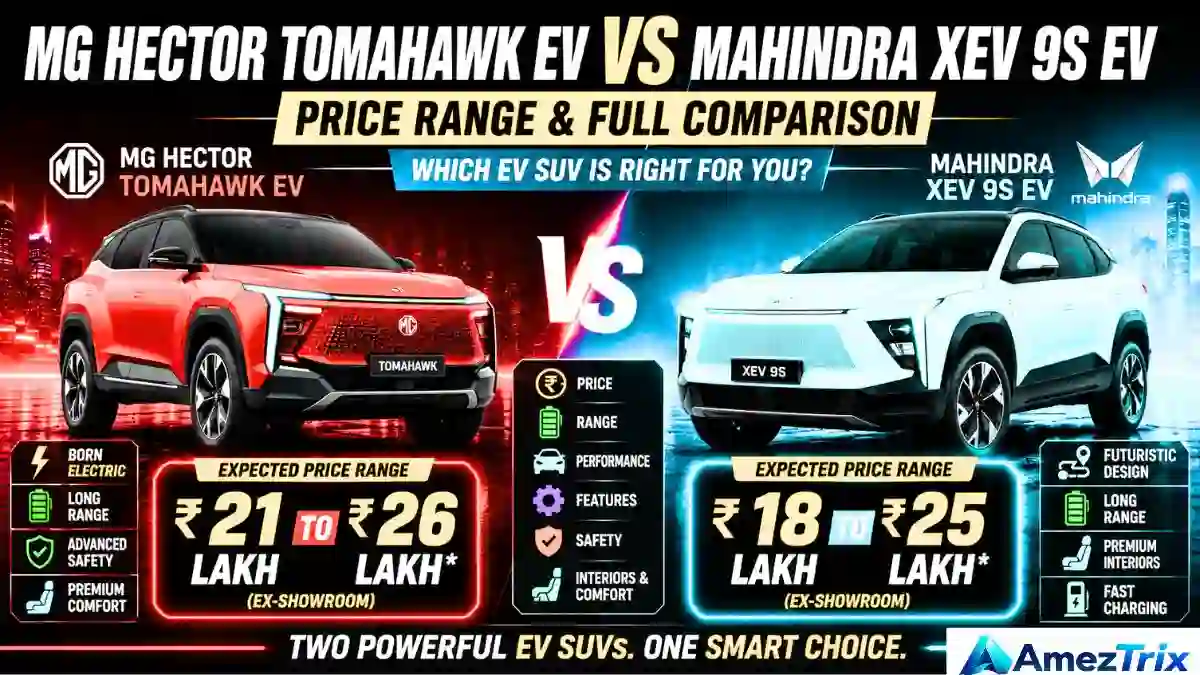
Quick Answer: Which Is Better, Hector Tomahawk or XEV 9S?
The Mahindra XEV 9S is the better car on paper. It offers up to 679 km of claimed range, 180 kW DC fast charging, 380 Nm of torque and a richer feature list. The MG Hector Tomahawk EV is the better value buy, thanks to a lower starting price (₹19.49 lakh), a Battery-as-a-Service option that drops the price to about ₹13.99 lakh, and a choice of 5-seat or 7-seat layouts.
Key Takeaways
- Price: Hector Tomahawk starts at ₹19.49 lakh; XEV 9S starts at ₹19.95 lakh.
- Range: XEV 9S goes up to 679 km; Hector Tomahawk manages up to 517 km.
- Charging: XEV 9S supports up to 180 kW; Hector Tomahawk tops out at 90 kW.
- Flexibility: Only the Hector Tomahawk offers BaaS, a 5-seat layout and a PHEV sibling.
MG Hector Tomahawk vs Mahindra XEV 9S: Specs Comparison Table
Start with the numbers. This table puts both electric SUVs side by side on the specifications buyers ask about most.
| Specification | MG Hector Tomahawk EV | Mahindra XEV 9S |
|---|---|---|
| Body style | Electric SUV | Electric SUV |
| Starting price (ex-showroom) | ₹19.49 lakh | ₹19.95 lakh |
| Battery options | 69.2 kWh | 59 / 70 / 79 kWh |
| Claimed range | Up to 517 km | Up to 679 km |
| Motor layout | Single motor | Rear-mounted motor |
| Peak power | Up to 201 hp (about 148 kW) | Up to 210 kW (about 282 hp) |
| Peak torque | 310 Nm | 380 Nm |
| Fastest DC charging | 90 kW | Up to 180 kW |
| Seating | 5 or 7 seats | 7 seats |
| Platform | MG ADAPT | Mahindra INGLO |
| ADAS | Level 2 | Level 2+ (top trims) |
| Display | 15.6-inch single screen | Triple-screen setup |
Only about ₹46,000 separates the two base prices. That gap looks tiny, but it widens quickly as you climb the variant ladder, both in what you pay and in what you get.
MG Hector Tomahawk EV: Price, Battery and BaaS Explained
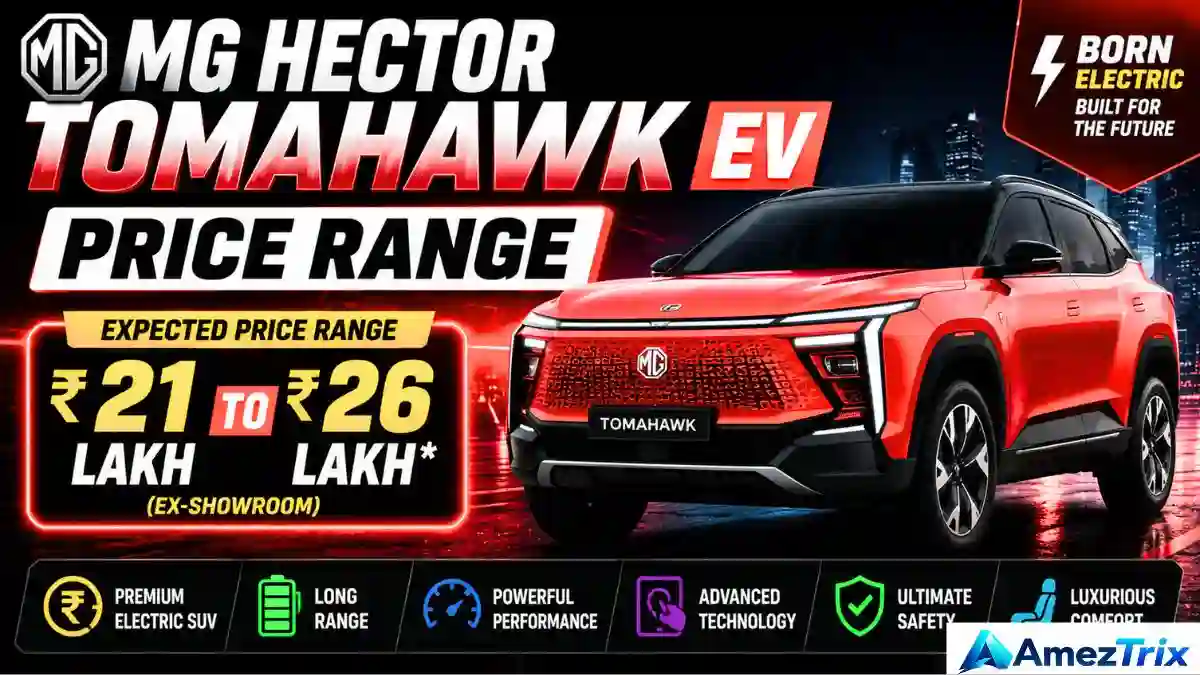
MG did not try to reinvent the wheel. The Hector Tomahawk takes a large, familiar SUV shape and electrifies it properly. It uses a single 69.2 kWh battery, which MG markets under the “MAGIC” battery banner and monitors through an onboard management system. The company says the pack has been through extensive crash and heat testing, which is exactly what you want to hear about a battery sitting under a family car.
The interesting part is the pricing model. MG also offers Battery-as-a-Service (BaaS), where you skip buying the battery and pay for it per kilometre instead. Choose that route and the car costs about ₹13.99 lakh, with a running charge of roughly ₹4.90 per km. Buy the battery outright and the price is ₹19.49 lakh. For anyone stretching a budget, that is a big difference, and it is rare in this segment.
If you are still working out what an electric car costs in India, this flexibility makes the Hector Tomahawk one of the most approachable large EVs on sale.
Mahindra XEV 9S: A Ground-Up Electric SUV
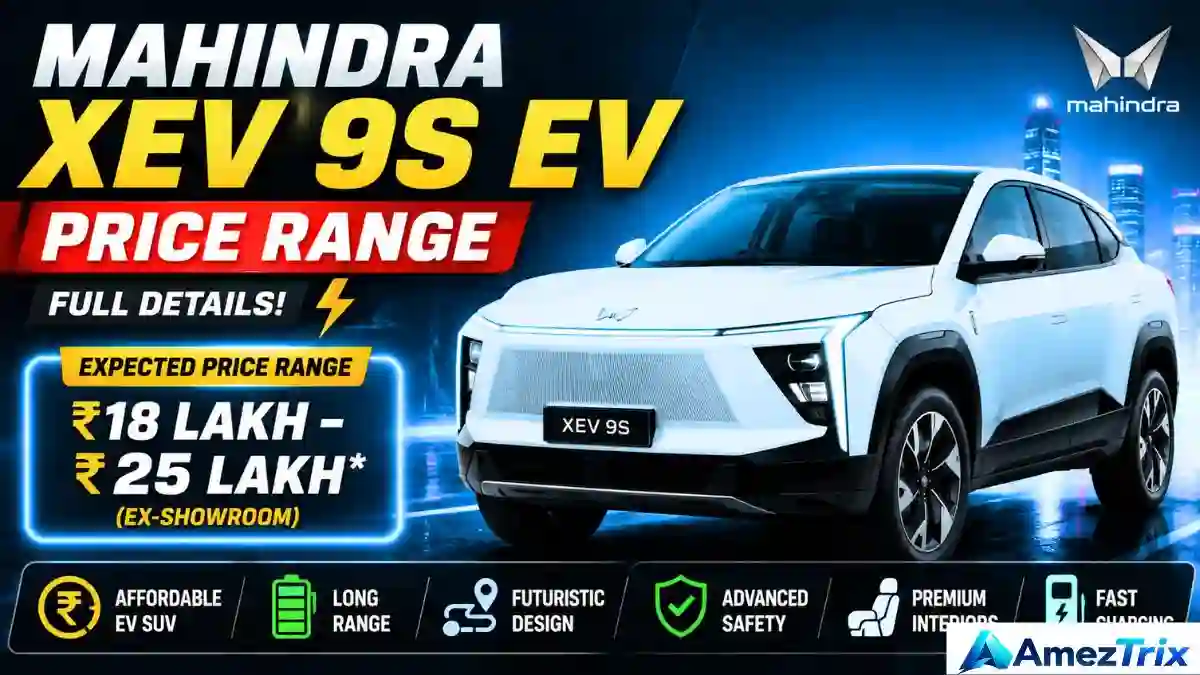
The XEV 9S goes the opposite way. Instead of adapting an existing body, Mahindra built it from scratch on the INGLO platform, essentially a dedicated EV skateboard rather than a petrol chassis in disguise. That matters more than it sounds, because it frees up cabin space and allows more flexible battery packaging.
There are three battery choices: 59 kWh, 70 kWh and 79 kWh. That is a smart call. City drivers can save money with the smallest pack, while families who take regular intercity trips can pick the 79 kWh version and its claimed 679 km range.
The tech list is long: Level 2+ driver assistance, multiple radar sensors, a triple-screen dashboard, Harman Kardon audio, an AR head-up display and automated parking. Prices start at ₹19.95 lakh and rise to about ₹29.45 lakh for the fully loaded 79 kWh model.
Price Comparison: Which Costs Less?
| Price Point | MG Hector Tomahawk EV | Mahindra XEV 9S |
|---|---|---|
| Starting price (ex-showroom) | ₹19.49 lakh | ₹19.95 lakh |
| Lowest possible price | About ₹13.99 lakh with BaaS | No rental option |
| Top-end price | Varies by variant | About ₹29.45 lakh (79 kWh) |
| Battery cost | Included, or ₹4.90/km under BaaS | Included in price |
On paper MG wins. A gap of ₹46,000 is modest, but every rupee counts, and BaaS pulls MG well ahead for anyone happy to pay per kilometre. Do not stop at the sticker price, though. The 59 kWh XEV 9S sits close to the Hector Tomahawk in cost and still beats its range, so the gap narrows fast when you compare similarly priced variants.
Winner: MG Hector Tomahawk, mainly for the BaaS flexibility.
Range Comparison: Where the XEV 9S Pulls Ahead
The Hector Tomahawk’s 69.2 kWh pack is rated at 517 km, a solid figure. Mahindra’s line-up goes further:
| Model and Battery | Claimed Range |
|---|---|
| MG Hector Tomahawk (69.2 kWh) | Up to 517 km |
| Mahindra XEV 9S (59 kWh) | Up to 521 km |
| Mahindra XEV 9S (70 kWh) | Up to 600 km |
| Mahindra XEV 9S (79 kWh) | Up to 679 km |
Even the smallest XEV 9S beats the Hector Tomahawk while carrying a smaller battery, and the top version leads by more than 160 km. A quick reality check: certified range is rarely what you see in real traffic, especially with the AC running through an Indian summer. Use these figures to compare cars against each other, not as a promise for your daily drive.
Winner: Mahindra XEV 9S.
Do You Really Need the Biggest Battery?
Probably not, unless you cover serious highway distance every month. A larger battery adds weight and cost, with diminishing returns if you drive 40 to 50 km a day inside the city. First-time EV buyers often chase the biggest number on the spec sheet and then pay for range they never use. For city-focused driving, the 59 kWh XEV 9S or the Hector Tomahawk’s 69.2 kWh pack should be plenty.
Performance: Power and Torque
The XEV 9S is quicker. MG’s motor makes up to 201 hp and 310 Nm, while Mahindra’s output ranges from 170 kW to 210 kW depending on the battery, with torque holding at 380 Nm across the range.
That matters in a family SUV. A seven-seater loaded with passengers and luggage is heavy, and the extra torque makes highway overtaking far less stressful.
Winner: Mahindra XEV 9S, especially the higher-powered variants.
Charging Speed and Time
| Charging Detail | MG Hector Tomahawk EV | Mahindra XEV 9S |
|---|---|---|
| Max DC fast charging | 90 kW | Up to 180 kW (79 kWh), 140 kW (59 kWh) |
| Claimed fast-charge time | 30 to 80% in about 35 minutes | 20 to 80% in about 20 minutes (79 kWh) |
| Home charger | 7.4 kW charger bundled | Check with dealer |
The XEV 9S is well ahead here, though real charging speed always depends on the charger you find, not only on what the car can accept.
Winner: Mahindra XEV 9S.
Design: Two Different Personalities
The Hector Tomahawk looks like a proper large SUV, with a bold front, sharp LED lighting and reassuring three-row bulk. Nothing about it screams “electric”, which some buyers actively prefer.
The XEV 9S feels like it belongs to a newer era. It has aerodynamic surfaces, a distinctive light signature and a cabin designed around the battery layout rather than borrowed from a petrol model. Design is personal, so see both in person before deciding. Photos rarely do either justice.
Space and Seating: Flexibility vs Commitment
Here is something the Hector Tomahawk offers that the XEV 9S cannot: both 5-seat and 7-seat layouts. If your family rarely needs the third row, the 5-seater gives you extra boot space every day.
The XEV 9S is seven seats only. Because it sits on a dedicated EV platform, Mahindra has managed usable room across all three rows, and higher trims add the premium triple-screen dashboard.
Winner: It depends on your family. Want flexibility? Choose MG. Fill all seven seats regularly? Choose the XEV 9S.
Features: Hector Tomahawk vs XEV 9S
| Feature | MG Hector Tomahawk EV | Mahindra XEV 9S |
|---|---|---|
| Main display | 15.6-inch touchscreen | Triple-screen cockpit |
| Sunroof | Panoramic sunroof | Panoramic sky roof |
| Audio | Standard system | Harman Kardon with Dolby Atmos |
| Driver assistance | Level 2 ADAS | Level 2+ ADAS with lane-change assist |
| Parking tech | 360-degree camera | AutoPark self-parking |
| Wireless charging | Wireless charging pad | Dual wireless charging pads |
| Connected features | i-SMART, voice assistant | Video calling, drive recording |
| Processor | Not specified | Snapdragon 8295, 24 GB RAM, 128 GB storage |
| Extras | Vehicle-to-home power output | AR head-up display, ventilated second-row seats |
The XEV 9S clearly has the richer feature list, especially near the top of the range. A lot of that tech is limited to pricier trims, so never assume the base model gets everything.
Safety: What Protects You
Both SUVs take safety seriously, but the XEV 9S goes a step further on top trims. MG offers multiple airbags, stability control, a 360-degree camera and Level 2 ADAS depending on the variant. Mahindra adds Level 2+ ADAS with several radar sensors, lane-centering, emergency steering support and cross-traffic alerts on higher models, and some versions include seven airbags with a driver knee airbag.
Always check what is standard on the exact variant you plan to buy. Brochures love to show top-spec features, and it is easy to assume they come with every trim.
Winner: Mahindra XEV 9S on paper, but confirm variant details before you sign.
Technology and Software
MG plays to its strengths with a connected ecosystem, decent voice control and an interface that does not overwhelm. Mahindra throws serious computing power at the problem. A Snapdragon 8295 chip with 24 GB of RAM sounds excessive in a car, but it puts the XEV 9S closer to what people mean by a “software-defined vehicle”. You can read more about where this is heading in our guide to the latest EV technology.
Winner: Mahindra XEV 9S, if cutting-edge cabin tech excites you.
Highway Trips vs City Driving
| Use Case | Better Pick | Why |
|---|---|---|
| Long highway trips | Mahindra XEV 9S | Longer range and much faster charging mean fewer, shorter stops |
| Daily city commute (under 50 km) | MG Hector Tomahawk | Lower entry price and BaaS; range matters less with home charging |
| Mixed use with occasional long trips | Mahindra XEV 9S (59 or 70 kWh) | Good range without paying for the biggest battery |
Running Costs and Ownership
EVs are generally cheaper to run than petrol cars, but the exact saving depends on your charging habits and local electricity rates.
MG’s BaaS lowers what you pay on day one but adds a per-kilometre cost for as long as you use the car. That suits low-mileage owners and gets expensive fast for high-mileage ones, so run the numbers first. At ₹4.90 per km, 1,000 km a month means ₹4,900 for the battery alone.
The XEV 9S keeps things simple. The battery is included in the price, with no battery rental attached later. Some buyers simply prefer that predictability.
MG’s Extra Card: The Hector Tomahawk PHEV
MG also sells a plug-in hybrid version of the Hector Tomahawk. It claims over 115 km of pure-electric driving and a combined range beyond 1,100 km once the petrol engine joins in. If you want EV driving most days but occasionally travel where charging is patchy, that is a useful safety net. The XEV 9S is electric-only. For a wider view of what else is on sale, see our list of the top 10 electric cars in the world.
Pros and Cons
| Car | Pros | Cons |
|---|---|---|
| MG Hector Tomahawk EV | Lower starting price, BaaS option, decent 69.2 kWh battery, 5 or 7 seats, PHEV alternative | Shorter range, less power than top XEV 9S trims, slower charging, BaaS adds ongoing cost, some features limited to higher variants |
| Mahindra XEV 9S | Dedicated EV platform, three battery sizes, longer range, stronger performance, faster charging, richer tech and ADAS | Higher overall price, top trims get expensive, several features locked to upper variants, biggest battery may be more than city drivers need |
Which One Should You Buy?
Choose the MG Hector Tomahawk EV if you:
- Want a big electric SUV without a big upfront bill
- Like the idea of Battery-as-a-Service
- Drive mostly in the city
- Need the option of 5 or 7 seats
- Want a PHEV backup on the same model line
Choose the Mahindra XEV 9S if you:
- Want maximum range and drive on highways often
- Value the fastest charging in this segment
- Prefer stronger performance
- Want the most feature-loaded cabin, and accept paying more for it
Frequently Asked Questions
Is the MG Hector Tomahawk better than the Mahindra XEV 9S?
It depends on your priorities. The XEV 9S wins on range, power, charging speed and technology. The Hector Tomahawk wins on starting price and ownership flexibility.
Which has more range, the Hector Tomahawk or the XEV 9S?
The XEV 9S, by a clear margin: up to 679 km on the top variant against 517 km for the Hector Tomahawk.
Which is cheaper?
The Hector Tomahawk starts at ₹19.49 lakh against ₹19.95 lakh for the XEV 9S, and BaaS can lower the MG’s price to about ₹13.99 lakh.
Which has the bigger battery?
The XEV 9S, which goes up to 79 kWh. The Hector Tomahawk has a single 69.2 kWh battery.
Which charges faster?
The XEV 9S, with up to 180 kW DC charging against 90 kW on the Hector Tomahawk.
Does the Hector Tomahawk come as a hybrid?
Yes. There is a PHEV version claiming 115+ km of electric-only range and over 1,100 km combined.
Is the XEV 9S a full seven-seater?
Yes. It is built around a seven-seat layout only.
Which suits families better?
Both can work. The Hector Tomahawk offers seating flexibility, while the XEV 9S offers dedicated seven-seat space. Check third-row room and boot space with all seats up before deciding.
Final Comparison Table: Category Winners
| Category | Winner |
|---|---|
| Starting price | MG Hector Tomahawk |
| Ownership flexibility | MG Hector Tomahawk |
| Maximum range | Mahindra XEV 9S |
| Battery options | Mahindra XEV 9S |
| Performance | Mahindra XEV 9S |
| Charging speed | Mahindra XEV 9S |
| Technology | Mahindra XEV 9S |
| ADAS | Mahindra XEV 9S |
| Seating flexibility | MG Hector Tomahawk |
| Highway driving | Mahindra XEV 9S |
| City value | MG Hector Tomahawk |
| Overall package | Mahindra XEV 9S |
Final Verdict
There is no universal “better” car here. The MG Hector Tomahawk is the sensible, budget-conscious choice, especially with BaaS in play. The Mahindra XEV 9S is the more ambitious, tech-heavy option for buyers willing to spend more on a purpose-built EV.
- Best overall spec sheet: Mahindra XEV 9S
- Best value for money: MG Hector Tomahawk EV, particularly through BaaS
- Best for highway travellers: Mahindra XEV 9S, thanks to bigger batteries and quicker charging
- Best for flexible buyers: MG Hector Tomahawk EV, with outright purchase, BaaS and a PHEV option
Before you decide, take both for a proper test drive, confirm exact variant pricing with your dealer, and read the warranty and battery terms carefully. Prices and specs shift often in this segment, so double-check the latest figures with MG and Mahindra.
About the Author
Rajendra Parmar is the Founder and Editor of AmezTrix, where he covers artificial intelligence, technology, WordPress, web hosting, digital marketing, gadgets and software. His aim is to simplify complex technology through practical tutorials, honest reviews and well-researched guides.

Rajendra Parmar
Founder & Editor • AmezTrix
Rajendra Parmar is the Founder and Editor of AmezTrix, a platform covering Artificial Intelligence, Technology, WordPress, Web Hosting, Digital Marketing, Gadgets, Software Reviews, and emerging innovations. His mission is to simplify complex technology through practical tutorials, honest reviews, and well-researched guides that help readers make smarter digital decisions.