Gemini 3.5 Flash vs GPT-5.5 vs Claude Opus 4.7: Which One Actually Wins?
Quick answer: There’s no single winner. GPT-5.5 leads broad knowledge work, Gemini 3.5 Flash dominates agentic and multimodal tasks, and Claude Opus 4.7 is the strongest pick for advanced software engineering. Your best model depends entirely on your workflow — not on which one has the flashiest benchmark score.
AI moved past the “which chatbot is smartest” question a while back. In 2026, these models write and debug code, dig through documents, reason through genuinely messy problems, read images and charts, run external tools, control software on their own, and chain together multi-step tasks without much hand-holding.
Right now, five names keep coming up in every comparison: Gemini 3.5 Flash, GPT-5.5, Claude Opus 4.7, Claude Sonnet 4.6, and Gemini 3.1 Pro. So which one actually wins?
Quick Answer: Which AI Model Is Best?
If you’re skimming, here’s the short version:
- Best overall for complex knowledge work: GPT-5.5
- Best for agentic and multimodal workflows: Gemini 3.5 Flash
- Best for advanced software engineering: Claude Opus 4.7
- Best balanced, cost-efficient option: Claude Sonnet 4.6
- Best for deep reasoning within Google’s Pro line: Gemini 3.1 Pro
Here’s the catch, though — benchmark leaderboards aren’t gospel. Different tests measure different skills, and how a model performs for your specific task depends on your tools, your data, and your workflow. The model with the highest score on paper isn’t automatically the right one for your project.
Gemini 3.5 Flash, GPT-5.5 & Claude Opus 4.7 – Quick Comparison Table
| AI Model | Best For | Major Strength |
|---|---|---|
| Gemini 3.5 Flash | AI agents, multimodal work, fast reasoning | Agentic workflows and multimodal performance |
| GPT-5.5 | Complex work, coding, research, data analysis | Broad real-world knowledge work |
| Claude Opus 4.7 | Advanced coding and software engineering | Complex engineering tasks |
| Claude Sonnet 4.6 | Balanced professional AI use | Strong reasoning and practical performance |
| Gemini 3.1 Pro | Advanced reasoning and multimodal tasks | Strong reasoning and Google ecosystem |
Google’s published Gemini 3.5 Flash evaluation table stacks all five models up against each other across coding, agentic use, UI control, finance, multimodal work, long context, and reasoning.
Full Comparison Table: Plans, Pricing & Specs
| Feature | Gemini 3.5 Flash | GPT-5.5 | Claude Opus 4.7 |
|---|---|---|---|
| Developer | OpenAI | Anthropic | |
| Free access | Google AI Studio free tier, generous rate limits | Available on eligible ChatGPT plans; separate API billing | Available on eligible Claude plans; separate API billing |
| API input price | $1.50 / 1M tokens | $5 / 1M tokens | $5 / 1M tokens |
| API output price | $9 / 1M tokens | $30 / 1M tokens | $25 / 1M tokens |
| Context window | 1M tokens | ~1.05M tokens | 1M tokens |
| Maximum output | 65,536 tokens | ~128,000 tokens | ~128,000 tokens |
| Extended thinking/reasoning | Yes (configurable thinking levels) | Yes | Yes (adaptive reasoning effort) |
| Text input | Yes | Yes | Yes |
| Image input | Yes | Yes | Yes |
| Video input | Yes | Product/API dependent | Product/API dependent |
| Audio input | Yes | Product/API dependent | Product/API dependent |
| PDF/documents | Yes | Yes | Yes |
| Function calling | Yes | Yes | Yes |
| Tool use / MCP support | Yes | Yes | Yes |
| Computer use | Preview | Yes | Yes |
| Code execution | Yes | Yes | Yes |
| Search/grounding | Yes — Google Search | Yes | Available via tools |
| Best for | AI agents, multimodal pipelines, fast workflows | Complex reasoning, coding, professional workflows | Advanced software engineering, long-running agent tasks |
*Pricing above reflects standard published API rates at the time of writing. Providers frequently adjust pricing, add promotional discounts, and roll out new tiers — always check each vendor’s official pricing page before making a purchasing or engineering decision, since these numbers move fast in 2026’s AI tools market.
Quick Answer (TL;DR)
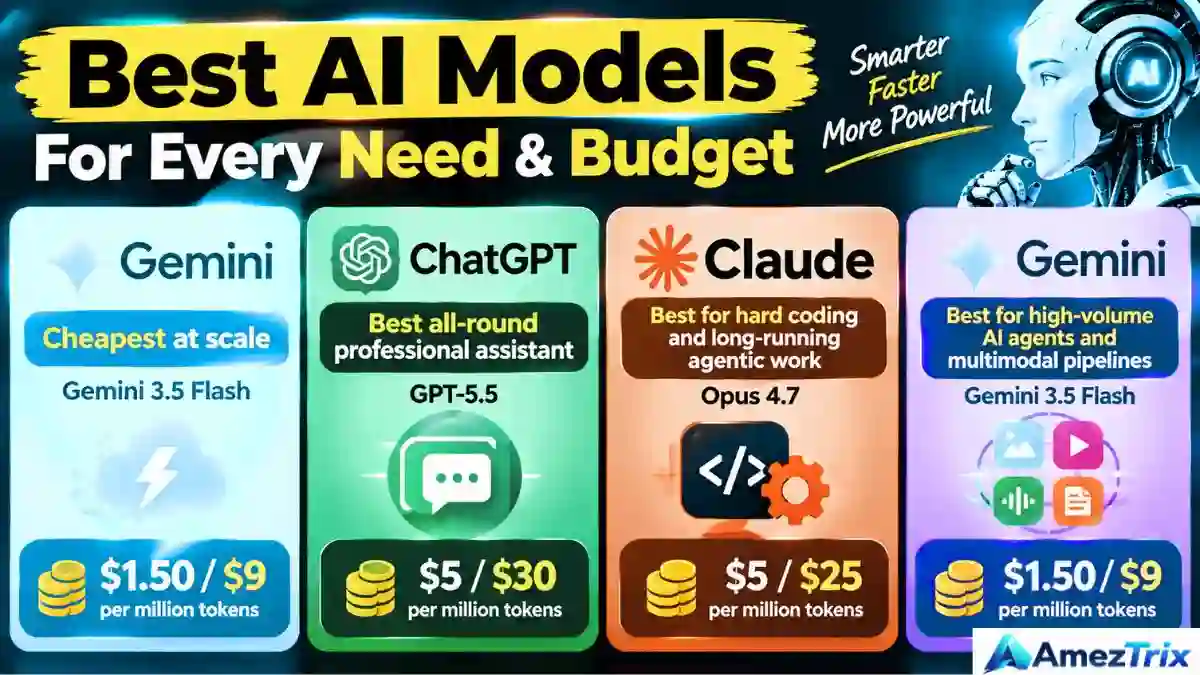
- Cheapest at scale: Gemini 3.5 Flash — $1.50/$9 per million tokens
- Best all-round professional assistant: GPT-5.5 — $5/$30 per million tokens
- Best for hard coding and long-running agentic work: Claude Opus 4.7 — $5/$25 per million tokens
- Best for high-volume AI agents and multimodal pipelines: Gemini 3.5 Flash
If you only remember one thing: Gemini 3.5 Flash wins on cost and throughput, GPT-5.5 wins on general-purpose reasoning breadth, and Opus 4.7 wins when the task is genuinely hard code that needs to be right the first time.
What Is Gemini 3.5 Flash?
Gemini 3.5 Flash is Google’s reasoning-focused model in the Gemini 3 lineup. Google describes it as natively multimodal, with adjustable “thinking levels” designed to balance quality, cost, and latency.
Why does that matter? Because most people don’t just want text back anymore — they want a model that reads a screenshot, makes sense of a chart, works through a document, writes functioning code, calls external tools, navigates inside software, and still explains what it did, all without falling apart halfway through.
Gemini 3.5 Flash’s numbers back this up. Google reports 83.6% on MCP Atlas, a benchmark built around multi-step MCP workflows, compared to 75.3% for GPT-5.5 and 79.1% for Claude Opus 4.7 in the same table. If you’re building AI agents or anything tool-heavy, that number is worth paying attention to.
Best for: developers and businesses building AI agents, multimodal apps, and tool-driven automation.
What Is GPT-5.5?
GPT-5.5 is OpenAI’s flagship model for complex, real-world work. OpenAI specifically highlights:
- Agentic coding
- Online research
- Data analysis
- Document creation
- Spreadsheet work
- Software operation
- Scientific research
- Multi-step tasks
The idea here is that GPT-5.5 doesn’t just answer questions — it’s built to understand what you’re actually trying to accomplish, pick the right tools, check its own work, and push through until the task is genuinely finished.
Think about the gap between asking “how do I analyze this dataset?” and just handing over the dataset and saying “analyze this, find the trends, write me a report.” That shift — from answering questions to actually finishing the work — is arguably the biggest change happening in AI usage right now.
Best for: professionals who want an end-to-end assistant for research, analysis, and document-heavy workflows.
What Is Claude Opus 4.7?
Claude Opus 4.7 is Anthropic’s high-end model, and it’s clearly built with software engineers in mind. Anthropic says it improves on Opus 4.6 specifically in tough engineering tasks, plus better visual understanding, document and interface creation, instruction-following, and longer-running jobs.
If you’re a developer working on a large codebase, part of an engineering team, a researcher, or anyone dealing with genuinely complex multi-step technical work, Opus 4.7 deserves a serious look. If your core question is “which model handles serious software engineering best?” — this is the one to test first.
Best for: software engineering teams, large codebases, and long-running technical workflows.
Claude Sonnet 4.6: The Balanced Option
Sonnet 4.6 sits between Anthropic’s lighter and heaviest models. It’s a solid pick when you want a mix of reasoning, coding, writing, and analysis for everyday productivity — without paying the cost or latency premium that comes with a top-tier model.
In Google’s benchmark table, Sonnet 4.6 shows up right alongside Gemini and GPT-5.5, which makes for an easy side-by-side read. The lesson a lot of people miss here: the most expensive model isn’t automatically the right one for your task. For everyday work, a balanced model often gives you a better mix of speed, cost, and capability.
Best for: everyday professional tasks where cost and speed matter as much as raw capability.
What Is Gemini 3.1 Pro?
Gemini 3.1 Pro is Google’s more advanced Pro-line model, aimed at hard reasoning, multimodal work, and coding. Google’s published numbers show strong performance on academic reasoning and scientific knowledge — 77.1% on ARC-AGI-2 and 94.3% on GPQA Diamond.
If your task needs depth over speed — think research-heavy reasoning rather than fast content generation — Gemini 3.1 Pro deserves a spot on your shortlist.
Best for: advanced research, scientific reasoning, and multimodal analysis within Google’s ecosystem.
Head-to-Head Comparisons
Gemini 3.5 Flash vs GPT-5.5: Which Wins?
This is probably the comparison people care about most right now.
Where Gemini 3.5 Flash pulls ahead: agentic workflows, multimodal reasoning, tool use, and fast applications — especially inside Google’s ecosystem. On MCP Atlas, it scores 83.6% versus GPT-5.5’s 75.3%.
Where GPT-5.5 pulls ahead: complex knowledge work, coding, research, data analysis, document generation, and multi-step professional tasks. OpenAI built it specifically around real workflows rather than simple Q&A.
Verdict: If you’re building tool-using AI agents, Gemini 3.5 Flash is hard to ignore. If you’re doing heavy professional knowledge work, GPT-5.5 is the safer general-purpose bet.
Gemini 3.5 Flash vs Claude Opus 4.7
This gets interesting for developers specifically:
- Terminal-Bench 2.1: Gemini 3.5 Flash 76.2% | Claude Opus 4.7 66.1% | GPT-5.5 78.2%
- SWE-Bench Pro: Gemini 3.5 Flash 55.1% | Claude Opus 4.7 64.3% | GPT-5.5 58.6%
Opus 4.7 falls behind on Terminal-Bench but jumps ahead on SWE-Bench Pro. That’s the whole pattern with these models — one benchmark favors one, a different benchmark favors another, and no single ranking holds up everywhere.
Verdict: Claude Opus 4.7 for deep coding work. Gemini 3.5 Flash for agentic, tool-driven tasks.
Gemini 3.5 Flash vs Claude Sonnet 4.6
| Capability | Gemini 3.5 Flash | Claude Sonnet 4.6 |
|---|---|---|
| MCP Atlas | 83.6% | 69.5% |
| OSWorld-Verified | 78.4% | 72.5% |
| Humanity’s Last Exam | 40.2% | 33.2% |
| ARC-AGI-2 | 72.1% | 58.3% |
| MMMU-Pro | 83.6% | 74.5% |
(Figures from Google’s May 2026 evaluation table.)
Verdict: For agents, multimodal reasoning, and computer-use tasks, Gemini 3.5 Flash comes out ahead by a clear margin.
Gemini 3.5 Flash vs Gemini 3.1 Pro
Same company, different jobs. Gemini 3.1 Pro is built for heavier reasoning; Gemini 3.5 Flash balances capability with speed and cost. Google reports Gemini 3.1 Pro at 77.1% on ARC-AGI-2 versus 72.1% for Flash — but Flash still wins on agentic tool use.
Choose 3.1 Pro when: reasoning depth matters most, or you need a Pro-class research model. Choose 3.5 Flash when: latency, agents, and multimodal input matter more than raw depth.
Best Model by Use Case
Best AI Model for Coding in 2026
Coding is the most competitive category in AI right now, and it’s not just autocomplete anymore. These models debug real errors, write tests, refactor whole applications, explain unfamiliar code, work inside terminals, touch multiple files, and reason about software architecture.
My practical ranking:
- GPT-5.5 / Claude Opus 4.7 (depends on your workflow)
- Gemini 3.5 Flash
- Gemini 3.1 Pro
- Claude Sonnet 4.6
Don’t treat this as permanent — these rankings shift fast.
Best AI Model for AI Agents
An AI agent understands a goal, breaks it into tasks, picks tools, executes, watches the results, fixes its own mistakes, and keeps going until the job’s done. This is exactly where Gemini 3.5 Flash shines, with an 83.6% MCP Atlas score against 75.3% for GPT-5.5 and 79.1% for Claude Opus 4.7.
Best AI Model for Reasoning
| Benchmark | Gemini 3.5 Flash | Gemini 3.1 Pro | Claude Opus 4.7 | GPT-5.5 |
|---|---|---|---|---|
| Humanity’s Last Exam | 40.2% | 44.4% | 46.9% | 41.4% |
| ARC-AGI-2 | 72.1% | 77.1% | 75.8% | 84.6% |
GPT-5.5 tops ARC-AGI-2. Claude Opus 4.7 tops Humanity’s Last Exam. No single model dominates every reasoning test.
Best AI Model for Multimodal Tasks
Gemini 3.5 Flash scores 84.2% on CharXiv and 83.6% on MMMU-Pro, against GPT-5.5’s 84.1% and 81.2%. A close race, with Flash edging ahead on heavy visual work.
Best AI Model for Business
- Broad knowledge work: GPT-5.5
- Advanced engineering: Claude Opus 4.7
- Agentic/multimodal workflows: Gemini 3.5 Flash
- Advanced reasoning: Gemini 3.1 Pro
- Balanced everyday work: Claude Sonnet 4.6
Best AI Model for Students
Students need clear explanations, research help, writing support, coding help, and study planning more than raw power. A balanced model handles daily study fine; for serious research, GPT-5.5, Gemini 3.1 Pro, or Claude Opus 4.7 make more sense. Use AI as a study partner, not a substitute for understanding the material.
Best AI Model for Content Creation
GPT-5.5 fits broad research and knowledge-work tasks well. Claude models are popular for long-form writing and editing. Gemini models help when research involves heavy visual or multimodal material. Regardless of model, human editorial judgment — fact-checking, original insight, a real edit pass — still matters before anything goes live.
Full Benchmark Table
| Benchmark | Gemini 3.5 Flash | Claude Opus 4.7 | GPT-5.5 |
|---|---|---|---|
| Terminal-Bench 2.1 | 76.2% | 66.1% | 78.2% |
| SWE-Bench Pro | 55.1% | 64.3% | 58.6% |
| MCP Atlas | 83.6% | 79.1% | 75.3% |
| OSWorld-Verified | 78.4% | 78.0% | 78.7% |
| Finance Agent v2 | 57.9% | 51.5% | 51.8% |
| CharXiv | 84.2% | 82.1% | 84.1% |
| MMMU-Pro | 83.6% | 75.2% | 81.2% |
| Humanity’s Last Exam | 40.2% | 46.9% | 41.4% |
| ARC-AGI-2 | 72.1% | 75.8% | 84.6% |
Source: Google DeepMind’s published Gemini 3.5 Flash model card comparison.
Notice how the “winner” changes row to row? That’s the entire story here — no single model sweeps every category.
Which Model Is Fastest?
Speed is hard to compare with one clean benchmark since real response time depends on server load, prompt size, output length, reasoning settings, and how many tools get called along the way. Gemini 3.5 Flash is explicitly designed to balance quality, cost, and latency. GPT-5.5 is positioned by OpenAI as delivering more intelligence without sacrificing serving speed versus GPT-5.4. Test inside your own app rather than trusting a chart.
SEO, GEO, and AEO: How AI Search Is Changing Content Strategy
SEO makes content discoverable in traditional search — search intent, internal links, page experience, clear headings, original information.
GEO (Generative Engine Optimization) makes information easy for AI systems to pull from — factually clear, well-structured, entity-rich, backed by trustworthy sources, organized around real questions.
AEO (Answer Engine Optimization) answers questions directly, right up front, before the supporting detail.
Example: “Which AI model is best for coding?” → “There’s no universal winner, but GPT-5.5 and Claude Opus 4.7 are strong picks for advanced coding, while Gemini 3.5 Flash competes well in agentic, tool-driven work.” Answer first, then back it up — that’s what gets pulled into AI-generated answers.
FAQ
Is Gemini 3.5 Flash better than GPT-5.5?
Not across the board. Flash is stronger in agentic, multimodal, and tool-use evaluations. GPT-5.5 covers broader complex knowledge work, coding, and research.
Is Claude Opus 4.7 better than GPT-5.5?
Depends on the task. Opus 4.7 is particularly strong for advanced software engineering; GPT-5.5 covers a wider range of complex real-world work.
Which model is best for coding?
No permanent winner — GPT-5.5, Claude Opus 4.7, and Gemini 3.5 Flash are all highly capable, and the edge shifts by benchmark and workflow.
Which model is best for AI agents?
Gemini 3.5 Flash, based on its 83.6% MCP Atlas score, is ahead of Claude Opus 4.7 and GPT-5.5.
Which model is best for reasoning?
Depends entirely on the benchmark — GPT-5.5, Claude Opus 4.7, and Gemini 3.1 Pro each lead different reasoning evaluations.
Is Gemini 3.1 Pro still worth using?
Yes — it remains a strong option for demanding reasoning and multimodal workloads.
Is Claude Sonnet 4.6 better than Claude Opus 4.7?
Not necessarily. Opus 4.7 is the heavier model for difficult engineering; Sonnet 4.6 is often the more balanced everyday pick.
Which model should businesses choose?
Match it to the workflow: GPT-5.5 for broad knowledge work, Claude Opus 4.7 for advanced engineering, Gemini 3.5 Flash for agentic and multimodal workflows.
Which model is best overall?
There isn’t one. GPT-5.5 leads broad complex work, Gemini 3.5 Flash leads agentic/multimodal workloads, and Claude Opus 4.7 leads advanced software engineering.
Final Verdict
The AI race in 2026 isn’t about one model beating everything else — it’s about specialization.
| Use Case | Recommended Model |
|---|---|
| Overall complex work | GPT-5.5 |
| AI agents | Gemini 3.5 Flash |
| Advanced coding | Claude Opus 4.7 / GPT-5.5 |
| Multimodal AI | Gemini 3.5 Flash |
| Advanced reasoning | GPT-5.5 / Gemini 3.1 Pro / Claude Opus 4.7 |
| Business workflows | GPT-5.5 |
| Software engineering | Claude Opus 4.7 |
| Tool-driven applications | Gemini 3.5 Flash |
| Balanced professional use | Claude Sonnet 4.6 |
| Google ecosystem | Gemini 3.5 Flash / Gemini 3.1 Pro |
Don’t pick a model because someone online called it “the smartest.” Pick it because it actually gets your specific work done — and if you can, test a couple of these against your own real tasks before committing.
Key Takeaways
- Gemini 3.5 Flash leads AI agents, multimodal tasks, and tool-driven workflows.
- GPT-5.5 is built for complex knowledge work, coding, and research.
- Claude Opus 4.7 stands out for advanced software engineering.
- Claude Sonnet 4.6 offers a balanced, cost-efficient option.
- Gemini 3.1 Pro remains strong for demanding reasoning and multimodal work.
- No single benchmark decides a universal “best” model — match the model to the task.
Last updated: September 2026. Benchmark figures are based on first-party model evaluations published by Google DeepMind, OpenAI, and Anthropic — verify against current model cards before publishing, as these numbers and model names change quickly.
About Author
Rajendra Parmar is the Founder and Editor of AmezTrix, where he covers Artificial Intelligence, Technology, WordPress, Web Hosting, Digital Marketing, Gadgets, and Software. His mission is to simplify complex technology through practical tutorials, honest reviews, and well-researched guides that help readers make smarter digital decisions.