Discover the latest EV technology — Sodium-ion vs LFP battery charging features — and what actually boosts real-world range in 2026.
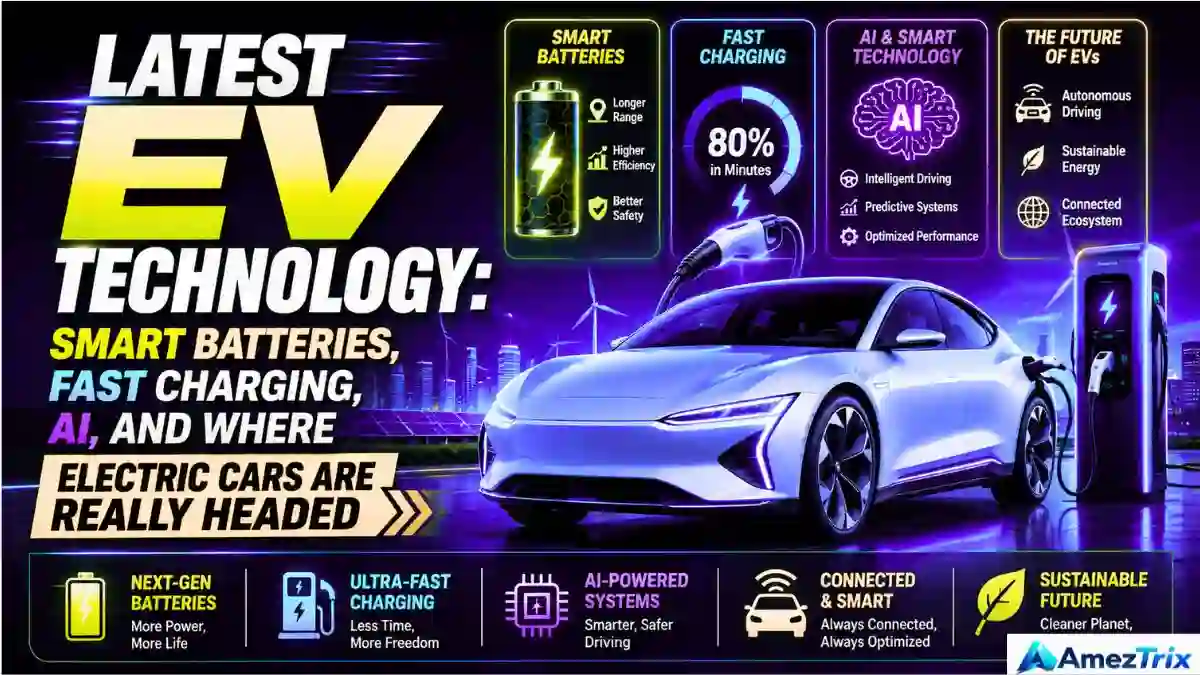
Latest EV Technology: Smart Batteries, Fast Charging, AI, and Where Electric Cars Are Really Headed
Introduction
Ten years ago, buying an EV basically meant one question: how far will it go on a charge? That’s it. Today, thanks to the Latest EV Technology, it’s a completely different conversation.
The car you drive home now might quietly get smarter next month through a software update. It might talk to your home’s power meter. It might even sell electricity back to the grid while you’re asleep. None of that was on anyone’s radar a decade back, and honestly, most of it wasn’t even common two or three years ago.
Batteries are where the biggest shifts are happening. Automakers haven’t stopped improving regular lithium-ion cells — they’re still squeezing out gains there — but at the same time they’re racing toward solid-state chemistry, sodium-ion alternatives, and higher-voltage electrical systems (800V, and now 1,000V) that make genuinely fast charging possible. This is really the core of what people mean when they talk about the Latest EV Technology today.
Charging itself is catching up fast too. The International Energy Agency’s Global EV Outlook says the first 1,000-volt production EVs hit the road in 2025, and by 2026 a handful of manufacturers were promising sub-ten-minute top-ups. Chargers above 250 kW are spreading quickly as well — though here’s the catch most people miss: not every EV on the road can actually pull that much power, even when the charger is capable of delivering it.
What I find more interesting, though, is the shift away from EVs being pure electricity consumers. Smart charging and Vehicle-to-Grid (V2G) tech are turning a parked car into something closer to a battery on wheels — storing cheap power and giving some back when the grid needs a hand.
This guide covers the Latest EV Technology that actually matters right now — not the marketing buzzwords, but what’s real, what’s still half-baked, and what it means if you’re trying to figure out the EV market in 2026.
So What Actually Counts as “Latest EV Technology”?
Put simply, it’s anything that meaningfully changes an EV’s range, charging speed, efficiency, safety, or how long the battery lasts. That covers a lot of ground: newer lithium-ion chemistries like LFP and NMC, solid-state and sodium-ion batteries, ultra-fast DC charging, 800V/1,000V platforms, silicon carbide electronics, smarter motors, AI-driven software, better battery management systems, V2G, improved regenerative braking, advanced thermal control, ADAS, over-the-air updates, connected-car features, and battery recycling.
None of these are killing off the others overnight. They’re all moving forward at the same time, which is honestly why the whole space feels like it’s changing every few months.
Where Battery Technology Actually Stands Today
The battery is still the piece that decides almost everything about an EV — how far it goes, what it costs, how quick it feels off the line, even how heavy it is to drive.

According to the IEA’s Global EV Outlook 2026, global EV battery deployment hit roughly 1.2 TWh in 2025. That’s close to 30% higher than the year before. EVs alone made up more than 70% of all battery deployment across the entire energy sector — a number that puts things in perspective.
Lithium Iron Phosphate Batteries(LFP)
LFP has quietly taken over the mass-market end of things, and it’s not hard to see why. It’s cheaper to make. It handles heat better, so it’s a safer bet under stress. Cycle life is long, and it barely touches nickel or cobalt, which keeps costs down. It also tolerates frequent full charges without complaining much — something older chemistries weren’t great at.
The IEA found LFP running nearly 30% cheaper per kWh than NMC back in 2024. NMC still wins on energy density, sure, but that price gap explains why LFP dominates budget EVs, city runabouts, and fleet vehicles.
NMC Batteries
Nickel Manganese Cobalt cells haven’t gone anywhere either. Wherever squeezing extra range out of limited space matters — premium sedans, big SUVs — NMC still earns its keep. You just pay for it through a pricier, more complicated supply chain.
Solid-State Batteries: More Hype Than Reality (For Now)
Everyone loves talking about solid-state batteries. Swap the liquid electrolyte for a solid one, and suddenly you’re looking at higher energy density, longer real-world range, better safety, smaller packs, and possibly much faster charging. Sounds almost too good, right?
Here’s the honest bit: solid-state isn’t ready for prime time yet. The IEA places the technology roughly at the pilot stage. Big prototypes exist, real money is being poured into manufacturing — but early commercial volumes will likely stay small for a while yet. There’s a wide gap between a lab success story and a factory churning out affordable packs by the thousands every month.
If manufacturers do eventually crack the cost and durability puzzle, though, solid-state could deliver something genuinely rare: more range, faster charging, better safety, and less weight, all at once. That combination is the one that could finally silence most of the usual objections to going electric.
Sodium-ion batteries: The Budget Play
Sodium-ion drops lithium out of the picture almost entirely, and that alone makes it worth watching. Sodium is everywhere and it’s cheap — which matters a lot to any automaker trying to keep an entry-level EV actually affordable.
It’s abundant, it doesn’t rely on the same constrained supply chains, and it handles cold weather reasonably well. It’s a realistic fit for budget EVs and stationary storage too.
The catch? Energy density. Sodium-ion cells just can’t match lithium-ion pound for pound — not yet, anyway. CATL rolled out a second-generation sodium-ion battery in 2025, per the IEA, and BYD has been pouring money into the chemistry as well. Don’t expect it to replace lithium across the board. Think of it more as a specialist — good where cost or cold weather matters more than squeezing every last mile of range.
Ultra-Fast Charging Is Finally Closing the Gap With Gas Stations
If there’s one thing that scares people off EVs, it’s charging time. And it’s also where progress has been the most dramatic, honestly.
Older DC fast chargers topped out around 50-100 kW. The newest hardware plays in a completely different league — 150 kW, 250 kW, entire 350 kW-class stations, some pushing 500 kW, and early megawatt-scale setups for bigger vehicles.
Global average power at public charging points jumped from just over 40 kW in 2024 to nearly 50 kW in 2025, the IEA reports, with above-250 kW chargers spreading steadily.
But here’s what a lot of buyers get wrong: a charger’s peak power number is only half the story. Real charging speed comes down to the battery’s chemistry, how hot or cold it is going in, current state of charge, how well the pack is cooled, the vehicle’s own electrical setup, and what the charger can actually deliver in practice.
So when you’re comparing EVs, don’t just look at the big kW number on the spec sheet. Look at the charging curve — how long the car actually holds that high power — because that single peak figure can be misleading on its own.
Why 800V and 1,000V Architecture Actually Matters
There’s a bit of simple physics underneath all this: power equals voltage times current. Push the voltage higher, and you need less current for the same power. Less current means less heat, fewer losses, and charging that’s genuinely faster and more efficient.
An 800V platform buys you noticeably quicker charging, lower current for the same power delivered, less heat wasted, stronger performance in high-power EVs, and smoother compatibility with the newest ultra-fast chargers.
The industry isn’t stopping there. The IEA confirms the first 1,000-volt production models arrived in 2025. As charging infrastructure keeps climbing in power, this move toward higher-voltage platforms is only going to become more important — not less.
Silicon Carbide: The Quiet Workhorse Nobody Talks About
Silicon carbide, or SiC, doesn’t get the headlines that battery chemistry does, but it’s doing real work under the hood. The inverter’s job is turning battery DC power into whatever the motor needs, and SiC does that with noticeably less waste than old-school silicon.
That translates into lower electrical losses, better overall efficiency, stronger performance when things get hot, smaller and lighter cooling systems, and better synergy with high-voltage platforms overall.
Why does that matter? Because a bigger battery isn’t the only route to more range. Squeezing extra efficiency out of the power electronics can matter just as much — sometimes more.
Electric Motors: Getting Smarter, Not Just Bigger
EV motors were already far more efficient than combustion engines to begin with. Manufacturers are still chasing gains anyway — better power density, less weight, less heat, and smarter torque control.
A lot of premium EVs now run two motors, one per axle. That unlocks all-wheel drive along with independent, software-controlled torque split front to back. Since it’s all handled electronically instead of through mechanical linkages, the response often feels quicker than a traditional AWD setup — you can genuinely feel the difference on a wet on-ramp.
AI Is Quietly Becoming the Real Brain of the Car
Every modern EV is drowning in data — cameras, radar, ultrasonic sensors, battery readings, motor telemetry, GPS, driving habits, charging patterns. AI is what turns that flood of numbers into something actually useful.
On the battery side, AI models can catch odd cell behavior early, predict how a pack will degrade over time, and fine-tune charging to protect long-term health. It’s also showing up on the factory floor — the IEA notes that AI-based image analysis is now catching manufacturing defects in battery cells before they ever leave the plant, which improves yields and cuts waste.
Behind the wheel, AI handles object detection, lane recognition, traffic prediction, parking help, route planning, and even guessing how much energy a trip will burn. It’s a big reason people now call modern EVs “software-defined vehicles” instead of just electric cars.
Smart Battery Management Systems
Think of the BMS as the battery’s nervous system. It’s constantly watching cell voltage, temperature, state of charge, overall health, and safety limits — and it balances individual cells so the whole pack ages evenly instead of one weak cell dragging the rest down.
A well-built BMS lets manufacturers safely pull more usable capacity out of a pack without cutting into safety margins. And this is going to matter a lot more soon, once older EVs start flooding the used market and buyers start asking sharper questions about battery health before signing anything.
Vehicle-to-Grid (V2G): Your Car as a Grid Asset
V2G flips the usual one-way relationship on its head. Normally it’s grid to EV. With V2G, it’s grid to EV and back again.
In practice, a fleet of V2G-capable cars could act like a distributed battery network — soaking up cheap or renewable power when it’s plentiful, then feeding some back during demand spikes. It could smooth out peak grid demand, store renewable energy more effectively, add stability to the grid, lower an owner’s effective charging bill, and even open up a small side income for EV owners.
The first commercial V2G offers for private owners showed up in 2025, per the IEA. But compatible vehicles are still few, and the rules around this are very much still being written. Promising? Definitely. Something every EV buyer should expect right now? Not quite.
Vehicle-to-Home and Vehicle-to-Load
V2G isn’t the only bidirectional trick these batteries can pull off.
Vehicle-to-Home lets a compatible EV power part of your house — handy during an outage, and a smart way to lean on stored energy strategically instead of pulling everything from the grid. Vehicle-to-Load goes further, letting the car power external gear directly — camping equipment, power tools, small appliances, even backup for essential devices at home.
Put it all together, and the EV starts looking less like a way to get from A to B and more like a mobile power station that happens to have wheels.
Thermal Management: The Unsung Hero
Temperature affects almost everything about how well an EV performs — charging speed, efficiency, range, battery lifespan, even motor output. It’s easy to overlook, but it shouldn’t be.
Modern EVs manage temperature across the battery, motor, inverter, cabin, and charging system all at once, often using efficient heat pumps instead of the wasteful resistive heaters older EVs relied on.
Battery preconditioning is one of the more genuinely useful upgrades here. The car warms or cools the battery automatically before you reach a fast charger, so it’s sitting at the ideal temperature the moment you plug in. It makes a real, noticeable difference — especially in cold climates, where charging can otherwise crawl to a frustrating pace.
Regenerative Braking Keeps Getting Smarter
Instead of burning off kinetic energy as heat through friction brakes, the motor flips into generator mode and feeds that energy back into the battery.
It improves overall efficiency, reduces brake wear over time, makes smooth one-pedal driving possible, and gives a modest but real bump to range. Software now blends regenerative and friction braking together so well that the handoff feels natural — something a lot of early EVs genuinely struggled with.
Advanced Driver Assistance Systems (ADAS)
Most new EVs ship with a serious set of driver-assist features these days — adaptive cruise control, automatic emergency braking, lane-keeping, blind-spot monitoring, traffic-sign recognition, driver monitoring, parking help.
Worth saying plainly: driver assistance is not the same thing as full autonomy. A bold marketing name doesn’t mean it’s safe to stop paying attention behind the wheel. Actual capability varies a lot by brand, region, and regulatory approval, so it’s worth reading the fine print rather than trusting the ad copy.
Over-the-Air Updates: A Car That Improves After You Buy It
Here’s something genuinely new — the car you buy today might actually get better six months down the road, without a single dealership visit. OTA updates can touch infotainment, charging behavior, efficiency tuning, driver-assist features, even the whole user interface.
That convenience comes with a catch, though. It puts more pressure on automakers to handle cybersecurity properly and support software for years, not just at launch. The IEA specifically calls out cybersecurity as a growing concern as cars get more connected — and that’s not a small thing to gloss over.
Connected Latest EV Technology
Connected EV technology stays in near-constant touch with smartphones, cloud platforms, charging networks, navigation services, and sometimes even home energy systems. That link feeds back real-time info on battery state, charging status, location, energy use, and upcoming service needs. For manufacturers, it also helps spot fleet-wide problems before they turn into a recall.
Charging Infrastructure Is Getting Smarter, Not Just Bigger
For years the goal was simple — install more chargers, everywhere. That’s shifting now toward building networks that are actually intelligent: scheduling around cheap electricity, dodging grid peak hours, syncing with home solar, supporting two-way charging where it’s available.
More than 1.3 million public charging points went in globally during 2024 alone, per the IEA, pushing the total stock past 5 million worldwide. The real challenge from here isn’t volume anymore — it’s making the whole network fast, reliable, and interoperable across brands and borders.
Wireless EV Charging: Still Early Days
Wireless charging moves electricity between a floor pad and a receiver built into the car, no cable involved. It’s appealing purely for convenience, and it pairs naturally with autonomous-parking ideas. Researchers are even testing dynamic wireless charging — cars topping up while driving over specially equipped road sections. Sounds like science fiction, but it’s real, just very early.
Infrastructure cost, efficiency losses, and a lack of standards mean wired charging isn’t losing its throne anytime soon, though.
Battery Recycling and Second-Life Storage
As millions of EV batteries eventually retire from cars, recycling stops being optional and starts being necessary — recovering valuable materials, cutting waste, easing pressure on raw-material supply.
Second-life use is the other half of the story. A battery that’s no longer great for driving can often still handle stationary jobs — solar backup, commercial power reserves, grid-scale storage. The economics are genuinely tricky here, though, since falling prices on new batteries compete directly with recycling for the same used packs.
Lightweight Design Still Matters More Than People Think
Weight and energy consumption are directly linked — no way around it. That’s why manufacturers keep chasing aluminum, high-strength steel, advanced composites, and even structural battery packs that double as part of the chassis. Aerodynamics counts just as much, particularly at highway speeds, where drag starts eating into efficiency fast.
The takeaway is simple: future range gains won’t come from the battery alone. They’ll come from the whole car working together as a system.
What Should Actually Matter to You as a Buyer?
Don’t judge the latest EV Technology purely by battery size or the range figure printed on the window sticker — that number rarely tells the full story.
| Technology | Why It Actually Matters |
|---|---|
| Battery chemistry | Shapes cost, durability, and charging behavior |
| Battery capacity | Sets the ceiling on available energy |
| Charging speed | Cuts down time lost on long trips |
| Charging curve | Shows how long peak speed really lasts |
| 800V/1,000V architecture | Enables genuinely fast charging |
| Motor efficiency | Drives real-world energy consumption |
| Thermal management | Keeps performance steady in extreme weather |
| BMS quality | Protects long-term battery health |
| ADAS | Affects everyday safety and convenience |
| V2G/V2H/V2L | Adds energy flexibility beyond just driving |
| OTA support | Determines how the car improves over time |
| Connectivity | Powers smart, app-based features |
The Latest EV Technology out there usually isn’t the one with the biggest battery. It’s the one that balances a well-sized pack with strong efficiency, a solid charging curve, and smart thermal control — the boring stuff that actually matters day to day.
Why All This Tech Genuinely Benefits Owners
Charging stops are shrinking closer to coffee-break length, thanks to high-voltage platforms and better cell chemistry. Motors, inverters, aerodynamics, and thermal systems together are chipping away at wasted energy, so cars go further on the same battery. Smarter chemistry and a capable BMS mean packs age more gracefully than they used to.
AI lets the car make better decisions on its own — charging strategy, route planning, that sort of thing — without you having to think about it. Smart charging and V2G tie individual cars into the bigger energy picture. And with fewer moving parts than a combustion drivetrain, running costs tend to stay lower over time.
Then there’s the OTA piece — the car you bought this year genuinely might not be the same car, feature-wise, a year from now. That’s a strange but mostly welcome change.
The Challenges Nobody Should Sugarcoat
Progress is real. So are the growing pains, and it’s worth being upfront about them.
Battery production still needs a lot of mineral supply, and that chain isn’t infinite. Charging infrastructure is expanding fast, sure, but coverage and reliability still swing wildly depending on where you live. Concentrated ultra-fast charging in one area can strain local grid capacity more than people expect. Battery costs keep falling, but packs remain one of the priciest parts of any EV.
Cold weather still hurts both range and charging speed — physics doesn’t care how advanced your BMS is. More connectivity means a bigger attack surface for cybersecurity risks, and that has to be taken seriously, not treated as an afterthought. And recycling systems capable of handling millions of retired packs? Still maturing, still catching up.
Where EV Technology Is Actually Headed
The next chapter probably won’t come from one dramatic breakthrough. It’ll come from how well everything works together. Picture a future where the latest EV
The IEA expects battery deployment to keep climbing steeply, with continued innovation across chemistry, cell design, manufacturing, and charging infrastructure.
Here’s the interesting part — no single chemistry looks likely to “win” outright. LFP for everyday affordable EVs, NMC for range-focused premium models, sodium-ion for cost-sensitive or cold-climate use, solid-state for high-end vehicles, and other advanced chemistries for commercial fleets. That kind of diversity is probably healthy — better than betting the whole market on one technology working out perfectly.
Latest EV Technology Trends Worth Actually Watching
Solid-state commercialization — can manufacturers move from prototypes to affordable mass production, or does it stay a lab story for a few more years?
Megawatt charging — increasingly relevant for commercial fleets, and slowly creeping into passenger-EV infrastructure too.
1,000V platforms — becoming the backbone for fast, efficient charging across more brands.
AI-defined vehicles — AI’s role in energy management and personalization keeps growing, quietly, in the background.
V2G expansion — bidirectional charging edging closer to something ordinary buyers can actually use.
Sodium-ion batteries — a real path toward cheaper EVs, not just a lab curiosity anymore.
Battery recycling — set to become essential once the first big wave of EVs starts aging out.
Software-defined vehicles — more and more of what a car “is” now lives in code, not hardware.
Frequently Asked Questions
What is the latest EV technology in Vehicles?
It spans advanced lithium-ion chemistries, solid-state and sodium-ion batteries, ultra-fast charging, 800V/1,000V architectures, silicon carbide electronics, AI-driven software, smart BMS, V2G, advanced thermal management, and connected-vehicle systems.
Which is the newest EV battery technology?
There isn’t one single chemistry that’s taken over everything. Solid-state and sodium-ion are the ones getting the most attention right now, while LFP and NMC lithium-ion keep improving in the background at the same time.
Are solid-state batteries better than lithium-ion?
Potentially, yes — higher energy density, better safety, possibly faster charging. But production cost, durability, and manufacturing scale are still real hurdles before they can properly compete on price.
What is 800V technology in an EV?
A higher-voltage electrical system that supports high-power charging while cutting current-related losses and heat, compared with older lower-voltage platforms.
What is V2G technology?
Vehicle-to-Grid lets a compatible EV send stored electricity back to the power grid, helping manage demand spikes and adding flexibility to the wider energy system.
Are EVs getting faster to charge?
Yes, clearly. Battery chemistry, thermal management, power electronics, and high-voltage platforms are all pushing charging speeds up. Real-world results still depend heavily on matching the right car to the right charger, though.
How does AI improve electric vehicles?
It supports battery monitoring, energy optimization, route planning, driver assistance, predictive maintenance, and even quality control on the factory line.
Will sodium-ion replace lithium-ion batteries?
Probably not across the board. It’s more likely to complement lithium-ion where cost, material supply, or cold-weather performance matter more than raw energy density.
What’s the single most important latest EV technology?
Honestly, there isn’t one. Battery chemistry, charging infrastructure, power electronics, thermal management, and software all pull together — a genuinely efficient EV with a strong charging curve can matter more day to day than one that just has a huge battery and nothing else going for it.
Final Verdict
The latest EV technology is turning electric cars into something closer to a digital energy platform than plain old transportation. Battery chemistry keeps getting better on the lithium-ion side, while solid-state and sodium-ion are edging closer to real commercial use.
Ultra-fast charging paired with 800V and 1,000V architecture is finally chipping away at the “charging takes forever” complaint. Silicon carbide electronics and smarter motors are pulling more range out of every kilowatt-hour, without needing a bigger battery to do it.
On the software side, AI, connectivity, and OTA updates are reshaping what a car even is, while V2G, V2H, and V2L stretch the battery’s job well past just turning the wheels.
If there’s one honest takeaway here, it’s that no single invention is going to define what comes next. It’ll be all of this working together — better batteries, faster charging, more efficient electronics, smarter software, tighter safety systems, deeper energy integration. As production and charging infrastructure keep scaling, expect this tech to move past premium badges and into the EVs regular people actually buy.
About Author
Rajendra Parmar is the Founder and Editor of AmezTrix, where he covers Artificial Intelligence, Technology, WordPress, Web Hosting, Digital Marketing, Gadgets, Software, and EV Vehicles. His mission is to simplify complex technology through practical tutorials, honest reviews, and well-researched guides that help readers make smarter digital decisions.