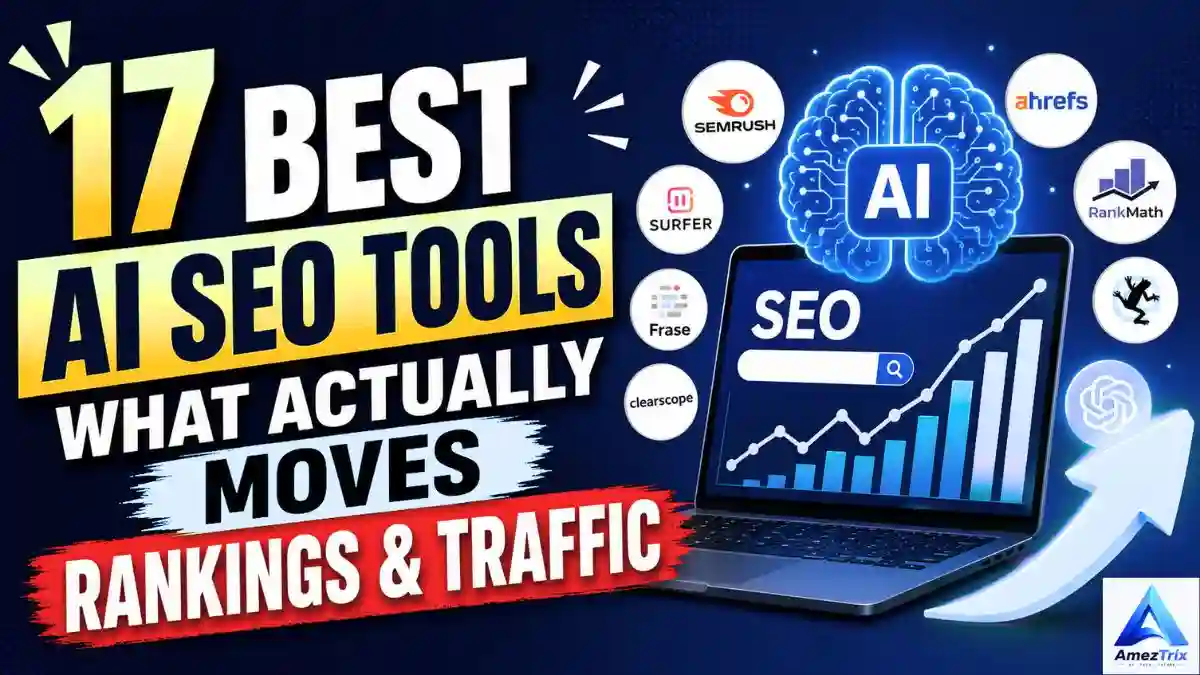
Confused about which AI SEO tool to pick? We tested 17 of the Best AI SEO Tools—from Semrush to ChatGPT—so you don’t have to. See the full breakdown.
17 Best AI SEO Tools 2026 — That Actually Work | AmezTrix
SEO doesn’t look the way it did a couple of years ago. Not even close. It used to be spreadsheets, gut instinct, and a lot of guesswork. Now there’s software watching over your shoulder — pulling intent out of a search query, spotting content gaps before you’ve finished your outline, catching a broken canonical tag while your coffee’s still hot.
That’s the world this guide lives in. Below, you’ll find a straight, practical look at the Best AI SEO Tools actually worth paying attention to in 2026. What each one’s good at. Where it falls apart. Who should bother paying for it, and who shouldn’t. This isn’t about chasing every new AI badge a company slaps on its homepage. It’s about figuring out which tools save you hours, and which ones just sit there as another tab you forget to close.
Here’s the thing though — none of these Best AI SEO Tools think for you. They speed up research, they catch patterns you’d have missed on your own, they take the boring stuff off your plate. But Google’s been fairly consistent on one point: it wants content that’s genuinely useful for a real person, not something stitched together to trick a ranking algorithm. Keep that in mind as you read through this.
What Even Is an “AI SEO Tool,” Anyway?
Basically, any software using artificial intelligence, machine learning, or a language model to make some part of SEO less painful. In practice, that could look like:
- Pulling keyword ideas and related questions out of thin air
- Figuring out what someone actually wants when they type a query
- Building content outlines based on what’s already ranking
- Scoring your draft against the competition
- Crawling your site for technical problems
- Tracking rankings — and, more and more, whether AI chatbots even mention your brand
- Drafting meta titles, schema markup, internal link suggestions
Honestly, the Best AI SEO Tools that matter combine AI with real SEO data. Not just generic text-spinning. Ahrefs is a good example — its AI features sit on top of an enormous keyword index, backlink data, a technical crawler, and visibility tracking for AI answers. Semrush works the same way. The AI stuff is layered inside a much bigger toolkit that already handles keyword research, competitor tracking, and rank monitoring.
Why Even Bother With AI in Your SEO Work?
Keyword research gets faster. Instead of brainstorming variations by hand for twenty minutes, AI throws out related terms, questions, and intent clusters from one seed keyword in seconds.
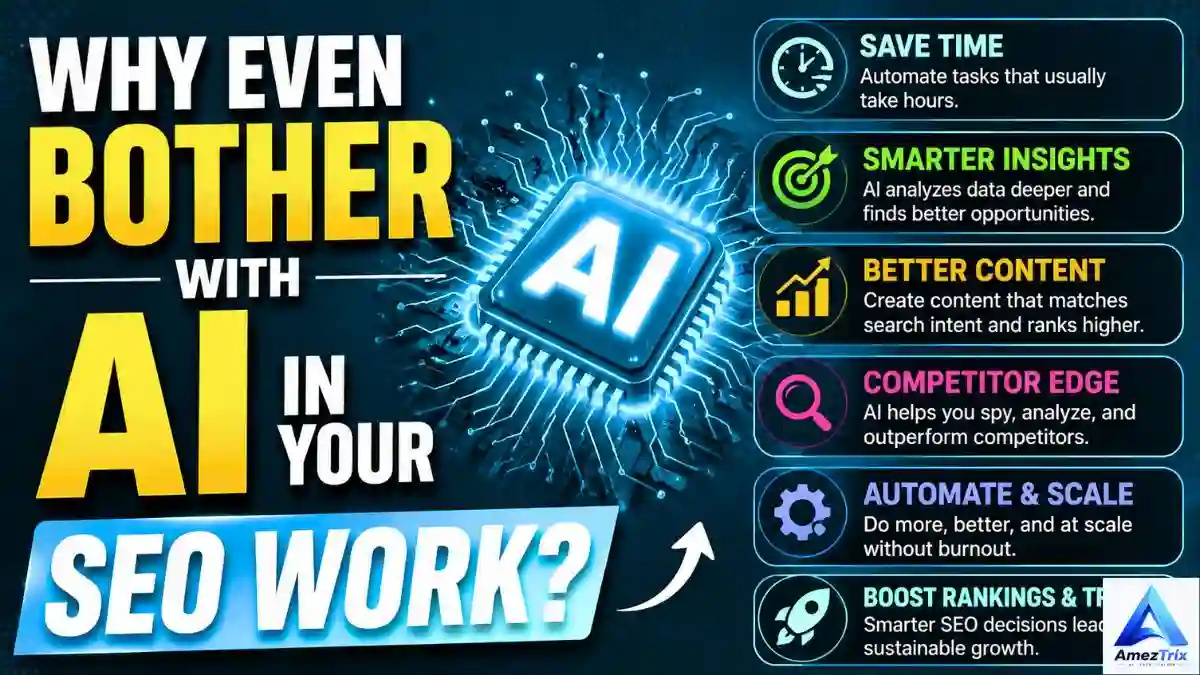
Content planning gets sharper. Rather than guessing which subtopics matter, these platforms scan what’s ranking already and show you exactly what competitors covered that you didn’t.
You catch optimization gaps you’d otherwise miss. Run your draft against the top pages and, more often than not, you’ll find a missing section or a weak explanation you didn’t notice while writing.
Technical issues get flagged before they pile up. Broken links, missing metadata, duplicate pages — a good crawler prioritizes these instead of dumping two thousand rows on you and calling it a day.
Competitor research gets a clearer lens. Not just their keywords and backlinks anymore — how visible they are inside AI-generated answers too.
And here’s something worth remembering: AI search visibility isn’t some separate thing you bolt on later. Google has said, pretty plainly, that solid SEO fundamentals still decide whether your content gets pulled into its generative AI search features. Same game, new scoreboard.
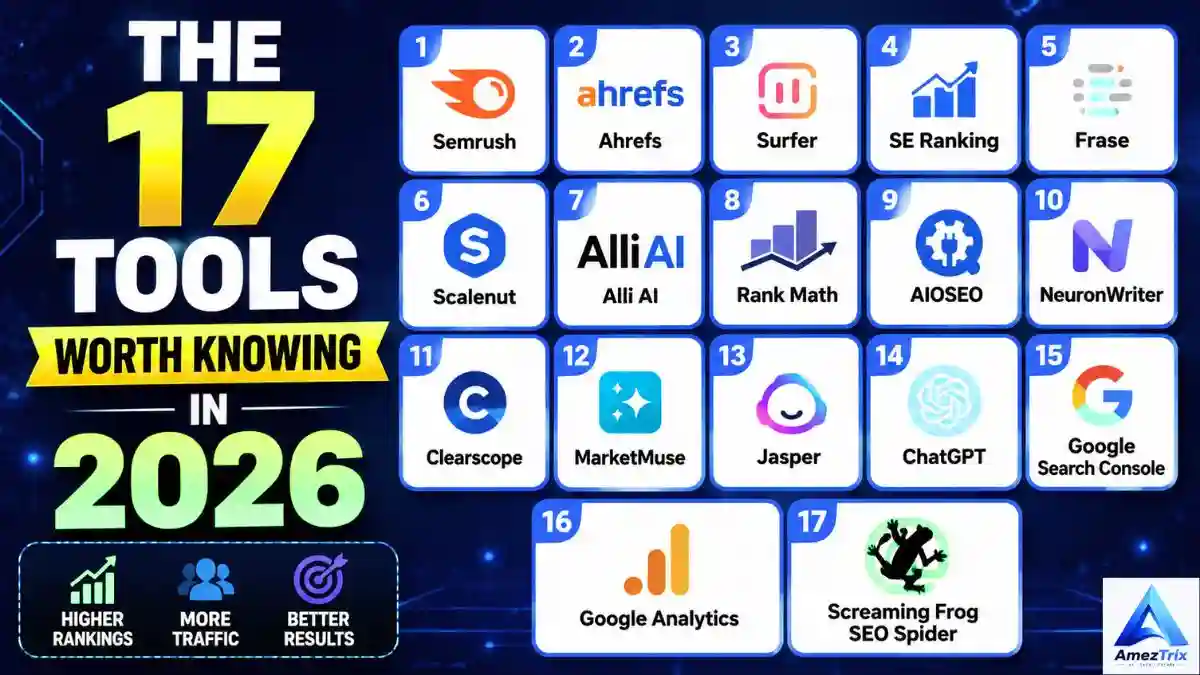
The 17 Best Tools Worth Knowing in 2026
- Semrush
- Ahrefs
- Surfer
- SE Ranking
- Frase
- Scalenut
- Alli AI
- Rank Math
- AIOSEO
- NeuronWriter
- Clearscope
- MarketMuse
- Jasper
- ChatGPT
- Google Search Console
- Google Analytics
- Screaming Frog SEO Spider
Not everything on this list brands itself as “AI-powered” first. A few are old-school SEO tools that quietly baked AI into what they already did well. That’s usually a good sign, not a red flag.
Best AI SEO Tools – Quick Comparison Table
| Tool | Best For | Keyword Research | Content | Technical SEO | AI Search |
|---|---|---|---|---|---|
| Semrush | All-in-one SEO | ✅ | ✅ | ✅ | ✅ |
| Ahrefs | Backlinks & research | ✅ | ✅ | ✅ | ✅ |
| Surfer | Content optimization | ✅ | ✅ | ❌ | Limited |
| SE Ranking | Growing websites | ✅ | ✅ | ✅ | ✅ |
| Frase | Content briefs | ✅ | ✅ | Limited | Limited |
| Scalenut | Content workflows | ✅ | ✅ | Limited | Limited |
| Alli AI | Automation | Limited | ✅ | ✅ | Limited |
| Rank Math | WordPress SEO | ✅ | ✅ | ✅ | Limited |
| AIOSEO | WordPress SEO | ✅ | ✅ | ✅ | Limited |
| NeuronWriter | Content optimization | ✅ | ✅ | Limited | Limited |
| Clearscope | Content optimization | Limited | ✅ | ❌ | Limited |
| MarketMuse | Topic authority | ✅ | ✅ | Limited | Limited |
| Jasper | AI writing | Limited | ✅ | ❌ | Limited |
| ChatGPT | SEO assistance | With data | ✅ | With data | ✅ |
| Search Console | Google data | Actual queries | ❌ | ✅ | Limited |
| Screaming Frog | Technical SEO | ❌ | ❌ | ✅ | Limited |
1. Semrush — The All-Rounder and Best AI SEO Tools
Semrush has been around forever, and honestly, it’s probably the most complete package on this list. Keyword research, competitor tracking, technical audits, rank monitoring, content optimization, AI visibility — it’s all in one place.
Standout features: keyword research, competitor and keyword-gap analysis, backlink tracking, Site Audit, Position Tracking, AI visibility monitoring, prompt research, AI brand sentiment, local SEO, content creation tools.
Best for: agencies, in-house marketing teams, affiliate site owners, bloggers who’ve outgrown the free stuff.
Why people keep it: you’re not bouncing between five logins to research a keyword, check a competitor’s backlinks, and audit your site’s health. It’s all right there.
2. Ahrefs — Best for Keyword and Backlink Depth
Ahrefs built its name on having one of the biggest link and keyword databases around. Over the past couple of years, it’s steadily woven AI in — keyword suggestions, intent detection, an AI Content Helper, translation tools, AI-content detection, and Brand Radar for tracking how (and how often) your brand shows up in AI answers.
Standout features: Keywords Explorer, Site Explorer, Site Audit, Rank Tracker, Content Explorer, Content Gap, AI Content Helper, Brand Radar.
Quick shoutout to the AI Content Helper — instead of pushing you toward keyword repetition, it compares your topic coverage against what’s already ranking and tells you exactly what’s missing. That’s a small feature that saves real time.
Best for: bloggers, affiliate marketers, agencies, and content teams who care about backlinks as much as on-page work.
3. Surfer — Best for Content Optimization
Surfer does one job, and it does it well: it tells you what your content needs to cover to actually compete for a keyword.
Standout features: content optimization scoring, SERP analysis, keyword recommendations, content briefs, AI-assisted drafting, content audits.
Ever stared at a blank page knowing your keyword but not what to actually say? That’s exactly the moment Surfer was built for.
4. SE Ranking — Best for Growing Sites on a Budget
SE Ranking covers most of what the bigger platforms do — rank tracking, keyword research, competitor analysis, site audits, backlink monitoring — but the pricing is a lot friendlier for smaller teams.
Best for: freelancers, small agencies, sites that have outgrown free tools but aren’t ready to pay enterprise prices.
5. Frase — Best for Content Briefs
Frase leans hard into research and brief-building. It scans the SERP for a query, pulls out the actual questions people are asking, and turns it all into an outline your writers can just run with.
Best for: content teams who want research and drafting inside one workflow instead of five browser tabs.
6. Scalenut — Best for Scaling Content Production
Scalenut is built for volume. Keyword planning, topic clustering, briefs, AI-assisted writing — all designed for sites that publish often and need to keep the pipeline moving.
Best for: publishers and content-heavy sites that need a repeatable process, not a one-off article tool.
7. Alli AI — Best for SEO Automation
Alli AI takes a different route from most tools here. Instead of helping you plan or write, it actually implements on-page changes across your whole site.
Useful for: on-page fixes at scale, internal linking, metadata updates, technical changes a dev team would otherwise take weeks on.
Best for: agencies and businesses running large, messy websites where editing pages one by one just isn’t realistic.
8. Rank Math — Best AI SEO Plugin for WordPress
Rank Math plugs straight into the WordPress editor — titles, meta descriptions, schema, sitemaps, redirects, internal linking, without ever leaving your dashboard.
Best for: WordPress bloggers and publishers who’d rather have SEO baked into their existing workflow than open a separate app.
9. AIOSEO — The WordPress Alternative
AIOSEO covers similar ground to Rank Math — on-page SEO, sitemaps, schema, redirects, social metadata. Worth trying if Rank Math’s interface just doesn’t sit right with you. Some people prefer one over the other purely on feel, and that’s fine.
10. NeuronWriter — Best Budget Content Optimizer
NeuronWriter gives you SERP-based scoring and semantic recommendations without the price tag that comes with the bigger names.
Best for: solo bloggers and small publishers who want data-backed optimization without a huge monthly bill.
11. Clearscope — Best for Enterprise Editorial Teams
Clearscope is clean, polished, and clearly built for teams that care a lot about editorial quality alongside the optimization side.
Best for: enterprise publishers and marketing departments with dedicated editors on staff.
12. MarketMuse — Best for Topical Authority
MarketMuse zooms out further than most of these tools. It looks at content strategy from a whole-site level — where your gaps are, which pages need work to build real authority.
Best for: large content sites planning months ahead instead of article by article.
13. Jasper — Best AI Writing Assistant
Jasper is really a marketing-content platform, not an SEO tool in the strict sense. It’s genuinely solid at drafting, but pair it with real keyword and SERP data — don’t treat it as your whole SEO strategy.
Best for: marketing teams focused on brand content and ideation.
14. ChatGPT — The Flexible SEO Assistant
ChatGPT has quietly worked its way into a lot of SEO workflows. Not as a replacement for dedicated platforms, but as a quick thinking partner — keyword clustering, intent classification, outlines, FAQ ideas, meta description drafts, content-gap brainstorming.
Just don’t publish what it hands you without reading it first. Google’s been pretty direct here: content mass-produced to game rankings, with no real human oversight, isn’t what it wants to reward. In my experience, the drafts that do best are the ones where AI wrote the skeleton and a person added the muscle.
15. Google Search Console — The One Free Tool You Can’t Skip
Search Console gives you something no third-party tool can — first-party data, straight from Google.
What it shows you: search queries, clicks, impressions, CTR, average position, indexing status, sitemap health, Core Web Vitals, mobile usability issues.
Every other tool on this list is estimating. This one’s showing you what’s actually happening.
16. Google Analytics — Best for Measuring What Happens After the Click
Analytics picks up where rankings stop mattering. A page sitting at position one that nobody clicks through on, or converts on, isn’t really a win. Analytics is how you catch that early.
17. Screaming Frog — Best for Technical Audits
Screaming Frog crawls your entire site and flags broken links, missing titles, duplicate metadata, redirect chains, canonical issues, indexability problems — the unglamorous stuff that quietly kills rankings.
Best for: anyone running a serious technical audit, whether in-house or for a client.
So How Do You Actually Pick One?
There’s no single best here. It depends on your site, your budget, your team size — honestly, sometimes it just depends on what you’re comfortable using day-to-day.
Start with size. A small blog gets by fine on Search Console, a WordPress plugin, and an AI assistant. A bigger operation needs real crawling, rank tracking, backlink data, and reporting built in.
Then think about the actual goal. Keyword research first? Go Ahrefs or Semrush. Content optimization your main headache? Look at Surfer, Frase, or Clearscope. On WordPress? Rank Math or AIOSEO will feel far more natural than logging into a separate platform. Technical audits — Screaming Frog is home turf.
Don’t overspend just because a tool has more buttons. Plenty of small sites do perfectly fine on free Google tools plus one mid-tier paid platform. You genuinely don’t need the enterprise suite to rank well.
And pay attention to what’s actually behind the AI. Recommendations are only as good as the data feeding them — look for real search volume, real SERP data, real backlink history. Not just AI generating plausible-sounding text.
One more thing — don’t sleep on AI search visibility. Semrush tracks it across AI platforms now. Ahrefs has Brand Radar for the same job. Worth factoring in, especially if your audience is asking chatbots questions instead of typing them into Google.
A Workflow That Actually Makes Sense
Here’s roughly how the pieces fit together, step by step:
- Find the opportunity. Use Semrush, Ahrefs, or Search Console to spot a keyword worth chasing.
- Nail down intent. Is the searcher after info? A comparison? A product? A fix for a specific problem?
- Study the SERP. What’s already ranking — how deep is it, what’s the structure, are there FAQs, images, original data, internal links?
- Build a brief. Let AI organize the research into something workable.
- Write it yourself, or edit hard. Add real examples, first-hand experience, actual data, expert opinions. This is the part AI can’t fake — not convincingly, anyway.
- Handle the on-page basics. Title, H1, headings, URL, meta description, internal links, alt text, schema where it fits.
- Check the technical side. Crawlability, indexability, mobile speed, canonical tags.
- Track it. Search Console and Analytics tell you if it’s actually working.
- Refresh when needed. Rankings slip, competitors get better, intent shifts — go back and fix old content instead of only chasing new topics.
AI SEO vs. Traditional SEO — It’s Not Really a Battle
| Traditional Approach | AI-Assisted Approach |
|---|---|
| Manual keyword research | AI-assisted keyword discovery |
| Manual SERP analysis | AI-assisted SERP analysis |
| Manual content briefs | Automated brief generation |
| Manual competitor tracking | AI-assisted competitor insights |
| Manual optimization checks | AI content recommendations |
| Manual technical audits | Automated crawling and flagging |
| Rank tracking only | Rank tracking + AI visibility monitoring |
| Search engines | Search engines + AI search surfaces |
AI didn’t replace SEO. It just took the repetitive stuff off your plate so you’ve got more time for the parts that actually need a human — strategy, judgment, and knowing your audience better than any tool ever will.
Does AI-Written Content Actually Rank?
Yes. But not automatically, and definitely not just because it’s AI-written. Content made with Best AI SEO Tools help can rank fine on Google — the real question is always whether it’s actually useful, not how it got made.
What tends to hold AI content back:
- It repeats what’s already all over the internet
- It has factual mistakes nobody bothered to check
- There’s no real opinion or original angle in it
- It exists purely to target a keyword, with no actual reader in mind
- It adds nothing beyond what’s already ranking
The answer isn’t to avoid AI completely. Use it as a first draft, then layer in the human part — fact-checking, real examples, opinions, edits that only someone who genuinely knows the topic would make. Aksar dekha gaya hai ki wahi content best perform karta hai jisme ek real insaan ka touch clearly dikhta hai.
Can Any of These Tools Guarantee a Ranking?
No. And be skeptical of anyone who tells you otherwise. None of these platforms have access to Google’s actual ranking system — they’re estimating from outside signals. What they can genuinely do: sharper keyword targeting, tighter topic coverage, fewer technical errors, better competitor insight, visibility tracking across regular and AI search. That’s not a guarantee. It’s better odds, which honestly is most of what Best AI SEO Tools ever was.
Building an SEO Stack on a Tight Budget
You don’t need five subscriptions to get moving. A solid free-to-cheap stack:
- Google Search Console — real data, straight from Google
- Google Analytics — traffic and engagement
- ChatGPT — brainstorming, clustering, outlines
- Rank Math or AIOSEO — on-page SEO for WordPress
- Google Trends — catching shifts in search interest
- Screaming Frog (free tier) — light technical audits
That combination alone can take a new site further than most people expect. I’ve seen it happen.
Best Setup by Use Case
Bloggers: Search Console for real queries, Ahrefs or Semrush for keyword and competitor research, ChatGPT for outlines, Rank Math for on-page, Analytics to measure. Beats relying on an AI writer alone, pretty much every time.
Small businesses: Semrush or SE Ranking, plus Search Console, Analytics, and a WordPress plugin. Focus on commercial keywords, local search, service pages, conversion-focused content — not sheer volume.
Agencies: Semrush or Ahrefs, mostly because they cover multiple client projects, rank tracking, reporting, backlinks, and AI visibility monitoring under one roof.
WordPress sites: Rank Math or AIOSEO for the plugin layer. But a plugin alone won’t do the job — you still need real keyword research, decent content, internal linking, and ongoing maintenance.
A Few Best Practices Worth Repeating
Write for intent, not just search volume. A high-volume keyword means nothing if your content doesn’t answer what the person actually wanted.
Cover the topic properly — skip the padding. Newer optimization tools, Ahrefs’ AI Content Helper included, score topic coverage now, not keyword repetition.
Skip keyword stuffing entirely. Use your target phrase where it fits naturally and let related terms show up on their own.
Add something only you could add. Real examples, actual data, screenshots, first-hand experience — that’s the difference between content that ranks and content that just sits there.
Keep it readable. Short paragraphs, clear headings, tables, useful internal links.
Build trust. Cite real sources, credit your authors, keep your About and Contact pages current.
Don’t skip the technical side. Speed, mobile usability, HTTPS, crawlability, clean sitemaps — none of it matters less just because your content is good.
Mistakes People Keep Making (and How to Skip Them)
Publishing AI drafts without a real edit. AI gets facts wrong more than people expect. Always check before you hit publish.
Pumping out too much similar content. Volume isn’t a strategy on its own. Google’s warned specifically against mass-producing content mainly to grab search traffic.
Obsessing over keyword density. That stopped mattering years ago, honestly.
Skipping technical SEO. Even great writing won’t rank if the page can’t be crawled or indexed properly.
Trusting a tool’s “SEO score” too much. A perfect score from any platform is a helpful signal — not a promise from Google.
Ignoring Search Console. Third-party estimates are useful, sure, but Search Console is the only place showing you real Google data.
Frequently Asked Questions
What are the best AI SEO tools right now?
Semrush, Ahrefs, Surfer, SE Ranking, Frase, Scalenut, Rank Math, AIOSEO, NeuronWriter, Clearscope, MarketMuse, ChatGPT, Google Search Console, and Screaming Frog all stand out. Which one’s right depends on whether you need keyword research, content optimization, technical health, or AI search visibility most.
What should a total beginner start with?
Search Console, Analytics, a WordPress SEO plugin, and an AI assistant like ChatGPT. Add a paid platform like Semrush or Ahrefs once the site’s grown enough to justify the cost.
Can these Best AI SEO Tools actually improve my rankings?
They speed things up — better targeting, sharper content, fewer errors. But no tool can promise a specific ranking spot. Nobody honest will tell you otherwise.
Is AI-written content bad for SEO?
Not on its own. What matters is whether it’s accurate and useful, written with a real person in mind — not who or what typed it.
Is ChatGPT actually an SEO tool?
It’s a genuinely useful assistant for clustering, outlines, and brainstorming. It doesn’t replace platforms built on proprietary keyword and SERP data, though.
Semrush or Ahrefs — which one’s better?
Semrush edges ahead as a broad marketing suite. Ahrefs is stronger specifically for backlinks, keyword depth, and content gaps. A lot of serious SEOs end up running both, honestly.
What’s the best free SEO tool, hands down?
Google Search Console. It’s the only place giving you Google’s own performance data for your own site.
Will AI replace SEO professionals?
Not anytime soon. AI handles the repetitive research. Strategy, technical judgment, and real expertise still need a person behind the wheel.
Final Verdict
There isn’t one best free SEO tools. There’s a best tool for your situation, and that’s a different answer for almost everyone reading this.
Best overall platform — Semrush, for sheer breadth. Best for backlinks and keywords — Ahrefs. Best for content optimization — Surfer. Best for WordPress — Rank Math. Best free data source — Google Search Console. Best flexible assistant — ChatGPT. Best for technical audits — Screaming Frog.
The real point? No single tool carries your SEO on its own. The sites winning long-term are the ones using the best free SEO tools for repetitive analysis while people bring the strategy, the original thinking, and the judgment no algorithm can fully copy. Use AI to research faster and think smarter — not just to publish more.
About Author
Rajendra Parmar is the Founder and Editor of AmezTrix, where he covers Artificial Intelligence, Technology, WordPress, Web Hosting, Digital Marketing, Gadgets, and Software. His mission is to simplify complex technology through practical tutorials, honest reviews, and well-researched guides that help readers make smarter digital decisions.