Discover the 15 best AI coding tools in 2026. Compare features, pricing, pros, cons, and choose the perfect AI coding assistant with AmezTrix.
Best AI Coding Tools in 2026: A Complete Guide for Developers
Writing every single line of code by hand is quickly becoming the exception rather than the rule. Across startups, agencies, and enterprise engineering teams, Best AI Coding Tools assistants have quietly become part of the everyday toolkit — sitting inside the editor, catching bugs before they ship, and turning a plain-English request into working code in seconds.
If you’re a self-taught beginner, a freelance developer juggling client projects, a founder racing to ship an MVP, or a senior engineer maintaining a sprawling codebase, there’s now an Best AI Coding Tools built with you in mind.
A well-chosen AI assistant can:
- Turn natural-language instructions into functional code
- Catch and resolve bugs automatically
- Explain code you didn’t write and don’t fully understand
- Clean up messy, hard-to-maintain code
- Draft documentation for you
- Write test suites
- Translate code from one language to another
- Flag security weaknesses before they become incidents
- Cut development time dramatically on repetitive work
This guide breaks down the best AI coding tools available in 2026, how they actually work under the hood, and how to pick the one that fits your stack.
What Exactly Is an AI Coding Tool?
Best AI Coding Toolsl is an application built on large language models (LLMs) that helps developers write, understand, troubleshoot, and maintain code. Rather than digging through documentation or old Stack Overflow threads, you describe the outcome you want in plain language, and the tool produces working code almost immediately.
Instead of manually typing out a login form line by line, you could simply say:
“Build a responsive login page with dark mode and email validation.”
And within seconds, you’d have a working starting point.
Most modern assistants support a long list of languages and frameworks, including Python, JavaScript, TypeScript, Java, C++, C#, PHP, Go, Rust, Swift, Kotlin, Ruby, SQL, HTML, CSS, Bash, React, Vue, Angular, and Node.js.
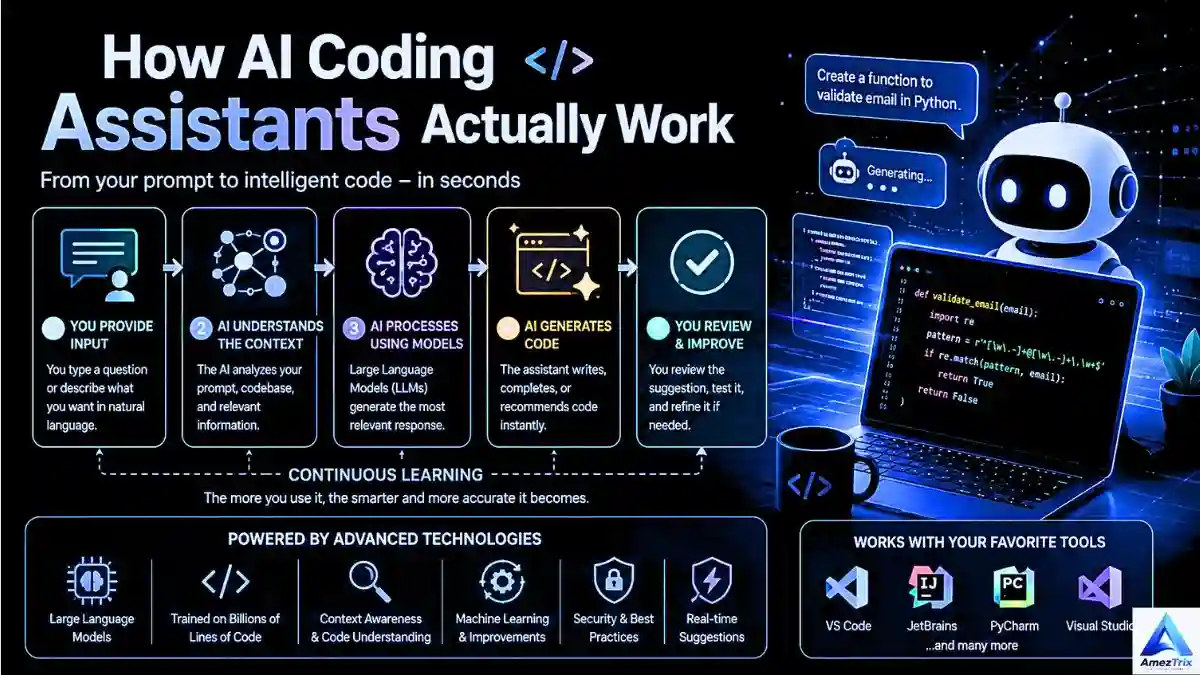
How Best AI Coding Assistants Actually Work
1. Large Language Models
Every Best AI Coding Tools is powered by a language model trained on enormous volumes of code, documentation, and technical writing. These models pick up on syntax, architecture patterns, framework conventions, common algorithms, and general best practices.
2. Natural Language Understanding
You don’t need to write pseudocode first. A prompt like “build a REST API using Express.js” is enough for the model to generate a working scaffold.
3. Awareness of the Whole Project
The Best AI Coding Tools don’t just look at the open file — they take in your entire repository: existing classes, functions, imports, naming conventions, and folder structure, which leads to suggestions that actually fit your codebase.
4. Continuous Learning
Many assistants adapt over time to your coding style, the libraries your team favors, and internal conventions — some enterprise-grade tools can even be tuned to match a company’s specific coding standards.
5. Live, In-Editor Suggestions
Most tools plug directly into editors like VS Code, IntelliJ IDEA, PyCharm, WebStorm, Visual Studio, Android Studio, and Neovim, predicting your next lines as you type.
Why Top AI Programming Tools Have Taken Over
Faster Shipping
Boilerplate work — CRUD operations, auth flows, database models, form validation, test scaffolding — can go from hours to minutes.
Cleaner Code
Good assistants nudge you toward better naming, simpler logic, and more maintainable architecture instead of just “whatever works.”
Less Time Debugging
Best AI Coding Tools are good at spotting syntax slips, logic errors, performance bottlenecks, memory leaks, and security holes — and many explain the root cause, not just the fix.
A Faster Way to Learn
New programmers can ask “why is this failing?” or “explain recursion” and get an answer tailored to their exact code, functioning almost like an on-demand mentor.
Measurable Productivity Gains
Teams that adopt AI assistants consistently report meaningful time savings on routine coding tasks, freeing developers to focus on harder problems.
What to Look for in an AI Coding Tool
- Language support — does it cover what you actually use daily?
- IDE compatibility — VS Code, IntelliJ, Visual Studio, and so on
- Context awareness — single-file understanding vs. whole-project understanding
- Privacy and data handling — critical if you work with proprietary or client code
- Pricing — free tier vs. paid plans vs. enterprise licensing
- Output reliability — clean, maintainable code vs. code you’ll spend hours fixing
- Team features — shared workspaces, collaborative reviews, admin controls
- Adaptability — can it learn your style and standards over time?
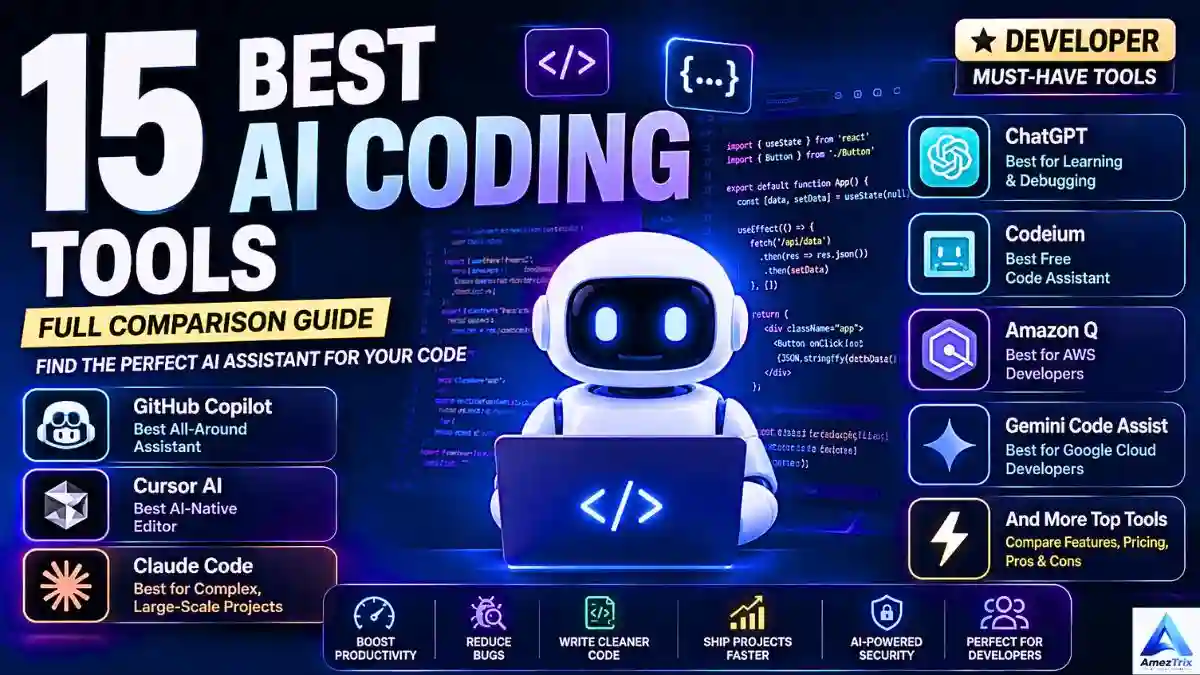
The 15 Best AI Coding Tools in 2026
1. GitHub Copilot — Best All-Around Assistant

Still one of the most widely used Best AI Coding Tools, Copilot plugs into your IDE and suggests everything from single lines to full functions and files, using project context to stay relevant.
Strengths: strong suggestion quality, fast, beginner-friendly, deep VS Code integration, huge community. Watch out for: advanced features sit behind a paid plan; suggestions still need a human review.
Plans: Free (limited), Individual, Business, Enterprise.
Great for: web developers, engineers, students, startups, enterprise teams.
2. Cursor AI — Best AI-Native Editor
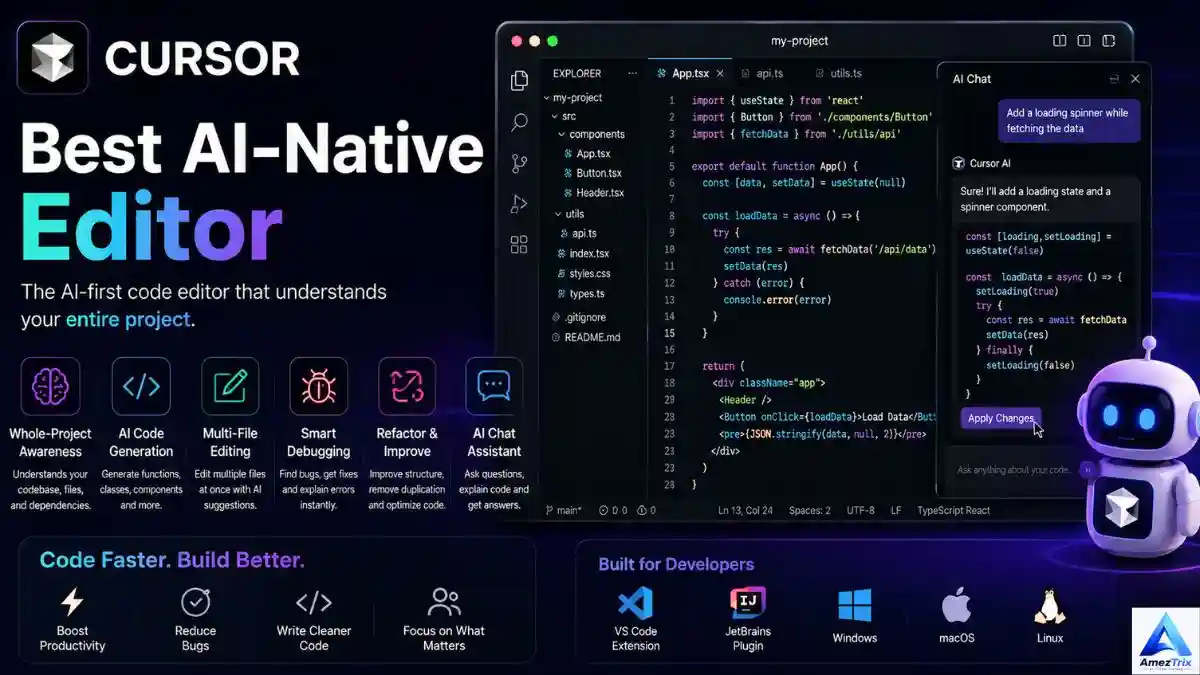
Built on top of VS Code, Cursor behaves less like a plugin and more like a pair programmer that understands your whole repository and can edit multiple files at once.
Strengths: deep repo understanding, high accuracy, fast responses, strong for large codebases.
Watch out for: paid tier for full functionality; heavier on system resources.
Plans: Free, Pro, Business.
Great for: professional developers, SaaS teams, AI engineers, large projects.
3. Claude Code — Best for Complex, Large-Scale Projects
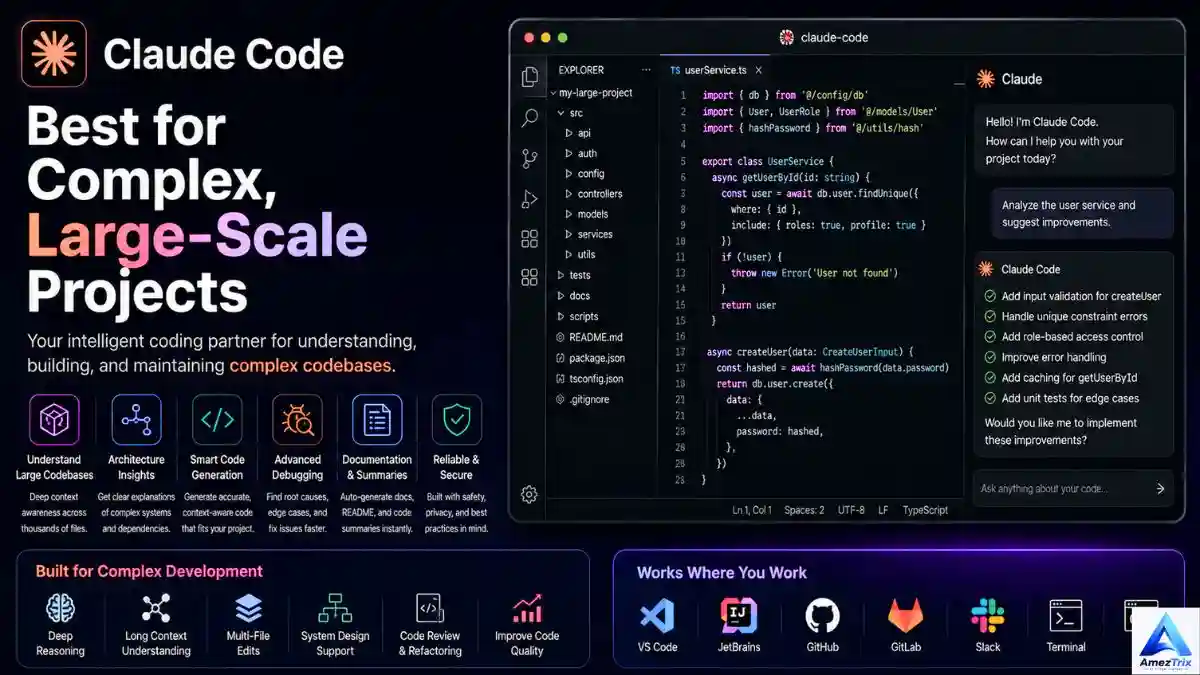
Built for developers navigating large, complicated codebases, Claude Code is particularly strong at explaining architecture, reviewing pull requests, and reasoning through implementation decisions.
Strengths: strong reasoning, high-quality documentation output, well suited to enterprise-scale code.
Watch out for: needs an internet connection; usage limits on lower tiers.
Plans: Free (limited), Pro, Team, Enterprise.
Great for: senior developers, tech leads, enterprise teams.
4. ChatGPT — Best for Learning and Problem-Solving
More than a chatbot, ChatGPT is used daily by developers to generate code, explain algorithms, optimize performance, debug, write SQL, and scaffold entire apps.
Strengths: broad language support, strong explanations, approachable for beginners.
Watch out for: results depend heavily on prompt quality; always test generated code.
Plans: Free, Plus, Pro, Team.
Great for: Best AI Coding Tools for students, freelancers, developers, educators.
5. Google Gemini Code Assist — Best for Google Cloud
Built to work hand-in-hand with Google Cloud, Gemini Code Assist offers cloud-aware suggestions, architecture guidance, and AI-assisted debugging.
Strengths: strong cloud integration, enterprise-ready, security-conscious.
Watch out for: shines brightest inside the Google ecosystem specifically.
Plans: Free tier, Standard, Enterprise.
Great for: cloud engineers, DevOps teams, backend developers.
6. Amazon Q Developer — Best for AWS
Purpose-built for AWS workflows, helping generate infrastructure-as-code, troubleshoot AWS services, and optimize cloud-native applications.
Strengths: deep AWS integration, real DevOps time savings.
Watch out for: less value if you’re not on AWS.
Plans: Free tier, Professional, Enterprise.
Great for: AWS developers, DevOps engineers, cloud architects.
7. Replit AI — Best Browser-Based IDE
Build, test, and deploy from a browser with no local setup — ideal for quick experiments, teaching, and early-stage prototypes.
Strengths: zero installation, beginner-friendly, quick deployment.
Watch out for: limited offline capability.
Plans: Free, Core, Teams.
Great for: students, educators, freelancers, MVP builders.
8. Windsurf — Best for End-to-End AI Workflows
Combines chat, code generation, agent-style automation, and full-project context into one workspace covering planning through refactoring.
Strengths: smooth UX, strong automation, modern interface.
Watch out for: deeper features require a paid plan.
Plans: Free, Pro, Teams.
Great for: full-stack developers, AI-first teams, startups.
9. Tabnine — Best for Privacy-Conscious Teams
Focused on secure code completion with private and on-premises deployment options for organizations with strict compliance needs.
Strengths: privacy-first design, enterprise-grade security, quick suggestions.
Watch out for: less conversational than chat-first competitors.
Plans: Free, Pro, Enterprise.
Great for: enterprises, finance, healthcare organizations.
10. Sourcegraph Cody — Best for Enterprise Code Search
Combines AI assistance with powerful code search to help teams navigate and understand massive, often legacy, codebases.
Strengths: excellent for legacy systems, strong search, solid enterprise integrations.
Watch out for: built more for large teams than solo developers.
Plans: Free, Enterprise.
Great for: enterprise teams and large organizations.
11. Bolt.new — Best for Prompt-to-App Building
Generates complete web applications from a prompt, entirely in the browser — great for validating an idea fast.
Highlights: full-app generation, browser-based, AI-driven UI creation, rapid MVPs.
Great for: founders and early-stage startup teams.
12. Lovable — Best for Frontend Builds
Focused on building React front ends quickly, with UI generation and backend integration baked in.
Highlights: React app building, UI generation, fast design iteration.
Great for: frontend developers and product designers.
13. Codeium — Best Free Option
A generous free tier with unlimited code completion, broad language support, and IDE integration.
Highlights: free unlimited completion, multi-language, built-in chat.
Great for: students, hobbyists, budget-conscious developers.
14. Continue — Best Open-Source Option
An open-source extension that lets you plug in different AI models, including local ones, for maximum flexibility and control.
Highlights: open-source, model-agnostic, local model support, highly customizable.
Great for: developers who value flexibility and data privacy.
15. Qodo (formerly CodiumAI) — Best for Testing and Code Quality
Focused specifically on automated test generation, code review, and static analysis to catch quality issues early.
Highlights: automatic test generation, review assistance, static analysis.
Great for: QA engineers and quality-focused teams.
Quick Comparison Table – Best AI Coding Tools
| Tool | Best For | Free Plan | IDE Support | AI Chat |
|---|---|---|---|---|
| GitHub Copilot | Everyday coding | Limited | Excellent | Yes |
| Cursor AI | AI-first coding | Yes | Excellent | Yes |
| Claude Code | Large projects | Limited | Good | Yes |
| ChatGPT | Learning & debugging | Yes | Moderate | Yes |
| Gemini Code Assist | Google Cloud | Yes | Good | Yes |
| Amazon Q Developer | AWS | Yes | Good | Yes |
| Replit AI | Browser coding | Yes | Browser-based | Yes |
| Windsurf | AI workflows | Yes | Excellent | Yes |
| Tabnine | Privacy | Yes | Good | Limited |
| Sourcegraph Cody | Enterprise | Limited | Good | Yes |
| Bolt.new | Prompt-based apps | Yes | Browser-based | Yes |
| Lovable | Frontend | Yes | Browser-based | Yes |
| Codeium | Free coding | Yes | Excellent | Yes |
| Continue | Open source | Yes | Good | Yes |
| Qodo | Testing | Limited | Good | Yes |
Which One Should You Actually Pick?
- Best overall: GitHub Copilot
- Best AI-native editor: Cursor AI
- Best for learning to code: ChatGPT
- Best for enterprise teams: Claude Code
- Best free option: Codeium
- Best for Google Cloud workflows: Gemini Code Assist
- Best for AWS workflows: Amazon Q Developer
- Best browser-based option: Replit AI
- Best for full-stack AI development: Windsurf
- Best for privacy and compliance: Tabnine
AI Coding Tools vs. Traditional Coding
| Factor | AI Coding Tools | Traditional Coding |
|---|---|---|
| Code writing | AI-assisted | Fully manual |
| Development speed | Very fast | Moderate |
| Bug detection | Automatic suggestions | Manual debugging |
| Refactoring | Near-instant | Manual, time-consuming |
| Documentation | AI-generated | Manual |
| Learning curve | Instant explanations | Docs & tutorials |
| Code reviews | AI-assisted | Human only |
| Testing | AI-generated | Manual |
| Project understanding | Whole codebase | Limited by developer memory |
AI tools clearly win on raw speed and repetitive work — but every output still needs a human eye for correctness, security, and long-term maintainability.
Best Picks by Use Case
| Use Case | Recommended Tool |
|---|---|
| Best overall | GitHub Copilot |
| Best free tool | Codeium |
| Best for beginners | ChatGPT |
| Best AI IDE | Cursor AI |
| Best for enterprise | Claude Code |
| Best for AWS | Amazon Q Developer |
| Best for Google Cloud | Gemini Code Assist |
| Best for startups | Bolt.new |
| Best for full-stack work | Windsurf |
| Best for privacy | Tabnine |
| Best for code search | Sourcegraph Cody |
| Best browser IDE | Replit AI |
| Best for testing | Qodo |
| Best open-source pick | Continue |
| Best frontend builder | Lovable |
Best AI Coding Tool for Beginners If You’re Just Starting Out
If you’re new to programming, prioritize tools that explain their reasoning instead of only spitting out code.
- ChatGPT — great for learning concepts, understanding algorithms, and debugging beginner mistakes step by step.
- Replit AI — ideal for browser-based coding, school projects, and quick experimentation with no setup.
- Codeium — solid free completion for daily practice and personal projects.
Best Tools for Professional Developers
- GitHub Copilot — dependable everyday coding companion.
- Cursor AI — built for complex, multi-file applications.
- Claude Code — strong for architecture review, content creaters and large repositories.
- Sourcegraph Cody — purpose-built for navigating enterprise-scale codebases.
By Language and Stack
HTML & CSS: GitHub Copilot, Cursor AI, ChatGPT
JavaScript: Cursor AI, GitHub Copilot, Codeium
React: Cursor AI, Lovable, ChatGPT
Angular: GitHub Copilot, Claude Code
Vue.js: Cursor AI, Codeium
Node.js: GitHub Copilot, Amazon Q Developer
Python: GitHub Copilot, ChatGPT, Cursor AI, Claude Code, Continue — useful for automation scripts, Django, Flask APIs, and ML work with TensorFlow, Pandas, and NumPy
Java (Spring Boot, Hibernate, microservices): GitHub Copilot, Cursor AI, Claude Code, Gemini Code Assist
C++ (STL, memory optimization, game dev, competitive programming): GitHub Copilot, Cursor AI, ChatGPT, Claude Code
Android (Kotlin, Java, Jetpack Compose): GitHub Copilot, Gemini Code Assist, Cursor AI
iOS (Swift, SwiftUI, UIKit): GitHub Copilot, ChatGPT, Cursor AI
Flutter: Cursor AI, GitHub Copilot, ChatGPT
Best Free AI Coding Tools
| Tool | Free Version | Best For |
|---|---|---|
| ChatGPT | Yes | Learning & debugging |
| Codeium | Yes | Code completion |
| Continue | Yes | Open-source flexibility |
| Replit AI | Limited | Browser coding |
| Gemini Code Assist | Yes | Cloud development |
| Windsurf | Yes | AI workflows |
| Bolt.new | Limited | Rapid prototyping |
Common Mistakes Developers Make With AI Tools
- Copy-pasting blindly — always understand what the generated code actually does.
- Skipping security review — AI-generated code can carry vulnerabilities.
- Skipping tests — run unit and integration tests regardless of the source.
- Vague prompts — the vaguer the ask, the weaker the output.
- Treating suggestions as final — AI is a starting point, not a verdict.
Getting Better Results From Any AI Coding Tool
Be specific. Instead of “build an API,” try: “Build a secure REST API using Node.js, Express, JWT authentication, MongoDB, and input validation.”
Give context. Mention your language, framework, project structure, style conventions, and performance needs.
Break tasks down. Ask for one feature at a time rather than an entire app in one go.
Review and refine. Treat the first output as a draft, not a final answer.
Check your dependencies. AI suggestions can lag behind the latest package versions — verify before shipping.
Will AI Replace Developers?
No — and that answer hasn’t changed in 2026.
AI is genuinely good at automating repetitive work, generating boilerplate, writing tests, explaining unfamiliar code, and speeding up debugging. But humans are still the ones making calls on system architecture, business logic, creative problem-solving, product direction, user experience, security trade-offs, and the kind of gnarly debugging that requires real judgment.
The developers who come out ahead won’t be the ones ignoring AI — they’ll be the ones who know exactly when to lean on it and when not to.
Frequently Asked Questions
What are AI coding tools?
Software applications powered by AI that help developers write, complete, debug, explain, refactor, and optimize code using natural-language prompts across multiple programming languages.
What’s the best AI coding tool in 2026?
It depends on your use case: Copilot for all-around use, Cursor AI for a full AI-native editor, ChatGPT for learning, Claude Code for enterprise-scale projects, and Codeium if you want a strong free option.
Are AI coding tools free?
Most offer a free tier with limited functionality. Paid plans typically unlock faster responses, larger context windows, more advanced generation, team collaboration, and enterprise security.
Can AI build a complete application?
Yes — landing pages, portfolio sites, REST APIs, full-stack apps, mobile prototypes, dashboards, and auth systems are all within reach. Just review, test, and harden anything before it goes to production.
Can AI replace developers?
No. It handles repetitive execution; humans still own architecture, strategy, security decisions, and collaboration.
Which languages do these tools support?
Most major ones support Python, JavaScript, TypeScript, Java, C++, C#, PHP, Go, Rust, Swift, Kotlin, SQL, HTML, CSS, Bash, React, Vue, Angular, and Node.js.
Is AI-generated code secure by default?
Not necessarily. Always review authentication logic, validate inputs, guard against SQL injection and XSS, scan dependencies, and run proper security audits.
Which tool is best for beginners?
ChatGPT, Codeium, Replit AI, and GitHub Copilot all offer strong explanations alongside code generation, which helps new developers actually learn.
Which tool is best for enterprise teams?
Claude Code, GitHub Copilot Enterprise, Tabnine, Sourcegraph Cody, Amazon Q Developer, and Gemini Code Assist are the usual picks for security, scale, and collaboration.
Do these tools work offline?
Most need an internet connection since they rely on cloud-hosted models, though some — like Tabnine and Continue — offer local or self-hosted options for stricter environments.
Where AI Coding Tools Are Headed
- More autonomous agents — handling planning, coding, testing, and deployment with less hand-holding.
- Deeper project understanding — reading entire repos, docs, and design files, not just code.
- Voice-driven development — building software by talking, not just typing.
- AI-assisted code review — catching logic and security issues before a human even opens the PR.
- Smarter DevOps automation — from CI/CD to monitoring to incident response.
- More personalization — assistants that genuinely adapt to your style and your team’s standards over time.
The Upside and the Trade-Offs
What you gain: faster development, better productivity, less time debugging, cleaner code, automatic docs, a gentler learning curve, easier collaboration, faster prototyping, and more consistent standards across a team.
What to watch for: occasional incorrect or outdated output, weaker handling of complex business logic, misread vague prompts, code that still needs optimization, lingering security gaps, and licensing questions worth checking on commercial projects. Human testing and review are still non-negotiable.
Final Take
Best AI Coding Tools have earned their place in the modern developer’s stack — automating the repetitive parts of the job, generating solid starting-point code, and speeding up delivery across the board. But the developers getting the most value out of them treat AI as a smart collaborator, not a substitute for actual engineering judgment.
If you’re just starting out, ChatGPT or Codeium are a genuinely good way to learn. If you’re deep into professional projects, GitHub Copilot, Cursor AI, or Claude Code will likely serve you better, and enterprise teams should lean toward options built with security and collaboration in mind from day one.
The developers who thrive from here on out won’t be the ones avoiding AI — they’ll be the ones who’ve figured out how to work with it well.
Key Takeaways
- Best AI Coding Tools meaningfully cut down on repetitive work and boost output.
- Different tools shine in different lanes — learning, enterprise, cloud, or full-stack work.
- Always review, test, and secure AI-generated code before it ships.
- Better prompts produce better results — specificity matters.
- Architecture, business logic, and judgment calls are still firmly a human job.
About Author
Rajendra Parmar is the Founder and Editor of AmezTrix, where he covers Artificial Intelligence, Technology, WordPress, Web Hosting, Digital Marketing, Gadgets, and Software. His mission is to simplify complex technology through practical tutorials, honest reviews, and well-researched guides that help readers make smarter digital decisions.