The Meta AI agent standard is a new open standard called the Personal Agent Protocol, announced on October 6, 2026, by Meta and Sierra. It sets rules for how a person’s AI agent signs in to a business, what permissions it gets, and what the business lets it do. In plain words: a safe, shared way for AI agents to get real tasks done.
One warning first. Many headlines say “Meta launches AI agent standard,” and that oversells it. The protocol is announced, not finished. The v0.1 specification hasn’t been published, so there’s nothing to download yet. This guide sticks to what’s confirmed and flags what isn’t.
Key takeaways
- The Personal Agent Protocol is an open standard from Meta and Sierra, announced October 6, 2026.
- Named partners: Genesys, Instinct, Rocket, Shopify, Stripe and Walmart.
- Sessions are built on OAuth, and users choose read-only or write access.
- It doesn’t replace MCP. A business can offer MCP-based APIs as one route inside it.
- There’s no download yet. The v0.1 spec and a reference implementation are planned for later in October 2026.
In this guide: What is an AI agent? | What the standard is | What was announced | How it works | vs MCP and A2A | OAuth | Meta AI agent Muse | AI agent examples | Businesses | How to build an AI agent | AI agent free | Risks | Download | FAQ
What Is an AI Agent? (Quick Refresher)
An AI agent is software that uses an AI model to pursue a goal and take actions on your behalf, not just answer questions. It can plan steps, use tools, and check its own progress. A chatbot tells you how to rebook a flight. An agent rebooks it, with your permission.
Is ChatGPT an AI agent?
It depends on how you use it. ChatGPT began as a chatbot, which means it responds to prompts. Some versions and modes can now take actions with tools, and in those cases it behaves like an agent. So the label describes what it’s doing at that moment more than what the product is called. The same logic applies to most assistants today, and it’s exactly why agents need clear rules about access.
| Chatbot | AI agent | |
|---|---|---|
| Main job | Answer and explain | Plan and act |
| Uses tools or accounts | Rarely | Often |
| Needs permission controls | Little | A lot |
| Example request | “How do I change my order?” | “Change my order to Friday delivery.” |
What Is the Meta AI Agent Standard?
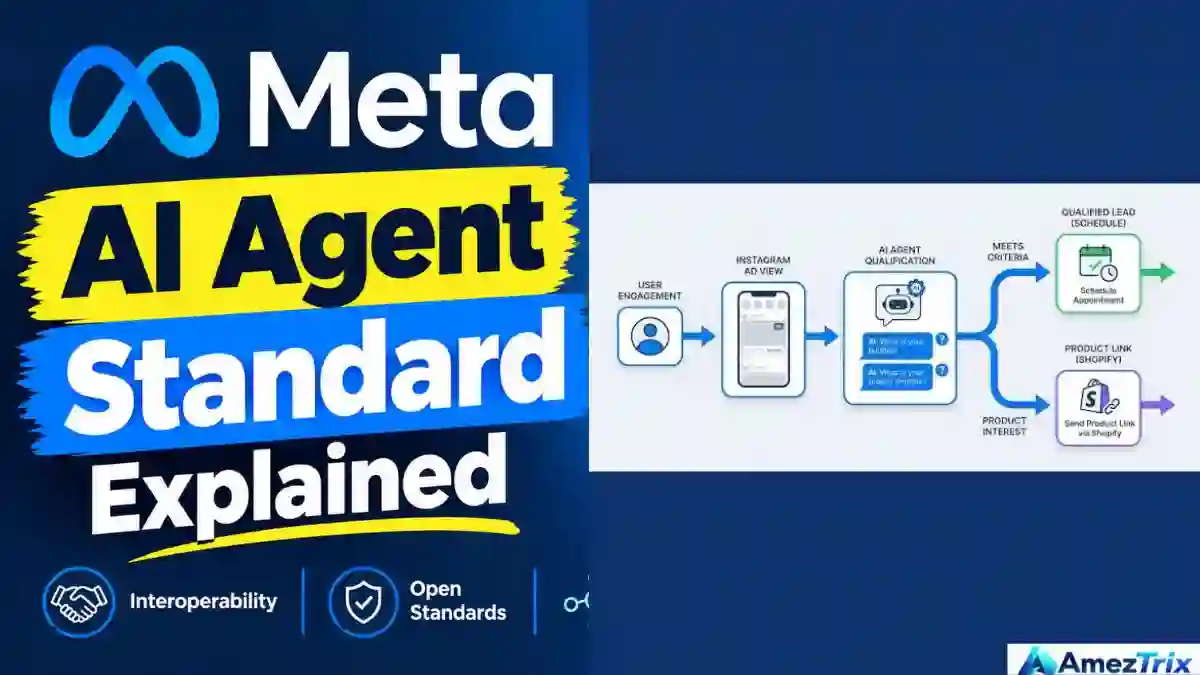
Short answer: it’s the Personal Agent Protocol, an open standard Meta and Sierra are developing with industry partners. It defines how personal Meta AI agents interact with businesses through websites, APIs or a company’s own agent. Customers decide what access their agent gets. Businesses decide what agents can do.
Think of it as a front desk for AI agents. Today an agent often acts like a human visitor, clicking through pages and hoping the form works. This standard tries to give it a proper door.
| Detail | What we know |
|---|---|
| Official name | Personal Agent Protocol |
| Developed by | Meta and Sierra |
| Announced | October 6, 2026, by Bret Taylor and Clay Bavor (Sierra) |
| Named partners | Genesys, Instinct, Rocket, Shopify, Stripe, Walmart |
| Authorization layer | OAuth |
| Access model | Read-only or write, chosen by the customer |
| Who can implement it | Anyone (described as open) |
| Spec status | v0.1 planned for later in October 2026 |
What Did Meta and Sierra Actually Announce?
The news came through a post on Sierra’s blog. It describes a standard the two companies are building together, plus a plan: publish the v0.1 specification, run design workshops with interested parties, and release a reference implementation so developers have a starting point. Sierra also says Instinct is joining the effort and that more partners are welcome.
The partner mix is worth a second look. Stripe handles payments, Shopify powers online stores, Walmart runs retail at huge scale, Genesys sits behind customer service for large companies, and Rocket is the home-financing group behind Redfin. These aren’t research labs. They serve real customers all day, which makes this feel more practical than most AI standards.
The problem it tries to solve
Most personal agents today use websites the way you would: load a page, find a button, fill in a form. When that fails, some fall back to calling support or opening a web chat. Slow, fragile, and sometimes the agent just gives up. Sierra argues a direct, secure connection could finish the same job in seconds. The catch is that each group wants something different.
| Who | What they want |
|---|---|
| Consumers | Speed, dependability and trust |
| Brands | Visibility and control over what agents do |
| Agent builders | One consistent way to work with many companies |
Without a shared standard, ten agents and a thousand businesses could mean ten thousand custom integrations. Nobody wants to maintain that.
How the Personal Agent Protocol Works
The guiding rule: you decide what access your agent gets, and the business decides what agents can do.
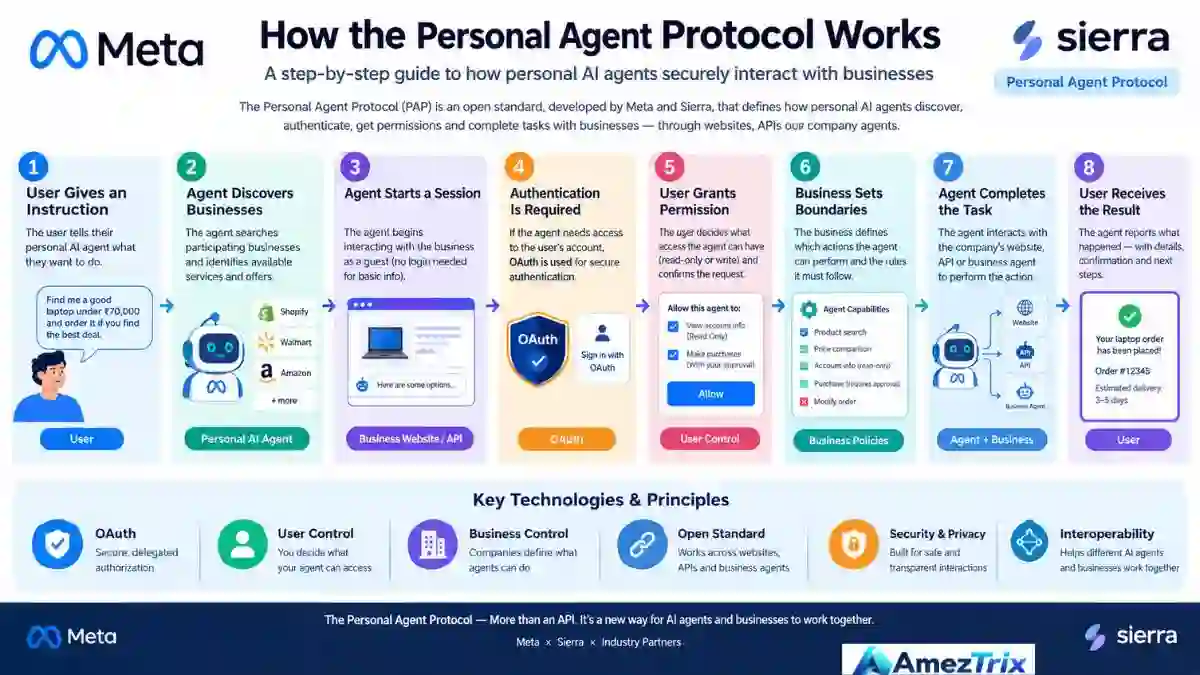
| Step | What happens |
|---|---|
| 1. Discovery | The agent starts on the company’s website and learns what it offers and how to reach it. |
| 2. Guest session | The agent opens a session for you. As a guest it can check stock or read a returns policy. |
| 3. Sign-in | If the task needs your account, you sign in on the company’s page or use credentials already set up with your agent. |
| 4. Permission | You choose read-only or write access. |
| 5. One session, many channels | A question before sign-in and an order change after it belong to the same visit. |
| 6. Best route | The task runs through the company’s website, its APIs, or its own agent. |
Step 6 is the interesting one. The company picks which doors stay open. A simple question might use a normal web page. A structured request might use APIs built on standards such as MCP and OpenAPI. Something messy, like a warranty claim, can go to the company’s own agent. And step 5 matters more than it looks: anyone who has explained the same problem to three different support agents will get it.
Meta Agent Protocol vs MCP vs A2A
Are they rivals? No, and this is where many articles go wrong. MCP helps an AI application connect to tools, data and services. The Personal Agent Protocol covers the relationship between your agent and a business. MCP is closer to a plug. This is closer to a front desk. Sierra’s own description lists MCP as one way a business can expose APIs, so they can work together.
| Question | MCP | A2A | Personal Agent Protocol |
|---|---|---|---|
| Main job | Connect AI apps to tools and data | Let agents talk to other agents | Define how a personal agent works with a business |
| Simple question | How does an agent use a tool? | How do agents talk to each other? | How does my agent deal with a company for me? |
| Who sets the rules | Mostly the tool owner | The agents involved | Customer sets access, business sets limits |
| Maturity today | Established | Established | Announced, spec pending |
A fair warning on A2A. Since the protocol lets a company route work to its own agent, there’s some overlap in spirit. But the announcement doesn’t say how the two would connect, so be careful with any article that claims it does.
Why OAuth Matters for AI Agents
OAuth is the idea behind the “Sign in with Google” button. You grant limited access without handing over your password. For agents, that’s a big deal.
Picture asking an agent to rebook a flight. It needs your booking, maybe a payment method, and permission to make changes. With proper authorization, you can say “look, but don’t touch,” or “change this booking only.” Without it, the only choice is sharing your login, and that’s how things go wrong.
Sierra also hints at later ideas: finer permissions for specific actions, push notifications (an airline telling your agent the moment a flight is delayed), and payment extensions so an agent can buy something without seeing your card details. Those are possibilities for future versions, not features today.
Meta AI Agent Muse: How It Fits In
This didn’t come from nowhere. On September 8, 2026, Meta introduced Muse, a personal AI agent built to take action. It runs on a dedicated secure virtual machine, can send email or book travel, and checks with you before sensitive steps such as sending a message or making a purchase. For payments, it uses Link by Stripe, including one-time-use cards so your real card details stay hidden.
Rocket’s CTO also said in Sierra’s announcement that a Muse agent can move across Rocket’s platform, from finding a home to arranging financing.
See the pattern? Meta builds the agent (Muse) and helps write the rules for how agents meet businesses (the protocol). My view: it’s a smart two-sided move, because a personal agent is only as useful as the places it can work with.
For readers outside the US: Meta says Muse is rolling out in the United States first, and its announcement doesn’t confirm other countries.
AI Agent Examples You Can Picture Today
The word “agent” gets thrown around loosely, so here are concrete examples that match what’s been announced or described.
| Example | What it does | Type |
|---|---|---|
| Muse (Meta) | Sends email, books travel, works across your apps with your approval | Personal agent |
| Company customer-service agent | Handles conversation-heavy jobs like a warranty claim | Business agent |
| Rebooking agent | Checks a flight, then changes it once you grant write access | Personal agent |
| Shopping agent | Compares retailers, checks delivery dates, buys after you approve | Personal agent |
Notice the split. Some agents work for you, others work for a company. The Personal Agent Protocol sits right between them, which is why it matters.
What It Could Mean for Businesses
For years, the question was “is our site mobile-friendly?” The next one might be “can an agent actually use our business?” Call it being agent-ready.
| Agent-ready basics | Why it helps |
|---|---|
| Clear, structured product and pricing data | Agents compare options without guessing |
| Documented APIs or a company agent | Real requests get handled quickly |
| Written rules for outside agents | You control what an agent can do |
| Sign-in that supports delegated access | Customers grant limited permission safely |
Ecommerce looks like the obvious first winner. Tell your agent “find a 55-inch TV under $600 with a long warranty,” and it could compare stores, check delivery dates and finish the purchase after you approve. No ten open tabs. Does that kill websites? I don’t think so. They stay, but a growing share of visits may come from agents instead of people, which changes how businesses measure traffic and conversions.
On the search side, classic SEO brings people to your site, and answer and generative engine optimization help AI tools quote your content. Agent readiness is a third layer: can an AI do something useful with your business once it arrives? Nobody knows yet how agent traffic will be tracked. Tidy structured data and well-documented APIs help today either way. New to agents? Start with our guide to AI agent automation.
How to build a Meta AI agent
If you’re curious about how to build a Meta AI agent, the basic recipe is shorter than people expect. Here’s the version I’d follow.
- Pick one narrow job. “Track order status” beats “run my business.”
- Choose a model. Any capable AI model that can follow instructions and use tools.
- Give it tools. Connect the systems it needs, often through MCP or a plain API.
- Set permissions first. Start read-only. Add write access only where needed.
- Add confirmation steps. Require approval before payments, emails or deletions.
- Test, log, and review. Watch what it actually does before trusting it with more.
Where does the Meta standard come in? If you build an agent that acts for customers, or you run a business those agents will visit, the Personal Agent Protocol is something to track. Just don’t build against it yet. There’s no final spec.
AI Agent Free: What Can You Try Without Paying?
People search “AI agent free” constantly, and fair enough. Here’s what’s confirmed and what isn’t.
- The Personal Agent Protocol: described as open for anyone to implement. Pricing or licensing details beyond that haven’t been published.
- Muse: Meta says it’s free for most of what people need, with subscription plans for people who want to do more. Currently a US rollout.
- Other agents and builders: many tools offer free tiers, but limits change often. Check each tool’s current pricing page before you commit.
A practical tip: free tiers are great for learning, but test anything that touches payments or customer data in a sandbox first.
Risks Nobody Should Ignore
A standard solves coordination. It doesn’t solve everything.
| Risk | What it looks like |
|---|---|
| Prompt injection | Hidden text on a page or in an email tricks an agent into an action you never asked for |
| Too much access | An agent with write permission everywhere can make expensive mistakes |
| Impersonation | Attackers pose as legitimate agents |
| Plain errors | Agents still misread instructions sometimes |
| Privacy | A personal agent may see email, calendar, addresses and shopping history |
That’s why the read-only versus write choice, plus the limits businesses set, may be the most important part of the design. My take: how carefully early adopters set permissions will matter more than the technical spec.
Meta AI Agent Standard Download: Is It Available Yet?
Not yet. There’s no specification file or reference code to download as of October 8, 2026. Here’s where things stand.
| Milestone | Status |
|---|---|
| Public announcement | Done (October 6, 2026) |
| v0.1 specification | Planned for later in October 2026 |
| Design workshops | Planned |
| Reference implementation | Planned |
| Final, stable standard | Not announced |
So if a site offers a “Meta AI agent standard download” right now, treat it with suspicion. Wait for the spec on Sierra’s blog or Meta’s official channels, then read it before deciding anything.
Will other AI companies adopt it?
Nobody can say yet. The Meta AI agent standard is open for anyone to implement, but the named partners come mostly from Meta and Sierra’s circle. Whether large AI providers and independent builders join is the real test. Standards win through adoption, not announcements, and this space already has several competing ideas. My guess is we’ll see layers rather than one winner, but that’s a guess, not a prediction.
Pros and Cons at a Glance
| What looks good | What still worries me |
|---|---|
| One consistent way for agents to work with companies | The spec isn’t published yet |
| Users choose read-only or write access | Security issues like prompt injection remain |
| Built on OAuth, a familiar standard | Adoption beyond the launch partners is unproven |
| Companies keep visibility and control | Implementation takes real work and cost |
| Open for anyone to implement | Competing standards could split the market |
Frequently Asked Questions
What is the Meta AI agent standard?
It’s the Personal Agent Protocol, an open standard from Meta and Sierra that defines how personal AI agents interact with businesses, covering authentication, permissions and company-set limits.
Can I download the Meta AI agent standard?
Not yet. The v0.1 specification and a reference implementation are planned for later in October 2026.
What is an AI agent?
Software that uses an AI model to pursue a goal and take actions for you, using tools and permissions, rather than only answering questions.
Is ChatGPT an AI agent?
It began as a chatbot. Some versions and modes can take actions with tools, and then it acts like an agent. It depends on how it’s being used.
What is the Meta AI agent Muse?
Muse is Meta’s personal Meta AI agent standard, introduced September 8, 2026. It can send email, book travel and work across apps, and it asks before sensitive actions. It’s rolling out in the US first.
Is the Personal Agent Protocol the same as MCP?
No. MCP connects AI apps to tools and data. The Personal Agent Protocol covers how a personal agent works with a business. A company can offer MCP-based APIs as one route inside it.
How do I build an AI agent?
Pick one narrow job, choose a model, connect the tools it needs, start with read-only permissions, add approval steps for risky actions, then test and review its work.
Is there a free AI agent?
Meta says Muse is free for most needs, with paid plans for more. Many other tools have free tiers, but limits change, so check current pricing.
Does the protocol use OAuth?
Yes. Sierra says the session is built on OAuth, and users choose between read-only and write access.
Which companies are involved?
Meta and Sierra lead it. Named partners are Genesys, Instinct, Rocket, Shopify, Stripe and Walmart.
Will AI agents replace websites?
Not soon. Websites will stay important, but agents may become another way customers reach businesses.
Final Verdict
Is it a big deal? Yes, with an asterisk. The news isn’t that Meta AI agent standard has another protocol. It’s the admission that the web was built for people clicking buttons, and agents need something more direct and more controlled.
The Personal Agent Protocol targets one piece of that puzzle: how your agent and a business can trust each other enough to finish a job. Everything now depends on what the v0.1 spec says, how it handles security, and whether companies beyond the launch group sign on.
For now, cautious curiosity is the right mood. Watch for the specification, read it when it lands, and if you run an online business, ask yourself what “agent-ready” would mean for yours.
Sources: Sierra: Introducing Personal Agent Protocol and Meta Newsroom: Introducing Muse.
About the author: Rajendra Parmar is the Founder and Editor of AmezTrix, where he writes about AI, technology, WordPress, web hosting, digital marketing, gadgets and software. His goal is to turn complex tech into practical tutorials, honest reviews and well-researched guides.