Explore Drone Camera Phone features, price, AI flying camera technology, expected launch, specifications, and future innovations on AmezTrix.
Drone Camera Phone: Is This the Next Big Leap in Smartphone Photography?
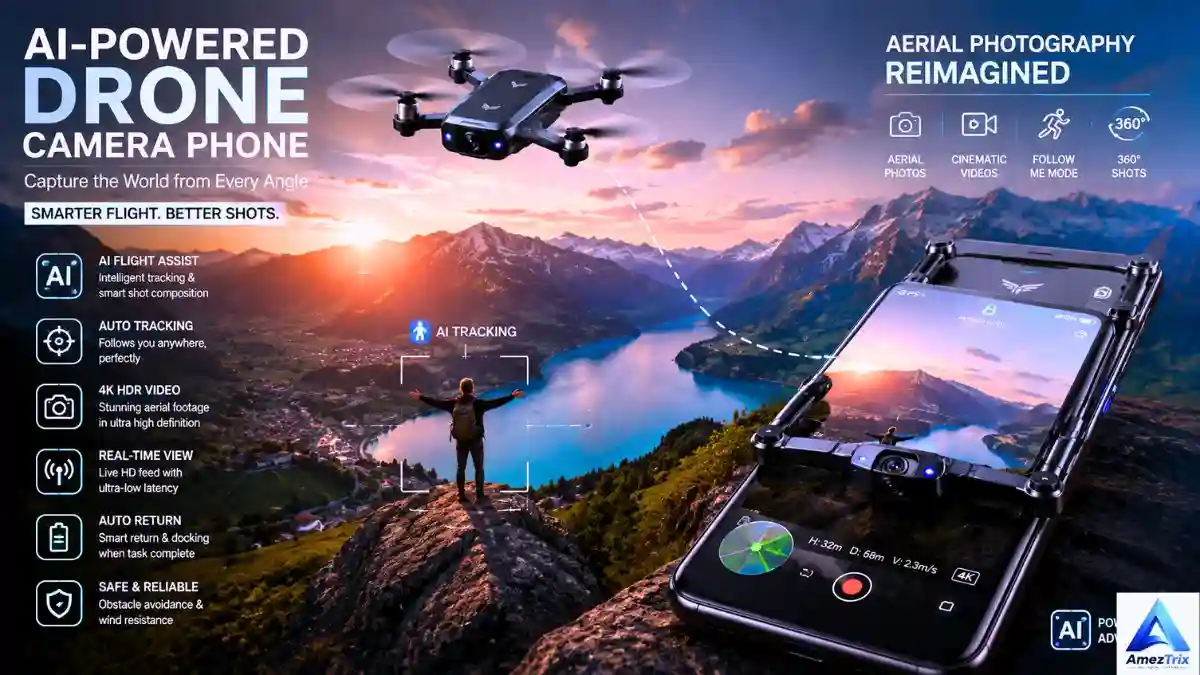
There was a time when adding a second rear lens felt like a genuine milestone. That era is well behind us now. Manufacturers have pretty much maxed out what sensors, chipsets, and screens can offer, and they’re setting their sights on something a lot more daring — a phone whose camera can physically detach and fly.
It sounds straight out of a spy thriller, but it’s not fiction anymore. A few major smartphone brands have already put working prototypes and filed patents on the table. And as curiosity around the Drone Camera Phone keeps building, tech fans are watching closely to see just how much this idea could shake up mobile photography, everyday content creation, and aerial video work.
What Actually Is a Drone Camera Phone?
Strip away the hype, and a Drone Camera Phone is really just a smartphone with one seriously ambitious upgrade: a camera module that can pop right out of the phone, unfold a set of miniature propellers, and take off on its own to grab aerial shots and cinematic footage.
Once you’re finished shooting, it flies itself back, docks into the phone, and starts recharging — no extra battery packs, no separate controller, no bulky case to lug around. It’s all packed into one device, which makes aerial photography far more practical for everyday use than it’s ever been.
Unlike the full-size drones enthusiasts carry around in backpacks, this flying camera phone isn’t built for long journeys through the sky. It’s designed for something more targeted: quick, smart, on-demand aerial shots that blend the ease of a smartphone with the creative freedom normally reserved for dedicated drones.
How Does the Whole Thing Actually Work in Flying Camera Phone?
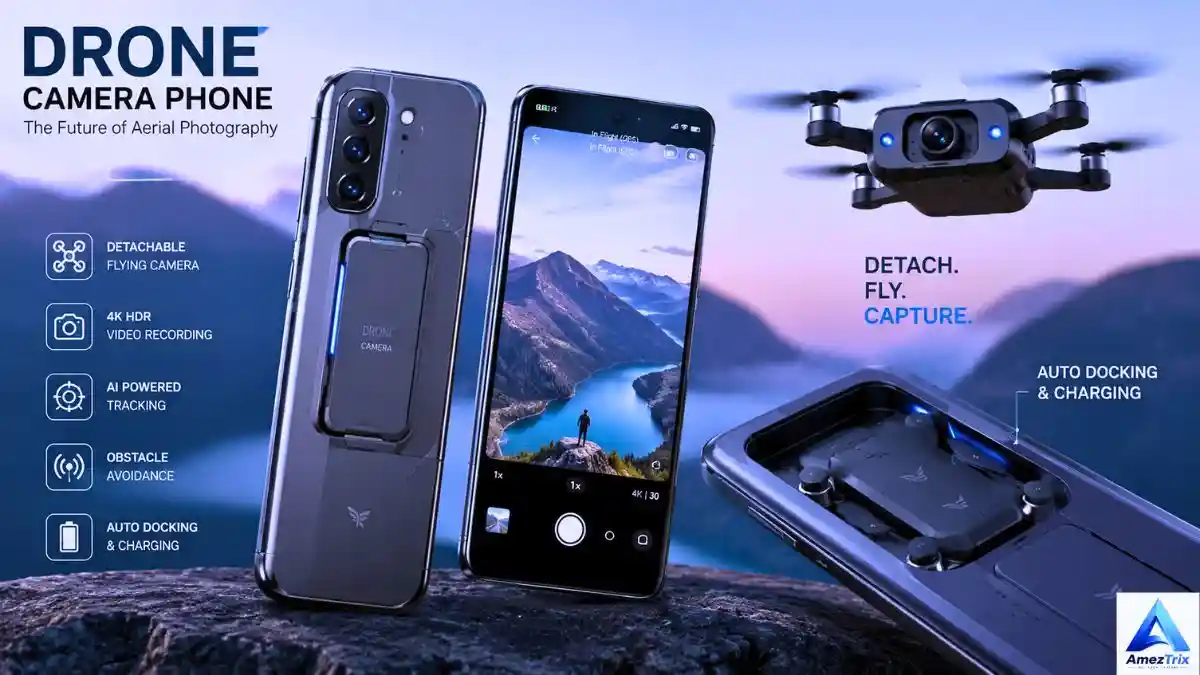
It’s less complicated than it sounds once you break it into steps.
1. The camera sits docked inside your phone. During everyday use, it looks and behaves like any normal rear camera.
2. You switch on “flight mode.” Miniature foldable blades snap open and tiny motors spin up almost instantly.
3. It talks to your phone wirelessly. Wi-Fi Direct, Bluetooth, and Ultra-Wideband keep the connection tight and low-lag.
4. AI takes the wheel. Onboard software handles balance, dodges obstacles, and locks onto faces or moving subjects — no joystick required.
5. It comes home on its own. Once you’re done filming, the module flies back and re-docks for a recharge, ready for next time.
Which Smartphone Brands Are Actually Working on Smartphone with Drone Camera?
The idea of a phone with its own flying Drone Camera Phone has generated a ton of buzz across the tech world, but there’s a real difference between an actual product, a filed patent, and a concept render someone leaked online. So let’s be clear upfront: no major smartphone maker has officially launched a commercial phone with a built-in, detachable flying drone camera. That said, a few brands have gotten close enough on paper to keep the rumor mill running.
1. Vivo
If one company’s name keeps coming up in this conversation, it’s Vivo. They filed a patent describing a smartphone with a detachable camera module — complete with tiny propellers, a dual-lens setup, and infrared sensors designed to detect obstacles mid-flight. The patent made headlines and got plenty of people talking, but it’s worth remembering: a patent filing isn’t a product launch. Vivo hasn’t released anything like this to the public.
2. Huawei
Huawei has floated some genuinely ambitious camera concepts over the years and keeps popping up in discussions around detachable flying Drone Camera Phone. The company has poured serious resources into AI photography and computational imaging, so if this category ever takes off commercially, Huawei is well positioned to be near the front of the pack.
3. Samsung
There’s no official word from Samsung on a Drone Camera Phone. But given how much the company has invested in AI-driven cameras, foldable hardware, and imaging research, it’s easy to see why speculation keeps circulating. As things stand, though, there’s no confirmed Samsung device with a flying camera in the works.
4. Xiaomi
Xiaomi has a reputation for jumping on unconventional smartphone ideas faster than most. Concept chatter and rumors do exist around the brand and flying cameras, but nothing has been officially confirmed or announced.
5. OPPO
OPPO has been busy pushing mobile imaging forward, and it recently confirmed it’s developing dedicated handheld gimbal cameras aimed at content creators. That’s a different product entirely from a flying Drone Camera Phone, but it does signal that OPPO is serious about pushing beyond the standard smartphone camera setup.
6. Apple
Apple hasn’t said a word publicly about anything resembling a drone camera phone. Still, between its computational photography chops, custom AI silicon, and growing interest in spatial computing, the company clearly has the technical foundation to explore something like this down the road, should the market ever demand it.
Where Things Stand Right Now
Right now, Vivo is the name most closely tied to this concept, thanks to its publicly known patent filing. Huawei, Samsung, Xiaomi, OPPO, and Apple all have the engineering muscle to build something similar, but none of them have brought an actual flying Drone Camera Phone to market. As battery tech, AI systems, and micro-drone engineering keep advancing, though, don’t be surprised if this idea eventually graduates from patent filings into a real flagship category.
Drone Phone Technology – Expected Specifications (Based on Industry Concepts & Patents)
Here’s the honest disclaimer first: since not a single smartphone brand has officially confirmed a commercial Drone Camera Phone, there’s no real launch date, no verified spec sheet, and no official pricing to point to. Everything floating around right now — including the table below — is pieced together from patent filings, leaked concepts, and educated industry guesswork.
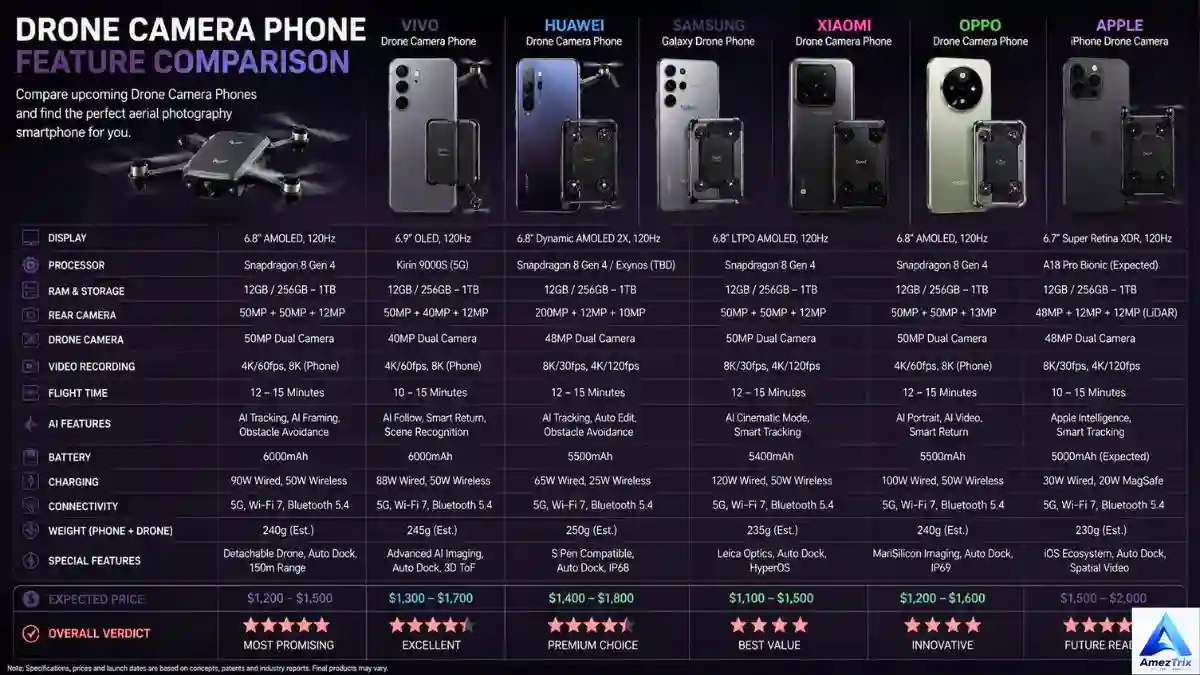
With that context in mind, here’s a breakdown of what each major brand’s version might look like if and when it actually reaches the market.
Upcoming Drone Camera Phones (Expected Specifications)
| Company | Where Things Stand | Likely Specs | Rumored Launch Window | Estimated Price |
|---|---|---|---|---|
| Vivo Drone Camera Phone | Furthest along — has a public patent and concept | 6.8″ AMOLED at 120Hz, flagship Snapdragon chip, 12–16GB RAM, 256GB–1TB storage, 6000mAh battery, detachable flying camera with a 50MP dual-lens setup, AI tracking, obstacle avoidance, 4K video | Possibly 2027–2028 | $1,200–$1,500 |
| Huawei Drone Camera Phone | Still just R&D chatter and concept talk | 6.9″ OLED display, Kirin flagship chip, 12–16GB RAM, 512GB storage, 6000mAh battery, AI-powered flying camera, HarmonyOS, 4K/8K recording | No confirmed timeline | $1,300–$1,700 |
| Samsung Galaxy Drone Phone | Purely rumor-stage at this point | Dynamic AMOLED 2X, Snapdragon/Exynos flagship chip, Galaxy AI, flying camera module, 200MP main sensor, 8K video, IP68 rating | No confirmed timeline | $1,400–$1,800 |
| Xiaomi Drone Camera Phone | Concept-level idea only | 6.8″ LTPO AMOLED, flagship Snapdragon chip, Leica-tuned camera system, AI-driven drone camera, 120W fast charging, HyperOS | No confirmed timeline | $1,100–$1,500 |
| OPPO Drone Camera Phone | Concept and future-tech territory | 120Hz AMOLED display, MediaTek/Qualcomm flagship chip, MariSilicon AI imaging chip, flying camera module, SuperVOOC fast charging | No confirmed timeline | $1,200–$1,600 |
| Apple iPhone Drone Camera | No official project exists | Super Retina XDR display, Apple silicon, Apple Intelligence, flying camera (concept only), Pro-grade camera system | No information available | $1,500–$2,000 |
A quick note before you take any of this at face value: every spec, price, and timeline above is a projection built from patents, concept art, and where current flagship phones are trending — not confirmed data. None of these companies has put an official Drone Camera Phone launch on the calendar.
So Who’s Actually Closest to Making This Real?
Out of every brand on this list, Vivo has the strongest claim to being ahead of the pack. It’s the only company with a publicly filed patent describing exactly this kind of device — a removable camera module built with miniature propellers, its own battery, and infrared sensors for dodging obstacles. That alone makes Vivo the most concrete step anyone has taken toward turning the Drone Camera Phone from a cool idea into an actual product.
What Makes These Phones Stand Out
A Camera That Actually Leaves the Phone
This is the headline feature. Being able to detach the lens entirely opens up shots a normal phone simply can’t take — overhead group photos, sweeping landscape footage, and cinematic flyovers that used to require a full drone kit.
Smart Subject Tracking
Whether you’re jogging, cycling, hiking, or vlogging on the move, the AI keeps you centered in frame automatically. There’s no need to hand your phone to a stranger or fumble with a tripod.
Built-In Obstacle Awareness
Onboard sensors watch for trees, walls, poles, and other hazards in real time, which cuts down significantly on accidental crashes.
High-Resolution Recording
Expect support for 4K and even 8K footage, along with slow-motion, HDR, and AI-driven stabilization to keep clips smooth.
Auto Return-to-Phone
Low battery or a weak signal automatically triggers the drone to fly back, so the odds of losing it mid-flight stay low.
Voice and Gesture Commands
Simple prompts like “follow me,” “take a photo,” or “come back” — plus gestures like a wave or a raised hand — mean you barely have to touch a control screen.
The AI Doing the Heavy Lifting
Artificial intelligence isn’t just a marketing buzzword here — it’s what makes the whole concept usable.
- Face recognition helps the drone identify and stay locked onto its owner.
- Scene detection automatically tweaks settings for sunsets, snow, cityscapes, portraits, and more.
- Object tracking follows people, pets, cars, or bikes through fast-moving action.
- Flight stabilization constantly adjusts motor output to counter gusts of wind.
- Computational photography brings HDR, night mode, super-resolution zoom, and automatic background blur to aerial shots too.
Drone Camera Phone vs. a Regular Smartphone
| Feature | Drone Camera Phone | Standard Smartphone |
|---|---|---|
| Flying camera | Yes | No |
| Aerial shots | Yes | No |
| Group selfies | Excellent | Limited |
| AI subject tracking | Advanced | Basic |
| Cinematic footage | Outstanding | Good |
| Creative angles | Practically unlimited | Limited |
Why People Are Excited About This
Shots you can’t get any other way. Top-down views, slow orbit shots, and full landscape sweeps — all without carrying separate gear.
A shortcut for content creators. YouTubers, travel bloggers, and Instagram/TikTok creators get pro-level aerial footage without buying, charging, and packing a standalone drone.
One device instead of two. No carrying case, no extra battery packs — everything lives inside the phone.
Hands-free filming. Great for runners, cyclists, and hikers who want footage of themselves without a camera operator.
Effortless group shots. Everyone gets in the photo — no timers, no selfie sticks, no asking a stranger.
The Catches Nobody Should Ignore
It’s not all smooth flying, though.
- Short battery life. Early estimates put flight time at roughly 5 to 15 minutes per charge — nowhere near a standalone drone.
- Weather sensitivity. Wind, rain, and dust can all ground such a small flying object fairly easily.
- A steeper price tag. The extra motors, sensors, and AI chips will almost certainly push these phones above typical flagship pricing.
- Local drone laws still apply. Even a phone-sized drone may fall under aviation and privacy regulations depending on where you live.
- More moving parts, more to go wrong. A detachable module means more mechanical components that need careful engineering and, potentially, pricier repairs.
Where This Technology Could Actually Get Used
- Travel and tourism — capturing mountains, coastlines, and cityscapes without hauling a separate drone
- Vlogging and social content — Reels, Shorts, and travel videos shot completely hands-free
- Real estate — quick aerial shots of properties and neighborhoods without hiring a drone operator
- Journalism — fast aerial coverage of events, traffic, or breaking news
- Construction — tracking site progress or inspecting rooftops without extra equipment
- Education — geography and science projects that benefit from an aerial view
- Adventure sports — cycling, trekking, surfing, and skateboarding footage that follows you automatically
Expected Specs on First-Generation Models
| Spec | Expected Range |
|---|---|
| Display | 6.8-inch AMOLED, LTPO |
| Refresh rate | 120Hz–165Hz |
| RAM | 12GB–24GB |
| Storage | 256GB–1TB |
| Phone battery | 5000–6500mAh |
| Charging speed | 100W–150W |
| Drone flight time | 8–15 minutes |
| Video recording | Up to 8K |
| Connectivity | 5G, Wi-Fi 7, Bluetooth, UWB |
Which Brands Could Get There First?
Huawei has already shown off one of the earliest concepts with a detachable flying camera, backed by its strong track record in AI photography.
Samsung is deep into foldable design and computational imaging, both of which line up naturally with a drone-phone hybrid.
Xiaomi tends to move fast on emerging tech and could realistically ship a lightweight, affordable version early.
OPPO and vivo both have strong imaging R&D that could translate well into stabilized, AI-tracked flying cameras.
Apple, while quiet on the topic publicly, has the computational photography and custom silicon chops to compete if the category takes off.
Roughly What They Might Cost
| Tier | Estimated Price |
|---|---|
| Entry-level concept | $700–$900 |
| Mid-range flagship | $900–$1,200 |
| Premium AI model | $1,200–$1,600 |
| Professional creator edition | $1,600–$2,000+ |
Is a AI Drone Camera Phone Worth Waiting For?
If you’re a traveler, content creator, or someone who just loves capturing memories from a fresh angle, this could eventually become your all-in-one gadget. If you need serious range, long flight times, or true professional cinematography, a dedicated Drone Camera Phone will still outperform a phone-based one for years to come.
FAQs: Drone Camera Phone
1. What exactly is a Drone Camera Phone?
It’s a smartphone built around a detachable camera module that can fly on its own and shoot photos or video from the air. Think of it as a phone and a mini drone rolled into one device.
2. How does a Drone Camera Phone actually work?
The camera pops out of the phone body, unfolds a set of tiny propellers, and stays connected wirelessly the whole time. From there, AI takes over — keeping it steady in the air, tracking your movements, and flying it back once you’re done.
3. Can I actually buy one right now?
Not really — at least not yet. What’s out there today are mostly prototypes and concept reveals. A small number of experimental models exist, but nothing mainstream has hit store shelves.
4. Who came up with the idea first?
Huawei is generally credited with showing off the earliest version of this concept — a phone with a flying Drone Camera Phone built right in. It never went into full commercial production, but it put the idea on the map.
5. Could this replace an actual drone someday?
Unlikely, at least for serious use. It’s built for quick, convenient shots, not the range or flight time a dedicated drone offers. Professionals filming long sessions will still reach for a proper drone.
6. How long can it stay in the air on one charge?
Based on current concepts, expect somewhere around 8 to 15 minutes per flight — shorter if it’s windy or you’re recording heavily.
7. Will it shoot in 4K or 8K?
That’s the plan for flagship versions. Expect 4K HDR as a baseline, with 8K likely reserved for higher-end models, backed by AI stabilization to keep footage smooth.
8. Is AI actually doing anything here, or is it just marketing talk?
It’s doing a lot, honestly. AI handles subject tracking, dodges obstacles, recognizes gestures, frames shots automatically, and adjusts settings based on the scene in front of it.
9. How far away can it fly from the phone?
Not very far — these are short-range by design, likely somewhere in the 10 to 50 meter range depending on the wireless connection and whatever local rules apply.
10. Is it actually safe to fly?
For the most part, yes, assuming you use it sensibly. Expect built-in safeguards like obstacle sensing, auto-landing, geofenced no-fly zones, and a quick emergency stop option.
11. Can it follow me around while I record myself?
Yes — that’s one of the standout features. A “Follow Me” mode uses AI to keep you in frame whether you’re walking, jogging, or cycling.
12. How much is one likely to cost?
Premium versions are expected to land somewhere between $900 and $2,000, depending on the camera hardware and how advanced the AI features are.
13. Can I fly it indoors?
You can, as long as there’s enough open space to avoid obstacles. The AI’s collision-avoidance system helps, but tight indoor spaces still carry some risk.
14. Does the camera charge itself after flying?
Yes — the idea is that it docks back into the phone automatically and starts recharging without you having to do anything.
15. Is it waterproof?
That depends entirely on the manufacturer. The phone itself might carry a solid water-resistance rating, but the detachable flying module could be built to a completely different standard.
16. What are the standout benefits?
- Aerial shots without needing a separate drone
- Smart, AI-driven subject tracking
- Hands-free recording
- Everything packed into one compact device
- Shooting angles a normal phone just can’t get
- A genuine win for travel content and vlogging
17. What are the downsides worth knowing about?
- Short flight windows
- A noticeably higher price tag
- More complex hardware that can go wrong
- Struggles in bad weather
- Pricier repairs if something breaks
- Still subject to local drone laws
18. Who’s this actually built for?
- Travel bloggers
- Vloggers and everyday content creators
- Social media influencers
- Photography enthusiasts
- Adventure and outdoor sports fans
- Small business owners needing quick promotional footage
19. What kind of processor would this need?
A flagship chipset with a dedicated AI engine — something powerful enough to handle real-time flight control alongside heavy-duty image processing.
20. Will selfies actually look better with this?
Quite likely. A flying camera can capture wider shots, fit more people into group selfies, and grab angles a front camera simply can’t reach.
21. Could I use this for professional photography work?
For everyday content and casual aerial shots, sure. For serious professional work, though, most photographers will still lean on dedicated cameras and proper drones for more control.
22. What technology is actually making this possible?
- Artificial Intelligence
- Computer Vision
- Machine Learning
- Wi-Fi Direct and Bluetooth
- Ultra-Wideband (UWB)
- GPS
- Brushless motors
- Image stabilization systems
23. Will it be any good at night photography?
That’s the goal — AI-powered night mode, HDR processing, and larger sensors are all expected to help these devices handle low-light shots better over time.
24. Is flying one of these actually legal?
It depends on where you live. Drone regulations vary a lot by country, so it’s worth checking local aviation and privacy laws before taking one up in the air.
25. Is it worth waiting for one?
If you’re into travel, filmmaking, or creating content for social media, this could turn into a genuinely useful all-in-one tool. Just weigh things like battery life, build quality, software support, and repair costs — plus your local drone laws — before deciding it’s for you.
The Bottom Line
Drone camera phones aren’t just another spec bump — they’re a genuinely different way of thinking about mobile photography. Battery life, weight, cost, and regulation are all real hurdles standing between today’s concept videos and a phone sitting on store shelves. But as AI, battery tech, and miniaturized motors keep improving, it’s not hard to imagine flying cameras becoming as normal a smartphone feature as dual lenses are today.
For now, it’s a technology worth watching closely — especially if you’re the kind of person who’s always looking for a better angle.
About Author
Rajendra Parmar is the Founder and Editor of AmezTrix, where he covers Artificial Intelligence, Technology, WordPress, Web Hosting, Digital Marketing, Gadgets, and Software. His mission is to simplify complex technology through practical tutorials, honest reviews, and well-researched guides that help readers make smarter digital decisions.

Rajendra Parmar
Founder & Editor • AmezTrix
Rajendra Parmar is the Founder and Editor of AmezTrix, a platform covering Artificial Intelligence, Technology, WordPress, Web Hosting, Digital Marketing, Gadgets, Software Reviews, and emerging innovations. His mission is to simplify complex technology through practical tutorials, honest reviews, and well-researched guides that help readers make smarter digital decisions.