Discover 6G Technology, its features, speed, applications, benefits, 5G comparison, and future. Learn everything in this complete guide by AmezTrix.
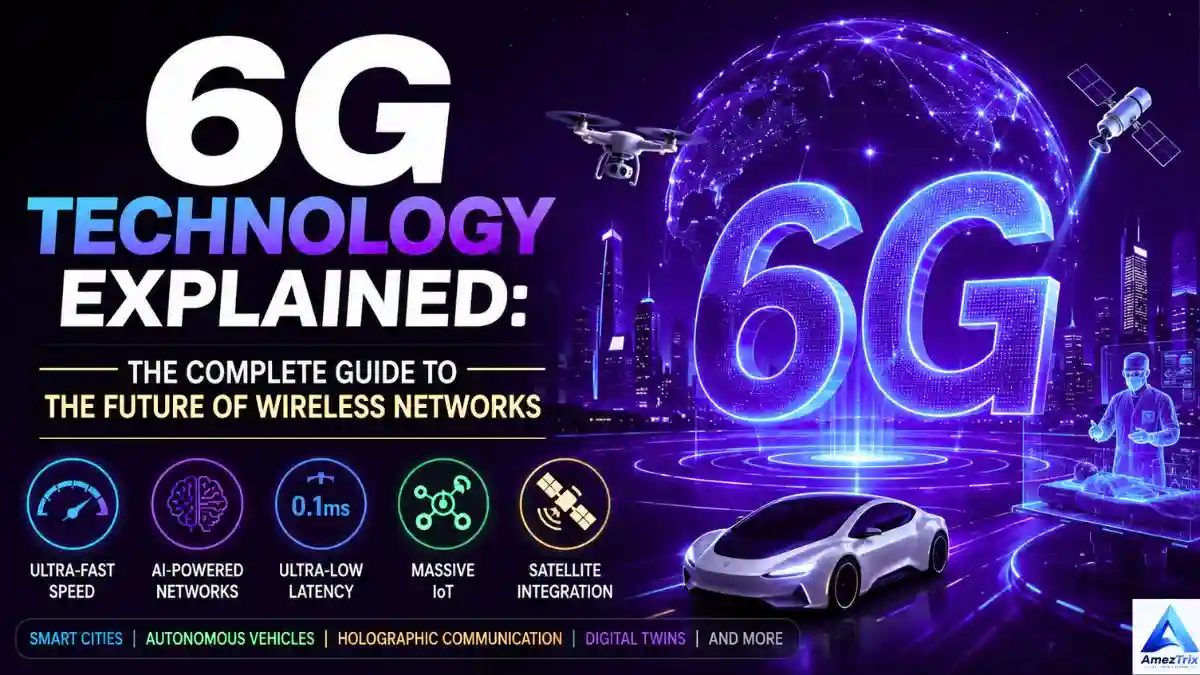
6G Technology Explained: The Complete Guide to the Future of Wireless Networks
Everything you need to know about 6G — speed, features, real-world uses, benefits, roadblocks, and what it actually means for the way we’ll live and work.
If you’ve been keeping an eye on tech headlines lately, you’ve probably noticed 6G Technology popping up more and more — even though most of us are still getting used to 5G. So what’s the deal? Is 6G just “5G but faster,” or is something bigger actually happening here?
Short answer: it’s bigger. Much bigger.
6G Technology isn’t simply the next number in a sequence. It’s being built as a completely different kind of network — one where artificial intelligence isn’t bolted on as an extra feature but woven into the very core of how data moves. Think self-driving cars talking to traffic lights in real time, surgeons operating on patients hundreds of miles away with zero lag, or holographic meetings that feel like the other person is actually in the room with you. That’s the world 6G is being designed for.
In this guide, we’ll break down what 6G Technology actually is, how it works, what makes it different from 5G, where it’ll be used first, and what obstacles still stand between today’s labs and tomorrow’s global rollout.
What Exactly Is 6G Technology?
6G Technology is the sixth generation of wireless network technology — the one set to take over once 5G infrastructure matures and reaches its limits. Where 5G focused mainly on faster mobile broadband and connecting more devices, 6G is aiming for something far more ambitious: a fully intelligent, self-optimizing network that blends the physical and digital worlds together.
Instead of treating AI, machine learning, edge computing, and satellite connectivity as separate add-ons, 6G is designed to bake all of these into a single, unified system from day one.
Most experts and standards bodies point to around 2030 as the target for commercial 6G rollout, though early trials and prototypes are already happening in research labs across the globe.
6G Speed at a Glance
| Feature | Details |
|---|---|
| Generation | Sixth Generation (6G) |
| Expected Rollout | Around 2030 |
| Theoretical Top Speed | Up to 1 Tbps |
| Target Latency | Under 0.1 milliseconds |
| Spectrum Used | Sub-Terahertz and Terahertz bands |
| AI Integration | Built-in, not bolted-on |
| Reach | Land, air, sea, and space |
| Core Goal | Smart, seamless global connectivity |
| Predecessor | 5G |
A Quick Look Back: How We Got Here
Wireless networks have come a long way in just four decades, and each generation solved a different problem.
| Generation | Era | Big Breakthrough |
|---|---|---|
| 1G | 1980s | Basic analog voice calls |
| 2G | 1990s | Digital calls and text messaging |
| 3G | 2000s | Mobile internet access |
| 4G LTE | 2010s | Smooth video streaming and app-heavy usage |
| 5G | 2020s | IoT, smart cities, low-latency connections |
| 6G | ~2030 | AI-driven, self-managing networks |
Each jump brought more speed and better reliability. But 6G Technology is aiming to change the game entirely by creating networks that can think, learn, and adapt on their own — rather than just moving data faster.
Why Do We Even Need 6G?
Fair question. 5G is still rolling out in many parts of the world, so why rush to the next thing already?
The truth is, several fast-growing technologies are already pushing 5G to its limits — things like:
- Fully autonomous vehicles
- Smart factories running on real-time automation
- Brain-computer interfaces
- Holographic communication
- Massive-scale IoT deployments
- Space-based internet
- Extended reality (AR/VR/XR) at scale
These aren’t sci-fi anymore — they’re being tested today. And they need something 5G simply wasn’t built to deliver: near-instant response times, enormous network capacity, and infrastructure that can manage itself intelligently. That’s the gap 6G Technology is stepping in to fill.
4G vs 5G vs 6G Network: Full Comparison Table

| Category | 4G LTE | 5G | 6G (Expected) |
|---|---|---|---|
| Full Name | Fourth Generation | Fifth Generation | Sixth Generation |
| Rollout Period | 2009–2010 | 2019–2020 | Around 2030 |
| Network Type | Mobile Broadband | Enhanced Mobile Broadband | AI-Native Intelligent Network |
| Peak Download Speed | Up to 1 Gbps | Up to 20 Gbps | Up to 1 Tbps (1,000 Gbps) |
| Everyday User Speed | 20–100 Mbps | 100 Mbps–1 Gbps | 1–10+ Gbps (projected) |
| Upload Speed | Up to 500 Mbps | Up to 10 Gbps | 100+ Gbps (projected) |
| Latency | 30–50 ms | ~1 ms | Under 0.1 ms |
| Frequency Bands | Below 6 GHz | Sub-6 GHz & mmWave | Sub-THz & THz spectrum |
| Bandwidth | Moderate | High | Extremely high |
| AI Integration | Not present | Limited, add-on | Fully native |
| Network Intelligence | Manually managed | AI-assisted | Fully autonomous |
| Cloud Integration | Basic | Advanced | Cloud + edge + AI combined |
| Edge Computing | Minimal | Supported | A core network layer |
| IoT Device Support | Thousands | Millions | Billions |
| Device Density | Low | High | Extremely high |
| Reliability | Solid | Very high | Ultra-reliable |
| Energy Efficiency | Moderate | Improved | AI-optimized, green-focused |
| Spectrum Efficiency | Moderate | High | Extremely high |
| Coverage | Land-based only | Land + limited satellite | Land, air, sea, and space |
| Automation Level | Manual | Partially automated | Fully intelligent |
| Beamforming | Basic | Advanced | AI-driven, dynamic |
| Massive MIMO | Limited | Supported | Highly advanced |
| Security | Standard LTE encryption | Stronger encryption | AI + blockchain + quantum-resistant |
| Communication Focus | Human-to-human | Human + connected devices | Human, machine, and intelligent systems |
| Real-Time Communication | Limited | Excellent | Practically instant |
Streaming, Gaming & Immersive Experiences
| Category | 4G LTE | 5G | 6G (Expected) |
|---|---|---|---|
| Video Streaming Quality | HD / Full HD | 4K & 8K | 16K, holographic & immersive |
| Gaming Experience | Standard online gaming | Cloud gaming | Immersive XR & metaverse gaming |
| Virtual Reality (VR) | Basic | Good | Ultra-realistic |
| Augmented Reality (AR) | Limited | Advanced | Immersive mixed reality |
| Extended Reality (XR) | Not optimized | Supported | Native, built-in support |
| Holographic Calls | Not possible | Experimental stage | Fully supported (expected) |
6G Technology – Real-World Applications: How Each Generation Performs
| Use Case | 4G LTE | 5G | 6G (Expected) |
|---|---|---|---|
| Autonomous Vehicles | Limited support | Supported | Highly reliable |
| Remote Surgery | Very difficult | Possible | Highly accurate & real-time |
| Smart Cities | Basic connectivity | Advanced | Fully intelligent city systems |
| Industrial Automation | Limited | Industry 4.0 level | Industry 5.0 level |
| Digital Twins | Not available | Just emerging | A core technology |
| AI Applications | Cloud-dependent | Edge AI | AI woven into everything |
| Smart Homes | Connected devices | Smart automation | Fully autonomous, intelligent homes |
| Satellite Integration | None | Limited | Fully integrated |
| Drone Communication | Limited | Reliable | Fully autonomous drone networks |
| Environmental Monitoring | Basic | Advanced | Real-time AI-based monitoring |
| Healthcare | Telemedicine | Remote patient monitoring | AI hospitals & robotic surgery |
| Education | Online learning | Interactive learning | Holographic classrooms |
| Agriculture | Smart sensors | Precision farming | Fully AI-driven smart agriculture |
| Manufacturing | Basic automation | Smart factories | Fully autonomous factories |
Core Technology & Big-Picture Goals
| Category | 4G LTE | 5G | 6G (Expected) |
|---|---|---|---|
| Main Underlying Tech | LTE, OFDMA, MIMO | Massive MIMO, edge computing, network slicing | AI, Terahertz spectrum, digital twins, quantum communication, edge AI, ISAC |
| Primary Goal | Faster mobile internet | Massive connectivity | Intelligent global connectivity |
| Expected Lifespan | 2010–2030+ | 2020–2040+ | 2030–2050+ |
Quick Scorecard: 4G vs 5G vs 6G
| Category | 4G | 5G | 6G |
|---|---|---|---|
| Speed | ⭐⭐ | ⭐⭐⭐⭐ | ⭐⭐⭐⭐⭐ |
| Latency | ⭐⭐ | ⭐⭐⭐⭐ | ⭐⭐⭐⭐⭐ |
| AI Support | Not present | Limited | Native |
| IoT Capacity | Basic | Advanced | Massive |
| Security | Good | Better | Best-in-class |
| Automation | Low | Medium | Fully AI-driven |
| Future-Readiness | Moderate | High | Extremely high |
| Smart City Support | Basic | Advanced | Fully intelligent |
| Metaverse Readiness | Not supported | Partial | Fully supported |
| Holographic Calling | Not supported | Experimental | Expected to be standard |
| Satellite Connectivity | Not supported | Limited | Fully integrated |
4G vs 5G vs 6G: The Deep-Dive Technical Comparison
A closer look under the hood — architecture, security, frequency bands, real-world use cases, and everything else that separates these three generations of wireless technology.
We’ve already covered the big-picture differences between 4G, 5G, and 6G — speed, latency, and general capabilities. But if you really want to understand why these networks behave so differently, you have to look past the headline numbers and into the actual architecture, security models, and industry applications behind them.
This guide breaks that down, category by category.
1. Network Architecture
| Category | 4G | 5G | 6G |
|---|---|---|---|
| Core Architecture | LTE-based | Cloud-native | AI-native |
| Core Network | EPC (Evolved Packet Core) | 5G Core (5GC) | AI-powered intelligent core |
| Virtualization | Minimal | NFV & SDN-based | Fully automated by AI |
4G relied on hardware-heavy infrastructure. 5G shifted much of that into flexible, software-defined systems. 6G Technology goes a step further, building a core network that can reconfigure and optimize itself without manual intervention.
2. Frequency Bands
| Network | Frequency Range |
|---|---|
| 4G | 700 MHz – 2.6 GHz |
| 5G | Sub-6 GHz plus 24–100 GHz (mmWave) |
| 6G | 100 GHz – 1 THz (expected) |
Higher frequencies mean more bandwidth and faster data transfer — but also shorter signal range, which is why 6G’s design leans so heavily on smart antennas and dense network deployment.
3. Coverage Reach
| Environment | 4G | 5G | 6G |
|---|---|---|---|
| Cities | ✅ | ✅ | ✅ |
| Rural Areas | Good | Moderate | Better (satellite-backed) |
| Airplanes | ❌ | Limited | ✅ |
| Ships | Limited | Limited | ✅ |
| Satellites | ❌ | Partial | Fully integrated |
This is where 6G’s satellite ambitions really stand out — the goal is coverage that doesn’t stop at the edge of a city or coastline.
4. Device Support
| Device Type | 4G | 5G | 6G |
|---|---|---|---|
| Smartphones | ✅ | ✅ | ✅ |
| Smartwatches | Limited | Excellent | AI-integrated |
| Smart Cars | Basic | Advanced | Fully autonomous |
| Robots | Limited | Good | Excellent |
| Drones | Basic | Advanced | AI-controlled |
5. Entertainment & Streaming
| Feature | 4G | 5G | 6G |
|---|---|---|---|
| HD Streaming | ✅ | ✅ | ✅ |
| 4K Streaming | Limited | Excellent | Excellent |
| 8K Streaming | ❌ | Supported | Even better performance |
| 16K Streaming | ❌ | ❌ | Expected |
| Cloud Gaming | Basic | Excellent | Ultra-low latency |
| Holographic Calls | ❌ | Experimental | Expected to be standard |
6. Business & Industry Applications
| Industry | 4G | 5G | 6G |
|---|---|---|---|
| Banking | Online banking | AI-assisted banking | Real-time intelligent banking |
| Healthcare | Telemedicine | Remote patient monitoring | Robotic surgery |
| Manufacturing | Basic automation | Smart factories | Industry 5.0 |
| Agriculture | Smart sensors | Precision farming | Fully AI-driven farming |
7. AI Capabilities
| Feature | 4G | 5G | 6G |
|---|---|---|---|
| AI Support | ❌ | Partial | Fully native |
| Self-Optimization | ❌ | Limited | Complete |
| Predictive Maintenance | ❌ | Basic | Advanced |
| Network Learning | ❌ | Partial | Fully autonomous |
8. Security Standards
| Security Feature | 4G | 5G | 6G |
|---|---|---|---|
| Encryption | Standard LTE | Advanced | Quantum-resistant |
| AI-Based Security | ❌ | Limited | Yes |
| Blockchain Support | ❌ | Experimental | Expected |
| Zero Trust Model | ❌ | Partial | Fully native |
9. Environmental Impact
| Factor | 4G | 5G | 6G |
|---|---|---|---|
| Power Consumption | High | Lower | AI-optimized |
| Carbon Footprint | High | Medium | Lower |
| Green Networking | ❌ | Partial | Fully implemented |
10. Communication Types
| Type | 4G | 5G | 6G |
|---|---|---|---|
| Human to Human | ✅ | ✅ | ✅ |
| Human to Machine | Limited | Advanced | Excellent |
| Machine to Machine | Limited | Excellent | Intelligent |
| Machine to AI | ❌ | Limited | Fully native |
11. Real-Life Examples
| Network | Everyday Examples |
|---|---|
| 4G | YouTube HD streaming, WhatsApp calls, Netflix |
| 5G | Cloud gaming, smart city systems, self-driving cars |
| 6G | Holographic meetings, digital twins, AI-powered robots, brain-computer interfaces |
12. Generation Timeline
| Generation | Launched | Defining Innovation |
|---|---|---|
| 1G | 1980s | Analog voice calls |
| 2G | 1990s | SMS & digital voice |
| 3G | 2000s | Mobile internet |
| 4G | 2010 | HD streaming |
| 5G | 2020 | IoT & smart cities |
| 6G | Around 2030 | AI-native networks |
13. Advantages & Disadvantages
| Network | Advantages | Disadvantages |
|---|---|---|
| 4G | Affordable, wide coverage | Higher latency |
| 5G | Fast, low latency | Coverage gaps in some regions |
| 6G | AI-driven, ultra-fast, intelligent | High cost, still under development |
14. Best Use Case by Network
| Use Case | Best-Suited Network |
|---|---|
| Video Streaming | 5G / 6G |
| Online Gaming | 5G |
| Smart Home | 5G |
| Industrial Automation | 6G |
| Remote Surgery | 6G |
| Metaverse | 6G |
| AI Robots | 6G |
| Digital Twins | 6G |
Line by line, the pattern is hard to miss: 4G built the foundation for mobile internet as we know it, 5G turned that foundation into a connected, low-latency ecosystem for millions of devices, and 6G Technology is being engineered to make the network itself intelligent — capable of securing, optimizing, and scaling itself with minimal human oversight.
If you’re planning for the next decade of connectivity — whether that’s a business strategy, a tech investment, or just staying informed — this is the level of detail that actually matters beyond the marketing headlines.
Top 10 Countries Leading the Global Race Toward 6G
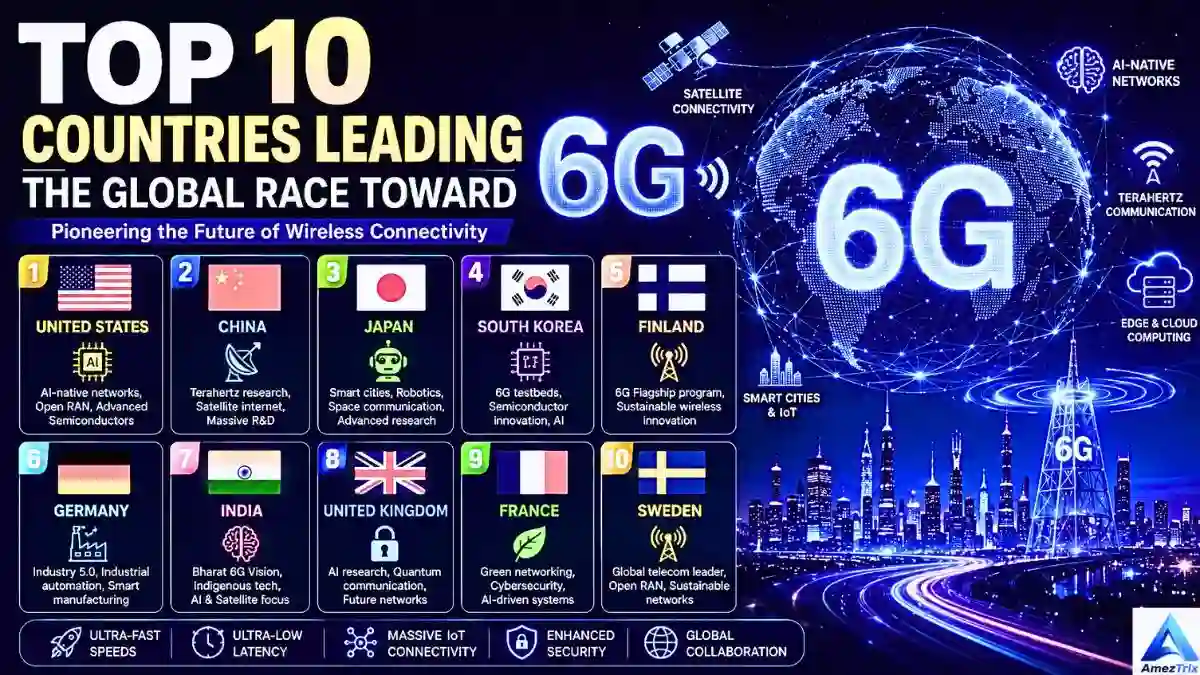
Which nations are actually putting money, talent, and infrastructure behind next-generation wireless networks — and what each one is focused on.
6G Technology is still years away from commercial rollout, but the race to develop it is already well underway. Governments, universities, and telecom giants across the globe are pouring billions into research, testbeds, and standardization efforts — each with a slightly different focus depending on their strengths.
Here’s a look at the ten countries currently setting the pace.
| Rank | Country | Key Focus Areas | Leading Organizations | Where Things Stand |
|---|---|---|---|---|
| 🥇 1 | United States | AI-native networks, Open RAN, defense communications | Next G Alliance, Qualcomm, Apple, Intel, NVIDIA | Deep industry collaboration backed by extensive research |
| 🥈 2 | China | Terahertz communication, satellite internet, AI-driven networks | Huawei, ZTE, China Mobile, Chinese Academy of Sciences | Massive, government-funded R&D with active prototype testing |
| 🥉 3 | Japan | Smart cities, robotics, space communication | NTT DOCOMO, NEC, Fujitsu, Sony | Well-established 6G research programs and live technology trials |
| 4 | South Korea | Semiconductor innovation, AI, smart devices | Samsung, LG Electronics, SK Telecom, KT Corporation | Early-stage 6G testbeds with heavy R&D funding |
| 5 | Finland | Sustainable 6G design, wireless innovation | University of Oulu, Nokia | Home to the internationally recognized 6G Flagship program |
| 6 | Germany | Industry 5.0, industrial automation, smart manufacturing | Fraunhofer Institutes, Deutsche Telekom, Siemens | Strong emphasis on factory and industrial-grade applications |
| 7 | India | Indigenous telecom development, AI, satellite communication | C-DOT, IITs, Bharat 6G Alliance | Building momentum through the national Bharat 6G Vision |
| 8 | United Kingdom | AI research, quantum communication, future wireless systems | University of Bristol, University of Surrey, BT Group | Close academic-industry partnerships driving next-gen research |
| 9 | France | Green networking, cybersecurity, AI | Orange, CEA, Nokia France | Prioritizing secure, energy-efficient network design |
| 10 | Sweden | Sustainable mobile networks, Open RAN | Ericsson, KTH Royal Institute of Technology | A longstanding global leader in telecom standards and radio tech |
So Which Network Is Actually Right for What?
It’s easy to assume “newer is always better,” but each generation genuinely fits different needs.
4G LTE is still perfectly capable for everyday things — HD video calls, scrolling social media, browsing, and general mobile internet use. If your needs are simple, 4G isn’t going anywhere soon.
5G is where things get serious for anyone using cloud gaming, 4K/8K streaming, IoT devices, or working within smart-city and enterprise environments. It’s the current sweet spot for speed and reliability without needing brand-new infrastructure.
6G Technology is being built for what comes next — AI-native networking, holographic communication, Digital Twins, Industry 5.0, fully immersive XR, autonomous systems at scale, and satellite-backed internet that reaches literally anywhere on Earth.
Key Features That Make 6G Different
1. Speeds That Sound Almost Unbelievable
5G tops out at roughly 20 Gbps in ideal conditions. 6G Technology is chasing a theoretical ceiling of 1 terabit per second — that’s roughly 50 times faster on paper.
What would that actually feel like day to day? Downloading an entire 8K movie in seconds. Pulling a massive AI model onto your device almost instantly. Backing up your entire phone to the cloud before you’ve finished your coffee.
2. Latency So Low You Won’t Notice It
Latency is the tiny delay between sending a signal and getting a response. 5G already cut this down significantly, but 6G is targeting under 0.1 milliseconds — a delay so small it’s essentially invisible to both humans and machines.
That level of responsiveness opens the door to things that simply can’t afford any lag: remote surgery performed by a robotic arm hundreds of miles away, split-second decisions in autonomous vehicles, and live holographic calls that feel completely natural.
3. A Network Built Around AI, Not Just Using It
This is arguably the biggest shift. In 6G, artificial intelligence isn’t a feature you turn on — it’s baked into the network’s DNA. AI systems will continuously:
- Reroute traffic to avoid congestion
- Spot and shut down cyber threats before they spread
- Predict when hardware is about to fail
- Balance bandwidth automatically across millions of devices
- Fine-tune energy use in real time
In short, the network manages itself, freeing up humans to focus on building things on top of it instead of babysitting it.
4. Tapping Into Terahertz Frequencies
To hit those massive speeds, 6G Technology will rely on Terahertz (THz) spectrum — frequencies far higher than anything used commercially today. The upside is enormous bandwidth. The catch is that THz signals don’t travel far and struggle to pass through walls.
Engineers are already working around this with smarter antenna designs and beamforming techniques that steer signals precisely where they’re needed, rather than broadcasting them everywhere.
5. Computing Power Right Where You Need It
Rather than shipping every request off to a faraway data center, 6G pushes much of the processing to the “edge” — servers physically close to where the data is generated. That means quicker responses, better privacy since less data travels long distances, and smoother performance for things like cloud gaming and real-time AI.
6. Coverage That Actually Reaches Everywhere
One of the more exciting promises of 6G is genuinely global coverage — not just cities and suburbs. By combining satellites, high-altitude platforms, ground towers, and even underwater systems, 6G aims to bring connectivity to mountain villages, open oceans, deserts, and everywhere in between.
7. Built With Sustainability in Mind
Given how much energy networks already consume, 6G Technology research is putting real weight behind sustainability — smarter power management, renewable-powered base stations, and AI systems that automatically dial down energy use when it’s not needed.
How Will 6G Actually Work Behind the Scenes?
6G isn’t one single technology — it’s an entire ecosystem of tools working together, including:
- Artificial Intelligence — constantly monitoring and tuning network performance
- Machine Learning — predicting traffic spikes before they happen
- Edge Computing — handling processing close to the user
- Cloud Computing — providing scalable backup power and storage
- Digital Twins — virtual copies of real-world systems used for testing and monitoring
- IoT Integration — connecting billions of devices at once
- Quantum Communication — a longer-term goal for near-unbreakable security
- Intelligent Reflective Surfaces — smart panels that redirect signals for better coverage
5G vs 6G Technology: A Side-by-Side Comparison
| Category | 5G | 6G |
|---|---|---|
| Status | Live and expanding | Expected ~2030 |
| Peak Speed | ~20 Gbps | Up to 1 Tbps (theoretical) |
| Latency | ~1 ms | Under 0.1 ms |
| AI Role | Add-on feature | Core architecture |
| Spectrum | Sub-6 GHz, mmWave | Sub-THz and THz |
| Device Density | High | Extremely high |
| Coverage | Mostly land-based | Land, air, sea, and space |
| Focus | Faster mobile broadband | Intelligent global connectivity |
Where 6G Will Actually Show Up in Everyday Life
Healthcare
Remote robotic surgery, continuous patient monitoring through wearables, AI-assisted diagnosis, and smart ambulances that relay vitals before a patient even arrives at the hospital.
Smart Cities
Traffic that adjusts itself in real time, smart street lighting, automated waste collection, and faster emergency response coordination.
Education
Holographic classrooms, virtual labs students can experiment in from home, and real-time language translation that breaks down classroom barriers entirely.
Autonomous Vehicles
Cars that talk directly to each other and to traffic infrastructure, dramatically cutting down accidents and improving traffic flow.
Smart Manufacturing (Industry 5.0)
Factories where robots and humans work side by side, predictive maintenance that flags problems before machines break down, and digital twins that simulate production lines before anything is built.
Agriculture
Drones monitoring crop health, precision irrigation systems, and autonomous tractors working fields around the clock.
Entertainment
Cloud gaming with zero lag, holographic concerts, and immersive metaverse experiences that finally feel real.
Space and Remote Connectivity
Satellite internet reaching the most isolated corners of the planet, plus support for future lunar and deep-space missions.
Defense and Public Safety
Secure military communication, disaster response coordination, and real-time surveillance for border security.
Finance
Instant fraud detection, biometric verification, and ultra-secure digital transactions.
The Real Benefits of 6G
- Blazing-fast internet for everything from downloads to live streaming
- Latency so low it feels instantaneous
- Networks that manage and heal themselves using AI
- Massive support for connected devices — think entire smart cities online at once
- Stronger, smarter cybersecurity
- Lower long-term energy consumption
- Truly global coverage, including remote and underserved regions
The Challenges Standing in the Way
It’s not all smooth sailing. 6G Technology still faces some serious hurdles before it becomes a everyday reality:
- Massive infrastructure costs — new towers, chips, and satellite systems don’t come cheap
- Short-range Terahertz signals — they carry huge bandwidth but don’t travel far or penetrate walls well
- Device compatibility — today’s phones and routers simply aren’t built for 6G
- Spectrum management — coordinating frequency use across countries is a regulatory headache
- Higher initial energy demand — running dense AI-powered networks isn’t cheap on power, at least at first
- Global standardization — getting every country and company to agree on protocols takes time
None of these are dealbreakers — they’re simply the kind of problems that get solved gradually, the same way they were with every generation before this one.
Security: What 6G Is Doing Differently
With billions of new devices coming online, cybersecurity has to level up too. Here’s what’s being built into 6G Technology to keep things safe:
- AI-based threat detection that spots unusual activity as it happens
- Quantum-resistant encryption to stay ahead of future quantum-computing threats
- Blockchain-based authentication for decentralized identity verification
- Zero Trust security models, where nothing is trusted by default — every device has to prove itself
- Privacy-preserving AI, using techniques like federated learning so systems can learn without exposing raw personal data
Who’s Leading the Race to 6G?
Countries and companies around the world are pouring resources into 6G research:
- United States — focused on AI-native networks, Open RAN, and semiconductor innovation
- China — heavily investing in satellite communication and Terahertz research
- Japan — pushing robotics, smart manufacturing, and space communication
- South Korea — building on its telecom leadership with AI-enabled networks
- European Union — prioritizing green networking and cross-border data sovereignty
- India — expanding indigenous telecom tech, semiconductor development, and satellite communication
On the corporate side, companies like Nokia, Ericsson, Samsung, Qualcomm, Huawei, Intel, Apple, NEC, Fujitsu, and MediaTek are all actively researching next-generation chipsets and radio technology.
What the Future Might Actually Look Like
Zoom out far enough, and 6G Technology starts to look less like an internet upgrade and more like the backbone of an entirely new digital economy — one where AI runs much of the network with minimal human oversight, satellites and ground networks blend seamlessly, and sustainability isn’t an afterthought but a design requirement from the start.
We’re likely looking at a gradual rollout rather than a single “switch flip” moment — early testbeds, then limited commercial deployment, then wider adoption as devices and infrastructure catch up.
FAQs About 6G Technology (People Also Ask)
1. What is 6G Technology?
6G Technology is the sixth generation of wireless networks, expected to take over from 5G sometime around 2030. It’s built around ultra-fast speeds, AI-driven network management, near-instant response times, and smarter connectivity for things like smart cities, self-driving cars, healthcare, and immersive digital experiences.
2. When is 6G expected to launch?
Most industry experts point to around 2030 for commercial availability, though research, prototype testing, and standardization work are already happening in labs worldwide.
3. How fast will 6G actually be?
On paper, 6G could hit theoretical speeds of up to 1 terabit per second (1 Tbps) — a massive jump over what 5G currently offers.
4. What really separates 6G from 5G?
Expect noticeably higher speeds, much lower latency, AI built directly into the network (rather than added on), better power efficiency, deeper satellite integration, and support for newer concepts like Digital Twins and holographic calling.
5. Is 6G going to completely replace 5G?
Eventually, yes. Just like every generation before it, 6G Technology will gradually take over — but 5G isn’t disappearing overnight. The two will likely run side by side for a good stretch of time.
6. What frequencies will 6G run on?
Researchers are focused on sub-Terahertz and Terahertz (THz) bands, which offer the massive bandwidth needed for those ultra-high speeds.
7. What are the standout features of 6G?
- Theoretical speeds up to 1 Tbps
- Latency targeted below 0.1 milliseconds
- AI-native network architecture
- Support for massive-scale IoT
- Built-in edge computing
- Satellite connectivity
- Digital Twin support
- Smart, automated network management
8. What are the biggest advantages of 6G?
- Extremely fast internet
- Practically zero lag
- AI-managed, self-optimizing networks
- Stronger cybersecurity
- Better energy efficiency
- Smarter city infrastructure
- Room for billions of connected devices
9. What downsides does 6G come with?
- High rollout and infrastructure costs
- Terahertz signals don’t travel very far
- More complex network design
- Global standardization still needs to be sorted out
- Privacy and security concerns tied to AI-driven data handling
10. Which countries are ahead in the 6G race?
The United States, China, Japan, South Korea, Finland, Germany, India, the United Kingdom, France, and Sweden are currently leading global 6G research efforts.
11. Which companies are actually building 6G?
Nokia, Ericsson, Samsung, Qualcomm, Huawei, Intel, Apple, NEC, Fujitsu, and MediaTek are among the major players investing heavily in 6G research and development.
12. Will my phone automatically get 6G once it launches?
No — current smartphones aren’t built to handle 6G’s radio technology. You’ll need new hardware designed specifically for it once commercial networks go live.
13. Can I use 6G right now?
Not yet. It’s still in active research and testing phases, with commercial rollout expected around 2030.
14. How much faster is 6G compared to 5G, really?
5G tops out around 20 Gbps theoretically. 6G Technology is aiming for up to 1 Tbps — roughly 50 times faster on paper.
15. Will 6G make gaming better?
Definitely. Thanks to near-zero latency and much higher bandwidth, expect smoother cloud gaming, more responsive VR experiences, and lag-free multiplayer sessions.
16. What kind of impact could 6G have on healthcare?
Think remote robotic surgery, AI-assisted diagnostics, real-time patient monitoring, fully connected smart hospitals, and faster, higher-resolution medical imaging.
17. Can 6G actually support self-driving cars?
Yes — its ultra-reliable, low-latency connections are exactly what’s needed for vehicles to communicate instantly with each other and with road infrastructure.
18. How big a role does AI play in 6G?
A huge one. AI is expected to be baked directly into the network, handling traffic optimization, threat detection, resource management, failure prediction, and general automation.
19. What does edge computing bring to 6G?
It moves data processing closer to the user instead of routing everything to a faraway data center, which cuts down latency and speeds up performance for real-time apps.
20. Will satellites be part of 6G?
Yes — one of 6G’s core goals is blending ground-based networks with satellite coverage for more complete, seamless connectivity everywhere.
21. Is 6G actually safe to use?
Safety and security standards are still being finalized. Regulators and researchers are working through spectrum rules and safety guidelines ahead of any large-scale rollout.
22. Which industries stand to gain the most from 6G?
Healthcare, manufacturing, transportation, agriculture, education, finance, entertainment, logistics, smart cities, and aerospace are all expected to see major benefits.
23. Will 6G power the metaverse?
Yes — the bandwidth and near-zero latency 6G offers are essentially what immersive virtual worlds and extended reality experiences need to actually work well.
24. What’s the target latency for 6G?
Researchers are aiming for under 0.1 milliseconds, though real-world performance will ultimately depend on how the technology is deployed.
25. How could 6G change day-to-day life?
Expect smarter homes, more connected transportation, better healthcare access, immersive learning environments, smarter workplaces, and seamless communication across billions of devices.
26. Will 6G make holographic calls a real thing?
That’s one of the long-term goals — 6G Technology is being designed with the bandwidth and speed needed to make holographic meetings and immersive communication genuinely usable.
27. Where is 6G technology headed in the long run?
The bigger picture is an AI-powered, intelligent network connecting people, machines, vehicles, robots, satellites, and smart infrastructure — effectively becoming the backbone of digital life after 2030.
Final Thoughts
6G Technology isn’t just about faster downloads — it’s about building a network that thinks for itself, reaches every corner of the planet, and quietly powers the next wave of technology we haven’t even imagined yet. From robotic surgery to holographic classrooms to cities that manage their own traffic, the applications sound futuristic today but will likely feel completely ordinary a decade from now.
There are real hurdles ahead — cost, infrastructure, security, and global coordination chief among them. But if the last five generations of wireless technology have taught us anything, it’s that these problems get solved, one breakthrough at a time.
The businesses and individuals who start paying attention to AI-driven connectivity, edge computing, and smart automation now will be the ones best positioned to make the most of 6G Technology when it finally arrives.
About Author
Rajendra Parmar is the Founder and Editor of AmezTrix, where he covers Artificial Intelligence, Technology, WordPress, Web Hosting, Digital Marketing, Gadgets, and Software. His mission is to simplify complex technology through practical tutorials, honest reviews, and well-researched guides that help readers make smarter digital decisions.