Discover how satellite internet works, real-world speeds, costs, pros and cons, and the best providers for rural homes, RV travelers, and businesses.

Satellite Internet Explained: The Complete Guide to Space-Based Broadband in 2026
Here’s a rewritten version with the same length and intent, but fresh wording and a natural, human tone:
A stable Satellite Internet connection has quietly turned into one of the basic essentials of daily life. Whether it’s logging into a remote job, joining a virtual classroom, or catching up with family overseas on a video call, losing internet access for even a single day throws everything off track.
And yet, for all the talk of a connected world, vast regions—small rural towns, hillside communities, remote islands, and farmland—still have no access to a wired broadband connection. Satellite Internet is stepping in to close this gap, offering dependable connectivity in places where traditional broadband simply hasn’t reached.
Rather than depending on buried fiber lines or nearby cell towers, satellite internet sends your connection down from satellites orbiting the planet, opening up internet access in areas where cable installation isn’t practical or affordable.
[Read more about Latest Technology News: AI, Gadgets & Future Tech | AmezTrix.]
Over the past few years, this space-based technology has advanced dramatically. Falling launch costs, denser Satellite Internet networks, and smarter data routing have combined to boost speeds while cutting down delays. Major players like SpaceX’s Starlink, Amazon’s Project Kuiper, and OneWeb are investing heavily in satellite fleets designed to deliver coverage across the entire globe.
Whether you live somewhere remote or simply want a solid backup connection, Satellite Internet is quickly becoming a realistic option for fast, reliable broadband. This guide covers everything you need to know—how the system works, its real strengths and weaknesses, and where the technology is headed next.
What Exactly Is Satellite Internet?
Satellite Internet is a broadband method that routes your data through satellites orbiting Earth rather than through underground fiber, copper DSL lines, or coaxial cable.
In plain terms: your signal doesn’t travel through a buried wire. It goes from a dish at your home, up to a satellite, and back down to a ground facility linked into the wider internet.
This setup makes it uniquely useful for:
- Rural and farming households
- Remote offices and job sites
- Cruise ships and cargo vessels
- Airlines offering in-flight Wi-Fi
- Disaster-relief and emergency teams
- Mining and drilling operations
- Research outposts in isolated regions
As the hardware keeps improving, this once-niche service is turning into a mainstream broadband choice for millions.
World Best Satellite Internet Provider Comparison

| Provider | Coverage Area | Starting Price* | Typical Download Speed | Upload Speed | Data Allowance | Best Suited For |
|---|---|---|---|---|---|---|
| Starlink | 100+ Countries | $55/month | 100–400 Mbps | 10–40 Mbps | Unlimited | Homes, Rural Users, Gaming, Remote Work |
| Viasat | Americas, Europe, Parts of Asia | $39.99/month | 25–150 Mbps | 3–10 Mbps | Unlimited (fair-use policy applies) | Rural Households |
| HughesNet | USA, Latin America | $39.99/month | 50–100 Mbps | Up to 5 Mbps | Unlimited (priority data tiers) | Everyday Browsing & Streaming |
| OneWeb | Enterprise & Government | Custom Quote | Up to 195 Mbps | Varies | Custom Plans | Businesses & Telecom Operators |
| Kacific | Asia-Pacific | Varies by Country | Up to 120 Mbps | Up to 20 Mbps | Depends on Plan | Remote Communities & Small Businesses |
*Starting prices can shift depending on your region, hardware costs, and any ongoing promotions.
Satellite Internet – A Closer Look at Pricing, Contracts, and Latency
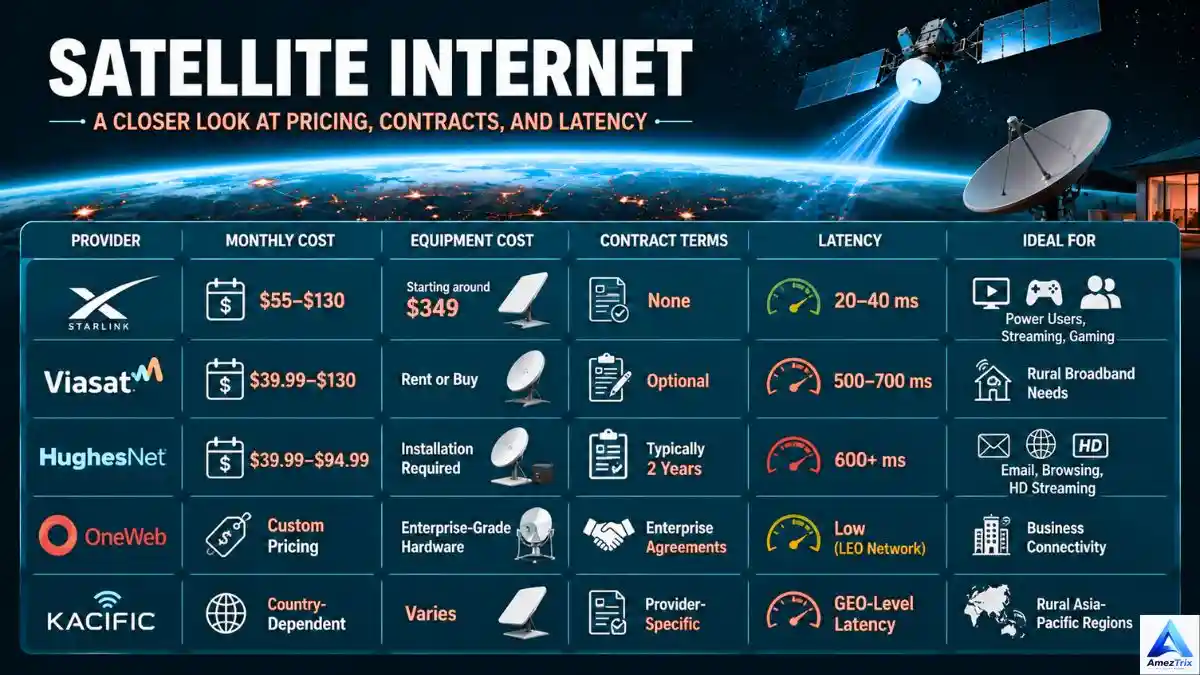
| Provider | Monthly Cost | Equipment Cost | Contract Terms | Latency | Ideal For |
|---|---|---|---|---|---|
| Starlink | $55–$130 | Starting around $349 | None | 20–40 ms | Power Users, Streaming, Gaming |
| Viasat | $39.99–$130 | Rent or Buy | Optional | 500–700 ms | Rural Broadband Needs |
| HughesNet | $39.99–$94.99 | Installation Required | Typically 2 Years | 600+ ms | Email, Browsing, HD Streaming |
| OneWeb | Custom Pricing | Enterprise-Grade Hardware | Enterprise Agreements | Low (LEO Network) | Business Connectivity |
| Kacific | Country-Dependent | Varies | Provider-Specific | GEO-Level Latency | Rural Asia-Pacific Regions |
Which Satellite Internet Provider Should You Choose?
| Use Case | Top Pick |
|---|---|
| Fastest Overall Speeds | ⭐ Starlink |
| Best for Rural Homes | ⭐ Starlink |
| Most Budget-Friendly | ⭐ Viasat / HughesNet |
| Best for Business Use | ⭐ OneWeb |
| Best Coverage in Asia-Pacific | ⭐ Kacific |
| Best for RVs & Remote Travel | ⭐ Starlink Roam |
World’s Top Satellite Internet Providers by Customer Base
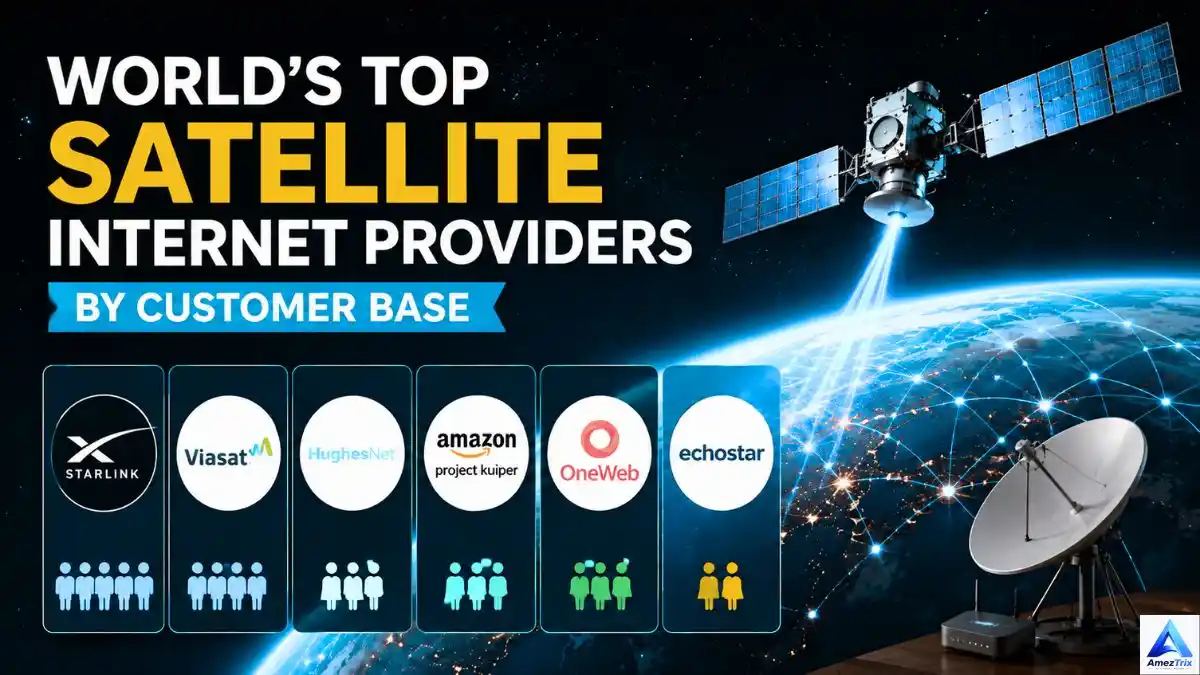
World’s top Leading Satellite Internet Providers by Customer Base
| Rank | Provider | Headquarters | Estimated Customers/Connections | Coverage Area | Satellite Type | Max Download Speed | Best Suited For |
|---|---|---|---|---|---|---|---|
| 1 | Starlink | United States | 7+ Million | 100+ Countries | LEO | Up to 300+ Mbps | Homes, RVs, Businesses |
| 2 | HughesNet | United States | 1+ Million | North & South America | GEO | Up to 100 Mbps | Rural Homes |
| 3 | Viasat | United States | 600,000+ | Americas, Europe, Asia-Pacific | GEO | Up to 150 Mbps | Residential & Aviation |
| 4 | SES Networks | Luxembourg | 500,000+ Enterprise Connections | Global | GEO + MEO | Up to 1 Gbps (Enterprise) | Enterprise & Government |
| 5 | Eutelsat OneWeb | United Kingdom/France | Enterprise & Telecom Customers | Global | LEO | Up to 195 Mbps | Businesses & Telecom Operators |
| 6 | Kacific Broadband Satellites | Singapore | 100,000+ | Asia-Pacific | GEO | Up to 120 Mbps | Rural Communities |
| 7 | YahClick | UAE | 100,000+ | Middle East, Africa & Asia | GEO | Up to 50 Mbps | Home & SME Users |
| 8 | NBN Sky Muster | Australia | 90,000+ | Australia | GEO | Up to 100 Mbps | Rural Australia |
| 9 | Xplore (Xplornet) | Canada | 300,000+ | Canada | GEO + Fixed Wireless | Up to 100 Mbps | Rural Canada |
| 10 | Gilat Satellite Networks | Israel | Enterprise & Government Customers | Global | GEO | Custom Enterprise Speeds | Defense & Enterprise |
What Sets These Providers Apart
Starlink continues to dominate the market, and it’s not close. With over 7 million users spread across more than 100 countries, its Low Earth Orbit network gives it a clear edge in both speed and reach — a combination that’s hard for GEO-based rivals to match.
[Read more about How to Make Money Using AI : 25 Proven Ways to Earn Online.]
HughesNet and Viasat remain the go-to names across the Americas, particularly for rural households that need dependable, if not blazing-fast, connectivity. Both have been in the satellite broadband business for decades and built loyal customer bases well before LEO networks became mainstream.
SES Networks and Eutelsat OneWeb operate in a different lane entirely — their customer base leans heavily toward enterprise, government, and telecom clients rather than everyday households, which is why their “customer count” looks different from consumer-facing providers.
Regional specialists like Kacific, YahClick, NBN Sky Muster, and Xplore fill in the gaps that global giants don’t prioritize — serving the Asia-Pacific islands, the Middle East and Africa, rural Australia, and remote Canadian communities respectively. These providers may have smaller subscriber numbers, but they’re often the only viable broadband option in their coverage zones.
[Read more about Best Web Hosting for Beginners: Fast, Secure & Affordable.]
Gilat Satellite Networks rounds out the list with a strong focus on defense and enterprise-grade custom solutions rather than residential plans, making it more of a B2B and government infrastructure player than a household name.
What This Comparison Tells Us
- Starlink leads the pack right now, pairing fast speeds with low latency and an expanding global footprint — making it the go-to option for most home users.
- Viasat appeals to buyers who want a lower entry price and dependable coverage across supported regions.
- HughesNet still works well for lighter needs like checking email, browsing, and video calling in rural spots.
- OneWeb is built around enterprise, government, and telecom clients rather than everyday household plans.
- Kacific stands out as a go-to satellite provider for underserved communities throughout the Asia-Pacific region.
How Does Satellite Internet Actually Work?
The process sounds futuristic, but it breaks down into a few simple stages.
1. Your device makes a request. Opening a webpage or app sends a data request from your phone or laptop through your Wi-Fi router to a satellite modem.
2. The dish transmits it skyward. That modem passes the signal to a compact dish mounted outside, which beams it up to an orbiting satellite.
3. The satellite relays the signal. The satellite bounces your request down to a ground station — sometimes called a gateway — that’s wired into the internet backbone.
4. The ground station fetches your data. From there, the request reaches whatever server you’re trying to reach, whether that’s Netflix, Gmail, or a cloud app.
5. The response makes the return trip. Data flows back along the same chain — server to ground station to satellite to your dish to your device — usually within a fraction of a second.
The Core Hardware Behind the System
A working Satellite Internet setup depends on five main pieces:
Communication Satellite — Acts as the relay point in orbit, handling traffic for potentially millions of users at once.
Satellite Dish — Installed at your property to send and receive the wireless signal; correct alignment matters enormously for performance.
Satellite Modem — Translates the incoming satellite signal into usable internet data for your network.
Wi-Fi Router — Spreads that connection across your devices at home or in the office.
Ground Station (Gateway) — The physical link between orbiting satellites and terrestrial internet infrastructure.
How Satellite Internet Has Evolved
The Early Days: First-generation satellite broadband was slow, expensive, and plagued by heavy lag — usable, but far from enjoyable.
The Middle Era: Better compression and improved satellite hardware brought faster speeds, wider coverage, and somewhat friendlier pricing.
Where We Are Now: Today’s networks lean on low Earth orbit satellites, phased-array antennas, reusable rockets, and AI-driven traffic management — a combination that has dramatically cut latency while boosting reliability.
The Three Types of Satellite Orbits
Satellite internet providers aren’t all built the same way — the altitude of their satellites changes everything about performance.
Geostationary (GEO) Satellites
Positioned around 35,786 km above Earth, GEO satellites stay fixed over one spot, so a handful can cover enormous regions.
Strengths: broad coverage, proven reliability, stable positioning. Weaknesses: the long signal path creates noticeably higher lag, which can hurt gaming and video calls.
Medium Earth Orbit (MEO) Satellites
Sitting between roughly 2,000 km and 35,786 km up, MEO satellites strike a middle ground — better response times than GEO, wider reach than LEO.
Low Earth Orbit (LEO) Satellites
Orbiting as low as 160–2,000 km, LEO satellites cut the distance data has to travel, which slashes latency and lifts speeds significantly.
Because they move fast across the sky, providers need huge fleets — often thousands of units — working together to keep coverage continuous. LEO technology is widely seen as the biggest leap forward the industry has made.
Why Demand for Satellite Internet Keeps Climbing
Several forces are driving adoption higher:
- Growth of remote and hybrid work
- Expansion of online learning
- Rising need for connectivity during natural disasters
- Smart farming and agricultural IoT devices
- Maritime and aviation connectivity demands
- Steadily improving speeds from LEO networks
As more capital flows into satellite infrastructure, places once considered “unconnectable” are finally coming online.
Key Advantages of Satellite Internet
1. Coverage Almost Anywhere on Earth
Because it doesn’t depend on buried cable or cell towers, satellite service reaches deserts, forests, islands, mountains, and offshore rigs — locations where no other broadband option exists.
2. Massive Geographic Reach
Building fiber networks across difficult terrain is slow and costly. Satellites skip that problem entirely, covering wide swaths of territory from space.
3. Fast Setup
Rather than waiting months for cable crews, most installations only require a dish, modem, router, and a technician visit.
4. A Reliable Backup Line
Hospitals, banks, retailers, and government offices increasingly use satellite service as a failover option if their primary line goes down during storms or construction accidents.
5. Genuine Remote-Work Support
Video meetings, cloud file access, and team collaboration tools all run smoothly enough on modern satellite connections to support full-time remote employees.
6. Noticeably Better Performance Than Older Systems
Compared to the satellite internet of a decade ago, today’s services offer sharper streaming, quicker downloads, and far more stable connections — largely thanks to LEO constellations.
7. A Lifeline During Disasters
When hurricanes, wildfires, or earthquakes knock out ground infrastructure, satellite links often keep functioning, which makes them critical for search-and-rescue and relief coordination.
Where Satellite Internet Still Falls Short
1. Latency on Older Networks
GEO-based systems still carry a heavy delay because of the huge distance signals travel — a real drawback for gamers, traders, and video callers. LEO networks have largely solved this.
2. Weather Sensitivity
Heavy storms, snow, or thick cloud cover can cause “rain fade,” a temporary dip in signal quality.
3. Upfront Equipment Costs
Dishes, mounting hardware, and modems add to the initial price tag, even though many providers now bundle this into monthly plans.
4. Data Caps on Some Plans
Unlimited plans are becoming standard, but certain providers still throttle speeds after a data threshold.
5. Line-of-Sight Requirements
Trees, buildings, or hills blocking the dish’s view of the sky can degrade the signal — professional installation helps avoid this.
Real Speeds You Can Expect
Speeds vary by provider and plan, but common ranges include:
- 25 Mbps
- 50 Mbps
- 100 Mbps
- 200 Mbps
- 300+ Mbps on premium LEO plans
Upload speeds matter just as much for video calls, cloud backups, and live streaming, and newer networks are steadily improving in this area too.
Latency Comparison Table
| Connection Type | Typical Latency |
|---|---|
| Fiber | 5–20 ms |
| Cable | 15–35 ms |
| 5G | 10–40 ms |
| LEO Satellite | 20–50 ms |
| GEO Satellite | 500–700 ms |
This gap explains why LEO technology is considered such a major upgrade over legacy satellite systems.
Satellite vs. Fiber vs. 5G: Which Should You Pick?
| Feature | Satellite | Fiber | 5G |
|---|---|---|---|
| Coverage | Global | Wired areas only | Urban/suburban |
| Setup | Dish install | Underground cable | Wireless receiver |
| Speed | 25–300+ Mbps | Up to multi-Gig | 100–1000 Mbps |
| Latency | Medium (LEO) / High (GEO) | Very low | Low |
| Rural Access | Excellent | Limited | Moderate |
| Weather Impact | Possible | Minimal | Moderate |
| Mobility | Moderate | None | Yes |
Pick fiber if it’s available and you want the lowest latency and highest speeds. Pick 5G if you’re in a well-covered city or suburb and want flexibility. Pick satellite if you’re rural, remote, or off the traditional broadband grid entirely.
Leading Satellite Internet Providers
Starlink — Runs one of the largest LEO constellations worldwide, known for strong speeds and comparatively low latency.
HughesNet — A long-running provider serving rural regions through geostationary satellites.
Viasat — Serves homes, businesses, aviation, and maritime clients with a focus on wide-area coverage.
OneWeb — Building a global LEO network aimed largely at enterprise and government customers.
Project Kuiper — Amazon’s emerging LEO broadband initiative aimed at expanding high-speed access worldwide.
Where Satellite Internet Is Making the Biggest Difference
Rural Households — Streaming, schoolwork, remote jobs, and everyday browsing become possible where no cable line exists.
Agriculture — Connected sensors, GPS-guided equipment, and smart irrigation systems all depend on a stable signal.
Maritime — Ships and offshore rigs use it for navigation, weather data, and crew communication.
Aviation — In-flight Wi-Fi lets passengers browse, stream, and work mid-flight.
Emergency Response — During floods, wildfires, or earthquakes, satellite links often keep emergency teams connected when everything else fails.
Travelers and Digital Nomads — RV owners and remote workers use portable terminals to stay online far outside cell tower range.
Business Continuity — Companies increasingly treat satellite service as an insurance policy against fiber outages.
Challenges the Industry Still Needs to Solve
- High infrastructure costs for launches, manufacturing, and ground stations
- Space debris concerns as constellations grow larger
- Regulatory hurdles across different countries’ telecom laws
- Weather-related disruptions, even if reduced compared to older systems
- Network congestion as user numbers climb
What’s Next for Satellite Broadband
The road ahead points toward:
- Bigger LEO constellations delivering more consistent global coverage
- Multi-gigabit speeds rivaling fiber in some markets
- AI-driven network management that predicts congestion before it happens
- Deeper integration with 5G and future 6G networks
- True universal coverage, reaching polar regions, oceans, and the last unconnected villages on Earth
If these goals are met, satellite broadband could meaningfully narrow the global digital divide within the next decade.
Tips Before You Sign Up With a Provider
- Confirm actual availability at your address, not just regional coverage maps
- Compare real-world download and upload speeds, not just advertised maximums
- Check for data caps or fair-use throttling
- Factor in equipment and installation costs upfront
- Read recent customer reviews for reliability complaints
- Review contract length and cancellation terms
- Ask about backup power options if you live somewhere with frequent outages
Frequently Asked Questions
1. What is satellite internet, in simple terms?
It’s a broadband service that connects you to the internet through orbiting satellites instead of fiber, cable, or DSL lines.
2. How does satellite internet actually reach my home?
Data travels from your dish to a satellite, then to a ground station connected to the internet, and back again — all within milliseconds.
3. Is satellite internet available everywhere?
Coverage is broad and growing fast, making it especially valuable in rural and remote regions without wired broadband access.
4. Can I stream HD or 4K video on satellite internet?
Yes, most modern plans handle HD and even 4K streaming comfortably, depending on your provider and plan tier.
5. Is satellite internet good enough for online gaming?
LEO-based services with lower latency work well for most games. Older GEO-based systems may still lag too much for competitive play.
6. Does bad weather really affect satellite internet?
Heavy rain, snow, or storms can occasionally weaken the signal, though modern hardware handles this better than older systems did.
7. Who benefits most from satellite internet?
Rural households, remote businesses, travelers, ships, aircraft, and anyone without access to reliable fiber or cable service.
8. What equipment do I need to get started?
Typically a satellite dish, a modem, a Wi-Fi router, and a professional installation to get everything aligned correctly.
9. Is my data safe on a satellite connection?
Reputable providers use strong encryption, though users should still follow normal cybersecurity habits like using a VPN and updating device software.
10. Where is satellite internet headed next?
Expect larger constellations, faster speeds, AI-optimized networks, and closer integration with 5G and 6G — all pushing toward truly global coverage.
Final Thoughts
Satellite Internet has gone from a clunky, expensive fallback to a genuinely competitive broadband option for millions of people. Low Earth Orbit constellations, in particular, have closed much of the speed and latency gap that used to separate satellite from fiber and cable.
Challenges remain — weather sensitivity, equipment costs, and regulatory complexity chief among them — but the trajectory is clear. As governments and private companies keep investing, satellite broadband is quickly becoming a mainstream way to get online, whether you’re running a remote business, living off the beaten path, or just want a solid backup connection.
About Author
Rajendra Parmar is the Founder and Editor of AmezTrix, where he covers Artificial Intelligence, Technology, WordPress, Web Hosting, Digital Marketing, Gadgets, and Software. His mission is to simplify complex technology through practical tutorials, honest reviews, and well-researched guides that help readers make smarter digital decisions.