AI Deepfake Music Copyright: What Artists Can Actually Do About Fake Songs
AI deepfake music copyright explained: what protects your voice, how to spot fakes and file takedowns fast. Includes an 8-step plan for artists.
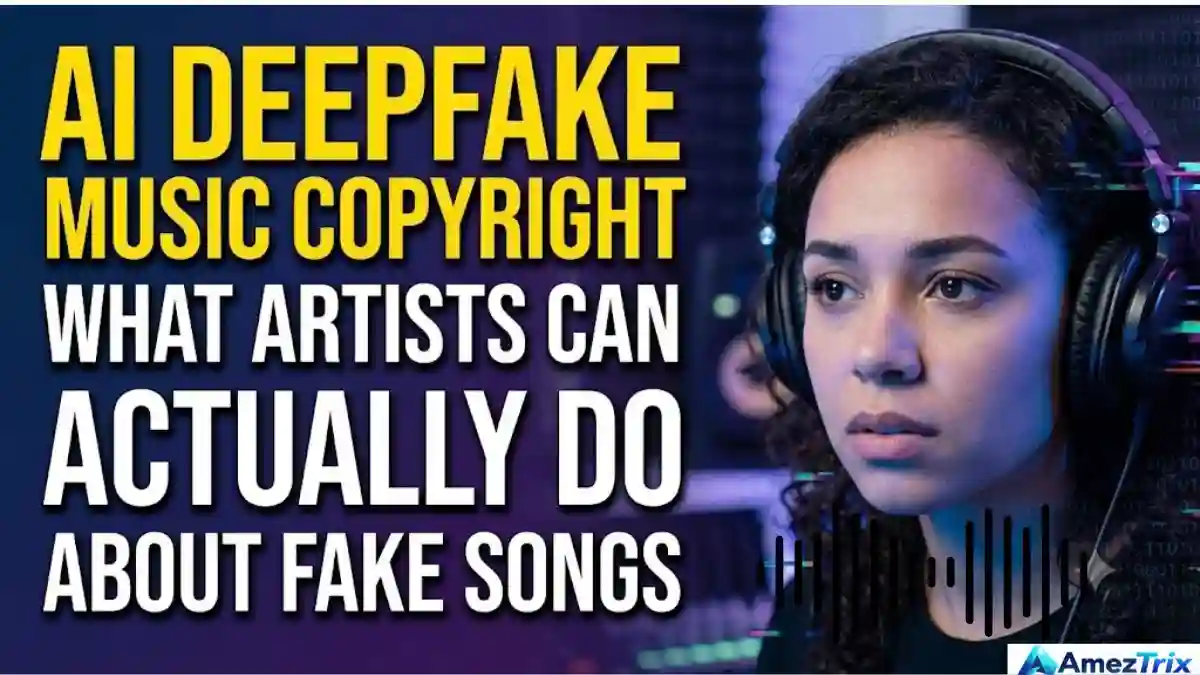
Here’s a feeling no musician wants: you scroll through your own Spotify page and find a track you’ve never heard. Your name is on it. Your voice is on it. And you had nothing to do with it.
If that sounds far-fetched, it isn’t. Fake songs are showing up for artists at every level, and the first question everyone asks is the same: does AI deepfake music copyright law actually protect me? The honest answer is “partly.” Let’s walk through the part that works, the part that doesn’t, and exactly what to do about both.
Quick Answer: Copyright protects your actual songs and recordings, so a fake that copies them can be pulled down. It does not clearly protect your voice on its own. For voice clones, you lean on platform impersonation rules, right-of-publicity laws and quick reporting.
Key takeaways
- Sony Music has asked platforms to take down more than 260,000 AI tracks imitating its artists (reported as of late September 2026).
- A song that merely sounds like you may fall outside copyright. A song that copies your recording, lyrics or melody doesn’t.
- In the US, music made purely by AI can’t be copyrighted. Human creative work inside a track can.
- The winning routine is simple: register, keep proof, claim your profiles, check weekly, report fast.
- No fix is perfect. Detectors miss things and the law is still playing catch-up.
First, What Do We Mean by an “AI Deepfake Song”?
Think of an impersonator who works for free, never gets tired and can “release” a hundred tracks a day. That’s the basic idea. An AI deepfake song uses artificial intelligence to copy a real artist’s voice, style or identity without asking.
In practice, you’ll run into three kinds:
- The voice clone. A brand-new song sung by a synthetic version of you.
- The fake release. AI tracks uploaded under your name, or slipped onto your artist page.
- The laundered song. Your real recording, lyrics or melody fed through AI and passed off as new.
Keep that third one in mind. It’s where copyright is at its strongest.
Why This Is Getting Worse (and Fast)
A convincing fake used to take a studio, a singer and a lot of time. Now it takes a text prompt and a few minutes. The reported numbers show the scale:
| What’s happening | Reported figure |
|---|---|
| Sony Music takedown requests | More than 135,000 by March 2026, then more than 260,000 by the end of September 2026 (Financial Times reporting) |
| AI share of daily uploads at Deezer | About 44%, or roughly 75,000 tracks a day, as of June 2026 (Deezer’s own data) |
| How complete is the count? | Sony itself says its number is only a fraction of the real total |
To be fair, not every AI track is a deepfake. Lots are cheap filler. But the harm is real. Fake tracks and bot streams drain royalties, and Sony has pointed out that fakes tend to appear when a real artist is busy promoting something new.
One case worth knowing: a viral track called “I Run” by Haven drew takedown notices from Sony’s distributor The Orchard, the RIAA and the IFPI. A group involved in the dispute alleged that four different distributors were used to deliver it, a way to sidestep normal takedowns. The takeaway? Fakes can slip back in through another door, so you want a routine, not a one-off scramble.
Does Copyright Actually Protect Your Voice?
This is the piece most guides gloss over, so let’s slow down.
Copyright protects works. In music, that means two things: the song itself (the composition) and a specific recording of it (the master). It doesn’t generally protect your tone, your vocal style or your general vibe.
So if an AI tool invents a new song that only sounds like you, copyright may not apply. If it lifts your melody, lyrics or recording, it likely does.
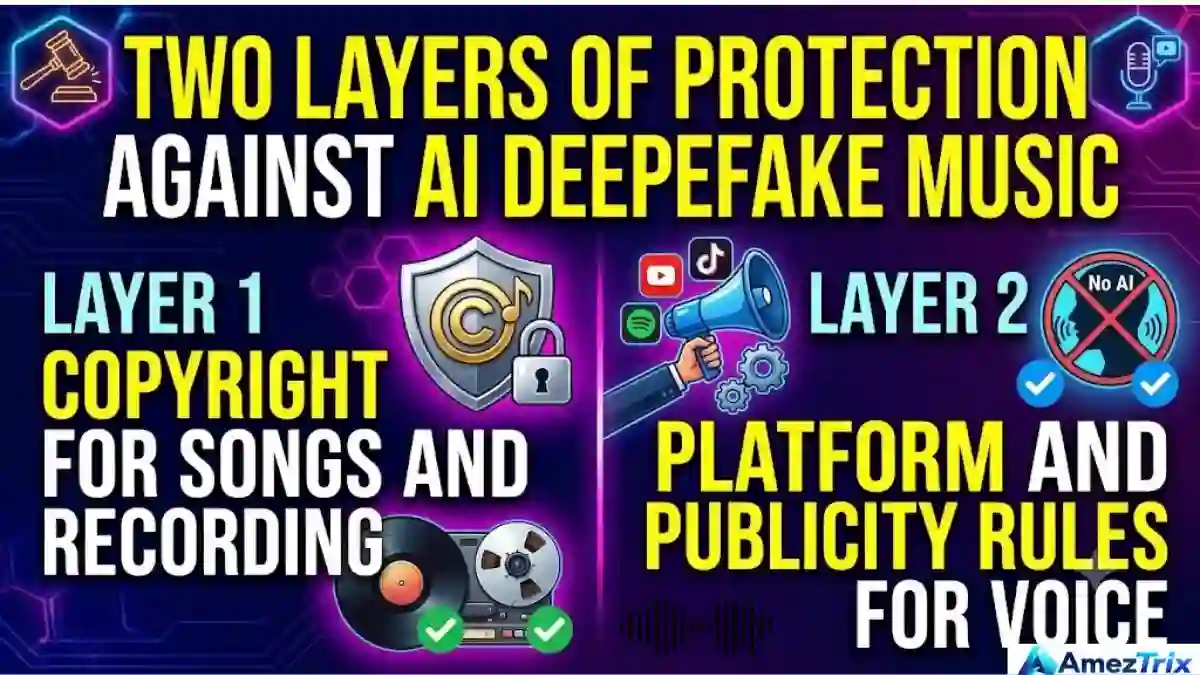
| What the fake did | Does copyright help? | What to use |
|---|---|---|
| Copied or sampled your recording | Yes | DMCA takedown |
| Reused your lyrics or melody | Yes | DMCA notice, publisher claim |
| New song, cloned voice, original lyrics | Unclear or no | Platform impersonation report, right of publicity, state voice laws |
| Fake tracks posted under your name | Not the main issue | Fraud report, distributor complaint |
| Model trained on your catalog without a license | Being tested in court | Lawyer, collecting society, licensing terms |
That’s why the smartest plan layers several defenses instead of betting everything on one.
Can AI-Generated Music Be Copyrighted?
This question matters even if you’re only worried about fakes, because plenty of artists use AI tools too.
In the US, here’s where things stand. Work made entirely by AI, with no meaningful human authorship, can’t be copyrighted. The Supreme Court declined to hear Thaler v. Perlmutter on March 2, 2026, so that rule stays.
What’s less settled is how much human input counts. The US Copyright Office has signaled that simply typing prompts may not be enough. If you add real creative work on top, that human part can be protected, but only that part.
| How the track was made | Protectable in the US? |
|---|---|
| Generated entirely from a text prompt | No |
| AI draft you heavily rewrite, rearrange and re-record | Your human contributions, yes |
| You write and perform it; AI just cleans the audio | Generally yes |
| You write lyrics and melody; AI builds the backing track | Your lyrics and melody, yes; the AI-made parts, no |
Rules vary by country and they’re moving. Treat this as a starting point.
Practical tip: Keep your drafts, session files and stems. If anyone ever questions who wrote what, that folder is your proof.
How to Protect Your Music From AI Deepfakes: 8 Steps
You won’t stop every fake. But you can make yourself harder to copy, easier to verify and quicker to defend. Take these in order.
Step 1: Register your copyrights
In the US, you generally need a registration before you can sue over infringement. Register before an infringement, or soon after first publication, and statutory damages usually stay available too. Elsewhere, the rules differ, so check your national copyright office.
While you’re at it, make sure you belong to a performing rights organization or collecting society, so your songwriting royalties are tracked.
Step 2: Keep proof that it’s yours
A takedown moves faster when you can show ownership in minutes. Keep a dated folder with:
- DAW project files and backups
- Raw stems, voice memos and early demos
- Timestamped lyric drafts
- Split sheets and signed agreements
Step 3: Claim and lock down your profiles
Claim Spotify for Artists, Apple Music for Artists and your YouTube Official Artist Channel. Switch on two-factor authentication everywhere. Fake releases often land on a real profile because of similar names, so being in control early saves you pain later.
Step 4: Keep your metadata tidy
Use one consistent artist name, accurate credits and correct ISRC codes through a reputable distributor. Clean data makes your real releases easy to verify and makes impostors stand out.
Step 5: Go easy on dry vocals and open stems
Clean, isolated vocals are exactly what voice-cloning tools like to learn from. You don’t have to hide your art, but think twice before posting free acapellas or stem packs, or attach clear license terms. This lowers risk. It doesn’t erase it.
Step 6: Read the AI terms before you upload
Before sending your voice or songs to any AI app, “AI mastering” tool or voice-model service, check what it says about training, ownership and reuse. If a clause lets the company train on your uploads, decide whether you’re fine with that before you click accept.
Step 7: Check on a schedule
Here’s a light weekly routine:
- Search your name on Spotify, Apple Music, YouTube, TikTok and SoundCloud
- Set a Google Alert for your artist name plus “AI”
- Ask fans to send you links to anything that feels off
- Review fingerprinting or Content ID claims, if you use them
- Scan your artist page for tracks you don’t recognize
Step 8: Add voice and AI clauses to contracts
When you sign with a label, publisher or collaborator, ask who may use your voice or likeness for AI, under what approval and for what payment. Fuzzy wording is how control slips away. A music lawyer can review this in an hour or two, and it’s often money well spent.
Remember: You can’t fully block cloning. What you can control is your proof, your speed and your profiles.
AI Generated Music Detector: What It Can and Can’t Tell You
An AI generated music detector hunts for patterns that AI models leave behind in audio. The best-known example is Deezer’s. In June 2026 it released a free public tool that scans playlists from Spotify, Apple Music and other services. Deezer claims 99.8% accuracy, though that’s the company’s own number.
Before you lean on any detector, keep these limits in mind:
- It’s built to catch fully AI-generated tracks from popular generators like Suno and Udio. It isn’t designed to spot a song where AI was only one ingredient.
- New models can slip through until detectors catch up.
- “Probably AI” is not the same as “impersonation” or “infringement.”
| Method | Good for | Weak spot |
|---|---|---|
| Deezer AI music detector | Scanning playlists for fully AI tracks | Doesn’t show who made it or whether a law was broken |
| Other third-party detectors | A second opinion on a suspicious file | Accuracy varies; false alarms happen |
| Fans and your own ears | Catching fakes tied to your name | Harder as quality improves |
| Metadata and distributor checks | Seeing who uploaded it and when | Fraudsters can use several distributors |
Think of a detector as a smoke alarm. It tells you to look closer. It doesn’t tell you who struck the match.
How to Report and Remove a Fake AI Song
Speed helps. Aim to do all of this the day you spot the fake.
- Save proof. Screenshot the track page and note the link, artist name, upload date, listed distributor and any ISRC.
- Report it on the platform. Use the impersonation, fraud or copyright form. Keep the wording plain: “This track uses my name and a clone of my voice. I did not release it.”
- Send a DMCA notice if your work was copied. In the US it goes to the service’s designated agent. Only use it when your recording, lyrics or composition are really inside the track. False claims have consequences.
- Contact the distributor. They can pull the release at the source, which is often quicker.
- Tell your fans. One short “this isn’t me” post protects your reputation and brings more reports.
- Escalate repeat offenders. If the same fakes keep coming back, speak with a music or media lawyer.
| Route | Use it when | Speed |
|---|---|---|
| Platform impersonation or fraud report | The fake uses your name or voice | Often the quickest |
| DMCA notice | Your real work was copied | Fast, but needs a genuine copyright basis |
| Distributor complaint | You can see which distributor delivered it | Fast to moderate |
| Right-of-publicity or state voice-law claim | Your voice was used commercially without consent | Slow; needs a lawyer |
What Streaming Platforms Are Doing
There’s no single industry rulebook yet, so each service goes its own way:
| Platform | Reported approach (October 2026) |
|---|---|
| Deezer | Tags fully AI tracks, keeps them out of algorithmic and editorial recommendations, and licenses its detector to others |
| Spotify | Fights spam, has an impersonation policy and supports AI credits in metadata; said it removed over 75 million spammy tracks in the year before September 2025 |
| Apple Music | Reportedly planning to tell listeners when music is AI-generated; said it demonetized two billion fraudulent streams in 2025 |
| Bandcamp | Banned AI-generated music in January 2026 |
Policies shift often, so read each platform’s current rules before you file anything.
Laws Worth Watching: NO FAKES Act and State Voice Laws
Since copyright doesn’t clearly cover your voice, lawmakers are drafting a separate right.
- NO FAKES Act (proposed, US): would give you a federal right over your voice and visual likeness, plus a notice-and-takedown system. The 2026 bill (S.4591) was introduced May 20, 2026, and the Senate Judiciary Committee advanced it unanimously on June 18. As of early October 2026, it isn’t law.
- Tennessee ELVIS Act (in force): protects voice and likeness from unauthorized AI replication and has applied since July 2024.
Outside the US, look up “personality rights,” “right of publicity” or “passing off” in your country. They can help even where no AI-specific law exists.
Is It Worth Paying For? A Quick Cost Guide
You can start with almost no budget. Here’s how the usual options compare. Costs vary by country and provider, so confirm current fees first.
| Option | Cost level | Why it can be worth it | Best for |
|---|---|---|---|
| Copyright registration | Low (US fees start at roughly $45 for a simple single-author claim; check the Copyright Office fee page) | Opens the door to lawsuits and damages in the US | Anyone releasing original music |
| PRO or collecting society | Low to moderate | Tracks and collects songwriting royalties | Songwriters and composers |
| Reputable music distributor | Low to moderate | Cleaner metadata and quicker takedown routes | Independent releases |
| Music lawyer (one-time review) | Moderate to high | Catches contract and AI-clause risks early | Artists about to sign a deal |
| Monitoring or content-ID service | Varies | Finds copies faster than manual searching | Artists with growing catalogs |
Your Protection Checklist
- ☐ Key songs and recordings registered
- ☐ PRO or collecting society membership active
- ☐ Project files, stems and demos saved with dates
- ☐ Spotify, Apple Music and YouTube profiles claimed
- ☐ Two-factor authentication on every artist account
- ☐ Distributor credits, ISRCs and artist name double-checked
- ☐ Public acapellas and open stems limited
- ☐ AI terms read for every tool and distributor
- ☐ Weekly check set up, with fans helping
- ☐ Takedown links and a reusable message saved
- ☐ Voice and AI clauses reviewed in contracts
Mistakes That Cost Artists Time
- Assuming copyright covers your voice. It often doesn’t, so a plain DMCA notice can fall flat.
- Putting off registration. Enforcing rights after the fact is harder.
- Reporting with no evidence. Links, dates and screenshots speed everything up.
- Filing a false copyright claim. If nothing of yours was copied, a DMCA notice can backfire.
- Shrugging off “small” fakes. They spread and chip away at fan trust.
- Clicking “accept” on AI terms. You might hand over training rights by accident.
- Trusting a single detector. They can be wrong in both directions.
Red Flags a Track Might Be a Deepfake
- No announcement, no social posts, no press
- Delivered by a distributor or label you’ve never used
- Missing, vague or oddly generic credits
- Recycled or AI-looking cover art
- Strange pronunciation, breathing or phrasing
- A new “similar” artist name suddenly tied to your profile
- Lots of streams but no real listeners, comments or shares
The Honest Downsides
No guide should oversell. Here’s what these steps can’t do:
- They can’t prevent cloning. If your voice is public, someone can copy it. You’re lowering risk, not removing it.
- Detectors aren’t perfect. They can miss new models and wrongly flag heavily processed human vocals.
- Enforcement is uneven. Major labels have legal teams. Independent artists often rely on forms and patience.
- The law is unsettled. The NO FAKES Act isn’t law yet, and AI training disputes are still in court.
- AI isn’t always the enemy. Some artists license their voice on purpose. The real goal is consent and control.
Frequently Asked Questions
Can AI-generated music be copyrighted?
In the US, music made entirely by AI with no meaningful human authorship can’t be copyrighted. If you add real creative work, such as writing lyrics, arranging or performing, those human contributions can be protected. Other countries have different rules, so check locally.
Is it illegal to use AI to copy an artist’s voice?
It depends on where you are and how the clone is used. Copyright may not cover a voice alone, but right-of-publicity laws, state laws like Tennessee’s ELVIS Act and platform rules can apply. Misleading fans or selling music with a cloned voice is the riskiest use.
How can I tell if a song is AI-generated?
Use an AI generated music detector, such as Deezer’s free tool, then check credits, the uploader and release history. Listen for odd phrasing or breathing. No single method is perfect, so combine several signs before you report.
How do I remove a fake AI song using my name?
Report it through the platform’s impersonation or fraud form, save links as evidence and contact the distributor. If it copies your real recording or lyrics, also file a DMCA notice. Do this the same day you find it.
Can a DMCA takedown remove an AI voice clone?
Only if the track copies your protected work, such as your recording, melody or lyrics. A new song that merely sounds like you may not qualify. In that case, use platform impersonation reports and right-of-publicity claims.
Is the NO FAKES Act law yet?
Not as of early October 2026. The 2026 bill (S.4591) cleared the Senate Judiciary Committee in June but hasn’t passed Congress. Tennessee’s ELVIS Act already applies at the state level.
How do I stop AI companies from training on my music?
You can’t fully stop it yet. Read the terms of any service you upload to, avoid platforms claiming training rights, register your work, and involve a lawyer or collecting society if you find unlicensed use. Laws and licensing deals are still evolving.
Do streaming platforms label AI music?
Some do. Deezer tags fully AI-generated tracks, and Apple Music has reportedly said it will inform listeners. Spotify supports AI credits in metadata. Policies differ and change fast, so check each platform’s current approach.
Where to Start Today
AI deepfake music copyright isn’t one tidy law. It’s copyright, platform rules and personal rights working together, and none of them is enough alone. The artists who recover fastest registered early, kept their proof and already had a takedown routine.
Pick three small moves for today: claim your artist profiles, save your project files in a dated folder and write a takedown message you can reuse. You’ll be ahead of most people the moment you do.
This article is general information, not legal advice. For a specific dispute, talk to a qualified music or media lawyer in your country.
Sources and further reading
- US Copyright Office: Copyright and Artificial Intelligence
- Deezer: AI detection technology
- Congress.gov: NO FAKES Act of 2026 (S.4591)
About Author
Rajendra Parmar is the Founder and Editor of AmezTrix, where he covers Artificial Intelligence, Technology, WordPress, Web Hosting, Digital Marketing, Gadgets, and Software. His mission is to simplify complex technology through practical tutorials, honest reviews, and well-researched guides that help readers make smarter digital decisions.

Rajendra Parmar
Founder & Editor • AmezTrix
Rajendra Parmar is the Founder and Editor of AmezTrix, a platform covering Artificial Intelligence, Technology, WordPress, Web Hosting, Digital Marketing, Gadgets, Software Reviews, and emerging innovations. His mission is to simplify complex technology through practical tutorials, honest reviews, and well-researched guides that help readers make smarter digital decisions.